The Possible Homosexuality of Grand Duke Nikolai Mikhailovich of the Romanov Family
A Caucasian childhood, scholarly work, liberal views, and an episode surrounding Rasputin’s murder — set against a life without marriage or children.
- Editorial team
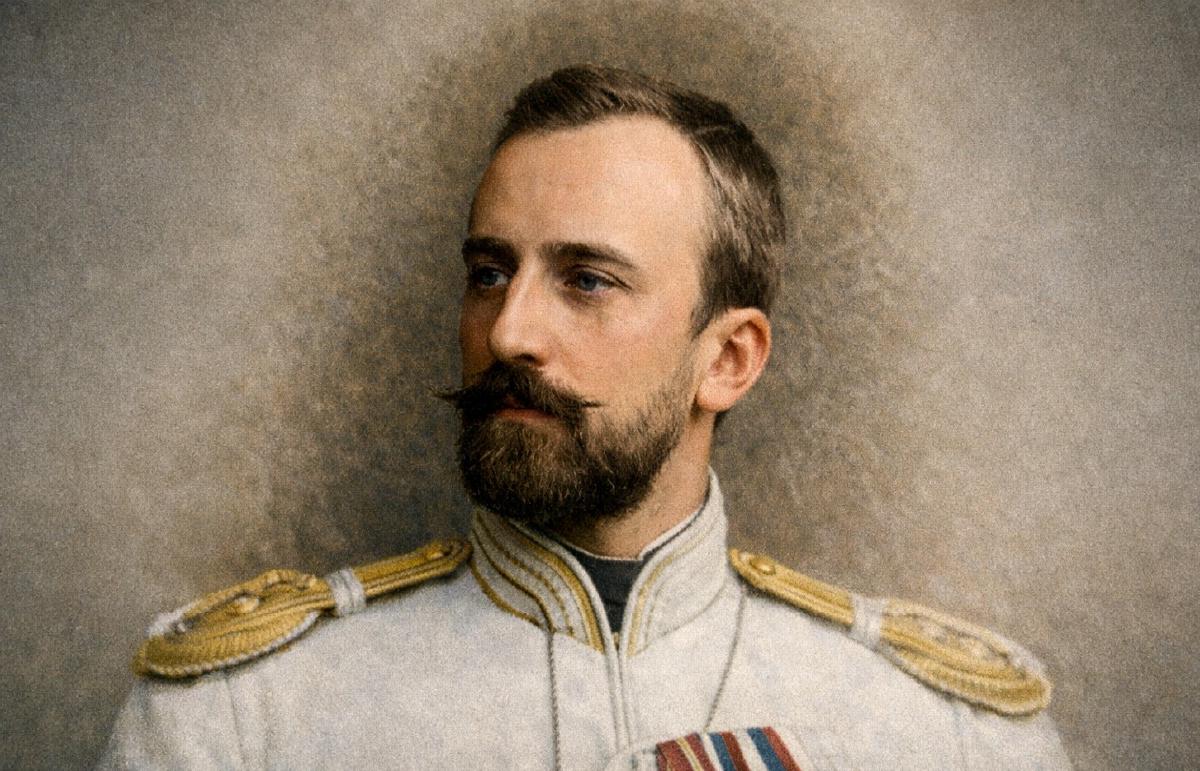
Nikolai Mikhailovich was the only Romanov praised both by his contemporaries and by historians of very different political persuasions — left and right alike. He was almost the only true intellectual in the family who pursued scholarship seriously.
This remarkable grand duke was also a “white crow” because of his political views. He adored France and its freedoms, argued for limiting the monarchy, and supported a constitution and a genuine parliament. In 1917, he even tried to become a deputy to the Constituent Assembly.
We have no reliable sources that directly confirm his homosexuality. Still, some historians have written that he intervened in the Rasputin murder affair immediately — that very morning — because he was connected to a homosexual circle of people involved in the killing of the mystic.
And indeed, Nikolai Mikhailovich never married, had no children, and in adulthood had neither mistresses nor any publicly known romances. At the same time, he was friends with well-known homosexual men — Felix Yusupov and Andrei Avinov.
In this article, we will discuss Nikolai Mikhailovich’s life, focusing on the personal side — his character, political views, and how he became linked to the case of Rasputin’s murder.
Childhood in the Caucasus and His Relationship with His Mother
Nikolai Mikhailovich Romanov — in the family he was called “Niki” (like Nicholas II) and “Bimbo” (“baby”) — was born on April 26, 1859, in Tsarskoye Selo near Saint Petersburg. He was a grandson of Emperor Nicholas I and the eldest son of Grand Duke Mikhail Nikolaevich and his wife Cecilia of Baden, a German by origin.
Three years after Nikolai’s birth, his father became viceroy of the Caucasus — for almost two decades. During that time, he strengthened the local population’s loyalty to the Russian crown and earned a reputation as a man who respected Caucasian traditions. Francis Vogel, who headed the postal service, later recalled him warmly: this Romanov did not behave arrogantly and did not look down on people. His children inherited that attitude as well.
Nikolai had five younger brothers and one sister. He spent his childhood and youth in Tiflis (Tbilisi) and at his father’s Borjomi estate. The family lived amid southern landscapes — brighter and more varied than the scenery of the cold Baltic — and this too shaped how the children grew up.
Mikhail Nikolaevich’s relationship with his eldest son differed little from his relationship with the other children. There was respect, but no real closeness developed. Niki’s bond with his mother took a different shape. Cecilia Augusta, born in 1837 and the youngest daughter of the reigning Grand Duke of Baden, converted to Orthodoxy before her wedding and took the name Olga Fyodorovna.
Olga Fyodorovna was intelligent and strong-willed. There are reasons to believe it was she who steered her eldest son toward a scholarly career. Within the family she was seen as a woman of iron will: a strict disciplinarian, domineering, sharp-tongued, and critical of those around her; at the same time, she tended toward nervous hypochondria and constant complaints about her health. Despite this, she set the tone in the household and dominated relationships.
If Mikhail Nikolaevich treated the children evenly, showing particular gentleness only toward his only daughter Anastasia, Olga Fyodorovna had a clear favorite. Niki remained her unquestioned darling. Once, when he was 24, she wrote, “Tomorrow evening Sandro [Niki’s brother’s nickname] will arrive,” and added that she would frankly prefer to see Niki.
Nikolai’s feelings toward his mother, judging by his letters, were extraordinarily strong and seemed almost painfully dependent, shaping his behavior in many ways. They corresponded extensively: when he was away, he wrote to her almost every day.
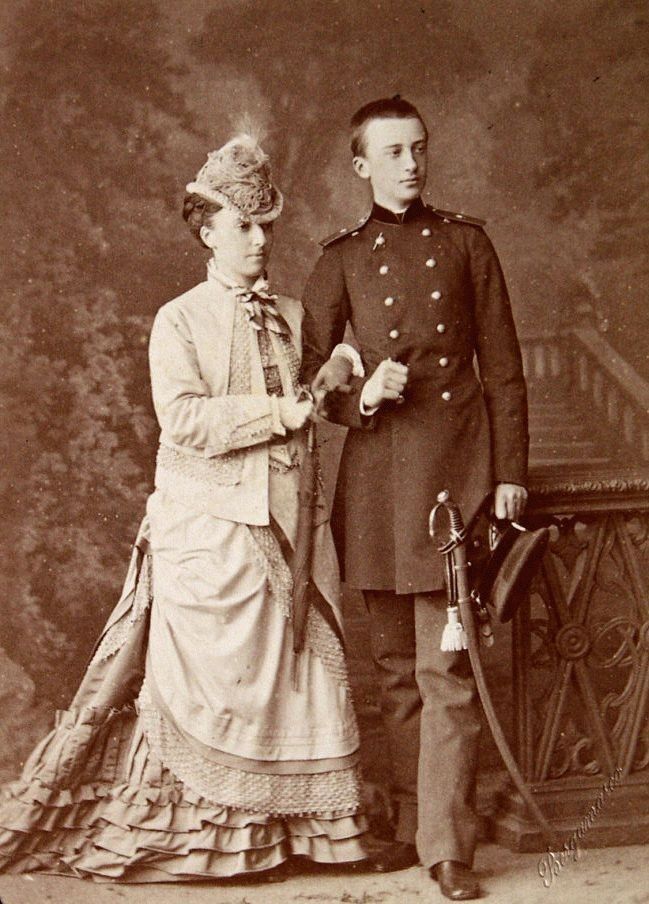
Physical separation from the rest of the Romanovs shaped the Mikhailovich branch’s outlook. Within the imperial family they were even nicknamed “the liberals.” Vogel noted that, among all the sons, Niki struck him as “the most warm-hearted.” Nikolai’s intellectual curiosity was already evident in his youth: he questioned Vogel endlessly about America, where Vogel had once lived.
The children were raised in conditions that resembled a barracks more than a home. They slept on narrow iron beds with thin mattresses laid over boards, rose at six in the morning, and any attempt “to sleep five more minutes” was forbidden. Breakfast was modest: tea, bread, and butter. Tutors came to the house and taught them the sciences, foreign languages, and music. Alongside this came practical training: fencing, riding, firearms handling, and bayonet charges.
“Of all Russia’s possessions, the Caucasus is such a rich and fascinating country in every respect. God grant that you will like this land and that it will leave you with good impressions!”
— Nikolai Mikhailovich, in a letter to the future Nicholas II
Appearance and Character: Acerbic Wit, Intrigue, Yet Warm Family Ties
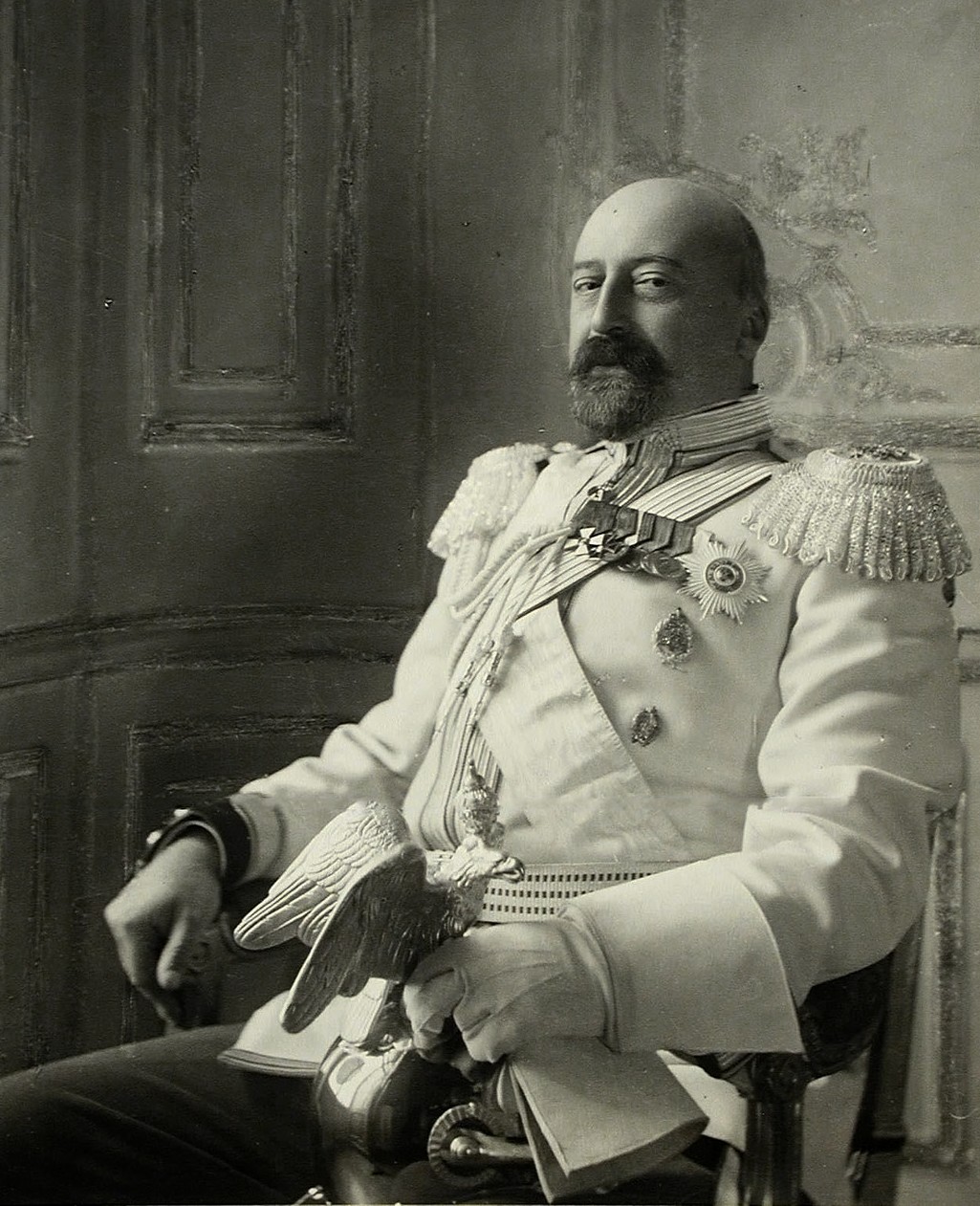
Nikolai Mikhailovich did not possess the “charismatic” beauty for which his younger brother Alexander was famous. Still, the court chancellor called Niki “quite handsome.” Like his brothers, he grew tall and wore a black beard throughout his life, which with age turned iron gray. In later years he was often described as a stout man, though surviving photographs do not support the image of excessive corpulence.
A portrait of Nikolai Mikhailovich by Maria Etlinger, painted when he was 23, shows an attractive young man with an elongated face. In his hand he holds a cigarette or a thin cigar — a familiar accessory which, contemporaries said, he did not part with until the end of his life.
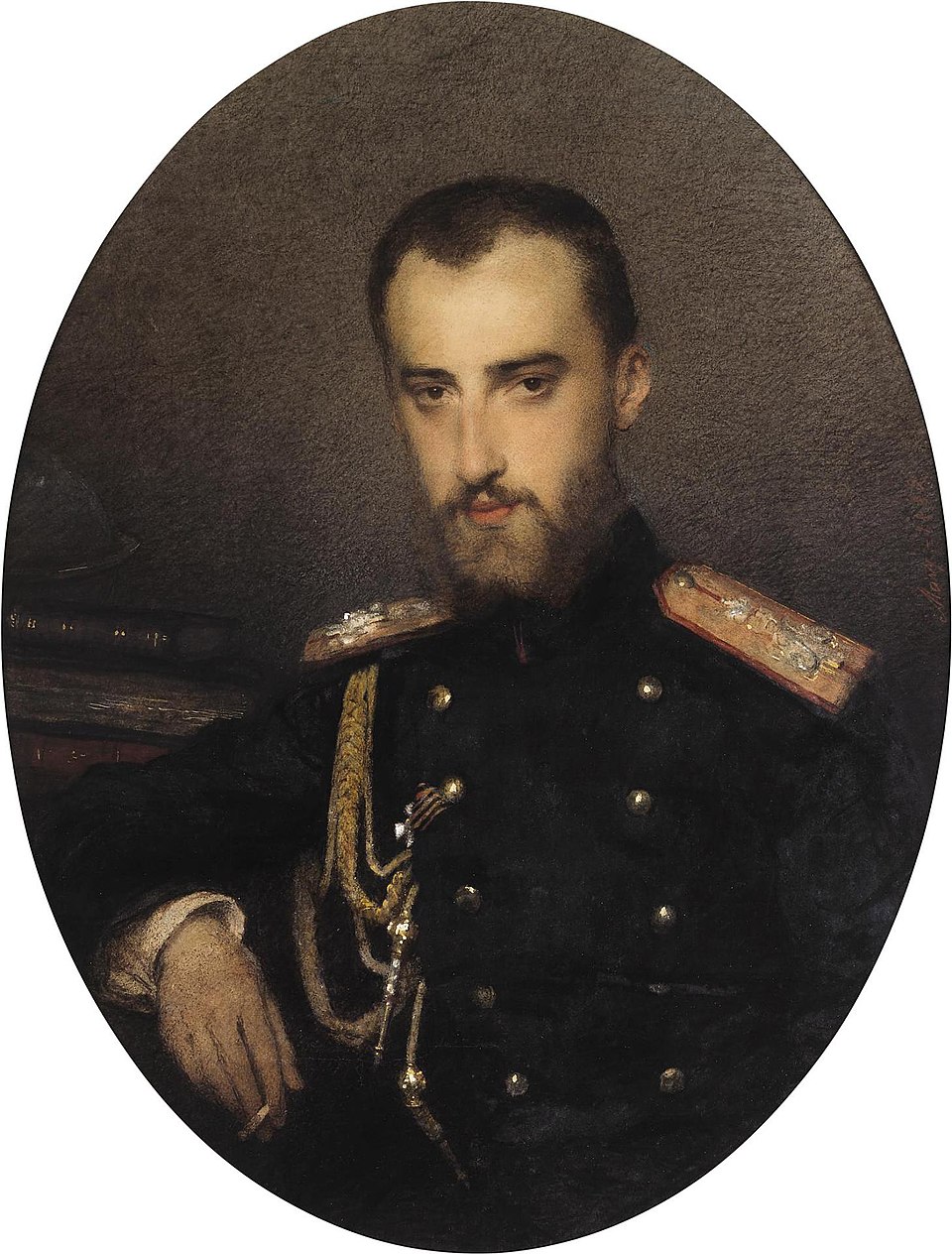
“Tall, slightly stooped […] a handsome, impressive face of a somewhat Eastern type (in children’s fairy-tale illustrations, this is how all sorts of Tatar khans or Indian princes and rajas are usually depicted) […] a stately figure inclined to fullness, yet still slender and very striking…”
— Alexander Benois on Niki
What most distinguished Niki from his brothers was his temperament. Already in his early twenties he developed an acerbic way of speaking — a “sulfurous tongue” that mercilessly cut down anyone who fell out of favor. The habit stayed with him for life and noticeably damaged his reputation. His peers generally disliked him: he believed himself entitled — and at times even obliged — to point out other people’s flaws, and he did so sharply.
He once called one interlocutor “ugly” and “fat,” another “colorless,” a third “thick-headed.” His letters to his mother are full of harsh labels such as “foolish,” “idiot,” and “ignoramus.” When he did not question a person’s intelligence, he struck at pride and manners instead. Thus, he described one general entering a formal dinner “like a bird of prey,” and referred to a politician as “a right-wing savage.”
Felix Yusupov remembered Niki as a talkative man and stressed that he constantly said what ought to have been left unsaid. Nikolai Mikhailovich himself understood this trait, yet either could not — or would not — restrain it:
“My tongue has no bones. I am capable of flaring up and saying what I think.”
Another of his traits was a taste for gossip and intrigue. People said that he “wove intrigues everywhere he went.” Countess Kleinmichel claimed he liked to pass the time by setting friends against one another, and was especially delighted when he managed to break up old friendships or even marriages with “treacherous hints.”
For all that, Nikolai Mikhailovich kept family ties warm. He remained close to his sister and younger brothers even in adulthood. He loved small children, and in old age “Uncle Bimbo” spent much time with his nephews and nieces.
As for leisure and “relaxing” pursuits, Nikolai was entirely typical of his milieu. He was often seen at balls and receptions, where he could dance for hours — from eleven at night until five in the morning. Like many Romanovs, he took up hunting. His second great passion was gambling: Nikolai and his brothers were regular visitors to Riviera casinos, and it was Niki who showed the strongest appetite for it, winning and losing enormous sums.
Personal Life and Possible Homosexuality
The British historian Orlando Figes mentioned Nikolai Mikhailovich among the participants in the conspiracy that led to Rasputin’s murder and described what happened as a “homosexual vendetta.” In doing so, he also hinted at the grand duke’s possible homosexuality. Some of the participants were indeed homosexual.
Even so, one cannot speak of Nikolai Mikhailovich’s homosexuality as “proven.” It is more accurate to frame the matter as a hypothesis — that his identity may have included a homo- or bisexual component — something that can be discussed only on the basis of indirect signs.
Such signs usually include the fact that Nikolai Mikhailovich never married and had no children. By itself, of course, this does not allow confident conclusions about sexual orientation. Yet the reverse line of reasoning is flawed as well: fleeting youthful infatuations with women do not prove “complete heterosexuality.” Still, at the turn of the nineteenth and twentieth centuries, the absence of marriage among grand dukes could indeed look like a possible hint — though not evidence.
Some arguments for the hypothesis also point to social context. Nikolai Mikhailovich belonged to high society, where male intimacy and related practices could be less taboo. He enjoyed male company and, for example, was closely acquainted with — and friends with — Andrei Avinov, also a butterfly collector and a homosexual. Niki gave Avinov money and advice before expeditions.
It is also important not to replace a discussion of sexuality with political labels. Nikolai Mikhailovich’s liberal convictions cannot serve as indirect “proof” of any presumed orientation. The contrast with his relative Grand Duke Sergei Alexandrovich is telling: despite Sergei’s conservative monarchist views, the evidence of his homosexuality is far more substantial.
The American historian Jamie H. Cockfield, by contrast, believed that the reason for Nikolai Mikhailovich’s bachelorhood was not attraction to his own sex, and that there is no reliable evidence of his homosexuality. As support, he cited homophobic remarks by Nikolai Mikhailovich himself: for instance, he referred to one European prince as a “pederast.” Yet such a remark does not settle the matter either: inner attitudes and outward words can diverge, and such language often reflects the norms of the era and the habitual speech of one’s milieu.
What women were there in Niki’s life? The first was his first cousin — Princess Victoria of Baden, the daughter of his mother’s brother. Nikolai met her when he was twenty. The Orthodox Church did not bless marriages between first cousins, and the tsar did not approve. According to the recollections of Nikolai’s brother, this prohibition was a severe blow to him. He gave the tsar a promise: if he was not allowed to marry Victoria, he would not marry anyone.
His second attachment was Amélie — the daughter of the Count of Paris. Niki met her at a dinner party and wrote his mother an agitated letter asking for advice. His mother’s reply is unknown, but their subsequent correspondence suggests that she firmly dissuaded her son. Nikolai replied contritely: it was painful for him to give up the idea of marriage, but he submitted to his mother’s will.
After that, he never again came close to marriage or to any other relationship with women. As his brother wrote, Niki remained a lifelong bachelor and lived “in his overly spacious palace” — among scholarly books, manuscripts, and collections.
Army Service and the Rejection of a Military Career
The Mikhailovich family returned to Saint Petersburg in the spring of 1873. Grand dukes were expected to pursue military careers, and in his early teens Niki also took service seriously — until science captured his attention. At eighteen he served under his father’s command during the Russo-Turkish War of 1877–1878. He then entered the General Staff Academy and, thanks to his abilities and a constant inner need to live up to his mother’s expectations, graduated in 1885 with distinction — among the very best.
After graduation he was assigned to the Chevalier Guard Regiment. According to his brother’s recollections, Niki so far surpassed many of his fellow officers in intellectual development that their company gave him no pleasure. His interest in scholarly pursuits — among fellow researchers and friends — remained far more alive.
His military career, moreover, progressed successfully: he commanded the 16th Mingrelian Grenadier Regiment, then the Caucasian Grenadier Division, and held other posts. Yet even then, Nikolai Mikhailovich’s first publications in entomology (the study of insects) showed that butterfly collecting had grown from a hobby into a fully formed scientific passion, while army service weighed on him more and more.
This continued until 1904, when Nikolai Mikhailovich left active service, moved into court duties, and finally settled permanently in Petersburg.
A Court Butterfly Collector
Almost everyone who wrote about Nikolai Mikhailovich agreed on one point: within the imperial family he was arguably the only genuine intellectual among the Romanovs. Among the Romanovs he had few equals in terms of real scholarly achievement. The only relative said to be comparable to him in scale was his brother George — a passionate numismatist.
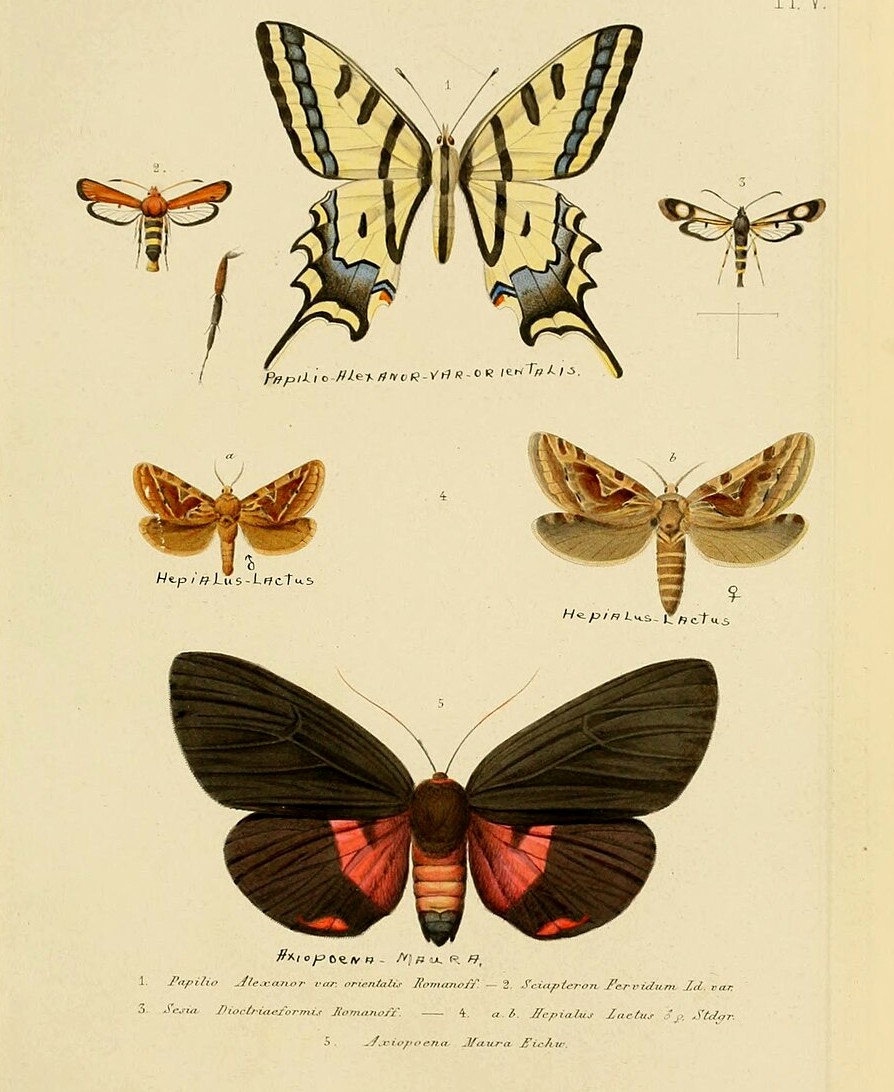
Nikolai Mikhailovich managed to establish himself in two fields at once: history and entomology, above all lepidopterology — the study of butterflies. He later recalled that he became interested in entomology at the age of eleven — in Tiflis, and especially in Borjomi, where in his spare hours he caught butterflies. The first spark was probably the Caucasian landscape itself, with its richness and variety.
![Prokudin-Gorsky, S. M., “View of [Nikolai Mikhailovich’s] Likani Palace from the Kura River in Borjomi.” 1905–1915.](/images/russian-queerography/nm-2.jpg)
The most tangible, “material” outcome of his work with butterflies was one of the largest private collections in the world. Later he donated it to the Zoological Museum; at the time of the transfer the holdings numbered about 110,000 specimens.
Beyond his own research, Nikolai Mikhailovich — like many members of the reigning house — acted as a patron of institutions and societies, including scholarly ones. He served as chairman of the Russian Geographical Society and the Russian Historical Society, honorary chairman of the Russian Entomological Society and the Russian Military-Historical Society, headed the Society for the Protection and Preservation of Monuments of Art and Antiquity, was an honorary member of the Moscow Archaeological Institute, and sponsored the Ural Society of Naturalists — and that is only part of the list. Yet unlike many Romanovs, his involvement did not stop at an honorary title: he immersed himself in day-to-day affairs, helped with organization, and acted as a benefactor.
In 1883 he conceived a new “butterfly” project — and thus the publication with the French title Mémoires sur les Lépidoptères was born. These were lavish volumes: expensive bindings, high-quality paper. Nikolai Mikhailovich assumed the financial burden entirely himself. Over seventeen years nine volumes appeared; some ran to as many as 700 pages. In the Soviet era, his contribution to science was, to a large extent, played down.
Yes, money and status mattered: they opened access to scholars, expeditions, publishing, and infrastructure. But such resources alone do not produce scientific results. Without stamina, discipline, and competence, Nikolai Mikhailovich would not have secured a place in the professional community. He truly made the effort and became a scholar. Colleagues named dozens of insect species in his honor — including, for example, the Panamanian butterfly Romanoffia imperialis and the ground beetle Carabus romanowi.
I received your note and am very sorry that, through an ill-considered word, I may have upset you. My aim was simply to tease you — nothing more. You chose to take my jokes seriously; so it is best to forget everything I chattered about today, and come to see me more often.
— Nikolai Mikhailovich, in a letter to the scholar Grum-Grzhimailo
A Court Historian
And yet the main basis for Nikolai Mikhailovich’s claim to intellectual distinction was his work as a historian. The shift of his interests from lepidopterology to history seems to have begun in the mid-1890s. He was especially absorbed by the Napoleonic era and the reign of Alexander I.
His first professional undertaking was the publication of a multi-volume reference album, Russian Portraits of the Eighteenth and Nineteenth Centuries, with biographical notes on famous historical figures. The second was the multi-volume Russian Provincial Necropolis, which remained unfinished because the war began. This reference work published burial registers, tombstone inscriptions, and epitaphs — for Moscow, Petersburg, and other cities, including Paris and its environs.
Continuing a family tradition, Nikolai Mikhailovich assembled an extensive collection of paintings and other works of art. He intended to bequeath it to the Russian Museum. After the revolution, however, the collection vanished; according to one version, the Bolsheviks sold it abroad.
Political Views: A Liberal Among the Romanovs
At the start of the First World War, almost everyone around him was sure the conflict would be short. Nikolai Mikhailovich insisted on the opposite: the war would drag on, and Germany would not collapse from a single blow — it could be defeated only through attrition, by the gradual exhaustion of resources. During the war years, Niki traveled close to the front, helped organize the evacuation of the wounded, the allocation of medical vehicles and hospitals, and assisted in establishing communications. It was then that his political outlook emerged with particular clarity.
One trait, formed as early as adolescence, was a deep, almost inexplicable love for France and its “free institutions.” He spoke French fluently. During the war this attachment sounded especially vivid in Nikolai Mikhailovich’s correspondence with his friend, the French historian Masson. The letters were full of admiration and solidarity: “Vive la France!”, “your wonderful country,” “the great spirit of the French people,” “my thoughts are always with France.”
These tastes and convictions were what most sharply set Niki apart from the other Romanovs. One observer called him “the most enlightened member of his tribe.” In essence, he looked like a twentieth-century liberal: he supported basic civil rights in the Lockean tradition and worked for Russia to be governed by a constitutional system with representative government. These views made it natural for him to associate with people “below” his own estate. Many of his close friends came from non-noble backgrounds, and they found it easy to treat him as an equal.
His brother Sandro called Nikolai Mikhailovich “the most radical” and “the most talented” in the family; nicknames such as “Nikolai Égalité” (“equality”) also stuck to him. His “egalitarian” manner showed even in everyday life: he insisted that his valet have breakfast with him at the same table — even though, in the presence of relatives, this violated unwritten rules.
At the same time, Niki was not a socialist, as right-wing circles claimed. Until the February Revolution he remained a monarchist — but a monarchist of the constitutional kind. Even so, his behavior reinforced his reputation as a “leftist” in the eyes of contemporaries. In his archive, for example, issues of Herzen’s The Bell (Kolokol) have survived — something other Romanovs usually did not keep. After the revolution, watching the disintegration of state order, he did not retreat into reaction and did not renounce the liberal ideal; over time his views shifted toward democratic republicanism.
Like many Romanovs, Nikolai Mikhailovich was not free of ethnic prejudice. In his correspondence with Masson, who shared similar attitudes, especially harsh antisemitic statements appear. Niki wrote about “international Jewry,” attributed to Jews an excessive influence of capital, and linked Russia’s internal problems to a “Jewish” factor.
Nikolai Mikhailovich’s religiosity, by contrast, did not seem particularly strong. Yes, he was raised in an Orthodox environment, and that could not fail to leave its mark. Yet faith did not become a dominant force for him and did not take the form of deep, steady religious devotion characteristic of many Romanovs.
Nikolai Mikhailovich and Rasputin’s Murder
By the autumn of 1916, Nikolai Mikhailovich had become one of the earliest and most persistent critics of the regime — above all because of mysticism at court, Rasputin’s influence, chaotic appointments, and talk of “dark forces.” At the same time, he did not regard the empress as a conscious traitor or a German agent. In his view, she was simply dangerously incompetent and blinded. She, for her part, saw his intelligence and independence as a threat.
Nikolai Mikhailovich tried to speak first with the empress and then with Nicholas II. He expressed to the sovereign, in person, harsh criticism of the occult circle and of the very mechanism of court influence. The empress knew this — her husband reported it to her — and the conflict between them reached a breaking point, though Nicholas II tried to defuse it.
Then came Rasputin’s murder. Nikolai Mikhailovich had always opposed Rasputin’s influence, yet he believed that removing Rasputin alone was pointless if the entire system was not dismantled — a system in which the empress played the decisive role.
He was not himself a participant in the plot, and he learned of what had happened only in the morning. But almost at once he inserted himself into the affair: he began to find out who was involved, went from one relative to another, visited Yusupov, tried to extract a confession by feigning inside knowledge, as if he already knew the details — though in reality he understood almost nothing. He also took part in the search for the body.
Once the circumstances became known, Nikolai Mikhailovich turned into the most consistent defender of Grand Duke Dmitrii Pavlovich — one of the participants in the killing. He worked to have the punishment reduced, saw him off, supported him — and later fell into disgrace himself.
After the murder, there was a brief impulse of dynastic unity. The Romanovs tried to act in concert: they discussed putting pressure on the tsar, wrote letters, and even talked through coup scenarios — up to and including the idea of “deposing the empress.” Yet, by Nikolai Mikhailovich’s own admission, at the last moment they “lacked the courage.”
The penalty for his attacks on the empress and his support for the “family opposition” was given formal shape. He was accused of “indecent things”: public speeches about the empress and contacts with Duma leaders. He was ordered to leave for the south, to his estate. In exile, Nikolai Mikhailovich appeared outwardly calm — he worked, hunted, ate, slept, and hardly felt bored. But the sense of catastrophe grew ever clearer: he could see everything in the capital coming apart.
The Final Years and Execution
On the eve of the February Revolution, Nikolai Mikhailovich returned to the capital. He walked around the city in civilian clothes, trying not to stand out; there were even rumors that he might have shaved off his beard. Then came Nicholas II’s abdication and Mikhail’s refusal of the throne. Niki was among the first to bring Mikhail detailed news of what was unfolding and urged him to show resolve — to try to save Russia and the dynasty. Mikhail, however, refused.
After the monarchy fell, Nikolai Mikhailovich did not retreat into the shadows. He focused on family and household affairs, tried to fit into the new system, and even offered his services to the government. He regularly communicated with leaders of the new authorities. Around the same time, Niki decided to run for the Constituent Assembly — in effect, to become the first Romanov to serve as an elected deputy. But Kerensky later told him that a decision had been taken to strip the grand dukes of voting rights.
In the first weeks after the October coup, the Bolsheviks’ dealings with Nikolai Mikhailovich looked almost theatrical. One moment they would appear under the pretext of “inspecting” prisoners of war; the next they would promise protection “in case of unrest”; then they would conduct an “inspection” of the basement. Once, soldiers came “to look at the wine cellar” — and staged a drunken rampage.
In meetings with Uritsky, the head of the Petrograd Cheka, Nikolai Mikhailovich insistently proposed a new self-definition: he was a historian, chairman of scholarly societies, a man of archives and publishing work — not a political enemy from the tsar’s family. He even spoke of a wish to emigrate — ideally to Denmark — yet no one intended to let him go. In February 1918, the Novo-Mikhailovsky Palace was officially confiscated and turned into an institution of the revolutionary administration; the building itself was soon looted.
When the German offensive began and the Bolsheviks evacuated the capital, the remaining Romanovs were ordered to be sent “into the interior of Russia.” They were offered several options, and Nikolai Mikhailovich, together with his brother George, chose Vologda. There, in modest circumstances, he tried to maintain his familiar routine: reading, letters, walks, rare visits, tea, and card games at their hosts’ home.
On July 1 they were sent to the Vologda prison. News of the murder of Nicholas II and his family arrived there as well. This broke Nikolai Mikhailovich: he wept and understood that the same outcome was now realistic for him. After that, everyone was transferred to Petrograd, where they were moved from one prison to another — the Kresty, then Shpalernaya, and other places of confinement. In prison Nikolai Mikhailovich did not lose heart: he argued, joked, made cutting remarks, and at times deliberately broke minor rules — for instance, refusing to turn off the light so he could read.
An unexpected figure in this story was Maxim Gorky. He rejected “senseless killings” and sympathized with the prisoners. Yet within Bolshevik power there was no single decision-making mechanism, and confusion — along with the speed (and failures) of communication — played its part. Gorky traveled to Moscow to see Lenin and secured Niki’s life — but it turned out to be too late.
In January 1919, Nikolai Mikhailovich and George, along with Pavel and Dmitrii Konstantinovich, were executed by firing squad at the Peter and Paul Fortress. The precise official motives were never fully clarified. It may have been political revenge and a “reply” to events in Germany (where revolutionaries were executed), the result of internal struggles and the particular harshness of local leaders, or simply the broader logic of terror — a display of force meant to intimidate.
Later, when the Church canonized the “New Martyrs,” Nikolai Mikhailovich was not included on the list. In 1999, the Russian Prosecutor’s Office announced the rehabilitation of Nikolai Mikhailovich and three other grand dukes executed with him.
🇷🇺 LGBT History of Russia
- Homosexuality in Ancient and Medieval Russia
- A Cross-Dressing Epic Hero: the Russian Folk Epic of Mikhaylo Potyk, Where He Disguises Himself as a Woman
- The Homosexuality of Russian Tsars: Vasily III and Ivan IV "the Terrible"
- Uncensored Russian Folklore: Highlights from Afanasyev's "Russian Secret Tales"
- Homosexuality in the 18th-Century Russian Empire — Europe-Imported Homophobic Laws and How They Were Enforced
- Peter the Great's Sexuality: Wives, Mistresses, Men, and His Connection to Menshikov
- Russian Empress Anna Leopoldovna and the Maid of Honour Juliana: Possibly the First Documented Lesbian Relationship in Russian History
- Grigory Teplov and the Sodomy Case in 18th-Century Russia
- Russian Poet Ivan Dmitriev, Boy Favourites, and Same-Sex Desire in the Fables 'The Two Doves' and 'The Two Friends'
- The Diary of the Moscow Bisexual Merchant Pyotr Medvedev in the 1860s
- Maslenitsa Effigy: The "Man in Women's Clothes" of Russia's Pre-Lent Carnival
- Sergei Romanov: A Homosexual Member of the Imperial Family
- Possible homosexuality of Grand Duke Nikolai Mikhailovich of the Romanov family
- Andrey Avinoff: A Russian Émigré Artist, Gay Man, and Scientist
 Subscribe to our Telegram channel (in Russian): Urania. With Telegram Premium, you can translate posts in-app. Without it, many posts link to our website, where you can switch languages — most new articles are published in multiple languages from the start.
References and Sources
- Винарский, Максим; Юсупова, Татьяна Ивановна. «Коллекционер бабочек: Великий князь Николай Михайлович, энтомолог из династии Романовых». 2026.
- Figes, Orlando. A People’s Tragedy: A History of the Russian Revolution. 1996.
- Бенуа, А. Н. Мои воспоминания. 1990.
- Korros, Alexandra. “White Crow: The Life and Times of the Grand Duke Nicholas Mikhailovich Romanov, 1859–1919. By Jamie H. Cockfield.” 2004.
- Tags:
- Russia
- Queerography