Ivan Dmitriev, Young Favourites, and Same-Sex Desire in the Fables 'The Two Doves' and 'The Two Friends'
A friend of Karamzin and Derzhavin, minister of justice, and a fable writer where friendship turns into male love.
Contents
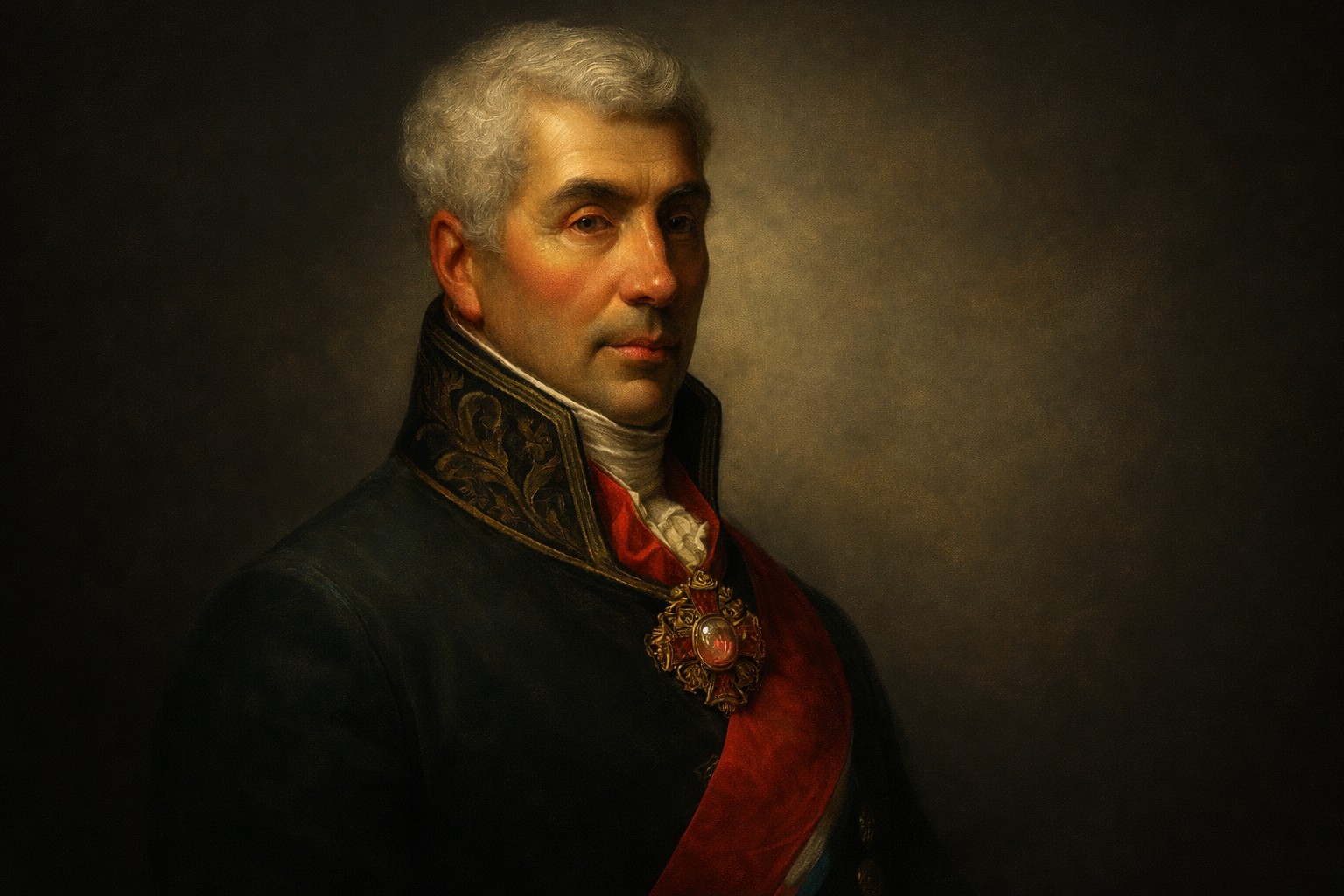
Ivan Ivanovich Dmitriev (1760–1837) entered history as a notable sentimentalist poet of the late 18th and early 19th centuries and as a statesman who rose to the post of minister of justice under Emperor Alexander I.
In official biographies, he appears as a strict and rational administrator. However, sources and memoirs indicate that he was regularly surrounded by young, talented men. His bachelor life, rumors about the nature of his attachments, and the absence of public scandals create the image of a figure whose private biography was shielded from publicity, yet remains legible through indirect evidence.
Dmitriev was also known as a man of letters and a translator, widely read in the noble milieu. In his translations, he often departed from the source text. The year 1795 is especially revealing: translating two fables by the French fabulist Jean de La Fontaine — “The Two Doves” and “The Two Friends” — Dmitriev altered the original and effectively transformed plots about friendship into works with a noticeable homoerotic subtext (the full texts of both fables are provided at the end of the article).
Biography and Historical Context
Ivan Dmitriev came from an old noble family that traced its origins to the princes of Smolensk. His mother belonged to the wealthy Beketov family. The future poet was born on 21 September 1760 on his father’s estate, Bogorodskoye, near Syzran. He received his early education at home, then spent several years at a private boarding school in Simbirsk, after which he continued his studies under his father’s guidance.
Among the books he read in his youth, Dmitriev was particularly influenced by the novel of the French writer Abbé Antoine François Prévost, The Adventures of the Marquis of G. (Mémoires et aventures d’un homme de qualité). Because the fifth and sixth volumes in Russian translation never reached Simbirsk, the young man turned to the French original: at first, he read with a dictionary, and then gradually achieved fluent command of the language.
His coming of age coincided with a difficult historical period. During the Pugachev Rebellion of 1773–75, the family left the estate and moved to Moscow. Financial difficulties forced his father to place his sons into military service. In 1772, Dmitriev was enrolled as a private in the Life Guards Semyonovsky Regiment — a privileged part of the Russian army that served, among other things, court functions. Later, his father brought Dmitriev to Saint Petersburg, where he completed the regimental school and received his first officer ranks.
Dmitriev’s service in the Semyonovsky Regiment was reflected in the memoirs of his contemporaries. The memoirist Filipp Filippovich Vigel (1786–1856) left the following characterization of him in his Memoirs:
“When, on ascending the throne, Paul made his heir [Alexander] the colonel-in-chief of the Semyonovsky Regiment, Ivan Ivanovich Dmitriev was a captain in it. His manly beauty struck the young man; his wit amused and captivated his fellow officers, while at the same time a certain natural gravity in his presence restrained excessive bursts of their merriment: they enjoyed him with respectful delight.”
— Filipp Vigel, Memoirs
Dmitriev displayed literary talent early. In 1777, under the influence of the journalist and publisher Nikolai Ivanovich Novikov, he began writing predominantly satirical verse (he later destroyed some of these early attempts). In 1783, Dmitriev met his distant relative, the future writer and historiographer Nikolai Mikhailovich Karamzin, who soon became his close friend.
By the late 1780s, Dmitriev had firmly entered literary circles: he grew close to the poet Gavriil Romanovich Derzhavin, met the playwright Denis Ivanovich Fonvizin, and other writers. In 1791, Karamzin published Dmitriev’s mature works in the Moscow Journal. Among them stood out the song “Golubok” (“The Gray Little Dove Moans”), which quickly became popular and was soon set to music.
▶️ “The Gray Little Dove Moans” (YouTube)
Dmitriev’s home became a meeting place for young authors. The aspiring writer Ivan Andreyevich Krylov visited there. After carefully reading his first texts, Dmitriev pointed him toward the most suitable direction, noting that fables constituted his true calling. After this, Krylov began working constantly in the fable genre. Later, in 1811, Dmitriev helped the young Alexander Sergeyevich Pushkin gain admission to the Tsarskoye Selo Lyceum.
Dmitriev’s official career also progressed successfully. In 1806, at the invitation of Emperor Alexander I, he took up the post of senator, and in 1810 he was appointed minister of justice. In this position, Dmitriev sought to bring order to the judicial system: he reduced the number of court instances and worked to accelerate case processing. Strictly adhering to official rules and avoiding court intrigues, he often came into conflict with powerful officials. Constant complaints led to his resignation in 1814, which Alexander I accepted with visible regret.
After leaving service, Dmitriev settled in Moscow, not far from Patriarch’s Ponds. There he headed a commission that assisted city residents affected by the Moscow fire of 1812. For this work, Dmitriev received the rank of Active Privy Councillor and the Order of Saint Vladimir, 1st class. This effectively marked the end of his state career.
Contemporaries noted in him a combination of strictness and a typical barin (landed nobleman) lifestyle. The same Vigel wrote:
“As in every extraordinary man, there were many contradictions in him: everything about him was measured, proper, neat, even prim, like a German; yet his habits and tastes were entirely those of a Russian barin: kvass, pies, and above all raspberries with cream were his delight. He also loved jesters, but in that role he usually cast pompous versifiers. Many considered him an egoist because he was a bachelor and seemed cold. He loved few, but he loved them passionately; to the rest he always wished well — what more can one demand of a human heart?”
— Filipp Vigel, Memoirs
Dmitriev never married. In 1801, he seriously prepared for marriage to Anna Lvovna Pushkina (Alexander Pushkin’s aunt), but the wedding never took place. The would-be spouses maintained warm relations and later became related through godparenting. Otherwise, the poet’s private life was carefully hidden from the public.
In his final years, he rarely left Moscow: he revised his early works and wrote his memoirs, A Look at My Life. Ivan Dmitriev died on 15 October 1837 and was buried at the Donskoye Cemetery.
Possible Homosexuality of Dmitriev
During the reign of Alexander I, high society maintained a hidden tolerance for same-sex relationships. Such ties were not discussed publicly, but people knew of them in private conversations. This tolerance was largely explained by a legal vacuum: the military code introduced under Peter I severely punished sodomy, but this norm was applied exclusively to military personnel to maintain army discipline. A secular law that would prosecute private, consensual homosexual contacts between civilians did not exist in the Russian Empire at that time. The situation changed only in 1832, when Emperor Nicholas I approved the “Code of Criminal and Correctional Punishments,” Article 995 of which criminalized consensual sodomy for all social estates for the first time.
Thanks to this window of legal invisibility, the aristocracy enjoyed the right to privacy. In the capital’s circles, same-sex relationships were often combined with patronage. Influential dignitaries formed circles of talented young men around themselves and ensured their rapid career advancement. Thus, contemporaries openly attributed homosexual inclinations to the minister of spiritual affairs and public education, Prince Alexander Nikolayevich Golitsyn.
Judging by the testimonies of contemporaries, Dmitriev acted in a similar manner. During his leadership of the Ministry of Justice, he was most often surrounded by young and attractive assistants. The most expressive testimony was left by Vigel. Describing Dmitriev’s first weeks as minister, he noted:
“A month had not passed since Dmitriev was appointed minister of justice and soon arrived in Petersburg; and he arrived not alone, but brought with him a small yet chosen retinue. Three youths accompanied him — Milonov, Grammatik, and Dashkov; the first two were merely poets, the last was whatever he wished to be.”
— Filipp Vigel, Memoirs
Among the mentioned “chosen retinue” were the eighteen-year-old elegiac poet Mikhail Vasilyevich Milonov and the philologist Nikolai Fyodorovich Grammatin (in editions of Vigel’s memoirs, his surname was often distorted as “Grammatik”).
The third, the twenty-one-year-old Dmitry Vasilyevich Dashkov, was transferred in 1810 from the Moscow archive to Petersburg under Dmitriev’s direct supervision. The relationship between the older mentor and the young assistant represented an example of a homosocial career elevator based on intellectual and, possibly, emotional closeness. Subsequently, Dashkov became one of the founders of the literary society “Arzamas,” and in 1832–39 he repeated his patron’s path, taking the post of minister of justice.
No testimonies from Dmitriev himself or documents that would unambiguously confirm his homosexual relationships have survived. However, numerous mentions by contemporaries allow us to presume he had homoerotic inclinations. In another episode, Vigel recounts a story showing how unlikely the idea of the minister having a love affair with a woman seemed to Petersburg society:
“Dmitriev was a friend of Severin, and even more so of his wife, who was much smarter and more enlightened than her husband. From this they concluded that he was her lover, and even attributed to him parental rights over the son she bore, although she was hunchbacked and a genuine monster. This was sheer falsehood, not slander: for no one thought to condemn Dmitriev for such youthful gallantry.”
— Filipp Vigel, Memoirs
This fragment reflects an established perception: rumors about Dmitriev’s connections with men seemed much more plausible to his contemporaries than gossip about an affair with the wife of the diplomat Dmitry Petrovich Severin.
Same-Sex Desire in Dmitriev’s Poetics
The main source of information about Dmitriev’s possible homosexuality is his own texts.
In most poems, the poet maintained an outwardly impeccable image and followed the norms of sentimentalism. His lyrical hero usually yearned for a conventional lady of the heart, most often named Chloe or Phyllis. In itself, this does not indicate hypocrisy: in the early 19th century, a double life was perceived as a common phenomenon.
Russian sentimentalism, with its programmatic emphasis on exceptional sensitivity, melancholy, and extreme attention to the subtlest movements of the soul, created a language that allowed the articulation of non-normative emotions. Within this aesthetic, emotional exaltation in relationships between men was accepted by society as a marker of a refined nature.
Translated literature often became a legal way of expressing suppressed same-sex desire. Fluent in French and German, members of the Russian elite could embed their own meanings into a translation, hiding them behind an authoritative original.
The translation scholar Sergey Tyulenev, in his study Translation as Smuggling, compared Dmitriev’s fable translations to the secret smuggling of forbidden goods. Outwardly, such texts look restrained, but inside they contain new semantic emphases.
Dmitriev, whom his contemporaries respectfully called the “Russian La Fontaine,” actively intervened in the material: he redistributed intonations, changed imagery, and added his own attitude to what was happening. At the same time, he seemed to remain in the shadows, yet an attentive reader could catch the author’s presence in the style and choice of details.
The world of Dmitriev’s works is almost entirely populated by male characters. This is especially noticeable in texts where the author is free to choose his heroes. For example, in the imitation “Golubok” (“The Little Dove”), he relies on the ancient poet Anacreon, who wrote, among other things, about love between men. The appeal to the ancient tradition served as a reliable intellectual cover. The hero of the poem talks with a little dove, calling it “beautiful” and “fragrant as a rose.” The bird says that it carries letters from the poet to his beloved boy Bathyllus (Bathyllos). The dove admits that it does not want freedom and prefers to stay with its master. The only female figure in the text — Venus — acts as an abstract mythological symbol of love.
Another frequent motif of sentimentalism was the cult of male friendship, which was considered spiritual and often placed above heterosexual love. Dmitriev used this motif in his reworking of the fragment “Love and Friendship” from a poem by the Scottish writer James Macpherson. The plot describes two youths in love with the same girl. In the finale, the friends choose a joint death, proving that their attachment to each other is stronger than their love for a woman.
Despite a public commitment to a heterosexual image, there are two texts in Dmitriev’s work that come close to an open expression of feelings — these are his reworked fables of La Fontaine, “The Two Doves” and “The Two Friends.” While in the French author they are stories about classic friendship, in Dmitriev they acquire a noticeable homoerotic tint and turn into texts about romantic male attachment.
The Fable “The Two Doves” with a Homoerotic Subtext
Dmitriev’s fable “The Two Doves” (1795) is a translation of La Fontaine’s text Les Deux Pigeons. The figure of the French fabulist was associated with the philosophy of freethinkers, who valued freedom and criticized social conventions. Dmitriev translated only some of La Fontaine’s fables.
The plot of “The Two Doves” is as follows: two doves have lived together for a long time and are strongly attached to each other. One grows tired of a monotonous life and sets off on a journey. The other unsuccessfully tries to stop him, fearing separation. Soon the wanderer experiences a series of dangers: he gets caught in a thunderstorm, gets tangled in a net, barely escapes a falcon, injures his wing, and then a boy throws a stone at him. Exhausted and crippled, the dove returns home. The moral of the fable: loving hearts should not seek happiness in wanderings, because next to a loved one, every moment already gains meaning.
Dmitriev’s translation is at times closer to an imitation than to a literal reproduction. La Fontaine has 83 lines, while Dmitriev has 106. The expansion of the plot indicates the translator’s personal involvement. Instead of the brief original phrase that the birds loved each other with tender love, the Russian version provides an extended description:
Two doves were friends,
Had lived together for a long time,
And ate and drank together.
The tonality also changes. In the original, the traveler hears a reproach expressed through the polite French vous (“you”) and the neutral frère (“brother”). In Dmitriev, a personal address using ty (the familiar “you”) and the diminutive bratets (“little brother”) appears:
“Have mercy, dear brother — how you’ve struck me!
Is it easy to be apart?.. Easy for you, cruel one!
I know it; ah! but for me... I, in deep sorrow,
Won’t live through a single day...”
The lines become longer and more emotional, and the French imprudent voyageur (“imprudent traveler”) is translated with the words “madman” and “schemer.”
Dmitriev strengthens the physical side of the bond. In La Fontaine, the birds cry and say adieu (“farewell”) to each other. In the Russian translation, the formal farewell gives way to physical contact:
The friends looked at each other, pecked,
Sighed, and parted.
The female figure in this male story requires special attention. In the original fable, the traveler meets a third male dove (un pigeon) near scattered wheat. In Dmitriev, a gender inversion occurs: this character turns into a female dove. It is she who serves as bait in the field, drawing the wanderer into a trap.
Another female figure arises in the author’s digression as the narrator’s beloved. She is unnamed and belongs to a conventional poetic type depicting an idyllic but rather bland love. Against this background, the pair of male doves stands out especially: their story, masquerading as a fable, persistently reads as an extremely “humanized,” tender romance.
The Fable “The Two Friends”: Idealized Male Intimacy
At the center of La Fontaine’s fable “The Two Friends” (Les Deux Amis, 1795) are two inseparable friends. One day, one dreams that his companion is sad. Frightened, he runs to his friend in the middle of the night. The friend wakes up, decides that a real disaster has happened, and immediately offers help: money, a weapon, or any action. Learning that there is no disaster, and the reason for the visit was only an anxious dream, he calms down.
Comparing the Russian text with the French, one can see how Dmitriev actively intervenes in the narrative: he clarifies details and strengthens the intonation. One of the main changes is the disappearance of the exotic frame. In La Fontaine, the action takes place in the land of Monomotapa — a fictional African location far from the corrupted morals of European courts. Dmitriev completely erases this geographical distance:
Long, long ago two friends lived somewhere...
The fable ceases to refer to a conventionally distant world and transfers the model of ideal relationships into a space relevant to the Russian reader.
Dmitriev develops the theme of closeness much more broadly than La Fontaine. The French text says: “Everything that belonged to one belonged to the other; the friends of that country, they say, are valued more than in ours.” Dmitriev writes that the friends:
...shared a single thought, loved one and the same thing,
And every hour
Could not take their eyes off one another;
Always together; only night alone parted them;
But no, even at night soul spoke with soul.
Mutuality goes beyond the bounds of everyday life: the bond continues even at night in sleep.
The translator removes reflections that he considers unnecessary. La Fontaine’s question “Which of them loved more, do you think, reader?” disappears. What comes to the fore is not the comparison of attachment, but the mutuality of feelings. In the Russian version, the heroes address each other as ty, in contrast to the formal La Fontaine’s vous. Dmitriev’s short, almost theatrical lines make the narrative dynamic:
Here is all my money! Has someone wronged you?
Here is my sword! I’ll run — I’ll die, or you’ll be avenged!
The most striking act of censoring the original consists in removing the heterosexual element from the climactic scene. In La Fontaine, the awakened companion offers three options for help: money in case of a card loss, his arm and sword, and a beautiful female slave if the friend is lonely sleeping (Une esclave assez belle…). Dmitriev decisively excludes the third option, leaving only the treasury and the sword. Thereby he cleanses the space of the fable from heteronormative clichés.
The same changes are visible in the moral. In La Fontaine, it is sustained in a gallant-chivalric manner. Dmitriev removes the abstract reasoning and derives an aphoristic formula:
A friend in the heart, a friend in the mind — and he is on the lips!
As a result, Dmitriev again smuggles his own worldview into the text “by contraband.” By cutting female figures out of classic plots and strengthening the closeness of male characters, he creates poems that, despite their outward sentimental decorum, function as encrypted messages.
Significance for the History of Russian LGBT Literature
Most researchers agree that Ivan Dmitriev experienced same-sex attraction, although the status of a high-ranking dignitary required absolute public restraint from him. His biography clearly demonstrates the specifics of aristocratic culture in the early 19th century: in the conditions of a legal vacuum, emotional attachment between men not only existed as an “open secret,” but also served as the basis for homosocial ties that formed the intellectual and managerial elite of the empire.
From a literary point of view, Dmitriev’s legacy represents one of the early examples of queer coding in Russian poetry. Unable to speak about his feelings directly, he masterfully used the legal frameworks of his era — the authority of the ancient tradition, the genre of translation, and the sentimentalist cult of friendship. By transforming classic plots, Dmitriev created a language that allowed the articulation of non-normative sensuality within high literature.
His texts show that the history of Russian homosexuality is not only a chronicle of secrecy or marginalization, but also a complex intellectual tradition in which authors found elegant ways to inscribe their personal experience into the canon of national culture.
A general assessment of his literary significance was expressed by Filipp Vigel:
“As a poet, he will always occupy a remarkable place on the Russian Parnassus. Before him, fashionable society and women did not read Russian verse or, if they read it, they did not understand it.”
— Filipp Vigel, Memoirs
The Two Friends
Long, long ago two friends lived somewhere,
They shared one thought, loved one and the same thing,
And every hour
They could not take their eyes off one another;
Always together — only a single night ever parted them;
And even then, no: at night their souls still spoke to each other.
Once, one of them had a dreadful dream;
In an instant he was out of the house,
Running, shaken, to his friend,
And woke him. The other sprang up.
“What help do you need? —”
He said, confused. —
“My friend has never been woken so early!
What does your visit mean? Have you lost at cards?
Here is all my money! Has someone wronged you?
Here is my sword! I’ll run — I’ll die, or you’ll be avenged!”
— “No, no, thank you — it’s neither this nor that,”
The gentle friend replied, “stay calm:
A cursed dream is to blame for everything!
At dawn I dreamed my friend was sad,
And I... I was so troubled by it
That I woke at once
And ran to you, to set my mind at ease.”
What a priceless gift — a true, wholehearted friend!
He looks for every way to serve you:
He senses sorrow, he prevents disasters;
A trifle, a dream, a nothing — and he is afraid for you;
A friend in the heart, a friend in the mind — and always on the lips!
<1795>
The Two Doves
Two doves were friends,
Had lived together for a long time,
And ate and drank together.
One grew tired of seeing the same thing day after day;
He decided to go out and wander, and told his friend.
To the other, the news was like a knife;
He shuddered, wept,
And cried out to his friend:
“Have mercy, dear brother — how you’ve struck me!
Is it easy to live in separation?.. Easy for you, cruel one!
I know it; ah, but for me... for me, in deep sorrow,
I won’t live through a single day... and besides, think:
Is this the time to set off on a journey?
At least wait until the zephyrs, my dear dove!
Why hurry? We’ll still have time to part!
Only now the raven has cried,
And without a doubt — I fear it beyond measure! —
He foretold some misfortune from the birds,
And a heart in grief believes it even more!
When I am parted from you,
Every day will threaten me with disaster:
Now a bold hawk, now cruel hunters,
Now kites, now snares —
Every evil thought will come back to me at once.
Alas for me! — I’ll say with a sigh — it’s raining!
Is my friend well? Is he suffering from cold?
Does he feel hunger?
And what won’t I imagine then!”
To fools, wise speech is like water in a brook:
It babbles and runs past.
The schemer listens, sighs,
And still wants to fly.
“No, brother, so be it!” he said. “I’ll fly.
But believe me: I won’t want to make you suffer;
Don’t cry — three days will pass, and I’ll be with you again,
To peck
And coo
Once more under the same roof;
And in the evenings I’ll begin to tell you —
For it will all come down to the same old refrain for us anyway —
What I saw, where I was, what was good, what was bad;
I’ll say: I was there, I saw such a wonder,
And there this happened to me,
And you, my dear friend,
Listening to me, will be so well informed by summer
As if you yourself had wandered the wide world.
Farewell!” — At these words,
Instead of all the “alas!” and “ah!”
The friends looked at each other, pecked,
Sighed, and parted.
One, with his beak drooping, sat down;
The other fluttered up, rose, and flew, flew like an arrow.
And surely, in the heat of it, he would have flown to the edge of the world;
But suddenly the sky was covered with gloom,
And straight into the traveler’s eyes
From a cloud came pouring rain, hail, a whirlwind — in a word,
A thunderstorm, with all its retinue, as is usual!
In such a case — dangerous, though not new —
The poor dove quickly perches on a branch,
And is even glad that he only got soaked.
The storm died down, the dove dried himself,
And set off again.
He flies and sees from on high
Scattered millet, and beside it — a she-dove;
He lands, and in an instant
Gets tangled in a net; but the net was weak,
So he armed himself with his beak against it;
Now with beak, now pulling with his little foot, pulling, he broke free
From the net without harm,
Losing only feathers. But is that a misfortune?
To make his fear still worse,
A falcon appeared, and with all his force
Attacked the poor wretch,
Who, like a criminal, was bound in chains,
Dragging behind him a cord with scraps of the snare.
But luckily, an eagle with broad wings
Dropped from the clouds to meet the falcon;
And so, thanks to a chance gathering of thieves,
Our traveler did not become the falcon’s prey.
Yet he still was not free of trouble:
In panic, losing both sense and keen sight,
He struck a roof edge head-on
And dislocated his wing; then a boy —
Clearly there was dove-blood in him, and some wit besides —
For a joke, flung a pebble with a slingshot,
And hit him so hard he almost collapsed;
Then... then, cursing himself, his fate, the road,
He decided to limp back, half-dead, half-lame;
And at last he arrived home a cripple,
Dragging his wing and trailing his leg.
O you whom the god of love has joined!
Do you want to travel? Forget the proud Nile,
And do not part farther than the nearest stream.
What is there for you to admire? Admire one another!
Let each find in the other, every hour,
A beautiful new world, always varied!
Is there, in love, even a moment when the heart is idle?
Love, believe me, will replace everything for you.
I myself have loved: then, for a lonely meadow,
Lit up by the presence of my beloved,
I would not have taken, in exchange, marble palaces
Nor a kingdom in the heavens!.. Will you return
Those minutes of joy, those minutes of rapture?
Or am I to live on memory alone?
Has the time of such sweet enchantments really passed,
And is it time for me to stop loving?
<1795>
Bibliography and Sources
- Vigel, Filipp. Zapiski [Memoirs]. Moscow: Universitetskaya tipografiya, 1864.
- Dmitriev, Ivan. Polnoye sobranie stikhotvoreniy [Complete Collection of Poems]. Leningrad: Sovetsky pisatel, 1967.
- Baer, Brian James. “Russian Gay and Lesbian Literature.” In The Cambridge History of Gay and Lesbian Literature, edited by E. L. McCallum and Mikko Tuhkanen, 421–437. Cambridge: Cambridge University Press, 2014.
- Tyulenev, Sergey. “Translation as Smuggling.” In Thinking through Translation with Metaphors, edited by James St. André, 241–274. Manchester: St. Jerome Publishing, 2010.