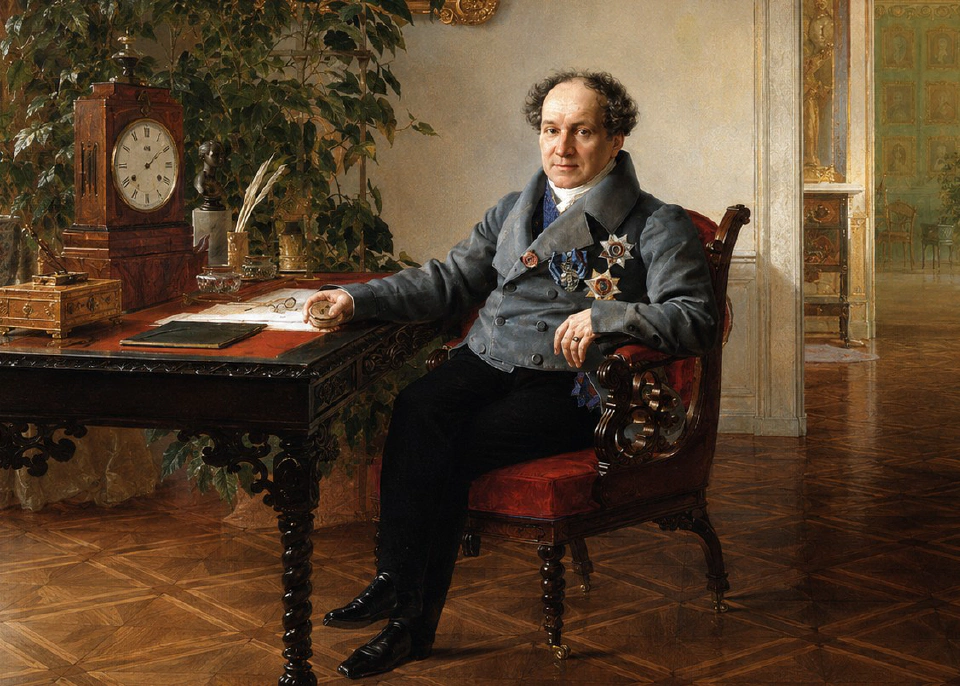
The Possible Homosexuality of Grand Duke Nikolai Mikhailovich of the Romanov Family
A Caucasian childhood, scholarship, liberalism, and involvement in the case of Rasputin's murder — against the backdrop of a life without marriage or children.
Contents
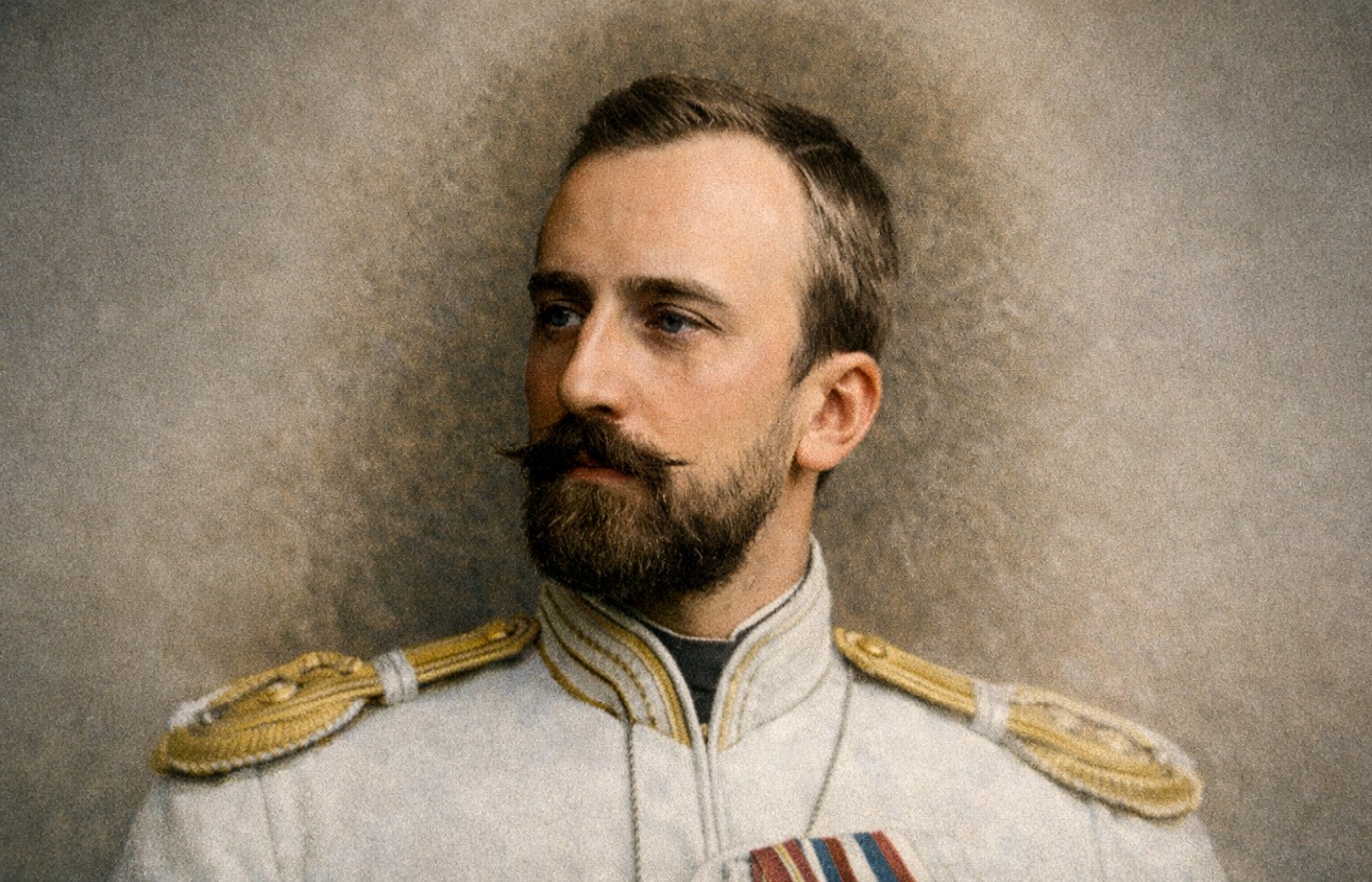
Nikolai Mikhailovich was almost the only Romanov highly praised both by his contemporaries and by historians of very different political persuasions — from left to right. Within the imperial family, he stood out as an intellectual who pursued scholarship seriously.
This grand duke was also a “white crow” because of his political views. He admired France and its freedoms, argued for limiting the monarchy, and supported a constitution and a genuine parliament. In 1917, he even tried to become a deputy to the Constituent Assembly.
There are no direct documentary confirmations of his homosexuality. In the past, some historians mistakenly linked his immediate intervention in the murder of Grigori Yefimovich Rasputin to his belonging to a homosexual circle of conspirators; however, modern researchers have proven that he was driven purely by political motives.
Nevertheless, there are indeed indirect grounds for discussions about his orientation. Nikolai Mikhailovich never married, left no heirs, and in adulthood had neither mistresses nor publicly known romances with women. At the same time, he preferred male society and maintained friendly relations with well-known homosexuals, such as Prince Felix Feliksovich Yusupov and the scientist Andrei Nikolaevich Avinov.
In this article, we will examine Nikolai Mikhailovich’s biography, paying special attention to his personality, his complex relationship with his family, his scientific achievements, and the circumstances of his tragic death.
Childhood in the Caucasus and His Relationship with His Mother
Nikolai Mikhailovich Romanov was born on April 26, 1859, in Tsarskoye Selo. He was the grandson of Emperor Nicholas I and the eldest son of Grand Duke Mikhail Nikolaevich and Cecilia of Baden (German: Prinzessin Cäcilie von Baden).
In the family, the boy was called “Niki” — like the future Emperor Nicholas II — or “Bimbo” (“baby”). As his brother Alexander Mikhailovich Romanov recalled, the childhood family nickname “Bimbo” later became firmly associated with the elephant calf from Rudyard Kipling’s tale, who “out of curiosity poked his long trunk everywhere.” This comparison aptly reflected not only Nikolai Mikhailovich’s passion for research but also his unhealthy propensity for gathering social and political gossip.
Three years after the birth of his firstborn, Mikhail Nikolaevich received an appointment as viceroy of the Caucasus, where he served for almost two decades. He managed to strengthen the loyalty of the local population to the Russian crown and earn a reputation as a man who deeply respected Caucasian traditions. The head of the postal service, Francis Vogel, recalled him with warmth: the viceroy did not behave arrogantly and did not look down on people. These democratic manners, according to contemporaries, were passed on to his children.
Nikolai had five younger brothers and a sister, Anastasia Mikhailovna. He spent his childhood and youth in Tiflis (Tbilisi) and at his father’s Likani estate in Borjomi. The family lived surrounded by southern nature, which was much brighter and more diverse than the harsh landscapes of the Baltic, which largely determined the development of the children.
Mikhail Nikolaevich’s relationship with his eldest son remained even: there was mutual respect, but no real closeness developed. The father showed particular gentleness only in his communication with his only daughter. Niki’s bond with his mother took a different shape. Before the wedding, Cecilia converted to Orthodoxy and took the name Olga Fyodorovna.
Olga Fyodorovna possessed a sharp mind and a strong character. In the family she was seen as a woman of iron will — a strict, domineering, sharp-tongued, and highly critical disciplinarian. Although she suffered from nervous hypochondria and constantly complained about her health, it was she who set the tone in the house and dominated relationships. Historians believe that it was his mother who steered her eldest son toward a serious academic career.
Nikolai was her clear and unquestioned favorite. When he turned 24, Olga Fyodorovna wrote: “Tomorrow evening Sandro [the younger brother Alexander] will arrive,” adding that she would frankly prefer to see Niki. Nikolai’s love for his mother was just as strong and bordered on painful dependence, largely determining his actions. Being away from home, he wrote to her almost every day.
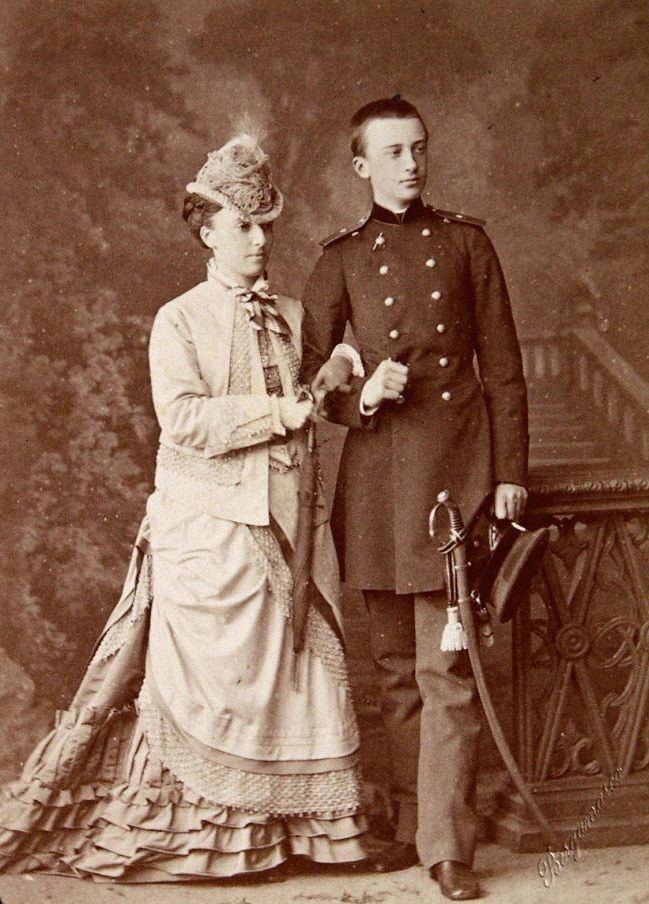
Life away from the Petersburg court noticeably influenced the worldview of Mikhail Nikolaevich’s family (the Mikhailovichi). Within the dynasty they were often called “liberals.” Vogel noted that among all the sons, Niki seemed the most warm-hearted to him. The young man’s intellectual curiosity manifested itself early: he constantly questioned Vogel about America, where the latter had once lived.
At the same time, the upbringing of the children resembled a barracks regime. They slept on narrow iron beds with hard mattresses, got up at six in the morning, and requests to “sleep five more minutes” were strictly cut short. Breakfast consisted only of tea, bread, and butter. Teachers came to the house, teaching sciences, foreign languages, and music. At the same time, severe military training was underway: the boys were taught fencing, horseback riding, handling firearms, and bayonet attacks.
“Of all Russia’s possessions, the Caucasus is such a rich and fascinating country in every respect. God grant that you will like this land and that it will leave you with good impressions!”
— Grand Duke Nikolai Mikhailovich Romanov in a letter to the Tsesarevich (the future Emperor Nicholas II)
Appearance and Character: Acerbic Wit, Intrigue, and Snobbery
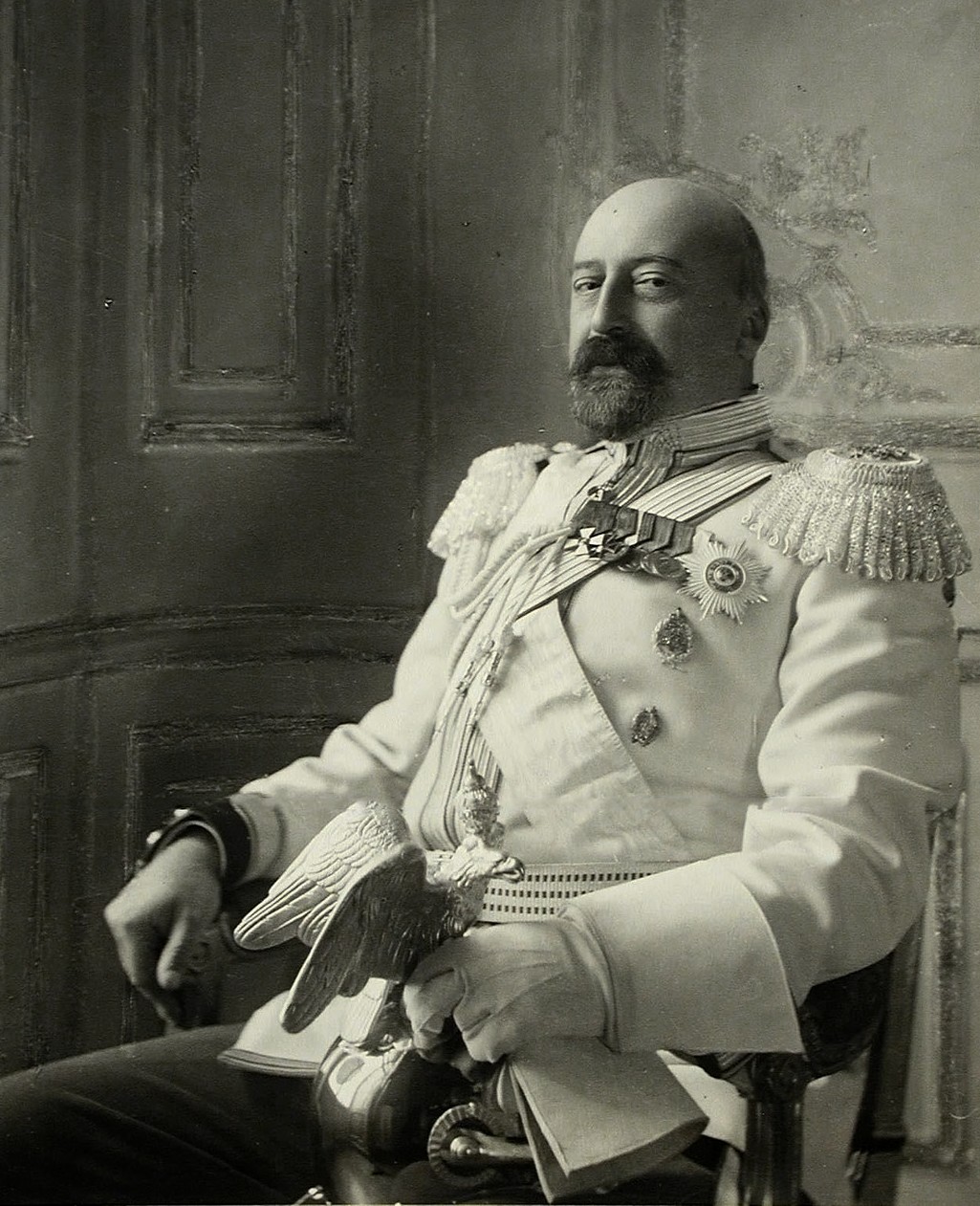
Nikolai Mikhailovich did not possess the beauty of his younger brother Alexander, although the court chancellor still found him handsome. Like his brothers, he grew tall and wore a black beard, which with age acquired the color of iron. In his mature years, he was often described as a stout man, however, surviving photographs do not confirm the rumors of excessive corpulence.
A portrait by Maria Etlinger (Eristova), painted in 1882, shows an attractive 23-year-old man with an elongated face. In his hand he holds a cigarette — a familiar accessory with which he did not part until the end of his life.
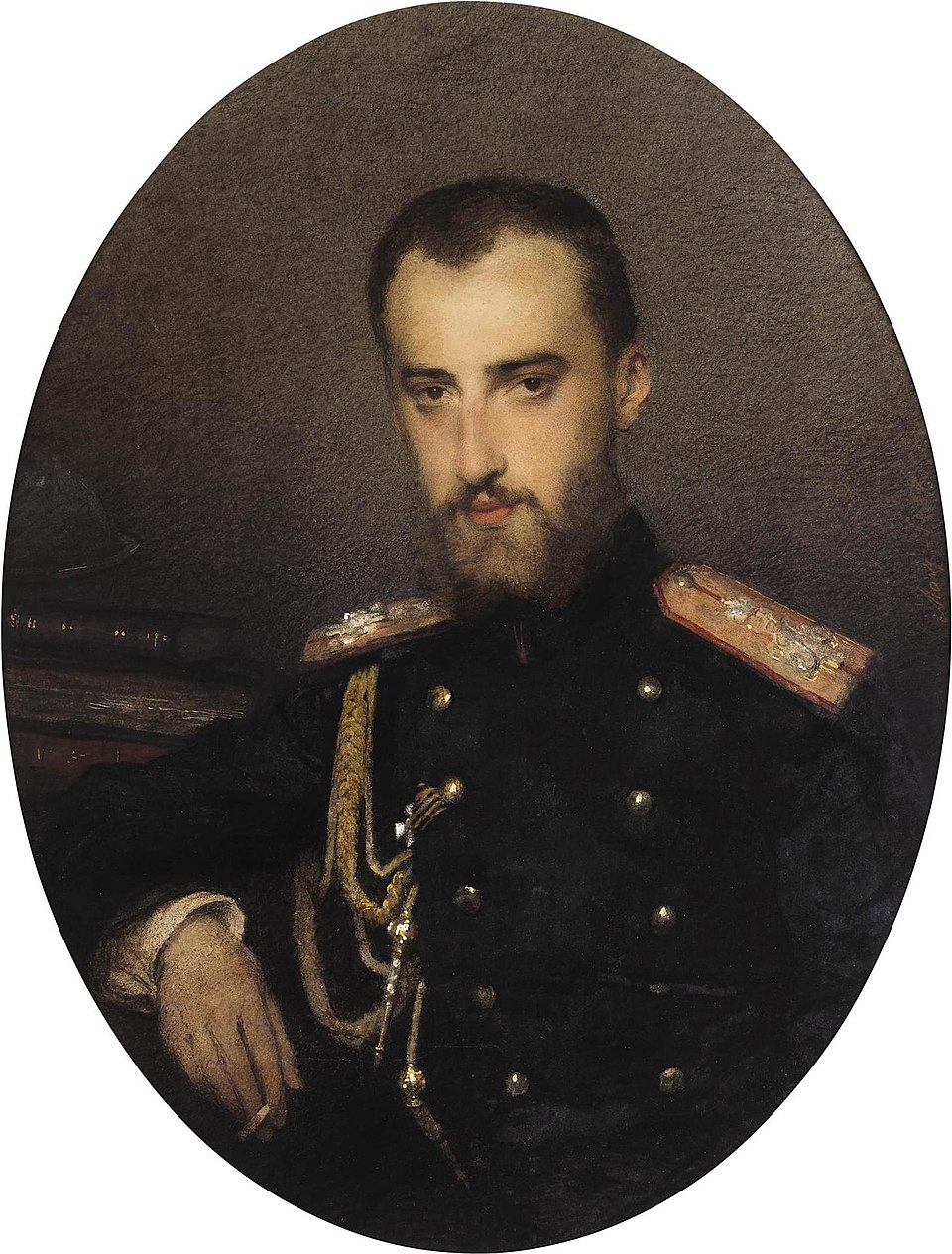
The prominent artist and art historian Alexander Nikolaevich Benois left a vivid verbal portrait of the grand duke:
“Tall, slightly stooped […] a handsome, impressive face of a somewhat Eastern type (in children’s fairy-tale illustrations, this is how all sorts of Tatar khans or Indian princes and rajas are usually depicted) […] a stately figure inclined to fullness, yet still slender and very striking…”
— Alexander Nikolaevich Benois, “My Recollections”
Nikolai inherited this distinctly swarthy and hook-nosed appearance from his mother. Persistent rumors circulated in high society that her real father was not the Grand Duke of Baden, but a Jewish banker from Karlsruhe surnamed Haber. Because of these gossips, Emperor Alexander III, who made no secret of his antisemitism, disliked this branch of the family and disparagingly called Olga Fyodorovna “Auntie Haber” behind her back, and her children the “Haberzons.”
From his brothers, Niki differed most of all in his difficult character. Already in his early twenties, he developed a habit of making acerbic remarks. His “sulfurous tongue” mercilessly walked over anyone who fell out of favor. The prince retained this manner for life, which considerably spoiled his reputation. His peers usually disliked him: Nikolai Mikhailovich considered it his right, and sometimes his duty, to sharply point out people’s flaws to them.
He openly called one interlocutor ugly and fat, another colorless, and a third thick-headed. His letters to his mother are replete with labels: “foolish,” “idiot,” “ignoramus.” If he did not question a person’s intelligence, he struck at their manners: he compared a general entering a formal dinner to a “bird of prey,” and christened a conservative politician a “right-wing savage.” Felix Feliksovich Yusupov remembered Niki as a talkative man who constantly said what ought to have been left unsaid. The grand duke himself was aware of his flaw:
“My tongue has no bones. I am capable of flaring up and saying what I think.”
— Grand Duke Nikolai Mikhailovich Romanov in a letter to Emperor Nicholas II (quoted from Jamie H. Cockfield’s “White Crow”)
Another repulsive trait of Nikolai Mikhailovich was a passion for intrigues. It was said of him that he wove conspiracies wherever he went. Countess Maria Eduardovna Kleinmichel claimed that the prince loved to pit friends against each other and received sincere pleasure when he managed to quarrel old friends or spouses with poisonous hints. One might assume that his social toxicity, snobbery, and habit of intellectual domination served as a kind of protective armor for a deeply lonely man, compensating for the absence of his own family.
Despite this, Nikolai Mikhailovich maintained warm relations with his brothers and sister. He loved small children, and in his old age “Uncle Bimbo” spent a lot of time with numerous nephews and nieces.
In his free time, the prince shared the usual entertainments of his circle. He was often seen at balls, where he could dance until five in the morning, and, like many Romanovs, he was passionately fond of hunting. Another of his weaknesses was gambling: Nikolai and his brothers regularly visited the casinos on the French Riviera, and it was he who showed the greatest passion, winning and losing colossal sums.
Personal Life and Possible Homosexuality
The question of Nikolai Mikhailovich’s sexual orientation remains one of the most debated aspects of his biography. The British historian Orlando Figes characterized the murder of Rasputin as an act bearing the hallmarks of a “homosexual vendetta,” referring to the participation of Felix Yusupov and Grand Duke Dmitrii Pavlovich Romanov. Although Nikolai Mikhailovich himself did not participate in the conspiracy, some authors tried to project this motivation onto him as well, hinting at the grand duke’s possible homosexuality.
However, one cannot speak of it as strictly proven; it is more accurate to discuss the hypothesis of a homosexual or bisexual component to his identity, relying only on indirect evidence.
The main reason for such assumptions is traditionally the fact that Nikolai Mikhailovich never married. Of course, the absence of marriage does not allow for a clear conclusion about orientation, but at the turn of the 19th and 20th centuries, the status of an eternal bachelor in the milieu of grand dukes was indeed often perceived as a kind of marker.
The social context also speaks in favor of this hypothesis. The prince belonged to high society, where close male friendship and same-sex intimacy were less taboo. He preferred male company, surrounding himself with adjutants, researchers, and collectors. In particular, he was friends and closely collaborated with the entomologist and artist Andrei Avinov — a well-known homosexual. Nikolai Mikhailovich patronized him and financed his scientific expeditions to the Pamirs. There is no documentary evidence that their connection went beyond patronage, but this social circle provided the grand duke with a comfortable environment of intellectual men with similar interests.
At the same time, political views cannot be used as an argument when discussing sexuality. Nikolai Mikhailovich’s liberalism does not prove his homosexuality, which is clearly seen in the example of his relative, Grand Duke Sergei Alexandrovich: he adhered to strict conservative-monarchist convictions, however, convincing historical evidence of his attraction to men has been preserved much more.
The American biographer Jamie H. Cockfield categorically rejected the hypothesis of the prince’s homosexuality. He based his conclusions on the facts of Nikolai’s early heterosexual infatuations. At the age of twenty, he fell passionately in love with his cousin, Princess Victoria of Baden (German: Victoria von Baden). The Orthodox Church did not allow marriages between close relatives, and Emperor Alexander II gave a harsh refusal. According to the memoirs of his brothers, this ban was the hardest blow for Nikolai, and he swore to the tsar that if he was not allowed to marry Victoria, he would never marry at all.
Later he made another attempt to arrange a dynastic alliance, becoming infatuated with Amélie of Orléans (French: Amélie d’Orléans), the daughter of the Count of Paris. Nikolai wrote his mother an agitated letter, but the correspondence shows that Olga Fyodorovna resolutely dissuaded her son from this step, probably because of religious differences: Amélie’s Catholic family did not want to change their confession. The prince answered penitently that it was hard for him to give up the thought of marriage, but he submitted to his mother’s will.
After these two cases, Nikolai Mikhailovich no longer sought marriage. As his brother wrote, Niki remained a bachelor forever and lived “in his overly spacious palace,” surrounded by scientific books, manuscripts, and the richest collections.
According to Cockfield, it was precisely these two deep disappointments that led Nikolai Mikhailovich to sublimate his energy into science. However, one should note that a youthful vow to “never marry” could have become a convenient social shield, legitimizing his celibacy in the conditions of the court’s compulsory heteronormativity.
As a second argument against the prince’s homosexuality, Cockfield considered his use of crude homophobic vocabulary. In private conversations, Nikolai Mikhailovich disparagingly called Ernst Ludwig, Grand Duke of Hesse, the brother of Empress Alexandra Fyodorovna, a “pederast.” However, such insults do not prove heterosexuality: in that era, accusations of homosexuality served as a political weapon. Furthermore, the grand duke hated the empress and her entire entourage, and this outburst was a way to humiliate them. Additionally, such rhetoric often reflects internalized homophobia — a psychological mechanism by which a person deflects any suspicions from society.
Army Service and the Rejection of a Military Career
The Mikhailovich family returned to Petersburg in the spring of 1873. Grand dukes were traditionally expected to have a military career, and in his youth Nikolai treated his dynastic duty with all seriousness. At eighteen, he was already participating in the Russo-Turkish War of 1877–1878 under his father’s command. For his bravery in the Battle of Aladzha Heights, the young man received the Order of Saint George, 4th class. He then entered the Nikolaev General Staff Academy and graduated with honors in the first category in 1885. This was facilitated not only by his abilities, but also by a constant inner need to justify his mother’s inflated expectations.
After graduation, he was enrolled in the Chevalier Guard Regiment. His military career developed according to the classical scenario: he commanded the 16th Mingrelian Grenadier Regiment, then the Caucasian Grenadier Division, and in 1913 he received the rank of general of the infantry.
However, drill and army routine increasingly weighed on Nikolai Mikhailovich. According to contemporaries, he so far surpassed his fellow officers in intellectual development that their company brought him no joy. He found true freedom only in the academic silence of his studies and on expeditions. Already in those years, his first publications in entomology showed that collecting butterflies had transformed from a simple hobby into a serious vocation. In 1904, the grand duke finally left active military service, moved to court duties, and settled in the capital.
A Court Butterfly Collector
Almost all memoirists agree on one thing: Nikolai Mikhailovich was the only representative of the House of Romanov to leave a significant mark on world fundamental science. He could only be compared in the scale of his enthusiasm to his brother George, a passionate numismatist. The prince managed to establish himself in two disciplines at once: the study of insects and history.
His passion for lepidopterology — the science of butterflies — was born in him at the age of eleven in Borjomi, where he spent hours catching insects among the rich Caucasian nature. Subsequently, he created around himself one of the main centers of lepidopterology in the Russian Empire.
![Sergei Mikhailovich Prokudin-Gorsky. “View of [Nikolai Mikhailovich’s] Likani Palace from the Kura River in Borjomi.” 1905–1915.](/posts/russian-queerography/nikolai-mikhailovich/nm-2.jpg)
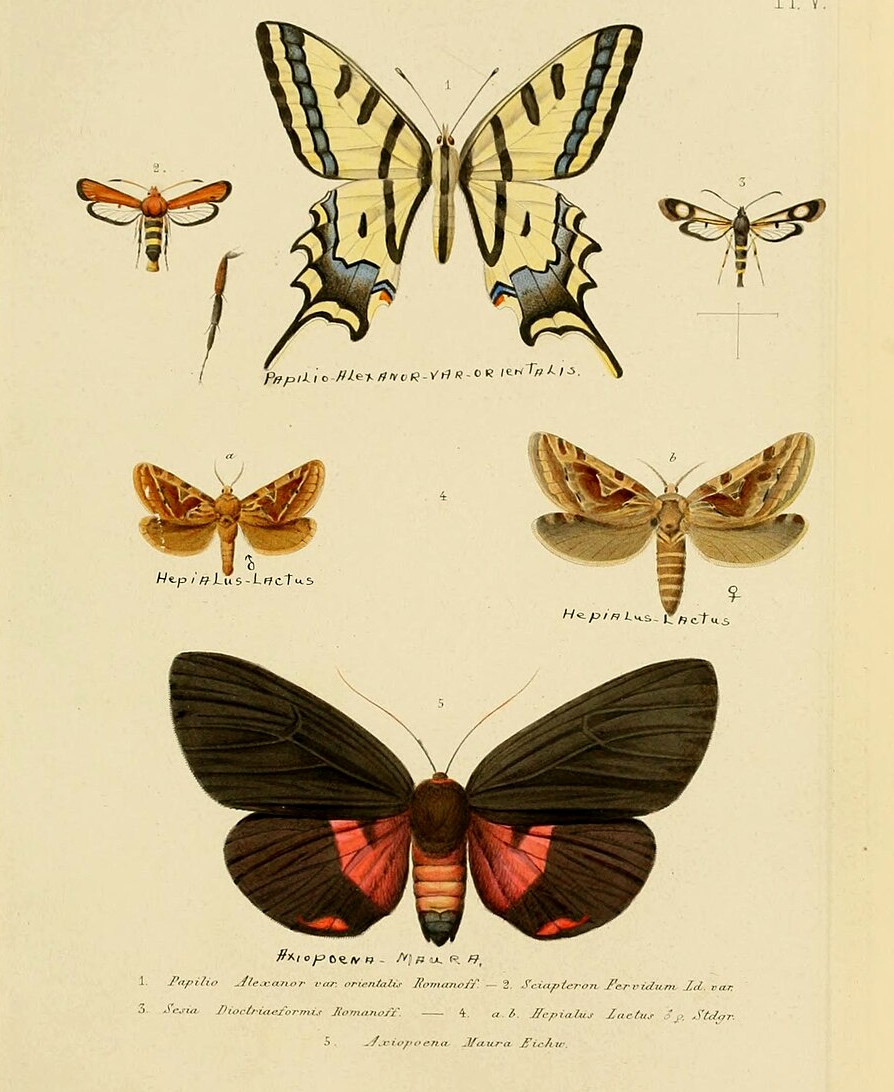
In 1883 he began to finance the publication of luxurious scientific works under the French title Mémoires sur les Lépidoptères (“Memoirs on Lepidoptera”). Nikolai Mikhailovich took upon himself all the colossal expenses: the volumes were distinguished by expensive binding and high-quality paper, and the color illustrations of butterflies were performed by lithographic offset printing with subsequent manual coloring of each image. Over 17 years, nine volumes were published; the eighth of them became a bibliographic rarity due to a fire in the printing house that destroyed part of the print run.
The first volume opened with a voluminous article by Nikolai Mikhailovich himself on the Lepidoptera of the Caucasus, in which he published the scientific original description of one of the subspecies. The prince sponsored research expeditions throughout the empire and Central Asia, uniting the leading scientists of Europe and Russia around his publication. The most impressive result of this work was one of the largest private collections of butterflies in the world. In 1900, realizing its scientific value, Nikolai Mikhailovich gratuitously donated it to the Zoological Museum of the Academy of Sciences. The collection numbered more than 50 thousand specimens. Colleagues highly appreciated his work and named dozens of taxa in his honor, adding the word Romanoff to them — for example, the Panamanian butterfly Romanoffia imperialis and the ground beetle Carabus romanowi. In the Soviet era, however, his contribution to entomology was hushed up.
Status and wealth opened doors for the grand duke that were inaccessible to ordinary scientists. But money alone does not guarantee academic recognition. Without colossal capacity for work and competence, Nikolai Mikhailovich would not have been able to take his rightful place in the professional community.
In addition to personal research, the prince acted as a patron of many societies. He headed the Russian Historical Society, the Russian Geographical Society, was honorary chairman of the entomological and military-historical societies. Unlike many relatives, he did not limit himself to the role of a nominal patron, but delved into the work of the institutions and generously subsidized their activities.
I received your note and am very sorry that an ill-considered word could have upset you. My goal was simply to tease you and nothing more. You deigned to take my jokes seriously, so it is better to forget everything I babbled about today, and come see me more often.
— Grand Duke Nikolai Mikhailovich Romanov in a letter to the entomologist Grigory Yefimovich Grum-Grzhimailo
Historian and Creator of Necropolises
In the mid-1890s, the prince’s interests shifted towards Russian history. Having received wide access to closed state and family archives, he focused on the Napoleonic era and the reign of Alexander I. For his monumental monograph on Emperor Alexander, the Council of Moscow University awarded the grand duke the degree of Doctor of Russian History in 1915. The renowned historian Vasily Osipovich Klyuchevsky spoke highly of his work with primary sources.
His most ambitious projects were encyclopedic collections that saved a huge layer of the country’s historical memory. In 1905–1909, five volumes of the catalog “Russian Portraits of the 18th and 19th Centuries” were published, based on the results of the grand Tauride Exhibition of Sergei Pavlovich Diaghilev. This reference book preserved images of thousands of historical figures whose original portraits later perished in the fires of the Civil War.
The second unprecedented work was the “Russian Provincial Necropolis.” Having conceived it in 1909, Nikolai Mikhailovich instructed the clergy of all confessions to copy the tombstones and epitaphs in the churchyards throughout the empire. The project’s chief archivist was Valery Vasilievich Sheremetevsky. In 1914, only the first volume managed to be published, covering the northern and central provinces. The outbreak of war and the revolution interrupted this work, but the collected materials survived and today serve as an invaluable source for genealogists.
Nikolai Mikhailovich also continued the tradition of dynastic collecting: his personal collection of paintings was intended for transfer to the Russian Museum, but after the revolution it disappeared without a trace.
Political Views: A Liberal and Frondeur
When the First World War began, many believed in its quick victorious conclusion. Nikolai Mikhailovich, on the contrary, prophesied a protracted conflict, warning that Germany could be defeated only by a systematic depletion of resources. During the war years, the prince was often near the front: he helped organize the evacuation of the wounded, the work of hospitals and established communications. It was during this period that his liberal views manifested themselves with maximum sharpness.
From adolescence he harbored a deep sympathy for France and its free orders. The prince spoke French brilliantly, and in his correspondence with the French academician Frédéric Masson (French: Frédéric Masson) words of admiration constantly sounded: “your wonderful country,” “my thoughts are always with France.”
His convictions made him a white crow among the Romanovs. Nikolai Mikhailovich shared the ideas of civil law and believed that Russia needed a constitutional system with a representative government. One of his contemporaries called him the most enlightened member of his tribe. It was easy for him to communicate with people of non-noble origin, and he always treated them as equals.
His brother Alexander Mikhailovich called him the most radical and talented in the family. The grand duke even acquired the nicknames “Nikolai Égalité” and “Philippe Égalité” — by analogy with the Duke of Orléans (French: Louis Philippe Joseph d’Orléans, known as Philippe Égalité), who supported the French Revolution. This egalitarian style was reflected in everyday life: Nikolai Mikhailovich insisted that his valet have breakfast with him at the same table. The French ambassador Maurice Paléologue, however, saw this more as a pose: “Nikolai Mikhailovich is more of a critic and frondeur than a conspirator; he loves salon epigrams too much.”
The prince was not a socialist; until the February Revolution he remained a supporter of a constitutional monarchy. However, in the archive of Nikolai Mikhailovich were kept issues of Herzen’s “The Bell” (Kolokol), reading of which was considered sedition. After the collapse of the monarchy, he did not fall into reaction, but gradually shifted to the ideals of democratic republicanism.
The liberalism of Nikolai Mikhailovich remained of a parlor nature and paradoxically combined with snobbery and ethnic prejudices. In correspondence with Masson, antisemitic statements regularly occurred: the prince reasoned about the influence of “international Jewry,” attributed to Jews total control over world capital and blamed them for the internal problems of Russia. The defense of civil liberties amazingly coexisted in him with xenophobia.
Unlike many Romanovs, Nikolai Mikhailovich was not distinguished by religiosity. Brought up in the Orthodox tradition, he observed the rites, but faith never became a dominant inner force for him.
Nikolai Mikhailovich and Rasputin’s Murder
By the autumn of 1916, the grand duke had turned into the unspoken leader of the “grand-ducal fronde” — the intra-family opposition to the destructive course of Nicholas II and Alexandra Fyodorovna. The reasons for outrage were mysticism at court, chaotic ministerial appointments and the influence of Grigori Yefimovich Rasputin. Nikolai Mikhailovich did not consider the empress a spy; he saw her as a blinded and incompetent woman. Alexandra Fyodorovna reciprocated, perceiving his independent mind as a direct threat.
The prince tried to reason with the emperor. In November 1916, he handed Nicholas II a voluminous note with harsh criticism of the occult entourage and the activities of Prime Minister Boris Vladimirovich Stürmer. Nikolai Mikhailovich sincerely hated Rasputin, but, being a shrewd historian, he perfectly understood: the elimination of one peasant would solve nothing unless the vicious system of government itself was broken.
When Rasputin was killed in December, Nikolai Mikhailovich knew nothing about the impending conspiracy. He was informed of what had happened only early in the morning of December 17 by phone. His immediate intervention — visits to relatives, trips to Felix Feliksovich Yusupov and persistent defense of Grand Duke Dmitrii Pavlovich Romanov — was explained purely by political motives. The prince tried to use the chaos to consolidate the dynasty and put pressure on the tsar for the sake of creating a government responsible to the Duma.
This plan failed, and for his audacity Nikolai Mikhailovich paid with disgrace. He was charged with contacts with Duma leaders and attacks on the empress, after which the tsar ordered him to leave the capital and go to the Kherson estate of Grushevka. In exile, the prince outwardly maintained composure: he read, hunted and worked, but the premonition of an impending national catastrophe became increasingly clear.
The Final Years and Execution
On the eve of the February Revolution, the disgraced prince returned to Petrograd. He tried not to attract attention to himself, walked in civilian clothes; a rumor even spread around the city that he had shaved off his beard. After the abdication of Nicholas II and the refusal of Mikhail Alexandrovich from the throne, it was Niki who was one of the first to rush to Mikhail, urging him to show will and save the country, but without success.
After the fall of the monarchy, Nikolai Mikhailovich tried to fit into the new realities: he communicated with the leaders of the Provisional Government, offered his services as a historian and even decided to run for the Constituent Assembly. However, Alexander Fyodorovich Kerensky soon informed him that members of the former dynasty had been deprived of voting rights.
After the October coup, the prince’s communication with the Bolsheviks at first bore an almost theatrical character. The new authorities alternately promised him protection and came with inspections, which ended with the plundering of the palace wine cellars. During interrogations with the head of the Petrograd Cheka, Moisei Solomonovich Uritsky, Nikolai Mikhailovich persistently emphasized his new identity: he is a scientist, chairman of scientific societies, and not a political opponent. In February 1918, his luxurious palace was officially nationalized and soon looted.
On March 26, 1918, the Soviet authorities issued a decree on the expulsion of members of the former imperial family. Nikolai Mikhailovich, together with his younger brother George Mikhailovich and his cousin Dmitrii Konstantinovich, chose Vologda. In exile, he lived relatively freely: he tried to maintain his usual rhythm, walked and continued to correspond with Masson, secretly transmitting letters through his French chauffeur Léon Reinhold (French: Léon Reinhold).
The situation deteriorated catastrophically in June 1918, when the Bolsheviks killed Grand Duke Mikhail Alexandrovich Romanov near Perm, declaring it an escape. Under the pretext of preventing similar incidents, on July 1, the Romanovs in Vologda were thrown into prison. According to the testimony of General Konstantin Karlovich Brummer, who was with them, the chairman of the Vologda Soviet himself did not understand the reasons for the arrest of the old scientist, who was far from politics, citing a direct telegraphic order from Uritsky. In the cell, Nikolai Mikhailovich behaved with dignity: he met visitors with a smile, smoked cigars, joked and thanked the cook for a modest dinner, behaving “like a true grandson of Nicholas I.”
Soon they were transported to Petrograd, where wanderings through prisons began — from the House of Preliminary Detention on Shpalernaya to the Peter and Paul Fortress. Even in the dungeons, the prince lost neither his cheerfulness nor his sarcasm. Meeting there the arrested former Minister of War of the Provisional Government Alexander Ivanovich Verkhovsky, Nikolai Mikhailovich openly mocked him: “You arrested us in April, and now you are sitting with us… Learn history!”.
The writer Maxim Gorky (Alexei Maksimovich Peshkov), together with the Academy of Sciences, launched a large-scale campaign to save the outstanding historian. Because of the failure of these attempts, the phrase “The revolution does not need historians” became popular in emigrant circles, which was attributed to Vladimir Ilyich Lenin or the Chekist Yakov Khristoforovich Peters. However, modern historians have proven that this striking, cinematic phrase is merely an apocryphal story with no corroboration in the archives of the Soviet government.
Intercession did not help. On January 9, 1919, the Presidium of the Cheka officially resolved to uphold the death sentence for “persons of the former imperial retinue.” In the final days of January, Nikolai Mikhailovich, along with his brother George Mikhailovich and the Princes Pavel Alexandrovich Romanov and Dmitrii Konstantinovich Romanov, were shot by a firing squad at the walls of the Peter and Paul Fortress. Their bodies were thrown into a nameless mass grave.
The motives for the reprisal are not completely clear: perhaps it was political revenge for the murder of Karl Liebknecht and Rosa Luxemburg in Germany, the arbitrariness of local Chekists, or simply a frightening demonstration of force.
The fate of the grand duke turned out to be paradoxical even after his death. When in 1981 the Russian Orthodox Church Outside of Russia canonized the Romanovs shot with him as New Martyrs, Nikolai Mikhailovich was not included in this list. The reason was his liberal convictions, criticism of the monarchy and public approval of the February Revolution. He forever remained an outcast both for the Soviet regime and for conservative emigration. Only in 1999 did the Russian Prosecutor’s Office officially rehabilitate him as a victim of political repression.
References and Sources
- Vinarsky, Maxim Viktorovich; Yusupova, Tatiana Ivanovna. “Kollektioner babochek: Velikiy knyaz Nikolai Mikhailovich, entomolog iz dinastii Romanovykh.” 2026.
- Figes, Orlando. A People’s Tragedy: A History of the Russian Revolution. 1996.
- Benois, Alexander Nikolaevich. “Moi vospominaniya.” 1990.
- Korros, Alexandra. “White Crow: The Life and Times of the Grand Duke Nicholas Mikhailovich Romanov, 1859–1919. By Jamie H. Cockfield.” 2004.