Sergei Alexandrovich Romanov: A Homosexual Member of the Imperial Family
The life of the Grand Duke — his homosexuality, childless "white marriage," service in Moscow, and death.
Contents
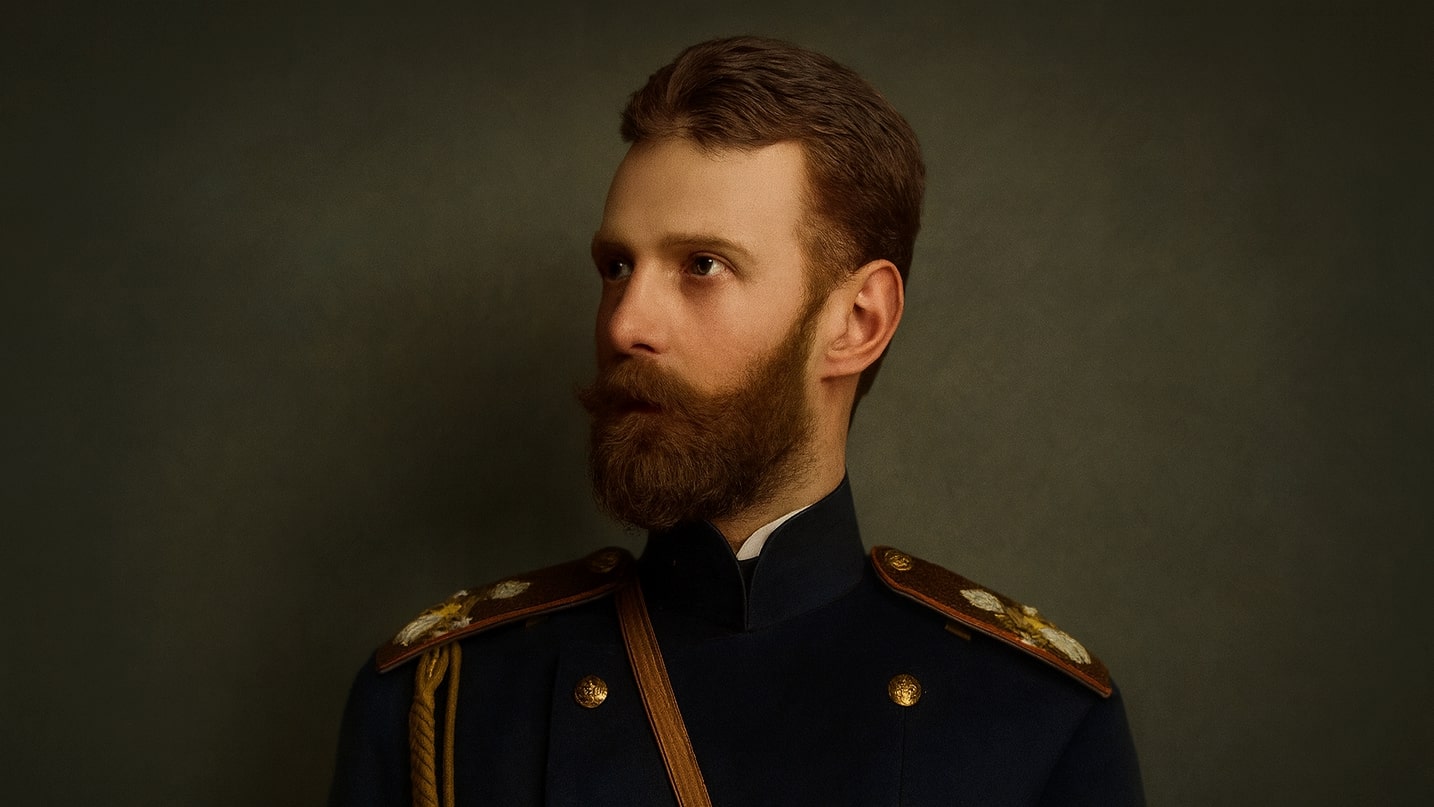
In the Romanov dynasty, every adult family member was expected to marry and produce heirs: this was seen as a duty to both the family and the state. Grand Duke Sergei Alexandrovich (a “Grand Duke” was a high-ranking title reserved for close male relatives of the Russian emperor), the brother of Emperor Alexander III, also married, but the couple had no children. The Grand Duke was homosexual.
The main source of information about Sergei Alexandrovich is considered to be his personal diary, which he kept for many years. In these entries, he comes across as a man with a vivid personality, intense emotions, and firm convictions. At the same time, evidence of his homosexuality has been preserved primarily in other documents: diaries of contemporaries, memoirs of statesmen, and satirical poetry.
This article is devoted to his life and how his homosexuality affected his fate and place in history.
Childhood, Education, and Coming of Age
Sergei Alexandrovich Romanov was born on May 11, 1857, in Tsarskoye Selo (an imperial residence town near Saint Petersburg). Today, it is the town of Pushkin. He became the seventh child of Emperor Alexander II, under whom major reforms began in Russia, and Empress Maria Alexandrovna. Sergei was the first child born after his father’s accession to the throne. In the Russian monarchical tradition, this status was called Porphyrogenitus (Russian: porfirorodny; порфирородный): it endowed the boy with a special aura of being chosen and predetermined the increased attention paid to his religious upbringing.
Sergei received a good education. He was taught by the strongest teachers of his time. Anna Tyutcheva (Russian: Anna Tyutcheva; Анна Тютчева), the daughter of the poet Fyodor Tyutchev, raised the boy until he was seven years old. Then his main mentor became a naval officer, the future admiral Dmitry Arsenyev (Russian: Dmitry Arsenyev; Дмитрий Арсеньев). Strict and deeply religious, he accustomed his pupil to harsh self-control and secrecy. Sergei read a great deal, was especially interested in history and culture, and sometimes conversed with Fyodor Dostoevsky.
The emperor’s children were raised strictly: they could not freely walk around and play with their peers, although they grew up in palace luxury. The combination of outward wealth and inward isolation affected their coming of age.
Researchers note that Arsenyev deliberately prolonged Sergei’s childhood, trying to protect him from the influence of the court environment. Due to this closed life, growing up was more difficult: at fifteen, Sergei played with porcelain pugs. On the day of his eighteenth birthday, together with his cousin, Grand Duke Konstantin Konstantinovich (K. R.), who was also homosexual, he blew soap bubbles. Sergei himself recorded in his diary at the time: “…and this at 18!!??”, marveling at his own childishness. Deep intellectual maturity coexisted in him with emotional inhibition.
As he grew older, Sergei became an educated and erudite man. During a trip to Italy, he conversed with Pope Leo XIII; according to eyewitnesses, in one dispute on questions of church history, it was the Russian prince who turned out to be right.
Inner maturity came to him during the Russo-Turkish War of 1877–1878. Twenty-year-old Sergei went to the front together with Arsenyev. In October 1877, he took part in a reconnaissance near the village of Koshevo, remaining with the artillery under enemy fire. For personal courage, he received the Cross of St. George, 4th Class. Later, in 1887–1891, the Grand Duke commanded the elite Life Guards Preobrazhensky Regiment (Russian: leyb-gvardii Preobrazhensky polk; лейб-гвардии Преображенский полк). This experience finally cemented his status in the military hierarchy and created a flawless facade of a combat officer.
Sergei loved wild strawberries, Crimean wines, and valued sapphires especially highly. Traveling in Europe, he did not idealize the West. In 1875 in England, Sergei wrote that the local way of life seemed too down-to-earth to him: the English, in his words, thought primarily about comfort, food, and sleep, and not about spiritual and cultural goals.
“I would rather be a thousand times a simple mortal than a Grand Duke.”
— Sergei Alexandrovich Romanov
By temperament, Sergei was an introvert, prone to solitude and inner experiences. Konstantin Konstantinovich wrote that his brother “never, or only with great difficulty, cries; he endures his grief in silence and does not speak out.”
The academic historian Mikhail Bogoslovsky (Russian: Mikhail Bogoslovsky; Михаил Богословский) called the prince “very shy.” His niece, Grand Duchess Maria Pavlovna the Younger, wrote that Sergei was not only shy but also secretive: he did not like to show his feelings and avoided frank conversations. This trait can be linked to the Grand Duke’s homosexuality. In the position of a member of the royal family and in a society where one could not live openly, such a private life required caution and silence, which amplified his withdrawal.
“Very tall, of highly thoroughbred beauty and extremely elegant, he gave the impression of an exceptionally cold man.”
— General Alexander Mosolov, from the memoirs “At the Court of the Last Emperor”
In 1880, Sergei lost his mother, and a year later — his father: Emperor Alexander II was killed by revolutionaries who threw a bomb at him.
“I ask myself, how can one live through all this?”
— Sergei Alexandrovich Romanov
After this tragedy, Sergei went on a pilgrimage to the Holy Land — to Palestine, to the places associated with the life and preaching of Jesus Christ.
The trip strongly influenced him. Upon returning, he founded the Imperial Orthodox Palestine Society (Russian: Imperatorskoye pravoslavnoye palestinskoye obshchestvo; Императорское православное палестинское общество). The organization built schools and shelters for pilgrims, and helped with housing, meals, and medical care. Thanks to this, trips to Palestine became accessible even to less wealthy people from the Russian Empire.
To a large extent, his future wife Elizaveta Fyodorovna helped Sergei out of his difficult state. She was a German princess from the House of Hesse-Darmstadt (the ruling dynasty of one of the German states) and a granddaughter of Britain’s Queen Victoria.
The future German Kaiser Wilhelm II courted Elizaveta, but her father chose a marriage for his daughter with the Russian Grand Duke. Elizaveta became for Sergei not only a wife but also a close friend. Seven years after the wedding, she voluntarily adopted Orthodoxy: this was her personal decision; formally, no one required it of her.
“Let people shout about me, but only never say a word against my Sergei. Take his side before them and tell them that I adore him, and also my new country, and that in this way I learned to love their religion too…”
— Elizaveta Fyodorovna, in a letter to her brother about her new life
The Grand Duke’s Homosexuality
Judging by the evidence, the spouses’ relationship was more friendly. They had no children. Contemporaries wrote that this marriage was difficult for Elizaveta, although she maintained composure in public.
Surviving letters show that respect and warm affection remained between the spouses. They cared for each other and behaved as close people. However, marital relations in the usual sense apparently did not exist. Sergei wrote to Elizaveta very tenderly:
“I am enchanted at the thought of seeing you tomorrow. I kiss you very tenderly.”
— Sergei Alexandrovich Romanov, in a letter to Elizaveta
The Russian Orthodox Church explained the absence of children differently. According to the Church’s version, even before the wedding, Sergei and Elizaveta took a vow of chastity — a promise to live without physical intimacy. Such a union was called a “white marriage”: the spouses lived together, but built their relationship like brother and sister.
In the Russian Empire, Article 995 of the Penal Code (Russian: Ulozheniye o nakazaniyakh; Уложение о наказаниях) had been in effect since 1845: for “sodomy” (Russian: muzhelozhstvo; мужеложство), people were deprived of all rights and exiled to Siberia for a period of four to five years. However, historians show that the law was applied almost exclusively to peasants, workers, and the urban underclass.
The aristocracy possessed an unspoken immunity. The émigré writer Nina Berberova, speaking about the composer Pyotr Tchaikovsky, cited an example of such class inequality: it was not the Grand Duke himself who suffered, but his alleged partner — a teacher of ancient languages:
“One case is known involving a man familiar to quite a few people, a teacher of Latin and Greek, the lover of the Moscow governor, Grand Duke Sergei Alexandrovich, who was tried and given three years of ‘exile’ to Saratov, and then returned to Moscow.”
— Writer Nina Berberova, from the book “Tchaikovsky. The Story of a Lonely Life”
In high society, rumors constantly circulated about Sergei Alexandrovich’s special attention to young officers, especially aides-de-camp. In many photographs, he is captured next to Konstantin Balyasny (Russian: Konstantin Balyasny; Константин Балясный) and Vladimir Gadon (Russian: Vladimir Gadon; Владимир Гадон), who frequently accompanied him. Of course, modern homophobic historians categorically deny the sexual subtext of these relationships, interpreting them solely as strong military camaraderie.
Such relationships were also discussed in the highest government circles. Finance Minister Sergei Witte (Russian: Sergei Witte; Сергей Витте) phrased his thoughts cautiously, but the meaning of his words remained clear:
“…he was constantly surrounded by several comparatively young men who were especially tenderly devoted to him. I do not mean to say that he had any sort of bad instincts, but a certain psychological abnormality — which often expresses itself in a particular kind of infatuated attitude toward young men — he undoubtedly had.”
— Finance Minister Sergei Witte, from the book “Memoirs”
Hints were also found in satirical poetry. In the poem “The Pride of Nations,” the chamberlain and satirical poet Vladimir Myatlev (Russian: Vladimir Myatlev; Владимир Мятлев) mocked representatives of the royal family and their entourage. The expression “Moscow Serg-ants” is built on wordplay: it refers to the word “sergeants” and to the name Serg (Sergei). Thus, the poet hinted at Sergei Alexandrovich, who held the post of Moscow Governor-General.
The line about “pretty little rascals with Eastern manners,” judging by the context, referred to the aide-de-camp Balyasny. The word “rascal” (Russian: kanashka; канашка) is an obsolete colloquial diminutive of “scoundrel” (Russian: kanalya; каналья). Here, it does not denote a criminal, but is a mocking nickname like a rogue or trickster.
“The Moscow ‘Serg-ants’
With their daring aides-de-camp,
With pretty little rascals
With Eastern mannerisms.”
— Vladimir Myatlev, from the poem “The Pride of Nations”
For the sake of outward decency, aristocrats more often pretended that nothing was happening, and men entered into marriage not necessarily out of love, but to meet social expectations. Drawing on the concept of the American Slavist Simon Karlinsky, historian Dan Healey wrote that Sergei Alexandrovich stood at the top of the empire’s “homosexual pyramid.” The status of brother, and later uncle, to the ruling emperor made him untouchable to the justice system.
More explicit rumors also circulated — for example, about Sergei Alexandrovich’s intimacy with Alexander Martynov (Russian: Alexander Martynov; Александр Мартынов), an officer of the Preobrazhensky Regiment and the Equerry (Russian: shtalmeister; шталмейстер) of the Grand Duke’s court. In the diary of Alexandra Bogdanovich (Russian: Alexandra Bogdanovich; Александра Богданович), the hostess of an influential St. Petersburg salon, Martynov is mistakenly called an aide-de-camp:
“Dorofeeva Sh., a resident of Tsarskoye Selo, […] said that it is known there that Sergei Alexandrovich lives with his aide-de-camp Martynov, and that he repeatedly suggested to his wife that she choose herself a husband from among the people around her. She saw a foreign newspaper where it was printed that le grand duc Serge avec sa maîtresse M-r un tel (Grand Duke Serge with his mistress — Mr. So-and-so) had arrived in Paris. Just imagine what scandals!”
— Alexandra Bogdanovich, from the diary “The Last Three Autocrats”
A similar entry was left by Boris Nikolsky (Russian: Boris Nikolsky; Борис Никольский) — a poet, jurist, and right-wing publicist linked to the monarchist movement. It is dated March 12, 1899, at the height of the first empire-wide student strike. After the dispersal of students at St. Petersburg University on February 8, unrest engulfed Moscow, Kyiv, Kharkiv, and other university cities. In right-wing circles, these events were tied to the bureaucratic maneuvers of Witte — his “tumbling about” (Russian: kuvyrkanye; кувырканье), in which monarchists saw a sign of readiness to make concessions.
Against this background, Nikolsky pondered who might take a firm stance next to the throne:
“I still hope that the tumbling will calm down considerably if Grand Duke Sergei Alexandrovich is appointed somewhere to Petersburg — for example, as chairman of the State Council. I still place hope in him — though he is a pederast, he is not a thief, and he is conservatively inclined.”
— Boris Nikolsky, diary, March 24 (12), 1899
The assumption about the post was a political fantasy: in 1899, as well as up until 1905, Grand Duke Mikhail Nikolaevich remained the chairman of the State Council. The mention of homosexuality here is important as a sign of the milieu: in political and educated circles, this was apparently common knowledge. Even the convinced monarchist Nikolsky mentions it as a given and shifts the conversation to the plane of political calculation.
This was also known on the other side of the barricades — among the political opponents of the autocracy. The famous theoretician of anarchism Peter Kropotkin made a transparent allusion to the Grand Duke’s homosexuality in his book “Memoirs of a Revolutionist” (1902). In those years, same-sex attraction was often described in medical language, so Kropotkin expressed himself as follows:
“Sergei Alexandrovich became famous for vices belonging to the realm of psychopathology.”
— Peter Kropotkin, “Memoirs of a Revolutionist”
The modern historian Alexander Bokhanov wrote that such gossip was spread especially zealously by his uncle’s wife, Grand Duchess Olga Fyodorovna. In high society, she was considered the empire’s main gossip: she easily launched malicious rumors about those she disliked. In one quarrel, she called Sergei Alexandrovich a “sodomite.” There was mutual hostility between them: Sergei did not hide that he could not stand either her or her sons.
When Sergei was appointed Governor-General of Moscow in 1891, the Minister of Foreign Affairs, Count Vladimir Lamsdorf (Russian: Vladimir Lamsdorf; Владимир Ламздорф) — who was also homosexual — recorded a joke: “Moscow has stood on seven hills until now, and now it must stand on one bump.” A play on words is hidden here: a “bump” (Russian: bugor; бугор) is an elevation, but the sound of the word resembles the French bougre, which at the time meant “sodomite.” Thus, the joke hinted at the reputation of the new Governor-General.
In that same year, 1891, Sergei’s younger brother, Grand Duke Pavel Alexandrovich, suffered a personal tragedy: his wife died in childbirth. Later he entered into a morganatic marriage — he married a woman of unequal birth. In the imperial family, such a union was considered unacceptable, and Pavel Alexandrovich was forced to leave Russia.
Sergei and Elizaveta took responsibility for his children — Maria and Dmitry (a homosexual and the future lover of Felix Yusupov). They effectively became parents to the children. In the Governor-General’s residence (today the Mayor’s Office building on Tverskaya Street in Moscow), they were given separate rooms. Sergei Alexandrovich himself lived on the first floor, and Elizaveta Fyodorovna on the third.
The liberal opposition frequently used the Grand Duke’s homosexuality as a metaphor for the moral decay of the government. A deputy of the First State Duma, the Kadet publicist Vladimir Obninsky (Russian: Vladimir Obninsky; Владимир Обнинский) wrote about Sergei Alexandrovich sharply and with hostility. He linked the Grand Duke’s private life with the misfortune of his wife and accused him of influencing his nephew Dmitry:
“This dry, unpleasant man, who even then influenced his young nephew [meaning Dmitry Pavlovich], bore on his face the harsh signs of the vice that was consuming him, which made the family life of his wife, Elizaveta Fyodorovna, unbearable and led her, through a series of infatuations natural in her position, to monasticism.”
— Vladimir Obninsky, from the book “The Last Autocrat”
Obninsky further expanded on this thought, presenting it as part of a more general phenomenon in high society and the army:
“Many well-known people in Petersburg gave themselves over to this shameful vice — actors, writers, musicians, Grand Dukes. Their names were on everyone’s lips; many flaunted their way of life. <…> It was also curious that not all Guard regiments suffered from this vice. At that time, for example, while the Preobrazhensky men indulged in it, together with their commander, almost to a man, the Life Hussars stood out for the naturalness of their affections.”
— Vladimir Obninsky, from the book “The Last Autocrat”
With this, Obninsky hinted that the commander of the Preobrazhensky Regiment, Konstantin Konstantinovich, also belonged to this milieu. The cousins were indeed very close and were friends throughout their lives. In Konstantin’s diaries, there are mentions of his same-sex relationships.
Growing up, Dmitry did indeed become close to Prince Felix Yusupov (Russian: Felix Yusupov; Феликс Юсупов), who was known for his open homosexual affairs. Emperor Nicholas II planned a marriage between his nephew and his eldest daughter Olga, but Grigori Rasputin (Russian: Grigory Rasputin; Григорий Распутин) told the royal family about the nature of the relationship between Dmitry and Yusupov. The engagement was broken off. This conflict became one of the motives that prompted them to organize the assassination of Rasputin in 1916.
Governor-General of Moscow
“He could often be self-confident. In those moments he would tense up, his gaze would become hard … Therefore, people formed the wrong impression. While they took him for a cold, proud man, he helped very many people, but did so in strict secrecy.”
— Ernst Ludwig, Elizaveta Fyodorovna’s brother, from the memoirs “Recollections”
At that time, the position of Moscow Governor-General gave authority not only over Moscow, but also over a number of neighboring territories. In this post, Sergei Alexandrovich engaged in education, helped the poor, and supported science and the cultural life of the city.
He donated money to more than ninety organizations and societies, among which were the Society for the Care, Upbringing, and Education of Blind Children, the Society for Public Health, the Moscow Architectural Society, the Society of Lovers of Natural Science, and the Russian Musical Society. Sergei Alexandrovich created the Society for the Care of Children of Poor Parents: thanks to his donations, free shelters and day nurseries were opened in the Moscow Province.
Sergei Alexandrovich also paid attention to culture. He transferred archaeological finds and works of art to the Imperial Historical Museum on Red Square (the present-day State Historical Museum). Under him, the museum became a notable cultural center: exhibitions, lectures, and concerts began to be held there. The prince also participated in the creation of the Museum of Fine Arts on Volkhonka Street — the future Pushkin State Museum of Fine Arts.
Under him, Moscow changed noticeably in technical terms: the first electric streetlights appeared in the city, and the first electric tram went onto the streets. The prince banned factories from dumping waste into the Moscow River to improve the city’s sanitary conditions. At his initiative, the first student dormitories of Moscow University were opened. Under him, construction was completed on a new stage of the Mytishchi Water Supply System (Russian: Mytishchinsky vodoprovod; Мытищинский водопровод) — a system that delivered clean water to Moscow.
His service also included a dark episode. In May 1896, during the coronation of Nicholas II, a stampede occurred on Khodynka Field. People came for festive distributions and events, the crowd became uncontrollable, panic began, and almost 1,400 people died. The organization of the celebrations was handled by the Ministry of the Imperial Court, which was exempt from the control of the Moscow administration. The police, headed by the Moscow Chief of Police Alexander Vlasovsky (Russian: Alexander Vlasovsky; Александр Власовский), were responsible for maintaining order. Sergei Alexandrovich himself recorded in his diary: “Everything will fall on one chief of police…”. As a result of the investigation, Vlasovsky was removed from his post; however, political opponents deliberately placed the blame on the Grand Duke, dubbing him the Prince of Khodynka.
In politics, Sergei Alexandrovich was a consistent conservative. According to historian Richard Wortman, the prince carried out a “Moscow scenario” — an attempt by the monarchy to return to its national-religious roots. He opposed liberal reforms and did not support the idea of a constitution or elected authorities. The prince supported the so-called Zubatov trade unions — named after Sergei Zubatov (Russian: Sergei Zubatov; Сергей Зубатов), a police official who promoted the idea of controlled workers’ unions. Their purpose was to allow workers to unite under state supervision and thereby sideline revolutionary organizations.
In his post, he became a ruthless executor of an anti-Semitic campaign. In the spring of 1891, Alexander III signed a decree on the eviction of Jews from Moscow, and the prince supervised this process. As a result of police raids, between 20,000 and 35,000 Jewish artisans and petty traders were deported from the city.
As discontent in the country grew and revolutionary sentiment intensified, Sergei Alexandrovich resigned on January 1, 1905, leaving the post of Governor-General. By this time, the Socialist-Revolutionary Party (the SRs) had already sentenced him to death.
Assassination
The SRs were a revolutionary party of the early 20th century that permitted terror against officials and representatives of power.
Sergei Alexandrovich was considered by the revolutionaries to be one of the main representatives of the “reactionary party” — as they called those who defended the autocracy and suppressed change. He was called “the most merciless and consistent spokesman for the interests of the Romanov dynasty.”
After his resignation, Sergei Alexandrovich continued to live in Moscow. He received many letters with threats and understood that he could be killed, so he often went out alone, without aides-de-camp or his family, not wanting to put them in danger. According to the memoirs of his long-time aide-de-camp Vladimir Dzhunkovsky (Russian: Vladimir Dzhunkovsky; Владимир Джунковский), the Grand Duke’s security was organized very poorly.
Meanwhile, the SR Combat Organization — the terrorist wing of the party — studied his routine, routes, and the weak points of his security.
On February 4, 1905, at about three o’clock in the afternoon, an explosion rang out inside the Kremlin walls. Sergei Alexandrovich, as usual, had left the Nikolaevsky Palace. When the carriage passed by the Nikolskaya Tower, the SR Ivan Kalyayev threw a bomb into it. The explosion was of such force that the Grand Duke’s body was torn to pieces. The coachman received fatal wounds, and windows were blown out in neighboring buildings.
Elizaveta was in the Nikolaevsky Palace at that moment. Learning of the tragedy, she was among the first to run to the scene. Without screaming or hysteria, silently, she gathered her husband’s remains with her own hands.
“Despite it being a weekday, crowds of thousands are making their way to the Kremlin to pay their last respects and bow before the ashes of the Grand Duke, who died a martyr’s death.”
— “Government Herald” (Russian: Pravitelstvenny vestnik; Правительственный вестник). February 11, 1905, No. 33
The remains of Sergei Alexandrovich were buried in the Chudov Monastery (Russian: Chudov monastyr; Чудов монастырь), which was then located on the territory of the Kremlin. On July 4, 1906, a specially built memorial church was consecrated over his tomb. At the site of the Grand Duke’s death, a memorial cross designed by the artist Viktor Vasnetsov (Russian: Viktor Vasnetsov; Виктор Васнецов) was erected. An evangelical phrase was engraved on the cross: “Father, forgive them, for they do not know what they do” — the words of Christ about forgiving those who cause harm.
Memory and Oblivion
After her husband’s death, Elizaveta Fyodorovna renounced secular life and devoted herself to helping people. In Moscow, on Bolshaya Ordynka Street, she founded the Marfo-Mariinsky Convent of Mercy. During the Civil War, in 1918, Elizaveta Fyodorovna was arrested by the Bolsheviks. She was later killed near Alapayevsk.
After the October Revolution, the new government destroyed everything that served as a reminder of the royal family. On May 1, 1918, the memorial cross at the site of Sergei Alexandrovich’s death was destroyed. According to the memoirs of the commandant of the Kremlin, the head of the government, Vladimir Lenin, personally threw a rope over the monument and pulled it along with other leaders. In 1929, the Bolsheviks also demolished the Chudov Monastery, blowing up the church under which the Grand Duke’s tomb was located. The remains of Sergei Alexandrovich were buried under the rubble.
Decades later, during archaeological excavations in the Kremlin, the remains of Sergei Alexandrovich were found. In 1995, they were transferred to the Novospassky Monastery (Russian: Novospassky monastyr; Новоспасский монастырь) in Moscow — the burial vault of the Romanov family. A memorial cross, made to the design of the destroyed one, was erected there again. A copy was also placed in the Kremlin.
The figure of the Grand Duke still remains a field of historical dispute. Some homophobic traditionalists revere him as an ideal statesman and a holy martyr, while rejecting any evidence of his homosexuality as slander. Among monarchists, there is a movement for his canonization — recognition as a saint in Church tradition. For internal veneration, he is even depicted on icons.
On the other hand, researchers rely on a wide array of contemporaries’ diaries — from Minister Lamsdorf to the staunch monarchist Nikolsky. In the past, historians often tried to reduce Sergei Alexandrovich’s religious rigorism and harsh conservatism to a simple psychological compensation for his hidden sexuality. However, today such a view seems oversimplified: his right-wing views and faith were deeply sincere.
For modern Russian LGBT history, the biography of Sergei Alexandrovich is important because it shows the full complexity of the past. Homosexuals have always been an integral part of Russian history, whatever their political views may have been, and were present at all levels of society, up to the ruling imperial family.
References and Sources
- Богданович, Александра Викторовна. Три последних самодержца. [Bogdanovich, Alexandra Viktorovna. The Last Three Autocrats.]
- Боханов, Александр Николаевич. Николай II. 1997. [Bokhanov, Alexander Nikolaevich. Nicholas II.]
- Великий князь Сергей Александрович Романов: биографические материалы. Кн. 1: 1857–1877. 2006. [Grand Duke Sergei Alexandrovich Romanov: Biographical Materials. Book 1: 1857–1877.]
- Вяткин, Валерий Викторович. Великий князь Сергей Александрович: к вопросу о его нравственном становлении. 2011. [Vyatkin, Valery Viktorovich. Grand Duke Sergei Alexandrovich: On the Question of His Moral Formation.]
- Кон, Игорь Семёнович. Лунный свет на заре: лики и маски однополой любви. [Kon, Igor Semyonovich. Moonlight at Dawn: Faces and Masks of Same-Sex Love.]
- Никольский, Борис Владимирович. Дневник // ГА РФ. Ф. 588. Оп. 1. Д. 1475. 1899. [Nikolsky, Boris Vladimirovich. Diary // State Archive of the Russian Federation. F. 588. Op. 1. D. 1475. 1899.]
- Секачев, Вячеслав. Великий князь Сергей Александрович: тиран или мученик? [Sekachev, Vyacheslav. Grand Duke Sergei Alexandrovich: Tyrant or Martyr?]