Homoerotic Themes in Taşlıcalı Yahya Bey’s Ottoman Poem “Shah and the Beggar”
A rare example of 16th-century Turkish literature in which a man falls in love with another man.
Contents
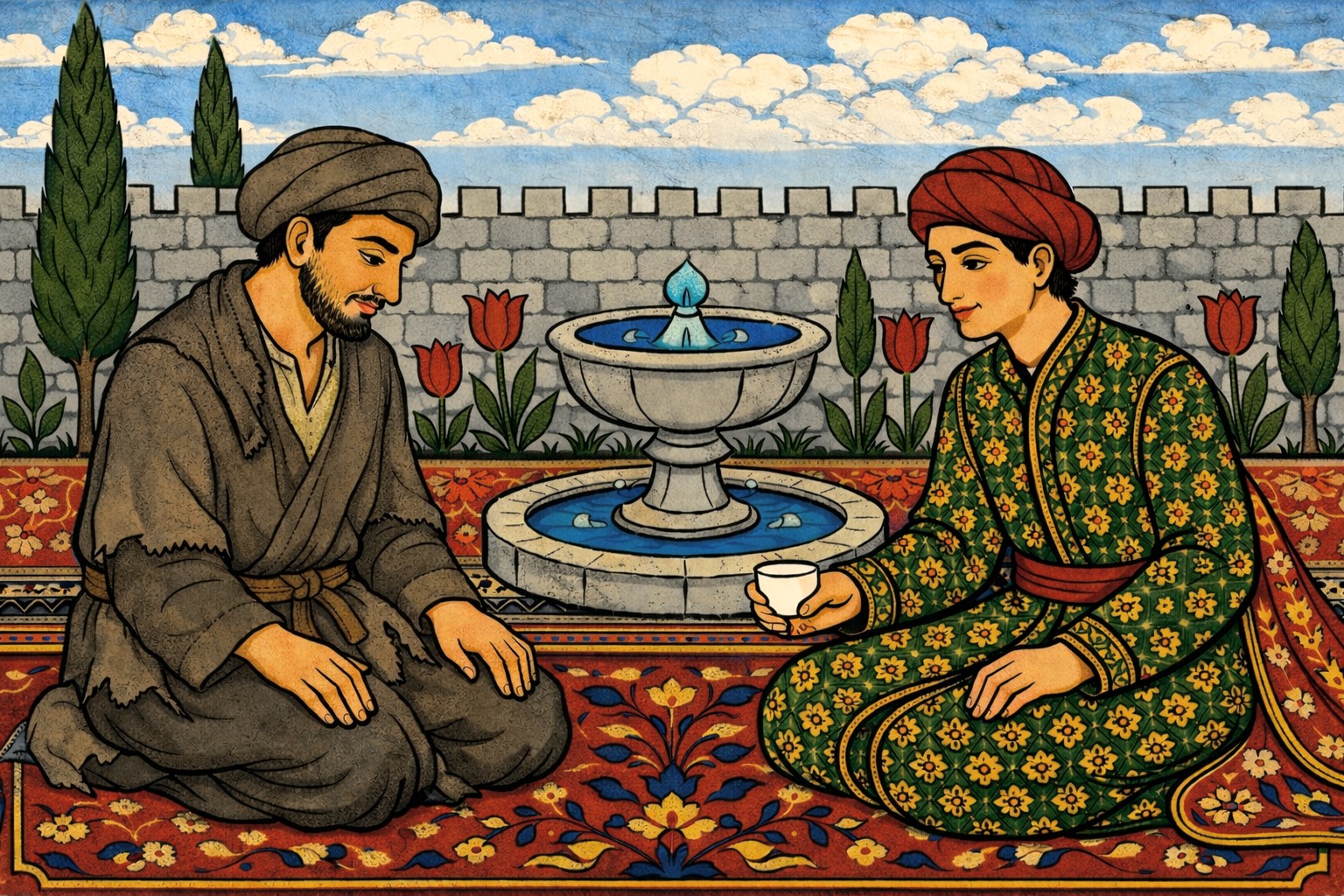
More than 480 years ago in the Ottoman Empire, the poet Taşlıcalı Yahya Bey wrote a poem about love between two men — a story of a poor man’s passion for a noble, beautiful youth. In the sixteenth century, when people in Europe were persecuted and executed for similar themes, Yahya described male love in an elegant allegorical verse form — and, as far as we know, he was not punished for it.
In this article, we will retell the plot of “Shah and the Beggar” and examine how Yahya Bey brings together the sensual and the spiritual, the homoerotic and the mystical.
About the Author and the Poem
Taşlıcalı Yahya Bey lived roughly from 1498 to 1573 or 1582 (the exact dates are unknown). He was a well-known Ottoman (Turkish) poet of the sixteenth century. Yahya spent his youth on military campaigns, and this experience clearly shaped his writing. In his poetry, he often drew on themes and imagery from Persian literature, but he reworked them into independent, original works.
One of his best-known works is the poem “Shah and the Beggar” (“Şah ü Geda”). It is a love allegory written as a mesnevi — a long narrative poem in rhymed couplets (a classic Ottoman–Persian form). The story is divided into 48 short chapters (1,915 couplets) and includes the traditional introductory sections: a prayer to God, praise of the Prophet and the righteous caliphs, a panegyric to the sultan, and other conventional elements. The poem is written in a relatively simple, flowing style, in the Ottoman Turkish of its time.
The main action unfolds in a recognizable, realistic Istanbul setting of the sixteenth century. The characters’ names are symbolic: “Shah” is a title (literally “king”) used as a name in the poem, while “Geda” is a word meaning “beggar.” Most likely, these are not personal names but character types. At the same time, some scholars have suggested an autobiographical subtext. In this reading, Geda is identified with the author himself, Taşlıcalı Yahya Bey, and the figure of Shah is linked to a real courtier named Ahmed Bey, who served as keeper of the palace gates under the sultan. Within this interpretation, the poem becomes a literary reworking of the author’s personal romantic attachment.
Yahya Bey claimed that he wrote “Shah and the Beggar” in just one week and did not borrow the plot from other books. Still, the “king and beggar” motif was known earlier in Persian–Turkic literature. Even so, Yahya Bey gave the classic theme such strong local color and emotional force that the poem gained a reputation as one of the most successful versions of the story.
In English, there are short retellings and selected couplets, while the full text is available in Turkish.
Plot Summary: The Love Story of Shah and the Beggar
The protagonist, Geda, dreams of a beautiful young man and is suddenly overwhelmed by love. When he wakes, the image does not leave him. Soon, while walking with friends at the Hippodrome in Istanbul, Geda recognizes the same youth among the passersby. Desire overtakes him: he stops, sighs deeply, and cannot take his eyes off the stranger. His friends notice the change in his behavior but cannot explain it.
The youth proves to be a nobleman known by the nickname Shah. Unable to conceal his feelings, Geda finds a way to inform Shah that he is in love. Shah, however, does not reciprocate. The beggar’s attachment to a high-born young man quickly becomes a subject of public talk: rumors spread about “disgrace.” When Shah hears this, he flies into a rage and decides that Geda has damaged his honor. In anger, he orders that Geda be driven out of the city. A period of suffering begins. People reproach him and urge him to abandon a hopeless attachment, but he cannot. He falls ill with lovesickness, and physicians are powerless. In the end, under the pressure of public condemnation, he leaves Istanbul at Shah’s command.
In exile, Geda wanders alone through deserted places and gradually loses his reason from love. He curses the malicious tongues and those who have spread the rumors. As the narrative reports, these curses take effect: his enemies are struck by misfortune, and Shah himself suddenly falls ill, as if reached by the echo of Geda’s lament. Although Geda has withdrawn from people, news from the city still reaches him. When he learns that Shah is gravely ill, he feels compassion and prays sincerely for his beloved’s recovery. In a fairy-tale turn, the prayer proves effective: Shah begins to recover miraculously.
Encouraged by this news, Geda decides to remind Shah of his existence. He writes a letter describing his sorrow, his love, and his devotion. Yet when Shah receives it, he is cold once again. His silence breaks Geda: the longing intensifies, and he nearly loses his mind. Geda begins to wander at night, speaking to the moon and the sun and confiding his grief to the silent lights of the sky.
Meanwhile, Shah is torn by an inner conflict. One day he holds a feast in a garden with his close companions and invites each guest to tell a moral tale. After listening to the others, Shah offers his own parable — about a secret love between two people. In effect, it is a veiled retelling of his relationship with Geda. In this way, Shah acknowledges for the first time (even if only through allegory) that this love exists. The scene becomes a turning point: in public, Shah maintains his distance, but among trusted friends he allows it to be understood that Geda’s story has not left him indifferent.
Learning that Shah is not indifferent to him, Geda decides to return to Istanbul in disguise. He comes as a slave: he changes his clothes and blends in with the others at the slave market. At the same time, Shah is looking for a new servant. Among those put up for sale, he notices an unfamiliar slave (Geda) and, not recognizing him, buys him. In this way, Geda, through cunning, enters Shah’s household — hoping to remain close to his beloved, yet forced to conceal his true identity.
In Shah’s house, Geda is constantly nearby, but he does not dare to reveal himself. The anguish of unreciprocated love and the need to keep up the deception undermine his health: he falls even more seriously ill and quite literally fades away. One of his friends, moved by pity, tries to help and arranges a meeting. One day, as Shah rides through the street, the friend leads the weakened Geda out to meet him. Shah sees the sick man and is visibly compassionate: under the pretext of caring for his servant, he tries to support Geda. Yet he still fears public judgment and, noticing the eyes of those around him, immediately restrains himself, feigning indifference. Even so, this brief encounter brings Geda such joy that he begins, almost miraculously, to recover.
Ill-wishers, learning that Shah and Geda have grown closer, launch new intrigues. They spread a false rumor that Geda could not endure his suffering and has taken his own life. Hearing this, Shah is seized by horror and profound grief — and, in doing so, he unwittingly betrays his feelings. When it becomes clear that Geda is alive, the shock they have endured only strengthens the bond between them: a shared catastrophe draws them closer than before.
After these trials, Shah decides to spend time alone with Geda. One night they are together in a secluded place, yet the meeting remains platonic: out of shyness, Geda does not dare to raise his eyes to Shah and feels reverent awe toward him. Shah understands that Geda’s too-open devotion could bring shame upon them. In the morning, therefore, he orders, “Go home and wait for me there.” Geda returns full of hope and begins to wait for the promised visit, but Shah never comes. The endless waiting drives Geda back into despair: he finally loses his grip on reality and lives only by the dream of a meeting.
Geda’s friends see that he is exhausted and insist that he tell them the truth about his relationship with Shah. In a sudden outburst, he tells them an invented story: that Shah came to him in secret at night, and until dawn they drank wine, laughed, and were happy — but when morning came, Geda realized it had only been a dream. This tale becomes the last flare of his romantic hope. His friends respond with gentle reproach and counsel: a person should not destroy himself for earthly love; he must turn his heart to God, because only the Almighty is a faithful beloved, while love for mortals brings suffering. In the poem’s finale, the author sums up the argument in the closing stanzas: earthly, bodily love is fleeting, but true Love is love for God. Geda passes through the torment of passion and, through it, comes to the recognition of divine love.
Homoeroticism in the Poem: Scenes, Motifs, and Context
“Shah and the Beggar” draws attention because it depicts attachment and love between two male characters, and it does so openly and with strong emotion. This choice is unusual for Ottoman classical literature: in romantic mesnevi poems, the central couple was typically a man and a woman.
Yahya Bey deliberately departs from the canon. In the preface, he expresses dissatisfaction with conventional poems about heterosexual love and states explicitly that he sees no reason to praise love for a woman. Instead, he chooses a plot built around one man’s platonic attraction to another man.
A number of key scenes and images in the poem are interpreted by scholars as homoerotic cues.
The first encounter in the city is presented as love at first sight: the man (Geda) is instantly captivated by a beautiful youth (Shah) and quite literally loses his mind from the shock of his beauty. This elevated admiration for a young man was a familiar motif in love poetry of the period, linked to the “erotics of the gaze” — the idea that desire is born through looking. In the poem, this is not merely the contemplation of beauty; it is the moment when passion begins. Contemporary readers could have understood the scene as an allusion to an urban culture of admiring youths. It is known that Istanbul’s Hippodrome in the sixteenth century was one of the places where elite men could notice handsome commoners. Professor Selim Kuru has argued that such plots reflect social reality: legal and moralistic writings of the period condemned relationships with “commoners,” while poetry, by contrast, often celebrated love for young, poor men from the people.
The author then praises Shah’s beauty through standard epithets of Ottoman lyric poetry (rose, cypress, moon, and so on). These comparisons were commonly applied to youthful beloveds regardless of gender. Within this tradition, the “beloved” is often described with androgynous or explicitly masculine features, and Shah’s appearance is presented as flawless. Applying this imagery to a male character intensifies the poem’s homoerotic tone. In particular, the beloved’s voice is compared to the voice of a nightingale or a parrot — sweet, intoxicating, and capable of driving the lover into ecstasy.
The hero’s torments of love for a beautiful youth are a classic motif of Eastern love literature, widely present in Persian poetry, including Sufi verse. In the poem, Geda suffers “like a moth in the fire of love,” and the object of his passion is a man. The surrounding world condemns this feeling: we are told directly that “people began to shame him.” Yet the author does not condemn the hero; on the contrary, he aestheticizes and romanticizes his “illness.”
Seeking to draw closer to Shah, Geda resorts to a ruse in order to become his purchased servant. The very motif of “the lover as a servant to the beloved” echoes practices found in many Eastern societies, where handsome young male attendants could become objects of their masters’ desire. Here, however, the roles are inverted: the one who loves serves, rather than the one who is admired. In Ottoman culture, there was indeed a practice of keeping beautiful servant-boys, and the literature of the period reflects such realities.
The climactic episode in which Shah and Geda are left alone is marked by a muted but unmistakable erotic charge. The two young men spend the night together: they feast and drink wine. Although the narrative insists on the “platonic” character of their relationship, the scene is framed as intimate. In Ottoman poetry, wine and a secluded garden are conventionally associated with lovers’ meetings. At the same time, the author keeps the encounter chaste: Geda reveres Shah so deeply that he “does not even look at his beloved.” Yet the mere possibility of two men spending the night alone within the plot generates a bold homoerotic tension. This is not a matter of fleeting glances in a public setting, but of genuine proximity — even if described with extreme restraint.
The next conflict is driven by rumor: villains circulate a story that Geda has supposedly taken his own life because of his love for Shah. This turn is typologically close to many tragic love plots (compare how Layla and Majnun, or Romeo and Juliet, die after receiving false news). When Shah hears of Geda’s “death,” he is devastated, and his reaction can be read as an expression of feeling that may undermine his “manliness” in the eyes of others. Motifs of shame, gossip about a disgraceful love, and compelled self-denial are typical of narratives about forbidden desire, including same-sex desire. In this sense, the poem explicitly foregrounds the theme of taboo attraction.
Most modern scholars agree that “Shah and the Beggar” contains a pronounced homoerotic subtext. The poem is saturated with the vocabulary and imagery of traditional love lyric, more often addressed to a beloved of the opposite sex, but here redirected toward a man. Geda calls Shah his “beloved,” speaks of the “fire of love,” and describes his suffering through familiar categories of romantic discourse.
Moreover, Shah and Geda are constructed as a pair of lovers in a classic romance: they move through recognizable stages — from the first glance to a shared feast, from tension and jealousy to reconciliation. Taken together, the poem reads as an account of passionate love, rather than a neutral bond of friendship.
A Reading Against the Poem’s Homoeroticism
An alternative interpretation emphasizes the poem’s mystical and allegorical character. From this perspective, the love between Shah and Geda is symbolic and should not be treated as a direct endorsement of same-sex passion in real life. Several arguments are commonly offered in support of this view.
First, the heroes’ love is framed as an idealized, Platonic bond: neither Geda nor Shah commits sinful acts, and their relationship remains chaste. The author repeatedly underscores the spiritual nature of their feeling: they suffer and speak more than they seek physical closeness. This makes it possible to relate their bond to the Sufi ideal of love — the kind that “purifies the soul.”
Second, the poem ends in a clearly didactic manner: the heroes’ passion is ultimately transformed into love for God. This is a familiar device in Sufi literature, where earthly love functions as a stage on the path toward understanding Divine Love. In this key, the beloved’s sex (male) is not decisive: it is contingent, since in Sufi tradition God is often compared to a beautiful youth — an unattainable beloved.
In this way, the story can be read as an allegory: Shah symbolizes God or divine beauty, Geda symbolizes the seeking soul, and their love and trials symbolize a mystic’s path through suffering toward union with the Almighty. From this viewpoint, the poem is not about “sinful” human desire, but about exalted mystical love, in which the characters’ gender is not essential.
The poem does not explicitly depict actual homosexual relations: the heroes do not cross the boundary of Platonic love, and their attachment is presented as spiritual rather than “base.” A further indirect argument for this reading is the absence of negative consequences for the author: the poem was not banned, and Yahya was not persecuted (unlike, for example, European writers who wrote about homosexual love). This may suggest that contemporaries read “Shah and the Beggar” more as a literary experiment and a Sufi parable than as a scandalous confession.
***
A plot of same-sex love like the story of Shah and Geda did not appear in a vacuum. In Persia and other Muslim lands, a long literary tradition existed around a man’s love for another man, reaching back to medieval Sufi poetry. At the same time, in sixteenth-century Europe openly homoerotic plots remained rare because of strict moral norms, even though they did surface in veiled forms. In Persia and the Ottoman Empire, writers could address such subjects more openly, often sheltering behind mysticism or the conventions of genre.
It is also important to keep in mind the broader cultural context of the sixteenth century as an era of paradoxes in matters of love. On the one hand, a “new early modern strictness” takes shape (in Europe people were executed for sodomy, and the “sin” was persecuted). On the other hand, Renaissance culture and parallel processes in the East (Safavid Iran, the Ottoman Empire in the age of Suleiman the Magnificent) show increased interest in the individual, in emotions, and in bodily beauty.
In this light, “Shah and the Beggar” appears as a product of its time and literary environment: it follows the canons of the Perso-Ottoman tradition, where love for a beautiful youth was a familiar theme. Yahya Bey’s distinctive move, however, is that he develops this motif not in a short lyric, but as a large romantic epic — almost an Eastern “novel” about love between two men. In Europe, writers generally did not pursue comparable scale: the closest parallels tended to be sonnet sequences or suggestive hints in drama. In this sense, one can argue that in the Ottoman Empire Yahya Bey created something that in European literature would be able to appear openly only centuries later.
“Shah and the Beggar” illustrates how Ottoman culture could give an aesthetic form to a forbidden theme, leaving later generations a work that is at once sensual and spiritual, bold and restrained. The poem produces a double impression — Platonic and homoerotic feeling at the same time. Ultimately, the text can be read as multi-layered: on the surface — a tense story of forbidden youthful love, and at a deeper level — a lesson about the vanity of the earthly world and the fact that the true Beloved is God.
References and Sources
- Andrews W. G., Kalpaklı M. The Age of Beloveds: love and the beloved in early-modern Ottoman and European culture and society.
- Kuru S. S. Sex in sixteenth-century Istanbul.
- Yaḥyā Bey Taşlıcalı. Şah u Geda, 1537. [Yaḥyā Bey Taşlıcalı – “Shah and the Beggar”]
🇹🇷 LGBT History of Turkey
 Subscribe to our Telegram channel (in Russian): Urania. With Telegram Premium, you can translate posts in-app. Without it, many posts link to our website, where you can switch languages — most new articles are published in multiple languages from the start.