Was Atatürk Gay or Bisexual?
What memoirs, biographies, and British intelligence reports say about the sexuality of Turkey's founder.
Contents
In this article, we first briefly look at the biography of Mustafa Kemal Atatürk, his personality, and his short family life. Then, drawing on memoirs, diplomatic documents, and historians’ works, we trace the origins and evolution of the claim that he may have been homosexual or bisexual.
Brief Biography and Political Career
Mustafa Kemal Atatürk was born in the late 19th century, at a time when the Ottoman Empire was trying to modernize. The exact date of his birth is unknown: the empire used different calendars. Later, he himself set his birthdate as May 19, 1881, linking it to the start of the national liberation struggle in 1919.
The name Mustafa means “the chosen one” in Arabic. The name Kemal, meaning “perfection,” was given to him at military school for his diligence. He received the surname Atatürk – “Father of the Turks” – in 1934 after the adoption of the Surname Law, which made surnames mandatory for all residents of Turkey.
In Ottoman censuses, people were recorded by religion rather than ethnicity. Mustafa Kemal’s family was registered as Muslim and spoke Turkish. His father was from Salonika; his mother came from nomadic Turks. Some historians have suggested that his father may have had Slavic or Albanian origins, but most consider him Turkish.
His father wanted to send his son to a modern school; his mother wanted a traditional Muslim one. In the end, Mustafa studied in both. In 1888, his father died when the boy was seven years old. His mother later remarried. After that, Mustafa, no longer the senior male in the household, was able to leave the family in order to pursue his education.
From a young age, he was drawn to European military uniforms. In 1896, he entered the military school in Monastir, today’s Bitola. Three years later, he continued his studies at the Ottoman Military Academy in Constantinople, today’s Istanbul. In 1902, he graduated from the academy and entered the Imperial Staff College – the highest institution for training staff officers. By the time he joined the army, he had about 13 years of military education behind him.
He served on several fronts. In 1911–1912 he took part in the war in Tripolitania against Italy; in 1912–1913 he fought in the Balkan Wars. During World War I, he became one of the key Ottoman commanders. In 1915, at Gallipoli, he thwarted an Entente landing. He then served on the Caucasus Front against the Russian Empire and on the Syrian front against British forces.
After the 1918 armistice, which meant the de facto surrender of the Ottoman Empire and the beginning of its occupation by the victorious powers, Mustafa Kemal opposed the partition of the country. In May 1919, he arrived in Samsun as an inspector of the Ottoman army. Formally, he was supposed to oversee order and the disarmament of troops; in practice, he began organizing the independence movement.
A year later, in Ankara, he created the Grand National Assembly as an alternative to the government in occupied Constantinople. In 1920–1922, Mustafa Kemal led the War of Independence against Greece and other intervening forces. Victory led to the 1923 treaty recognizing Turkey’s independence. On October 29, 1923, the republic was proclaimed, and Mustafa Kemal became its first president.
As president, he carried out sweeping reforms. In 1924, the caliphate was abolished. The country moved to secular legislation based on European legal systems. In 1928, the Latin alphabet was introduced. He reformed education and expanded women’s rights, granting them legal equality and voting rights earlier than many European countries. At the same time, he pursued industrialization and further separation of religion and state. The reforms met resistance, especially in conservative regions, and uprisings were suppressed by the army. In foreign policy, Atatürk sought neutrality.
In the last years of his life, he suffered severely from liver cirrhosis. On November 10, 1938, Atatürk died in Istanbul, at Dolmabahçe Palace, which at the time served as the presidential residence.
Character Traits, Lifestyle, and Views
Contemporaries described Atatürk as a fit man of medium height – about 174 centimeters tall and weighing around 75 kilograms. He had light-blue eyes, broad shoulders, a well-developed chest, and an always neat appearance. He wore European suits and deliberately shaped the image of a “new Turk.” People noted his decisiveness, his readiness to take unpopular steps, his charisma, and his intolerance for sloppiness and incompetence. In conversation, he often cut people off sharply and gestured a great deal.
Those close to him recalled that he lived on a nocturnal schedule. Atatürk preferred to work and discuss affairs late in the evening, slept little, and could sit at the table for hours, going through future reforms and laws.
He said about himself:
“There is one trait I have had since childhood. In the house where I lived. I never liked spending time with my sister or with a friend. From early childhood I always preferred to be alone and independent – and that is how I have always lived. I have another trait as well: I never had patience for any advice or instruction that my mother – my father died very early – my sister, or any of my closest relatives gave me, as they saw fit. People who live with their families know that there is never a shortage of innocent and sincere advice coming from the left and the right. There are only two ways to deal with it. Either to ignore it, or to submit to it. I believe that neither of these ways is right.”
- – Mustafa Kemal Atatürk*
He regularly drank alcohol. Typically, he drank about half a liter of rakı – a strong Turkish anise-flavored spirit. He also smoked heavily, mostly cigarettes.
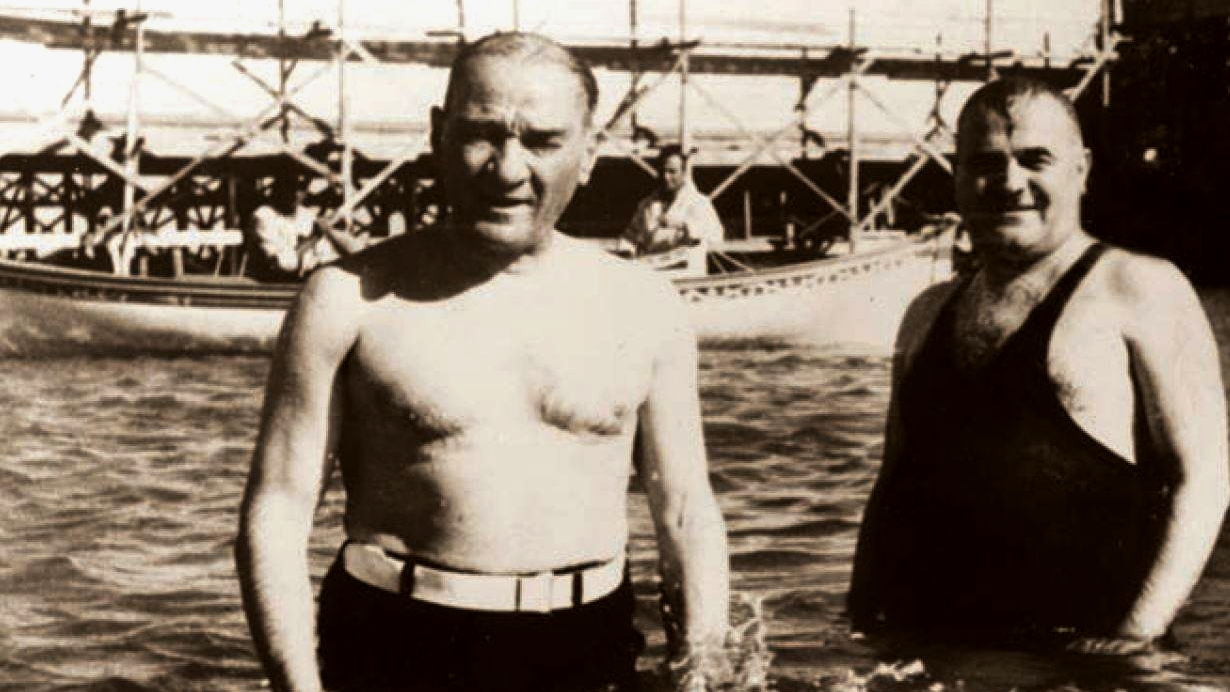
Atatürk loved music and dancing, rode horses, swam, and played backgammon and billiards. He was especially interested in the folk dance zeybek, traditional Turkish wrestling, and Rumelian songs – that is, songs of people from the Balkans. In his free time, he most often read history books. Contemporaries noted his love of sharp, sometimes harsh humor and his ability to laugh at himself. He was gentle with animals, especially his horse Sakarya and his dog Fox.
In military schools, he studied Arabic, Persian, and French. He spoke French fluently. He knew Arabic at a level that allowed him to read and interpret the Qur’an on his own. At the Military Academy, he chose German as his second foreign language. He could understand spoken English, but read English slowly.
Assessments of his religious views diverge. Some researchers considered him a skeptic, an agnostic, a deist, or an atheist. Most authors, by contrast, described him as a devout Muslim. His adopted daughter recalled that he prayed before battles. In the early 1920s, Atatürk publicly spoke of “our religion,” emphasizing the unity and greatness of Allah. In a 1933 interview, he rejected agnosticism and declared faith in a single Creator. At the same time, he sharply criticized the fact that people did not understand the Qur’an, and believed that thoughtful reading of this book could lead Turks to abandon Islam.
Marriage, Divorce, and Adoptive Family
Atatürk was married once. His only wife was Latife Uşaklıgil, who came from a well-known and wealthy family of shipowners from Smyrna. She received a European education, read widely, knew how to hold a conversation, and was interested in the most varied areas of life.
They met on September 8, 1922, when the Turkish army recaptured Smyrna from Greek forces. Before leaving, Atatürk let Latife know that she mattered to him and said: “Don’t go anywhere. Wait for me.”
On January 29, 1923, he secured her family’s consent to the marriage. During the wedding ceremony, Latife did not cover her face, even though brides customarily did so at the time. Her gesture became a noticeable challenge to old tradition.
Right after the wedding, the couple did not go on a traditional honeymoon: parliamentary elections were approaching, and Atatürk returned to state work. Later, they did take a trip together, but it had political significance. Atatürk openly showed his wife to the public, wanting to give Turkish women a living example of a new model of behavior.
During one of their trips, in Erzurum, a serious conflict broke out between the spouses, and their relationship came close to breaking. On August 5, 1925, they officially divorced. The exact reason for the collapse of their marriage has never become known.
Latife’s letters and diaries were closed to the public. A court banned their publication for 25 years. Starting in 1975, her correspondence was kept by the Turkish Historical Society. When the ban expired, Latife’s family demanded that these materials remain sealed. As a result, details of their family life still remain hidden.
Atatürk had no biological children. However, he created a large adoptive family: he took in eight girls and one boy.
The Political and Media Context of Discussions About Atatürk’s Sexuality
Turkish authorities at the official level firmly reject any claims about Atatürk’s alleged homosexuality. His figure occupies a central place in state ideology. Turkey has a special law prohibiting insults against him; such statements can carry a real criminal sentence.
Within the country, this topic sometimes becomes a tool of political struggle. Conservative religious circles, hinting at Atatürk’s “homosexuality,” try to undermine the authority of the secular republican project. In this rhetoric, homosexuality itself is presented as a “deviation from the norm” and as something foreign to Turkish culture.
Outside Turkey, such accusations more often serve as a form of anti-Turkish rhetoric and a way to insult Turks as a people. In Greece and some Balkan countries, such stereotypes sometimes find expression through offensive statements about Atatürk. In the spring of 2007, a Greek video on YouTube captioned “Atatürk and the Turks are gay” triggered an online conflict: by decision of a Turkish court, access to YouTube within Turkey was blocked. Later the block was lifted, and the Turkish press accused the Greek side of deliberate provocation. In March 2025, AFP reported that Greek users were widely sharing an AI-generated image of “gay Atatürk,” in which he was hugging a Black man.
In 2007, a similar scandal erupted in Belgium. In the educational handbook “Fighting Homophobia,” published in the French-speaking region of Wallonia, Atatürk was listed among “famous gays and bisexuals.” After an official protest from Turkey, Belgian officials acknowledged the error. They explained that the handbook’s compilers had used random open internet sources without verification.
But what can we actually learn about this topic from memoirs, testimonies of contemporaries, and serious historical research?
Arguments for Atatürk’s Homosexuality
The discussion of Atatürk’s sexuality draws primarily on documents by British military officers and diplomats from the 1920s–1930s, as well as on memoirs and biographies. Already in those years, a number of sources contained assertions about his homosexuality.
British Intelligence Reports on Atatürk’s Sexuality
For the British administration of the early 1920s, Mustafa Kemal long remained a figure about whom relatively little was known. In January 1921, the headquarters of the occupation command in Constantinople prepared an extensive profile of Kemal. It was compiled from information provided by a former commander, school and college classmates, an agent in Constantinople, and other informants. The overview stated that Kemal was born into a modest family in Salonika and had studied at a military school.
His service as a military attaché in Sofia in 1913 was highlighted separately. According to British reports, he there indulged in “debauchery” and contracted a venereal disease. The authors of these reports claimed that the illness instilled in him “contempt and disgust for life,” became an obstacle to marriage, and pushed him toward “homosexual debauchery.” The same profiles emphasized that at the front he behaved with reckless bravery.
British Prime Minister David Lloyd George went even further in private assessments. He called Kemal an alcoholic pederast and claimed that on one occasion Kemal’s envoy in London had to be literally pulled out of “sodomy” in a brothel.
A special role in shaping British perceptions of Atatürk belonged to General Charles Harington, commander of the British Army of the Black Sea, which occupied parts of Turkey after World War I. Harington controlled a well-organized intelligence source that collected relatively accurate information about Atatürk in the early 1920s. The goal was practical: to understand how to persuade Kemal to negotiate.
Unlike many British diplomats and ministers, Harington did not feel hostility toward the Turks because of their victories. His strategy was built on bluff and deterrence: to demonstrate readiness to use force while striving to avoid a new catastrophic war. His approach assumed an understanding of the opponent and even a certain respect for him, whereas many British leaders perceived the Turks as an “insignificant and evil race” and were infuriated by Kemal’s goals and successes. For that reason, his reports are difficult to explain by personal animosity alone.
In one report dated January 1921, Harington repeated motifs that had already appeared in other military accounts: in his words, the venereal disease “apparently instilled in Atatürk contempt and disgust for life, forbade marriage and pushed him into homosexual debauchery, and he became somewhat excessively fond of alcohol – but he was still charismatic and capable, the only incorruptible leader in Turkey, a patriot.”
Later, the British historian A. L. Macfie, analyzing these and other sources, wrote that in his youth Mustafa Kemal was indeed sexually promiscuous and openly boasted of his exploits. When asked what quality he valued most in a woman, he reportedly answered: “availability.” Macfie repeats the version that Kemal may have contracted a venereal disease during his service in Bulgaria in 1913. In his view, this experience for a time instilled in Kemal contempt for life and led him to indulge more often in what a British military-intelligence report called “the homosexual vice.” At the same time, Macfie noted that such information could well have come from Atatürk’s political enemies and served as an attempt to discredit him.
Rıza Nur’s Memoirs: Atatürk Caught With His Wife’s Nephew
Alongside British sources, stories about Atatürk’s homosexuality spread through Turkish memoirs. In 1929, the memoirs of former minister Rıza Nur were published in Paris. In the early years of the Turkish Republic, he served as Minister of National Education, then as Minister of Health. He later entered into a sharp conflict with the government and left Turkey in 1926. Many contemporaries considered him mentally ill. In his own books, Nur wrote about his psychological difficulties and called himself a neurasthenic.
In his memoirs, Nur says that at one point he himself fell in love with a young man. In Volume 4, he also claims that Mustafa Kemal had sexual relations with Vedat Uşaklıgil, the nephew of his wife Latife Hanım. In his version, Latife Hanım walked in on them during the sexual act, after which a scandal broke out that led to the divorce, and Vedat himself was allegedly driven to his death by his aunt.
Here is how Nur describes the episode:
“As it turned out, two or three days before the divorce affair, Latife’s brother İsmail and Melahat, the daughter of Süreyya Pasha, went to Ankara. They were guests at Çankaya. At that time, Mustafa Kemal’s secretary was Halit Ziya’s son, Vedat. A handsome, moustacheless young man. One evening, when dusk was already falling, İsmail and Melahat went out onto the balcony. They saw Vedat doing it with Mustafa Kemal under a tree. They called Latife. She saw it too. A terrible scandal erupted. Latife said to Mustafa Kemal: ‘I saw everything, I endured everything. I can’t endure this anymore.’ The Gazi [i.e., Atatürk] slipped away and went to İsmet’s house. ‘I will divorce this woman at once,’ he said. İsmet convened the Council of Ministers early in the morning. They made the decision on the divorce.”
- – Rıza Nur, about Mustafa Kemal Atatürk*
Nur then gives another story in which Atatürk supposedly shifted his attention to his wife’s younger sister:
“According to Latife’s words, in those days her younger sister was once visiting her. Mustafa Kemal made an advance on the girl. She tore herself free from his hands and ran away, into her sister’s room. Mustafa Kemal entered the room with a revolver in his hand. The sister, hugging the girl, shielded her with her own body. Mustafa Kemal fired, but, fortunately, the servant Bekir – who had been close to Mustafa Kemal for a long time and knew everything – grabbed his hand, and the bullets went wide; they say he fired three times…”
- – Rıza Nur, about Mustafa Kemal Atatürk*
Turkish historians generally treat these stories with extreme skepticism. For example, İ. Ortaylı called Rıza Nur’s memoirs “gossip with no historical value.” Nevertheless, these texts continue to circulate online. In 2013, the Turkish blogger Tuncay Tokat posted a photograph of Atatürk on Facebook with the caption “Was Atatürk gay?” He explained that he had learned “this version” from Volume 4 of Rıza Nur’s book. The post led to a court case.
Atatürk’s alleged lover, Halil Vedat Uşaklıgil, was born in 1904 in Istanbul into a writer’s family. After the wars, he traveled widely with his family across European cities, especially often living in Bern and Paris. On Atatürk’s orders, Vedat transferred from the Ottoman Bank to the Ministry of Foreign Affairs. Latife Hanım was his cousin, and thanks to his talent as a pianist, he had the chance to get to know Atatürk closely. He was later sent to London for diplomatic service. On December 3, 1937, while serving as first secretary of the embassy in the capital of Albania, he took his own life by ingesting medication. According to one version, he was murdered.
Atatürk’s Biographers on “Losing Faith in Women” and an Attraction to Young Men
Similar motifs appear in Western biographies. The British biographer Hugh Armstrong wrote:
“As a result of the reaction he lost all faith in women and for a time became enamoured of his own sex. […] He had a number of open liaisons with women and with men. He was attracted to young men.”
- – Hugh Armstrong, about Mustafa Kemal Atatürk*
Armstrong’s book became the first biography of Atatürk in English. It was published while he was still alive and immediately caused controversy. Some reviewers considered it a realistic biography; others called it a provocative fabrication.
The next major British biographer, Patrick Balfour, wrote:
“Women, to Mustafa, were a means of satisfying male appetites, no more; and, in his eagerness for new sensations, he would not have been inclined to refuse fleeting adventures with youths, if the opportunity arose and if the mood, in that bisexual fin-de-siècle era of the Ottoman Empire, came over him.”
- – Patrick Balfour, about Mustafa Kemal Atatürk*
Similar descriptions also appear in the work of the Turkish author İrfan Orga. He served as a fighter pilot under Atatürk’s command, then spent three years in the United Kingdom as a military diplomat, and there fell in love with an Irishwoman. Because cohabitation with a foreign woman was then considered a military offense in Turkey, Orga resigned and moved to the UK.
He later published several books about Atatürk and described him like this:
“He never loved a woman. He knew men and was used to commanding. He had been trained to the harsh comradeship of the Officers’ Mess, to the infatuation with a handsome youth, to fleeting encounters with prostitutes.”
- – İrfan Orga, about Mustafa Kemal Atatürk*
***
The version of Atatürk’s bisexuality draws on several groups of sources: British intelligence reports, Rıza Nur’s memoirs, and statements by a number of biographers. In its favor, people usually cite Mustafa Kemal’s short marriage to Latife Hanım and the accounts of memoirists and biographers.
Opponents of this version point out that there are no irrefutable documents or testimony of Atatürk’s homosexual relationships. In many recollections by people who worked and lived alongside him, there are not even hints of such relationships. For that reason, cautious skepticism predominates in academic circles.
References and Sources
- Armstrong H. C. Grey Wolf, Mustafa Kemal: an intimate study of a dictator. 1972.
- Balfour P. Ataturk: a biography of Mustafa Kemal, father of modern Turkey. 1992.
- Ferris J. Far too dangerous a gamble? British intelligence and policy during the Chanak crisis, September–October 1922. 2010.
- Macfie A. L. British views of the Turkish national movement in Anatolia, 1919–22. 2002.
- Macfie A. L. Ataturk. 2014.
- Nur R. Hayat ve Hatıratım, cilt 4. n.d. [Nur R. – My life and memoirs, vol. 4]
- Orga İ.; Orga M. Atatürk. 1962.
- Simsir B. N., ed. British documents on Ataturk (BDA). 1973–1984.