Goddess Nephthys — a lesbian?
What the sources say about the Ancient Egyptian goddess of the night.
- Editorial team
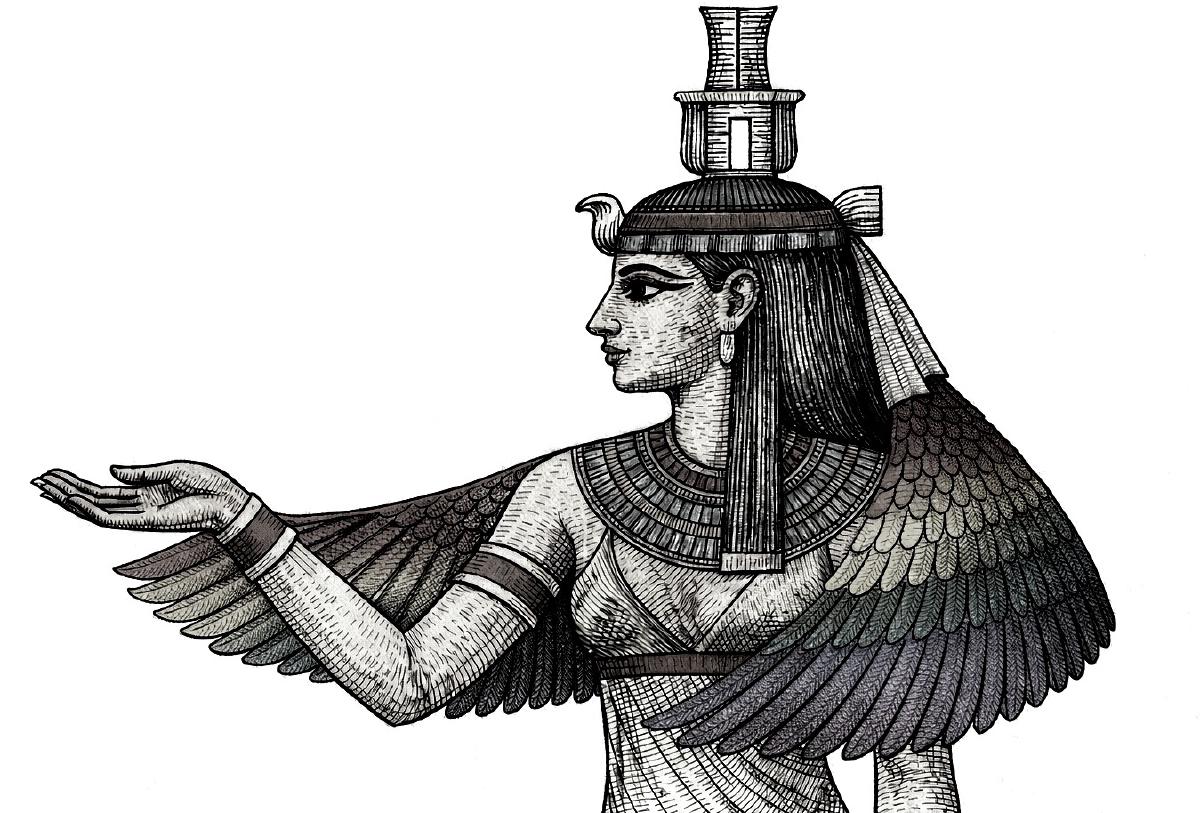
Who is Nephthys
Nephthys is an Ancient Egyptian goddess who belongs to the so-called Heliopolitan Ennead — a group of nine major gods worshipped in the city of Heliopolis.
Her name in Egyptian sounded like Nb.t-ḥw.t and literally meant “Mistress of the House” / “Mistress of the Temple” — the lady of sacred space. The name itself already highlights Nephthys’s connection to religious worship, temples, and rituals.
By origin, she belongs to the main divine lineage: Nephthys is the daughter of the sky goddess Nut and the earth god Geb, and also the sister of Isis, Osiris, and Seth. Because of this, she stands at the center of Egyptian mythology and appears in key narratives that explained the order of the world and ideas about the afterlife.
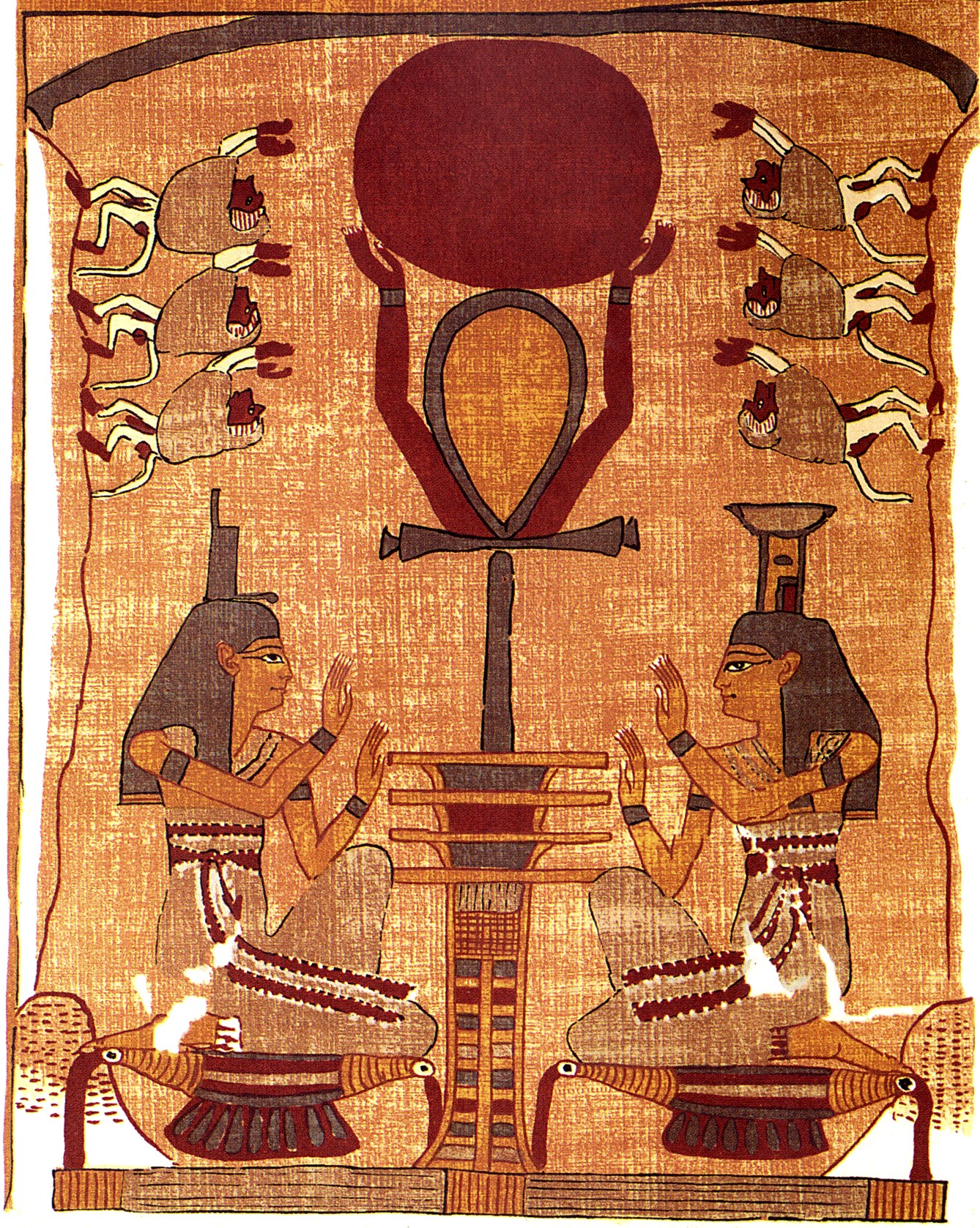
Her role is revealed most clearly in the myth of Osiris. In it, Seth, who embodies chaos and destruction, kills his brother Osiris and dismembers his body. After that, Nephthys acts alongside Isis: Isis, as Osiris’s wife and a goddess of magic, mourns the dead god and — together with Nephthys — searches for the scattered body parts, helps reassemble him, and prepares him for burial. The image of the two sisters jointly mourning and guarding the dead god became significant in Egyptian religion: it showed that death could be overcome through correct rites and ritual care.
Because of this function, Nephthys came to be seen as one of the principal goddesses of the funerary cult. She cared for the dead, guarded mummies, and was believed to be symbolically present at burial ceremonies. People thought she protected the deceased’s body and helped them travel into the afterlife, which is why her images were often placed on sarcophagi and in tombs beside Isis — as a guarantee of divine protection.
In the earliest religious sources — the Pyramid Texts — Nephthys gains another meaning: she appears as a deity of the night. Egyptians imagined the sun’s movement as a voyage by boat through the sky and the underworld: by day the solar barque is accompanied by certain forces, and by night — by others. In this scheme, Isis is linked with the morning and daytime journey, while Nephthys accompanies the solar barque at night. This emphasized her connection to darkness, transition, and the hidden side of existence — to a “between” state that corresponds to the road of the dead: the soul has already left its former life, but has not yet reached rebirth.
In art, Nephthys was often depicted with outstretched wings or in the form of a bird of prey — most often a vulture or a falcon. Her wings seem to cover the head and shoulders of the deceased, showing patronage and protection; the birds themselves were associated with the sky and divine guardianship.
Her cult attributes were recognizable. On Nephthys’s head artists depicted the hieroglyphs for “house” and “basket”, which together form her name. In her hands she often holds magical and royal symbols: the was-scepter (power and order), the ankh (the sign of life), and other signs of protection and magic.
In later texts, the image of Nephthys expands: she is described as a goddess of help and support — caring and beneficial; sometimes she was even called the “mother” of the pharaoh. At the same time, her fearsome side was acknowledged as well: she was believed to be able to breathe fire and burn the pharaoh’s enemies, protecting his power and the order of the country.
Despite this, Nephthys usually remained secondary compared to Isis: she did not have an equally large independent cult, major standalone temples, or the same level of popular devotion. Most often she was worshipped alongside Isis and Osiris — as part of a shared mythological circle, where she played an important but “shadowed” and supporting role.
Why Nephthys is called a lesbian
In some modern texts about Ancient Egyptian gods, Nephthys is sometimes described as an “LGBT icon”. She is presented as a “lesbian goddess” — or, conversely, as a figure supposedly taken outside of sexuality altogether.
Such versions usually refer to a formula from the Pyramid Texts. In one fragment, Nephthys is called something like a “substitute without a vulva”, and in another translation tradition there is a variant along the lines of a “fake (imitation) woman without a vagina”.
If you read this literally, the phrase looks like a description of a body — and it can easily start to feel like a hint about sexuality. But in the text itself it functions differently. The passage lists deities who can “come” in a “bad coming”, meaning they may appear in a dangerous and improper form. Such labels work as ritual “tags”: to name something is to neutralize it, to strip it of power, to stop an unwanted intrusion.
A second argument is linked to the pair Nephthys — Seth. If she is called a “substitute without a vulva”, then her union with Seth is interpreted as “formal” or “unconsummated” in a bodily sense. If you look at the mythological material, this couple really does not have what is usually expected from a stable divine family: there is no shared storyline, no joint actions, no line of offspring. The marriage exists, but it does not “work” in the expected way.
People also cite the myth about the birth of Anubis. In one version, Nephthys conceives Anubis not by Seth, but by Osiris: she takes on the appearance of Isis and enters into a relationship with Osiris through deception.
From these arguments, popular media draw a conclusion: if Nephthys does not have children by her husband, if she is described as “substitute”, and if she is constantly alongside Isis, then she gets labeled a lesbian. In blogs and in neopagan or esoteric projects, these labels are used without caveats and without any attempt to align them with the Ancient Egyptian language and worldview.
But if we follow a scholarly approach, we need to stop here. Ancient Egyptian sources contain no direct indications of Nephthys having sexual relationships with women. And Ancient Egypt did not have the language of “orientations” in the modern sense. Even the harsh formula from the Pyramid Texts is embedded in a ritual context and does not have to describe anatomy or intimate practices. The claim “Nephthys was a lesbian” is not supported academically: the sources do not confirm it, and confident statements here would be speculation.
***
At the same time, a queer-analytic lens can still find material here. Nephthys is constantly “displaced” relative to familiar roles: she is not fixed as a straightforward wife and mother, her union does not become a stable family line, and her presence in ritual formulas is described through substitution and a “wrong coming” — that is, through a disruption of the expected order.
That does not make her a “lesbian”, but it does show that Ancient Egyptian texts allow a female figure who is not reduced to reproduction and domestic function. In that sense, Nephthys is an example of how myth and ritual can construct femininity outside the usual set of duties and scripts.
🏺 This piece is part of the article series “LGBT History of Ancient Egypt”:
- A Queer Lexicon of Ancient Egypt
- Divine Homosexuality in the Ancient Egyptian Myth of Horus and Seth
- Khnumhotep and Niankhkhnum: The First Same-Sex Couple in History
- A Homoerotic Plot in Ancient Egyptian Literature: Pharaoh Pepi II Neferkare and General Sasenet
- Idet and Ruiu: Lesbian Lovers in Ancient Egypt?
- A Possible Scene of Same-Sex Intercourse from Ancient Egypt — The Love Ostracon
- Goddess Nephthys — a lesbian?
📣 Subscribe to our Telegram channel (in Russian): Urania. With Telegram Premium, you can translate posts in-app. Without it, many posts link to our website, where you can switch languages — most new articles are published in multiple languages from the start.
References and Sources
- Mercer, The Pyramid Texts, 292; Pinch, 171
- Tags:
- Ancient-Egypt