A Homoerotic Plot in Ancient Egyptian Literature: Pharaoh Pepi II Neferkare and General Sasenet
And their secret nighttime meetings.
Contents
Ancient Egyptian literature rarely talked about the personal lives of the pharaohs. Pepi II is an exception. Of particular interest is the homoerotic “Tale of Neferkare and the General Sasenet”: in that era, such stories were rarely written down.
To begin with, it is important to clarify who exactly is the main character.
Who Is Pepi II
Pharaoh Pepi II Neferkare, also known as Pepi, ruled Egypt during the 6th Dynasty of the Old Kingdom. His throne name was Neferkare – “Beautiful is the soul of the god Ra.”
He came to the throne in the 2180s BC, several centuries after the construction of the Cheops pyramids. At the time of his accession to the throne he was about six years old; in the early years his mother probably played a decisive role.
In foreign policy, Pepi II generally continued the course of his predecessors. The Egyptians maintained a presence in the Sinai Peninsula, where they extracted valuable resources, and developed trade with Nubia to the south.
Under him, the Ancient Kingdom weakened noticeably. Real power passed to local rulers (nomarchs). They grew stronger and conflicted with each other, and the center lost control over the regions. Soon after the death of the pharaoh, Egypt fell apart.
The reign of Pepi II is not known exactly. The priest Manetho in the 3rd century BC wrote that the pharaoh reigned for 94 years – this would be a record. But only 62 years have been reliably confirmed.
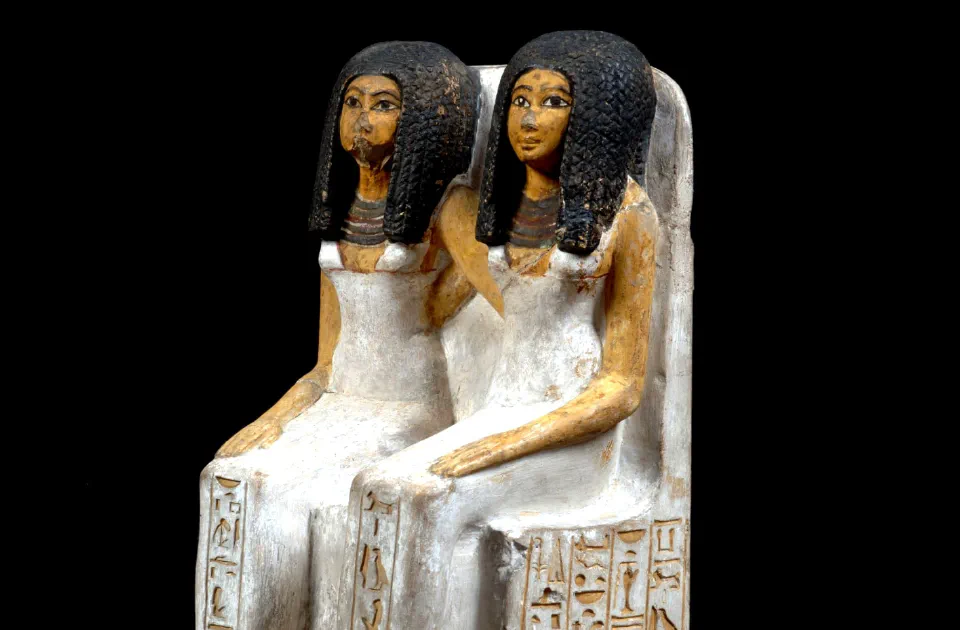
Little material evidence about Pepi II has survived. Three statues of him are known: in the Brooklyn Museum he is depicted on his mother’s lap, in Cairo – as a naked child, in the Metropolitan Museum only his head has been preserved. His funerary complex included a pyramid, now in ruins, and a temple, but in scale they were inferior to the buildings of his predecessors.
It is Pepi II who becomes the central figure of the ancient Egyptian “Tale of Neferkare and the General Sasenet”, also known as “The Plaintiff of Memphis”. The key theme of this text is their homosexual relationship.
Story plot: key episodes
The story begins with the mention of Pharaoh Neferkare, the ruler of Upper and Lower Egypt, the son of the god Ra, who was called “faithful to the voice.” The source characterizes him as a benevolent king.
Before the main plot, an episode appears with a certain “Memphis petitioner”. He tried to appeal to the court, but the court musicians drowned out his voice. The pharaoh and the general Sasenet are present in this scene. This suggests that the petitioner was deliberately prevented from speaking.
Perhaps he wanted to complain about the ruler’s relationship, which was already rumored. Then this episode shows the reaction of society and gives the story a moral overtone. At the end of the scene, the petitioner leaves Memphis in tears.
Historian Richard B. Parkinson notes that the phrase about the absence of a wife has parallels in other texts (for example, the P. Berlin 13538 papyrus) and works literarily as an "implicit explanation or at least a prelude to a secret sexual relationship" between the king and the general. Parkinson also emphasizes that this story shows how the ideal, "proper" homosocial love and devotion between a king and a courtier (which was extolled in Middle Kingdom texts) could cross the line in the imagination of Egyptian writers and readers and become a physical sexual relationship.
The story then focuses on the pharaoh and Sasenet. When the warlord first appears, the text notes that he “had no wife.” This was atypical for an Egyptian: without a wife and heir, there was no one to support his posthumous cult. In the environment of the Egyptian aristocracy, the absence of a woman in the house of a high-ranking military official was considered a profound social anomaly.
Sasenet’s high status and this anomaly unambiguously mark his image as associated with same-sex attraction. At the same time, it remains unclear what comes first here: celibacy or sexual preferences.
On the contrary, the text is silent about the marital status of Neferkare himself, although it is known that he had several wives.
Then a new character enters the story – Cheti, the son of Henet. This is a commoner who gets a rare opportunity to see the pharaoh:
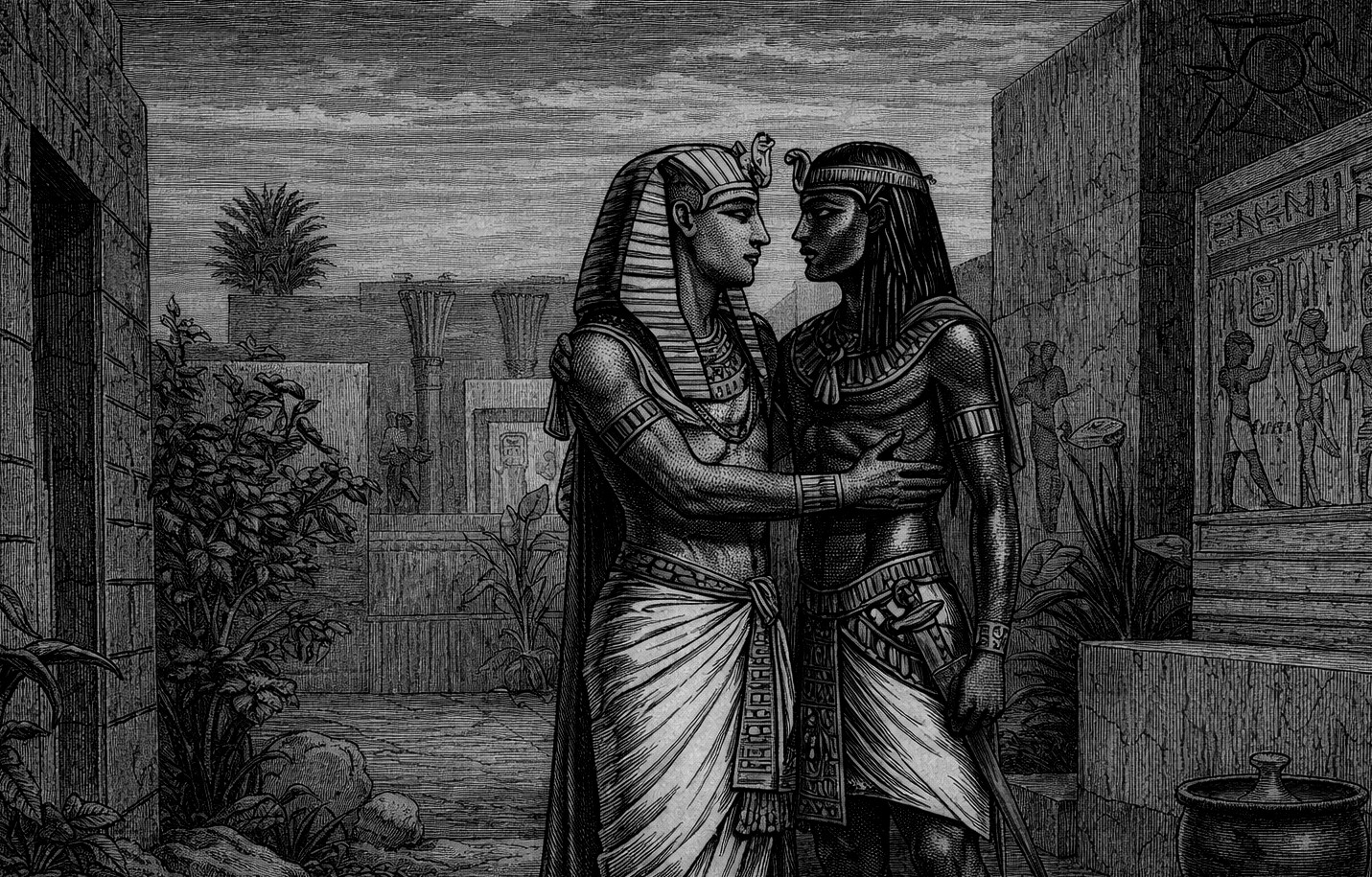
“Then he, Cheti, noticed: His Majesty, the king of Upper and Lower Egypt, Nefer-ka-Ra, who went alone for a walk, and there was no one with him. Cheti retreated before the king, not allowing him to see him. Cheti, the son of Henet, stopped and thought: “If this is so, then the rumors that he comes out at night are true.” Then Cheti, the son of Henet, followed this god [Pharaoh], not allowing his heart to accuse him, in order to observe his (that is, the king’s) every deed.
Then he [the pharaoh] reached the house of the general Sasenet. He threw the brick, stomping his foot. Then a ladder was lowered down to him and he went up. Meanwhile, Cheti, son of Henet, waited for his Majesty to come out. After his Majesty had done what he wanted to do to him (that is, to the general), he went to his palace, Cheti behind him. Only after His Majesty had reached the Great House [palace], may he be alive, well and prosperous, did Cheti go home.”
- – The story of Cheti, the son of Henet (Middle Kingdom), an episode of the night meeting between the pharaoh and Sasenet*
The word “desire” that the author uses is important. It indicates the nature of the relationship between the king and Sasenet. Here the word takes on an explicit sexual meaning, with the pharaoh playing an active role. Sex itself is described in a veiled manner, without direct expressions – this is what distinguishes the text from many other monuments of the era.
The phrase “to do what one wants with someone” (in the original iryt mrrt – “to do what the heart/majesty desires”) was a common, flowery euphemism for an intimate sexual act in the ancient Egyptian language. Similar expressions are found in texts about the union of gods and queens. Perhaps this fragment parodies earlier writings or alludes to ritual love unions, which were traditionally described with restraint.
The story then continues the theme of repeated nightly visits:
“Regarding His Majesty’s walk to the house of General Sasenet, it should be noted that four hours of the night had passed. He spent another four hours in the house of the commander Sasenet. (And) when he entered the Big House, there were four hours left before dawn.
Cheti, son of Henet, followed him every night, not allowing his heart to blame him. only after His Majesty ascended <to the Big House, Cheti returned home…>”.
- – The story of Cheti, son of Henet (Middle Kingdom), description of repeated night visits*
In the ideas of the ancient Egyptians, the night was divided into 12 hours. Cheti, of course, did not have instruments for accurately measuring time, but he could navigate by the stars.
The ruler’s secret meetings were apparently perceived as beyond the pale. This is indicated by the secrecy of the visits and rumors about the pharaoh’s nightly exits. Judging by the text, such meetings were regular, and the interest in them was so great that one of the courtiers decided to follow the king.
Like many other Egyptian works, “The Tale of King Neferkare and the General Sasenet” was not completed in full: its ending has been lost.
How Egyptologists explain this story
Translator and historian Posener associated Neferkare’s long reign with political decline and suggested that the story was satirical. According to this version, the text ridicules the morals of the Old Kingdom on the eve of its collapse. However, this interpretation remains a hypothesis.
Even if the manuscript does condemn the royal affair, it does not follow that Egyptians as a whole considered homosexuality reprehensible. Rather, the problem could be the very fact that the pharaoh, a sacred figure, entered into a relationship with a mere mortal. The king’s status was considered so exceptional that most of his subjects were probably forbidden to even touch him.
Posener also noted that in different eras homosexuality was often interpreted as a sign of decadence. However, ancient texts describing chaos in the country usually do not associate such relations with social degradation. In the story itself, the tone is rather light, but there is a hint of the scandalous nature of what is happening – primarily because the pharaoh himself acts in the story.
Although the text expresses disapproval of homosexual relationships, Neferkare is criticized not for his choice of partner, but for his weakness as a ruler. In general, his image corresponds to the type of “bad” kings known from the Egyptian literary tradition.
Some Egyptologists see here the motive of “royal corruption.” At the same time, researcher Greenberg emphasizes that the author avoids direct and harsh assessments. However, the very desire of the pharaoh to hide the relationship indicates an ambivalent attitude towards such behavior: his attraction, apparently, was so strong that he sought opportunities for secret meetings until he was exposed.
The Dutch historian Jacobus van Dijk drew attention to the fact that Egyptian art and literature are full of symbols and allusions that were understandable primarily to the educated elite. He assumed that the story of Neferkare and Sasenet also contained such a mythological reference.
Van Dijk singled out the figure of the pharaoh’s lover. In his opinion, the choice of military leader could not have been accidental. This status meant not only closeness to the king, but also symbolized the ritual humiliation of enemies. In this reading, the scene takes on a parodic meaning and ridicules conventional ideas about power and submission.
There is another possible parody layer in the text. The night is divided into three parts of four hours, and the pharaoh spent time at the general’s house from the fifth to the eighth hours of the night. In Egyptian cosmogony, this period was called wš3w (“deep darkness”). According to mythological tradition, the mystical union of Ra and Osiris lasted exactly the same amount of time. According to myth, during the hours of deep darkness, Ra reached maximum vulnerability, passed through the underworld (Duat), and Osiris gave him the power to be reborn at dawn. Their mysterious union lasted exactly four hours – the same amount of time that, according to legend, the pharaoh spent with the military leader.
There are no openly sexual motives in this myth. However, the ancient texts say that the gods “embraced each other” and Ra, becoming one with Osiris, was called “Horus in the arms of his father.” The next morning the solar god was resurrected, rising from these embraces. The very birth of young Horus as the son of Osiris also allows for the interpretation of a “connection of a special kind,” although not in the usual sense.
This myth, which the Egyptians called “the great secret,” revealed one of the key aspects of their religion. In the story of Neferkare’s nightly meetings with the general, he essentially becomes an object of ridicule. Pharaoh, like the sun god, rises at dawn in his palace, which is called “the horizon where Ra dwells.” Neferkare himself is the embodiment of the father-god.
The sexual overtones of the scene seem to be deliberately emphasized. Posener compared it with the texts of the 18th dynasty, where almost the same formula describes the union of Amun with the queen and the subsequent birth of the divine king: “… after His Majesty had done with her everything he wished.”
According to van Dijk, the satirical meaning of the story is clear. Neferkare’s behavior is condemned: it violates the ideal of “maat” (world order and justice), especially for the king. At the same time, the story, apparently, was supposed to entertain listeners.
It is difficult to establish exactly how “The Story of Neferkare” was perceived in Ancient Egypt. However, educated listeners probably grasped its double meaning: for some it could be funny, for others it could be shocking or even blasphemous. Ultimately, the author dared to parody one of the most important myths of the Egyptian religion.
Where is this story known from: sources and dating
French Egyptologist Georges Posener introduced into scientific circulation the ancient Egyptian literary monument “The Tale of Neferkare and the Commander Sasenet.”
The text survives in three fragmentary copies, dating between 1295 and 656 BC, that is, the time of the late New Kingdom and subsequent eras. At the same time, researchers believe that the story itself arose much earlier. Posener, relying on language, style and references to historical figures, dated it to the end of the Middle Kingdom, that is, long before the 19th dynasty.
Three sources have survived to this day:
- wooden tablet of the 18th or 19th dynasty from the Institute for the Study of Ancient Cultures of the University of Chicago;
- ostracon of the 20th dynasty, found in Deir el-Medina, a settlement of artisans who worked in the Valley of the Kings;
- Chassinat I papyrus (Louvre E 25351) from the 25th dynasty, which is kept in the Louvre. It includes three pages, but the first is almost completely lost.
The story belongs to the elite written tradition. It was copied and read over several centuries, maintaining its presence in Egyptian literary culture.
Full translation of the surviving fragments
Fragment, tOIC 13539
(Once it happened that His Majesty, the king of Upper and Lower Egypt, Nefer)-ka-Ra, the son of Ra, the true voice, was a [merciful] king [over all this land]. Then there was the hereditary prince(s) /// of His Majesty, (he) ///, named Iti. [/// /// ///] love [///] general Sasenet, not having a wife [in his house].
[And so] General Sasenet [went for a walk] to have fun. [///////] son of Ra Cheti, true voice…
pChassinat I = pLouvre E 25351
… General Sa[senet]. He discussed [//////] with his majesty, the king of Upper and Lower Egypt, Nefer-ka-[Ra]. Then General Sasenet went [/////] to the great [///], overseer of the king’s musicians (?), chief steward of the domains, chamberlain, [//////] king’s scribe, bearer of the king’s scribe’s writing tablet, commander of the fields, [//////] [courtiers (?)] of the [residence] and [members of the council (?)] Memphis without going to [//////] Memphis.
Meanwhile, the [petitioner (?)] from Memphis reached the [gatekeeper (?)]. He ///// with the singing of singers, with the music of musicians, with the rejoicing of those rejoicing, until the petitioner left Memphis because of their [///]. [They] stopped [//////]. When the petitioner came out of Memphis to speak with the overseer of the gate, he made (?) the singers sing, the musicians play, the rejoicing rejoice, the rejoicing rejoice, until the petitioner left Memphis without being heard when they stopped arguing with him. Weeping profusely, the petitioner left Memphis, his hair ///////////////
Then he (a certain Cheti) noticed (?) His Majesty, the king of Upper and Lower Egypt, Nefer-ka-Ra, who went for a walk alone, unaccompanied. Cheti retreated in front of the king, not allowing him to see him. Cheti, the son of Henet, stopped, thinking: “If this is so, then the rumors about his night walks are true.”
Then Cheti, the son of Henet, followed this god, not allowing his heart to condemn him, in order to observe each of his (that is, the king’s) actions. He then reached the house of General Sasenet. He threw the brick after stomping his foot. Then they lowered a ladder for him and he climbed up.
Meanwhile, Cheti, son of Henet, waited until his Majesty left. After His Majesty had done what he wanted to do to him (that is, to the general), he went to the palace, and Cheti followed him. Only when His Majesty reached the Great House – life, prosperity, health – did Cheti go home.
Regarding His Majesty’s walk to the house of General Sasenet, it should be noted that four hours of the night passed. He spent another four hours at General Sasenet’s house. (And) when he entered the Great House, four hours remained before dawn.
From that moment on, Cheti, the son of Henet, followed him every night, not allowing his heart to condemn him. (And) only after His Majesty [the king] entered the [Great House, Cheti returned home…]
Literature and sources
Dijk J. van. The Nocturnal Wanderings of King Neferkare, in Hommages Leclant 4, 387–393, 1994.
Posener G. Le conte de Neferkarê et du général Siséné. 1957.
Greenberg D. F. The Construction of Homosexuality, 2008.
Parkinson R. B. ‘Homosexual’ Desire and Middle Kingdom Literature, Journal of Egyptian Archaeology, 1995.
Parkinson R. B. Boasting about hardness: constructions of Middle Kingdom masculinity. // Sex and Gender in ancient Egypt. Edited by Carolyn Graves-Brown. 2008.