Idet and Ruiu: Lesbian Lovers in Ancient Egypt?
Kinship or partnership—what the titles and the pose suggest.
- Editorial team
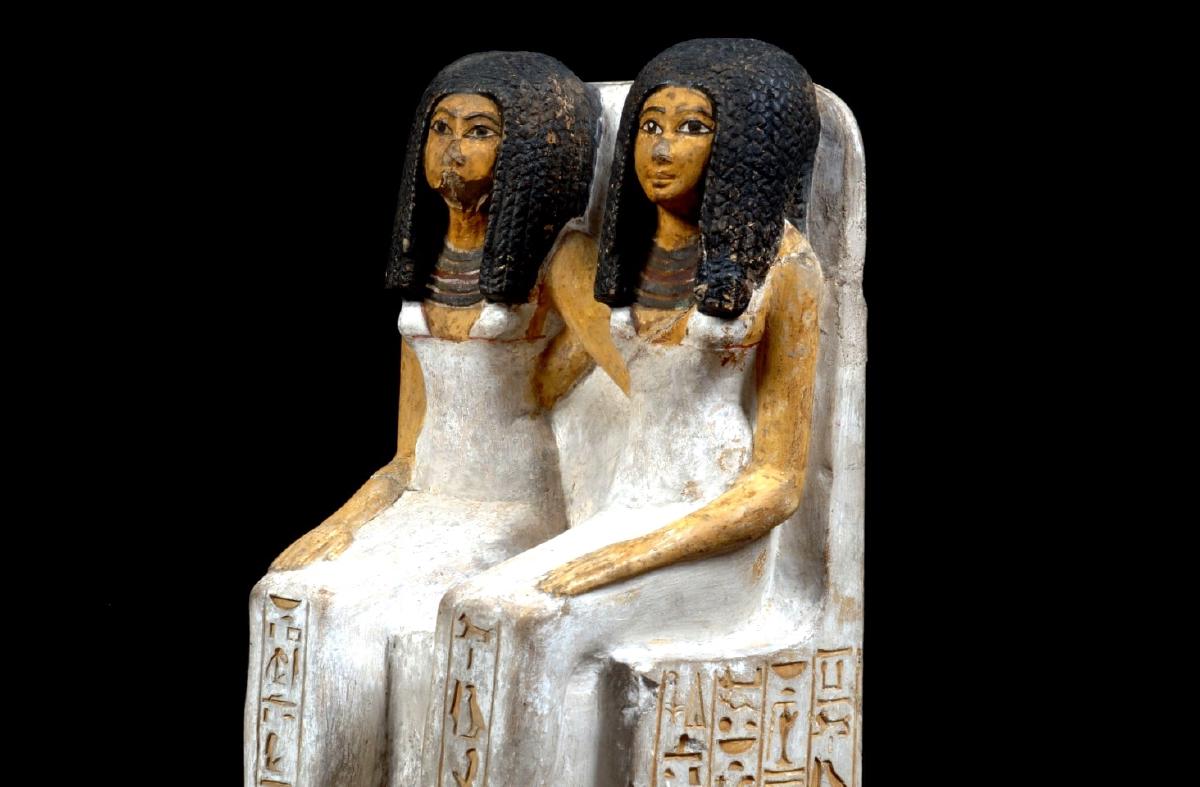
This sculpture belongs to Egypt’s New Kingdom, specifically the 18th Dynasty, which flourished roughly between 1480 and 1390 BCE. The New Kingdom was the high point of Egyptian power: the state expanded its borders, erected major temples, and produced vast quantities of art. The period is noted for preserving traditional artistic conventions while paying closer attention to individual features.
The work is thought to have been made at Thebes, in the area of Deir el-Medina. At the time, Thebes was among Egypt’s principal religious and political centers. Deir el-Medina was a village of artisans and painters responsible for building and decorating royal tombs.
The sculpture is carved from limestone, a soft stone widely used in Egypt for small-scale statuary. Originally the figures were brightly painted, since ancient Egyptian statues were almost always covered with polychrome decoration, most of which has typically been lost over time.
The sculptor’s name is unknown—an entirely normal situation for ancient Egyptian art, especially for smaller portrait statues of the 18th Dynasty.
The piece entered the museum in the 19th century and became part of the so-called “Old Collection,” assembled between 1824 and 1888. Precise information about who discovered the statue and under what circumstances has not survived.
Today the sculpture is housed in the Egyptian Museum in Turin, one of the largest collections of ancient Egyptian art outside Egypt. In the museum catalogue it is registered under inventory number Cat. 3056.
The bond between Idet and Ruiu: kinship or romance?
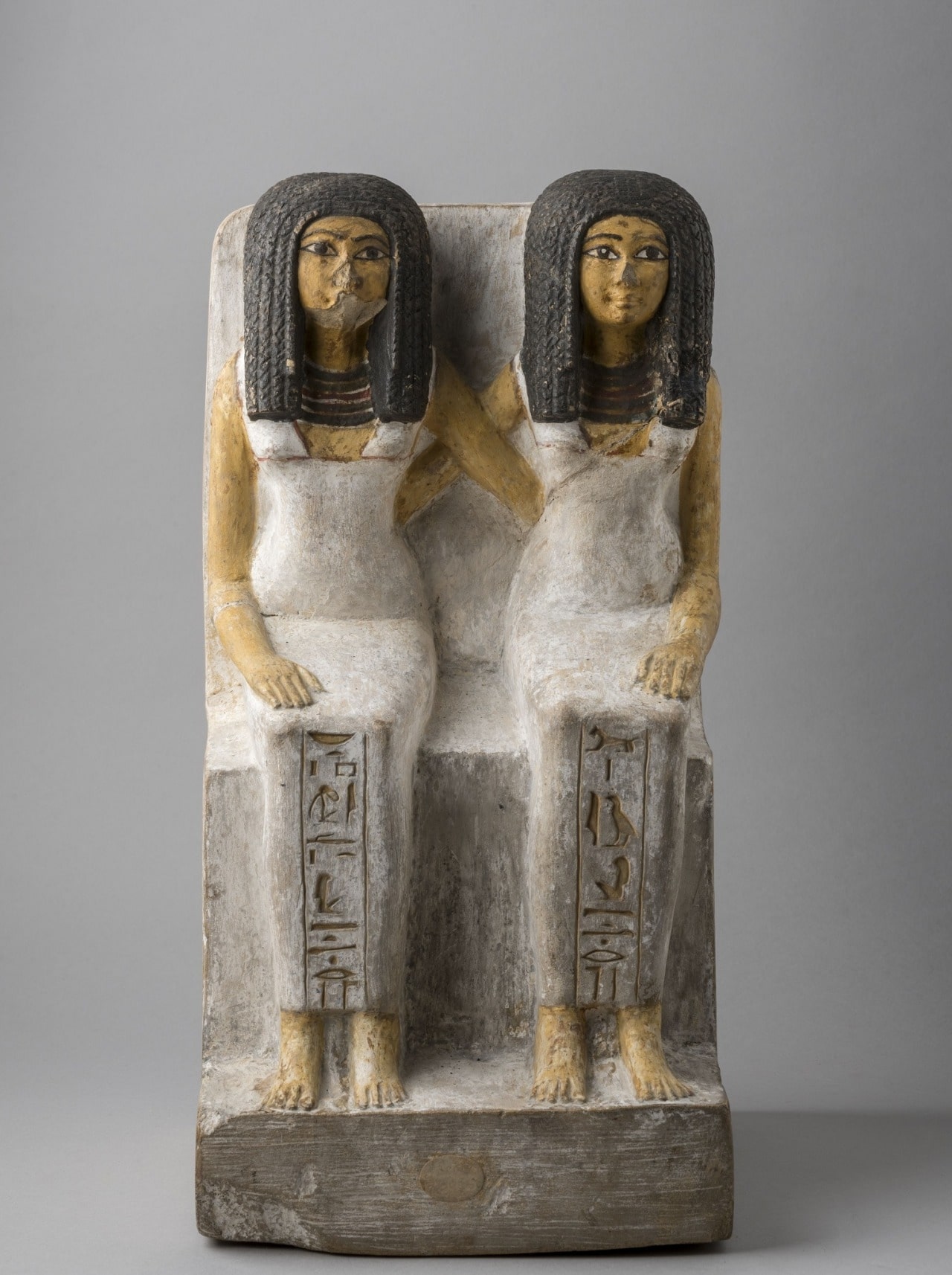
The statue depicts two women seated side by side: Idet and Ruiu. In English-language museum descriptions, Idet’s name is sometimes rendered as Idu.
Idet sits on the right, the “side of honor”: in ancient Egyptian iconography the right side was considered the more prestigious position. In the inscription she is called “Lady of the House,” in Egyptian nbt pr (“nebet per”). This title usually indicates a married woman—the mistress of a household—and signals her social standing. Ruiu, by contrast, is given no title in the inscription.
The two women are shown in close physical contact: one embraces the other, placing an arm around her back. This pose is well known from 18th-Dynasty monuments and is most often used for a married couple seated together. Taken as a whole, however, the details make Idet appear the senior figure: she occupies the honored seat, she bears a title, and—within Egyptian social logic—she seems to possess an established status. Ruiu, on the other hand, is presented as the junior figure, without a title.
On the back of the sculpture, on both sides, offerings to the god Osiris are carved. In ancient Egyptian religion Osiris was lord of the underworld and judge of the dead. The inscriptions contain the standard funerary offering formula: “To Osiris, lord of eternity, [may he grant] all good and pure things and the sweet north wind to the ka (‘spirit’) of the Lady of the House Idet, justified,” and an analogous text addressed to Ruiu. The word “justified” indicates that both women were already deceased and had been declared righteous at the judgment in the afterlife. The statue is therefore memorial in character and was intended for their commemoration.
Museum descriptions note that the inscriptions do not specify the relationship between Idet and Ruiu. The texts do not tell us whether they were mother and daughter, sisters, or spouses. No known Egyptologist states outright that the statue depicts a romantic or sexual partnership between two women.
Such images are very rare, though not unique. At least two close parallels are known. One is in Copenhagen, in the Ny Carlsberg Glyptotek (Æ.I.N. 586), and another is in the Royal Museum of Mariemont (81/9). The Copenhagen example has no inscriptions, while the Mariemont statuette—dated to the beginning of the 18th Dynasty—preserves text. In that case, the woman seated on the right is called “Lady of the House Hetepet,” while the woman on the left is identified as “her daughter” Moutouy and likewise has no other titles. This combination—title for the senior woman, no title for the younger figure, and an analogous pose—provides grounds to suspect that on the Turin statuette Ruiu is most likely Idet’s daughter.
At the same time, the deliberate vagueness of the Turin inscriptions is itself noteworthy. In ancient Egyptian monuments, family ties were usually recorded when they mattered for status, inheritance, or the correct commemoration of the dead. If a bond did not fit the usual public language of self-presentation, it might be left unspoken. This was not necessarily because such a relationship was “forbidden” in a modern sense, but because Egyptian epigraphy preferred socially legible roles—wife, daughter, sister. From this perspective, one cannot entirely rule out a different interpretation: that the statue shows two women whose closeness was companionate or romantic, expressed through a universal gesture of affection that allowed multiple readings and raised no questions for contemporaries.
The most cautious conclusion, then, is this: the “mother and daughter” explanation remains the most likely, supported by known parallels. Yet the combination of an intimate pose and the inscriptions’ silence leaves room for alternative interpretations, including the possibility that the two women were a couple—portrayed in a way that could be read as “proper” and required no explicit definition of their relationship.
References and Sources
- Arnette, Marie-Lys. La gémellité biologique dans l’Egypte ancienne: synthèse des cas potentiels. 2017.
- Dief, Shaima. Ancient Egyptian Hybrid Deities in Visual Form as Mediator in Cultural Transmission. 2023.
🏺 LGBT History of Ancient Egypt
- A Queer Lexicon of Ancient Egypt
- Divine Homosexuality in the Ancient Egyptian Myth of Horus and Seth
- Khnumhotep and Niankhkhnum: The First Same-Sex Couple in History
- A Homoerotic Plot in Ancient Egyptian Literature: Pharaoh Pepi II Neferkare and General Sasenet
- Idet and Ruiu: Lesbian Lovers in Ancient Egypt?
- A Possible Same-Sex Intercourse Scene from Ancient Egypt — An Erotic Ostracon
- Goddess Nephthys — a lesbian?
 Subscribe to our Telegram channel (in Russian): Urania. With Telegram Premium, you can translate posts in-app. Without it, many posts link to our website, where you can switch languages — most new articles are published in multiple languages from the start.