What Gender Is God in the Old Testament?
A queer-theological text about the genderlessness of the Christian God.
Contents

In many ancient religions, male deities are depicted with explicitly emphasized sexuality.
In the Bible, the portrayal is different. God is disclosed through Israel’s history and through the speech of the prophets, and these disclosures are preserved in the texts of the Old Testament. They describe how God presented Himself to people. Within these texts, He calls Himself the Father of Israel. Does this imply that God is male? No. Below are reasons why biblical language employs masculine terms without reducing God to male sex.
What the Grammar of Ancient Hebrew Says
To understand why the Bible describes God in masculine terms, it is necessary to consider the original language.
The Bible opens with the words: “Bereshit bara Elohim” — “In the beginning, God created” (Genesis 1:1). The verb bara is masculine singular. At the same time, Elohim is a plural form. In ancient Hebrew, it can be associated with either masculine or feminine grammatical gender. Elohim is one of the names of God in the Bible. Literally it means “gods,” yet it is also used to refer to the one God of Israel.
Its wider usage is instructive. In 1 Kings, Elohim appears twice in different contexts. In one instance, it refers to YHWH (Yahweh): “Thus says the LORD, the God of Israel” (1 Kings 11:31). In the other, it refers to Ashtoreth, a pagan goddess: “They have forsaken Me and worshiped Ashtoreth, the deity of the Sidonians” (1 Kings 11:33). Therefore, Elohim as a grammatical form is not fixed to a single gender and can be applied to different divine referents.
In ancient Hebrew, masculine gender frequently functions as a neutral default — it can refer both to men and to inanimate objects. For this reason, many grammatical forms in the text appear in the masculine. Yet there are exceptions. In Genesis, for example, the Spirit of God is called ruach, a feminine noun. The verb describing its movement — rachaf (“was hovering”) — is likewise feminine (Genesis 1:2). This verb appears only twice in the Bible. The second occurrence is in Deuteronomy 32:11: “like an eagle hovering over its nest” — again in a feminine form. This shows that Scripture can also permit feminine grammatical marking in particular descriptions of divine activity.
At the same time, personal pronouns referring to God in the Old Testament are consistently masculine. One rare exception is sometimes proposed in Numbers 11:15. In the Masoretic Text, Moses uses a second-person feminine suffix when addressing God: “If You [fem.] are dealing with me like this, then kill me.” Yet later in the same verse a masculine form appears: “in Your sight.” In the Samaritan version, only the masculine forms appear in these places. For this reason, the feminine form in the Masoretic tradition is often treated as a scribal error, as noted in the apparatus of BHS (Biblia Hebraica Stuttgartensia — the standard critical edition of the Hebrew biblical text).
Scripture also regularly employs fixed masculine formulas, such as: “vayomer Elohim” and “vayomer YHWH” — “and God said.” In these constructions, the verb “said” is always masculine. The feminine form — vatomer — is never used with reference to God. This consistency indicates that the biblical text presents God in masculine grammatical gender in a stable and systematic manner.
Nevertheless, grammar is only one key to the biblical portrayal of God. It is equally important to consider the theological framework in which linguistic forms point beyond themselves.
Approaches in Theology
Some nineteenth- and twentieth-century biblical scholars argued that Old Testament texts preserve traces of earlier mythological ideas from the Ancient Near East — Sumerian, Akkadian, and Canaanite. According to this hypothesis, early biblical thought included matriarchal motifs that were later reinterpreted and adapted to a patriarchal worldview. Within this framework, the earth in the Bible is read as a feminine principle that participates in co-creation with God: together, God and the earth bring the human being to life. Today, however, this view is generally considered outdated and is not supported by most modern researchers.
The American theologian Stanley Grenz identified four main approaches to how God’s sex and gender are understood in the Old Testament. These approaches offer different explanations for why Scripture uses gendered imagery when speaking about the Divine.
The first approach recommends demythologizing figurative language and avoiding a literal reading of the gendered grammatical forms applied to God. Grenz noted that the biblical authors described God in human terms in order to make the Divine more accessible to readers. At the same time, God is neither male nor female — God has no sex and stands beyond human categories. Scripture consistently distinguishes God from human beings, as in the statement: “God is not a man” (1 Samuel 15:29).
The second approach treats biblical descriptions of God as evidence that God has a definite sex. This position often results in the conclusion that God is male by nature, and sometimes even in the claim that God is literally a man. Feminist theologians strongly criticize this view. One of the most well-known responses is a phrase by Mary Daly, who approached theology from a feminist perspective: “If God is male, then the male is God.” It is worth noting that no church accepts this maxim.
The third approach proposes distributing divine traits by gender: masculine characteristics are assigned to the Father and the Son, while feminine ones are attributed to the Holy Spirit. In some variants of this model, the feminine principle is linked not only with the Spirit but also with the Son. However, the biblical texts, especially the New Testament, provide no basis for such a division. The same YHWH who in some passages is portrayed as compassionate and loving is in others explicitly called Father. Even metaphors in which God displays traits traditionally considered feminine appear alongside the image of fatherhood and do not imply a change of sex.
The fourth approach, the most feminist, calls for a radical rethinking of the image of God. In this perspective, the Divine is presented as a feminine principle — either through a return to the ancient image of the Great Mother (a symbol of fertility and care), or through a re-reading of the Christian Trinity with an emphasis on Sophia (i.e., Divine Wisdom; Sophia is the Greek word for “wisdom,” often personified in theological language). Within this model, God is imagined not as father but as mother — the source of life, care, and creative power.
Biblical texts do permit comparing God to a mother. The prophet Isaiah conveys God’s words: “As a mother comforts her child, so I will comfort you” (Isaiah 66:13), and “Can a woman forget her nursing child, that she should have no compassion on the son of her womb? Even if she forgets, I will not forget you” (Isaiah 49:15). These images stress the tenderness and strength of God’s love, which can include maternal features.
However, in neither the Old nor the New Testament is God directly called “Mother.” This indicates a fundamental distinction between the Creator and the created world: God transcends human categories, including sex. The use of masculine grammatical forms for God reflects not God’s essence, but the historical and cultural shape of ancient Hebrew religious language.
Attempts to identify, in prehistoric beliefs, a primary image of a female deity — the so-called Great Mother — have not yielded convincing results. The claim that a feminine hypostasis (i.e., a distinct “person” or mode of being) of God stands at the foundation of religious tradition is not confirmed either by biblical sources or by evidence from Ancient Near Eastern culture. The image of Sophia, although marked by feminine grammatical gender, likewise does not appear in Scripture as a separate female deity.
The scholar Tikva Frymer-Kensky wrote: “We usually imagine the father as punishing and the mother as compassionate, and we tend to call the passages where God shows compassion ‘maternal passages,’ and the passages where God pronounces judgment or announces punishment ‘paternal passages.’ Yet the biblical text itself does not make such a division, and God as parent goes beyond our gendered picture of parental roles. The same parent can be both strict and compassionate, both punishing and emotional.”
The American Presbyterian minister Elizabeth Achtemeier proposed an explanation for why the Bible describes God primarily through masculine images — unlike the religions of the Ancient East, where both gods and goddesses are present. In her view, this is connected not so much with the patriarchal character of biblical culture as with a deliberate linguistic strategy meant to prevent confusion between the Creator and creation — a risk typical of religions in which deities take a female form and are closely associated with natural cycles, birth, and sexuality:
“The primary reason for this designation of God as male is that the God of the Bible will not allow himself to be identified with his creation… If God is portrayed using female language, images immediately arise of carrying in the womb, giving birth, and nursing… A female goddess produced the world! But if creation comes from the body of the deity, it shares the substance of the deity; the deity is in, through, and under all things, and therefore everything is divine… If God is identified with creation, in the end we ourselves become gods and goddesses — and that is the greatest primal sin (Genesis 3).”
— Elizabeth Achtemeier
Critics of Achtemeier’s argument note that masculine metaphors for God can also contribute to the sacralization of sexuality — just as feminine ones can. In the religions of the Ancient Near East, male deities often display sexual activity no less than goddesses do. This raises a further question: why, in the biblical tradition, is God presented specifically as “he,” and not “she”?
The Bible does not answer this question directly. However, in Achtemeier’s view, one may assume that the danger of fully identifying YHWH with a goddess — and therefore with sacred sexuality and the function of giving birth — was greater than it would have been with a masculine metaphor. The feminine principle, especially in the context of ancient cultures, was closely associated with childbirth and sexual function, and this association was perceived as immediate and self-evident.
The biblical scholar Tikva Frymer-Kensky offered an important observation, using Sumerian culture as an example, that can be applied to many religious systems of the Ancient Near East. She argued that men could occupy social roles not tied to anatomy, whereas feminine power was viewed as directly determined by the body. Goddesses govern reproduction, sexuality, and fertility — functions that society treats as the quintessence of female nature. A woman, whether human or divine, is associated primarily with bodily existence — specifically with reproductive function, where the central role is played by the vagina, an organ that is biologically unique and indispensable in these processes.
God Has No Sex
Both the third and the fourth approaches align poorly with the structure of the biblical texts themselves and with the religious context of the Ancient Near East. Biblical imagery, in which God is described through both masculine and feminine metaphors, does not imply that God is ontologically — that is, in His very being — a man or a woman.
This is already evident in the opening lines of Scripture, beginning with the creation account in Genesis: the Hebrew tradition moves beyond the division into male and female. The human being is created in the image of God and reflects traits that belong to the Creator: the capacity to enter into relationship, to sustain unity amid diversity, and to engage what is other. Sexuality, by contrast, belongs only to the created world and does not pertain to the nature of God Himself. In this sense, God remains radically “other” in relation to every creature.
Unlike the deities of Ancient Near Eastern cults, who were often assigned sexual features and functions, YHWH in Scripture has no physical markers of sex. He does not “fertilize” the earth through an act of intercourse, as fertility gods do. Rather, God directly grants the earth the ability to bear fruit and continues to sustain life — without participating in sexual acts. The Old Testament also contains not a single mention of a spouse of YHWH or of any divine partnership.
Although the Old Testament employs both masculine and feminine images of God, these remain strictly metaphorical. Prophets and poets attribute to Him qualities associated with the human experience of motherhood — compassion, care, tenderness. Yet none of these images grants the feminine principle a sacred status. On the contrary, the refusal to sacralize the feminine remains a defining feature of the biblical understanding of God. (“Sacralize” here means to treat something as divine, holy, or worthy of worship.)
The Franco-American theologian Samuel Lucien Terrien emphasized a key difference between ancient Israel and its neighbors in how they understood the relationship between sexuality and divinity. Unlike the religions of the Near East and the Mediterranean, Israelite faith insisted on God’s complete transcendence in relation to nature. Yahwists, psalmists, prophets, and sages never identified God with natural forces; therefore, they did not think of Him in categories of sexuality. For them, God was neither male nor female.
Although the ancient Israelites did not avoid the topic of sexuality, they consistently separated it from the sphere of the sacred. Sexuality, according to their conviction, could not serve as a means of communion with God. At the same time, their language about God naturally drew on human experience. Hence both masculine and feminine characteristics were used to describe His actions and qualities.
Resisting attempts to equate the Creator with creation is one of Scripture’s central themes. This theological distinction is precisely what led Israel to reject fertility cults typical of Canaanite religion, where sexuality was divinized. The Bible deliberately avoids attributing a feminine aspect to God in a way that could encourage a return to those ideas.
And yet Scripture makes one point clear: although God is referred to as “He,” this does not mean that the masculine exhausts His essence. On the contrary, YHWH transcends all sexual categories and remains beyond the binary division into male and female.
What the Church Says
Among the early Church Fathers, a general theological pattern is clear: they used maternal imagery when speaking about God, but avoided feminine pronouns.
Clement of Alexandria, for example, emphasized both maternal and paternal qualities in God, yet did not shift into feminine language. Blessed Augustine likewise employed metaphors associated with femininity. These cases reflect a broader approach: even when God is described through images of motherhood, this does not imply that God is understood to have a female nature.
St. John of Damascus explained that, in human beings, birth is linked to sexual difference and requires the participation of a man and a woman. This principle cannot be applied to God. He wrote: “In a human being, nature is — male or female… But God, who surpasses everything and every act of understanding — has no such difference.” St. Gregory of Nyssa, commenting on “God created the human… male and female” (Genesis 1:27), emphasized: “In the image of God there is no division into male and female.”
Early Christian thinkers also warned that imagining God literally as a being with sex or gender is a crude mistake. Tertullian mocked the idea: to ascribe sex to God is to place Him alongside pagan gods who beget children. St. Gregory the Theologian (Gregory of Nazianzus) wrote: “For us God is Father, because He begot the Son before all ages, and God is Mother, because He cares for and nourishes creation; but in essence — God is neither, because He surpasses every word of ours.”
In general, this aligns with the overall direction of the theological tradition. Yet a question remains: do the churches themselves differ on this issue?
The Orthodox Church
Orthodox theology proceeds from the conviction that God, by His very nature, surpasses human concepts — including the category of sex. He is Spirit (John 4:24): invisible, immaterial, and bodiless, and therefore without the physical features that distinguish male and female bodies. All three Persons of the Trinity, in their divine essence, are neither male nor female.
Dogmatic tradition emphasizes the same point: God is the bodiless Perfect Spirit. For example, the Catechism of the Russian Orthodox Church states that God is invisible and incorporeal: He has neither hands nor feet, nor any “outward appearance” in a material sense. Therefore, speaking about “God’s gender” in a literal sense is not applicable. This understanding is shared by all Local Orthodox Churches — Russian, Greek, Serbian, Antiochian, and others.
At the same time, Orthodox theology traditionally uses masculine pronouns and masculine grammatical forms for God. This does not mean that God is classified as male. Rather, a linguistic convention is at work: in languages with grammatical gender (for example, Slavic or Romance languages), the masculine often has a generalizing function and may refer to persons of any sex, whereas the feminine typically specifies. In languages without grammatical gender (for example, many Turkic languages), this contrast does not exist: a single pronoun may refer to people of any sex — and the debate would take a different form.
In the first centuries of Christianity, Orthodox iconography avoided direct depictions of God the Father. This corresponded to the biblical claim: “No one has ever seen God” (John 1:18). The Church mainly permitted symbolic images of the Holy Trinity. The most canonical became the image of the Old Testament Trinity — the three Angels who visited Abraham (Genesis 18). This is the scene Andrei Rublev used in his famous icon. The three angels are painted almost identically, without emphasis on sexual features, thereby conveying a dogmatic point: God, in His being, is beyond sex — even though He can reveal Himself in the form of “men” (that is, male-presenting figures) who speak with the voice of the Lord.
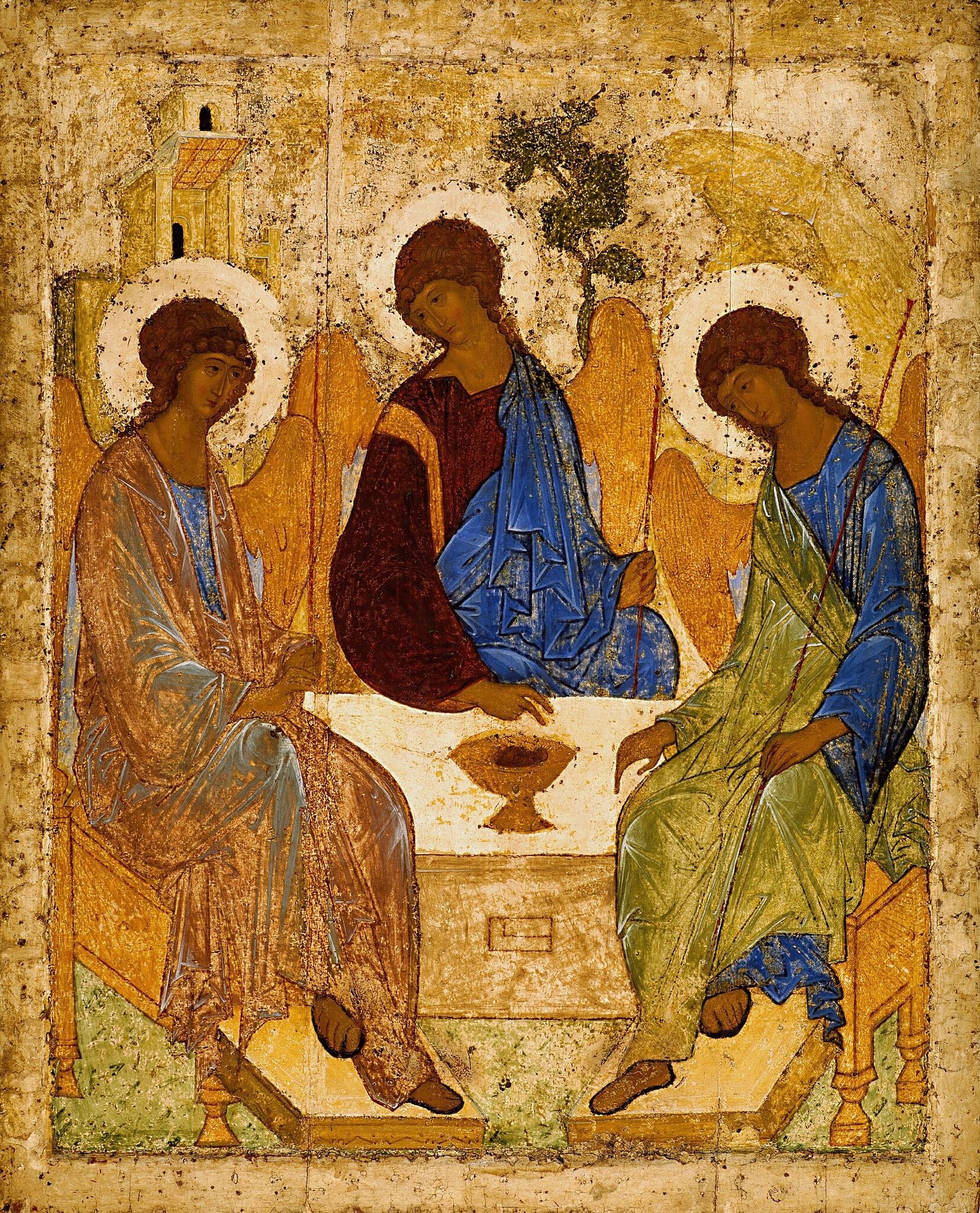
Later, in the 16th–17th centuries, depictions of the so-called “New Testament Trinity” spread in Russia, where God the Father is shown as an old man with a gray beard, the Son as the young Jesus, and the Holy Spirit as a dove. The Church treated this anthropomorphic tendency (that is, the tendency to attribute human traits to God) with caution. The Great Moscow Council of 1667 ruled that God the Father should not be depicted in human form, except in cases where God revealed Himself in that way — for example, as the “Ancient of Days” in the prophet’s vision (Daniel 7:9). This decision aimed to prevent believers from taking God literally as a “man” in the ordinary sense.
At the beginning of the 20th century, Russian theological thought developed teachings about Divine Sophia (the Wisdom of God) — a line pursued by philosophers and theologians including Vladimir Solovyov and Archpriest Sergius Bulgakov. Within this approach, some attempted to introduce into theology the image of “eternal femininity” as a special dimension of the Godhead. However, the Church rejected such ideas, viewing them as a threat to the dogma of the Trinity. In 1935, the Russian Orthodox Church Outside Russia officially condemned Fr. Bulgakov’s “sophiology” as contrary to Orthodox doctrine.
Contemporary Orthodox theologians emphasize that Christian tradition never originally understood God as male in a human sense. Archpriest Alexander Schmemann argued that the language of Scripture was shaped not by social stereotypes, but by revelation: God names Himself Father to express a relationship of love, not sexual characteristics. Metropolitan Kallistos (Ware) observed that in God there are — and are surpassed — qualities that people typically associate with both sexes: mercy can be compared to a mother’s love, strength to a father’s, but God Himself, in essence, is above sex.
The Catholic Church
The Catechism of the Catholic Church (No. 239) emphasizes that God transcends the human distinction between the sexes. He is neither man nor woman — He is God. The document explains that the traditional address of God as Father highlights two points: first, God is the source of all that exists and the Lord of the world; second, He is a caring and good parent who is close to every person.
Although masculine forms of address are established in theological tradition, the Catechism clarifies that they should not be taken literally. Since God does not have a body, He does not have sex in the human sense.
The Catechism also notes that human fatherhood corresponds only partially to the true reality of God’s fatherhood. The experience of earthly parents can serve as a starting point for knowing God, but it remains limited and may be distorted.
Thus, theological language uses images accessible to human beings to speak about God’s inexhaustible and transcendent nature (that is, a nature that exceeds the limits of human experience). As the CCC stresses: “No one is father as God is Father.”
Protestantism
In the introduction to the collection An Inclusive Language Lectionary, published by the U.S. National Council of Churches — an association of a number of Protestant denominations — it is stated that the God worshiped by the authors of the Bible, and worshiped in the Church today, cannot be understood as having sex, race, or skin color.
Mormons
The Church of Jesus Christ of Latter-day Saints (Mormons) holds a view of the Trinity that differs from most Christian denominations: the Father, the Son, and the Holy Ghost are understood as three separate persons, each of whom is male and of a male nature. In addition, Mormon theology teaches the existence of a Heavenly Mother — the divine spouse of God the Father. According to this teaching, all human beings are spiritual children of these two heavenly parents.
***
The biblical text consistently describes God using masculine grammatical forms, and in that sense this is the customary way to speak about Him. However, it is important to clarify that when people speak about God’s “masculine gender” or “masculinity,” they primarily mean grammatical gender — not biological sex or sexual characteristics. Grammatical gender, by itself, does not make God male in a human sense.
It should also be noted that the use of masculine grammar for God does not impose limits on inclusive language in communication between people. The Bible speaks about God in a particular way, but this does not amount to a ban on respectful and diverse language in other contexts.
References and Sources
- John of Damascus. An Exact Exposition of the Orthodox Faith.
- Achtemeier E. Why God Is Not Mother: A Response to Feminist GodTalk in the Church.
- Daly M. Beyond God the Father: Toward a Philosophy of Women’s Liberation.
- Davidson R. M. Flame of Yahweh: Sexuality in the Old Testament.
- Frymer-Kensky T. Law and Philosophy: The Case of Sex in the Bible.
- Grenz S. J. Is God Sexual? Human Embodiment and the Christian Conception of God.
🙏 Queer Theology of Christianity
Introduction
 Subscribe to our Telegram channel (in Russian): Urania. With Telegram Premium, you can translate posts in-app. Without it, many posts link to our website, where you can switch languages — most new articles are published in multiple languages from the start.