“The Bitten Peach”: Duke Ling of Wei and Mizi Xia as One of the Earliest Same-Sex Court Tales in Chinese History
How a Legalist parable about favoritism turned into a metaphor for same-sex love.
- Editorial team
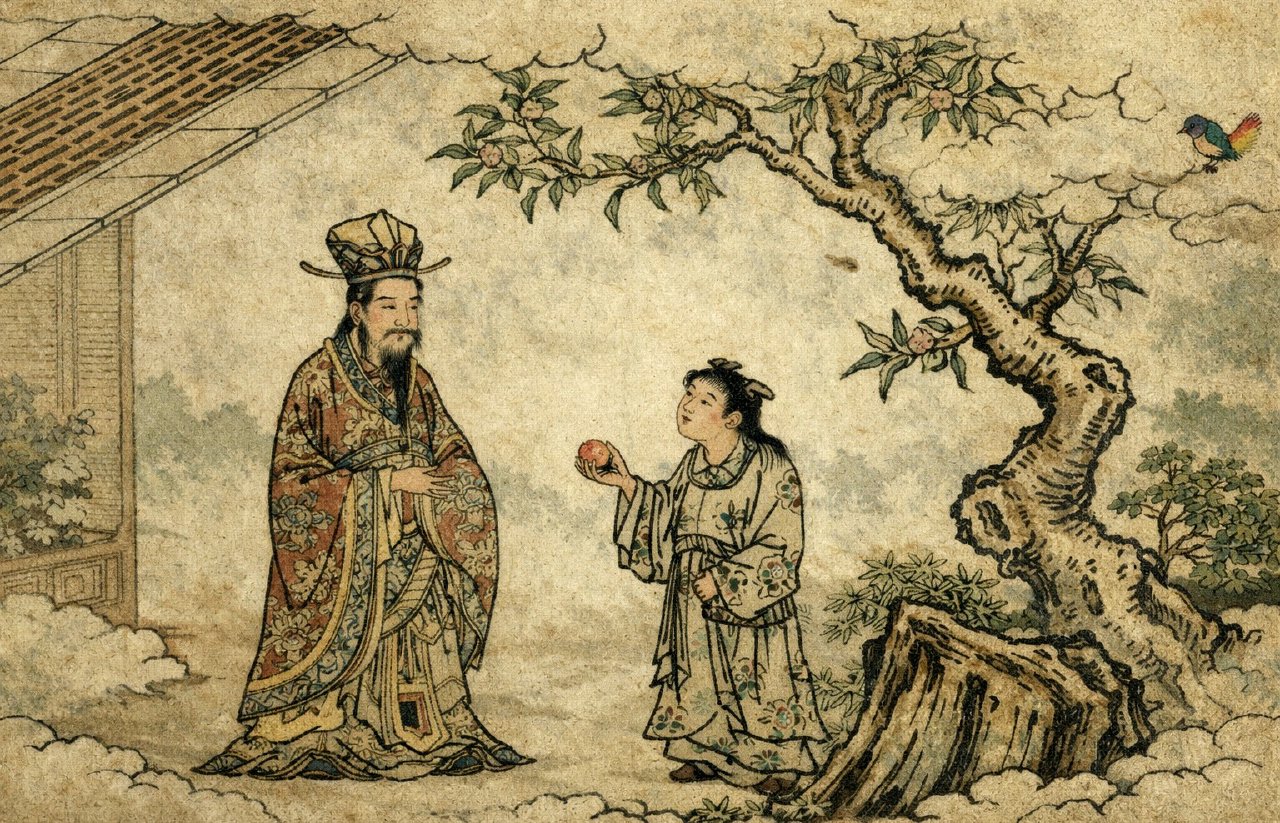
Ling, the ruler of the ancient Chinese state of Wei in the 6th–5th centuries BCE, was married. Yet when he is mentioned, people more often recall his relationship with a young man named Mizi Xia. Their love gave rise to the image - and the expression - “the bitten peach,” (余桃) which came to signify male same-sex love in Chinese culture.
This story proved remarkably enduring. It has been retold, debated, and interpreted in many different ways over the centuries. In this article, we will examine it in detail.
The Story of Duke Ling and Mizi Xia
The story of Duke Ling (卫灵公) and Mizi Xia (弥子瑕) is known from the philosophical work Han Feizi (韩非子). The text is named after its author, Han Fei, a thinker of the 4th–3rd centuries BCE and one of the leading representatives of Legalism.
Legalism was a school of ancient Chinese philosophy that portrayed the state as a rigid system of power, laws, and punishments, without regard for the personal likes and dislikes of the ruler - or anyone else. Han Feizi is structured as a collection of instructive anecdotes intended for rulers and officials.
In the chapter “Shuo Nan,” we are told that Duke Ling once showed favor to a close attendant named Mizi Xia. Mizi Xia apparently made a successful court career and held a special position with the ruler. In scholarship, Mizi Xia is considered a semi-legendary figure: while he may have existed in reality, we have no reliable information about him beyond this story.
Han Fei relates that one day Mizi Xia’s mother fell gravely ill. At night, someone secretly entered the palace and informed him. Mizi Xia wanted to go to his mother at once. To do so, he forged an order in the ruler’s name, climbed into the duke’s chariot, and set off. Under the laws of Wei, the unauthorized use of the ruler’s chariot was deemed a serious crime, punishable by the amputation of the feet. Yet Duke Ling did not punish the young man. On the contrary, he praised him, saying that Mizi Xia had shown true filial devotion, forgetting the penalty for breaking the law for his mother’s sake.
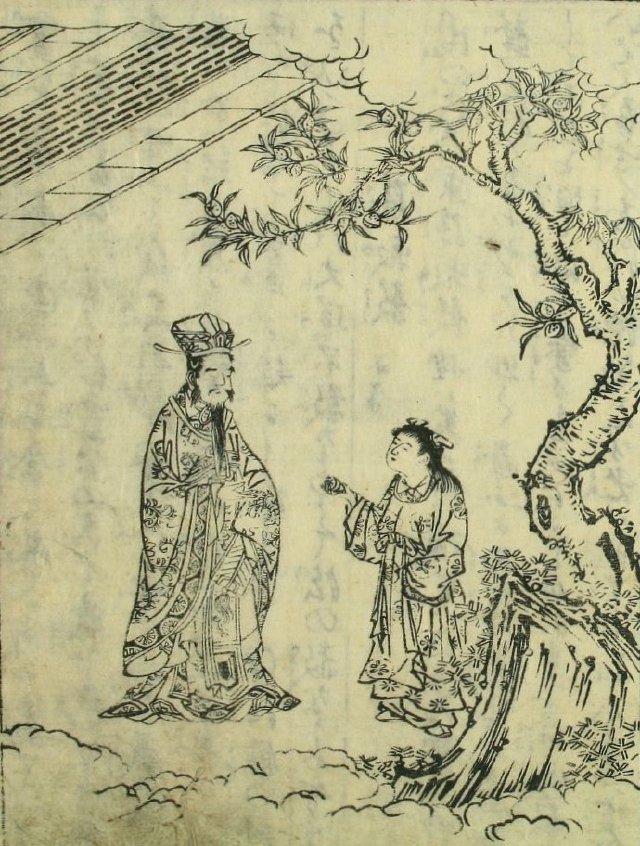
Han Fei then gives another episode. Mizi Xia was strolling with the ruler in a garden and eating a peach. The fruit struck him as exceptionally sweet. He took a bite, then stopped and offered the remaining portion to Duke Ling so that he, too, could taste it. The ruler was moved and exclaimed: “How sincere your love for me is! You have forgotten your own appetite and think only of giving me something delicious!” This is where the famous image of “the bitten peach” comes from.
Han Fei adds, however, that a ruler’s favor is not eternal. In time, Mizi Xia lost his youth and former attractiveness, and Duke Ling’s interest in him waned. When Mizi Xia was accused of some new offense, the ruler recalled the earlier episodes - but now interpreted them differently. He declared that Mizi Xia had, in fact, stolen that chariot; and that on another occasion he had given him a half-eaten peach to finish, behaving disrespectfully toward his lord.
In the end, Han Fei explains: if someone enjoys a ruler’s love, even dubious actions will be construed as signs of virtue. But if the ruler has fallen out of love - or come to hate him - those very same actions will become proof of crimes and vices.
Over time, the tale became known to all educated people in China, and the expression “the bitten peach” became a designation for male homosexuality. The name Mizi Xia also acquired a figurative meaning and came to be used to refer to a handsome youth desired as a sexual partner.
Why Han Fei Wrote This Story
The author of the tale, Han Fei, was not trying to study social mores or pass judgment on same-sex relationships. His interest lay elsewhere. Han Fei was a Legalist thinker. From the Legalist point of view, a ruler must remain impartial, and any personal attachment is dangerous because it disrupts order and makes authority vulnerable.
That is why Han Fei uses the story of Duke Ling and Mizi Xia as an example of the threat that favoritism poses to the state. Institutionalized favoritism - when a ruler consistently singles out a favorite and grants him special privileges - undermines the foundations of government, in the Legalist view. The favorite gains influence not through law or merit, but through personal closeness to the ruler, and this makes power unpredictable and unstable.
It is characteristic that Han Fei describes the relationship between Mizi Xia and the duke not in terms of sexual orientation, but as a social bond between a superior and an inferior. For ancient China - and for the ancient world in general - this approach was natural. In that era there was no concept of “homosexuality” as an inner psychological trait of the individual. That is why neither Han Fei nor other sources from the Zhou period use a word equivalent to the modern term “homosexual.” Instead, they employ the notion of chong 宠, meaning favor or patronage bestowed by an elder upon a junior. Such a relationship could include sexual intimacy, but it was defined above all by hierarchy and dependence.
The tendency to describe same-sex bonds through social roles and relationships - rather than through an abstract “erotic essence” - persisted in Chinese culture for many centuries. Only in the 20th century, under the influence of Western scholarship and medicine, did new terminology enter Chinese that began to speak of same-sex desire as a type of personality or an orientation.
It also matters that Han Fei portrays Mizi Xia sympathetically. At the beginning of the story, Mizi Xia is prepared to take a risk in order to visit his sick mother. In the peach episode and later in the narrative, he is shown as loving, sincere, and selfless. No innate depravity is pinned on him. The rupture in the relationship results not from Mizi Xia’s conduct, but from the duke’s own fickleness and unreliability.
The story’s bleak ending matches the overall style of the historical - philosophical literature of the period and does not, by itself, imply condemnation of same-sex relationships. On the contrary, it is precisely the tragic outcome that seems to have made the story worth recording. Elsewhere, too, Han Fei never speaks of homosexuality as something sinful, strange, or requiring denunciation. Like other ancient authors, he mentions it in passing and uses the plot only as a vivid example within a broader argument about power.
Mizi Xia in Chinese Culture
In Chinese culture, the story of Duke Ling and Mizi Xia was written first and foremost for political purposes: to warn courtiers and to show how dangerous it is to depend on a ruler’s personal love. But in later Chinese literature, Mizi Xia was increasingly invoked as a celebrated beauty and as a symbol of male same-sex love.
Roughly 700 years later, the poet Liu Zun (died 535 CE) praised Mizi Xia and the tradition of allusive references associated with him. In one poem he wrote:
The favors of the cut sleeve are generous,
The love of the half-eaten peach never dies.
The poet was confident that any educated reader would immediately understand what was meant, because “the cut sleeve” and “the half-eaten peach” were already perceived as cultural codes linked to famous stories of male love at court.
Another well-known poem from the Liang era on a homosexual theme is attributed to Emperor Jianwen of Liang. He was considered a master of poetry and is remembered above all for lyric verses about plum blossoms and feminine beauty. Yet one of his strongest works is often said to be a panegyric to his beloved youth. Here is an excerpt:
Charming boy - how beautiful you are!
You surpass Dong Xian and Mizi Xia…
In such texts, Mizi Xia’s name began to function as an immediately recognizable allusion, which can be seen in other monuments as well. The earliest surviving Chinese document that touches on homosexuality - Bo Xingjian’s “Poetic Essay on Supreme Joy” - lists Mizi Xia among the best-known examples and phrases it this way: “Mizi Xia shared a peach with his lord.”
By the 12th century CE, male companions generally no longer wielded much influence at princely or imperial courts, and the name Mizi Xia increasingly came to be associated not with a favored courtier, but with ordinary male prostitutes.
Later still, changes in norms and language affected the situation. The narrowing of gender roles under the Qing dynasty and the influence of homophobic attitudes imported from the West eventually made any mention of “the bitten peach” entirely taboo. That is why today Mizi Xia is largely little known within China.
Duke Ling of Wei as a Historical Figure
Duke Ling was the ruler of the small Chinese state of Wei (衛) during the Spring and Autumn period, that is, in the first half of the 1st millennium BCE. His personal name was Yuan, and “Duke Ling” is not a personal name but a title and a posthumous honorific: gong means “duke,” while “Ling” was granted after death as a concise characterization of his rule.
His reign is usually dated to roughly 534–492 BCE. This was a time when, formally, the king of the Zhou dynasty stood above everyone, but in practice the country was divided into dozens of near-independent principalities that constantly fought wars and formed alliances. Wei was one of those principalities - not the strongest, but quite ancient. It was located roughly in the area of the northern part of what is now Henan Province.
Duke Ling came to power at a moment of unrest in Wei. The best-known episode of his reign is a revolt: part of his entourage rose up, Duke Ling had to flee for a time, and then return. Even after returning, he was unable to punish all those responsible.
The chronicles also devote much attention to his wife, Nanzi, and to the conflict surrounding her. Duke Ling’s son, out of hatred for his mother, wanted to kill her, but the plot failed and the son fled to another state. After Duke Ling’s death, power ultimately passed not to the son, but to a grandson.
Duke Ling is also remembered for his connection with Confucius, who lived in this very era and was searching for a ruler willing to govern according to his principles. There is a well-known episode in which Duke Ling asked Confucius about military formations, but Confucius - realizing that this was not the ruler he needed - answered evasively, saying that he had not studied warfare. Confucius then left for another principality.
In 492 BCE, Duke Ling died after 42 years of rule. Over time, Wei weakened and eventually disappeared, absorbed among stronger states.
References and Sources
- Hinsch, Bret. Passions of the Cut Sleeve, 1990.
🇨🇳 LGBT History of China
 Subscribe to our Telegram channel (in Russian): Urania. With Telegram Premium, you can translate posts in-app. Without it, many posts link to our website, where you can switch languages — most new articles are published in multiple languages from the start.