Vladimir Lamsdorf: A Homosexual at the Head of the Russian Foreign Ministry under Nicholas II
Forty years in the ministry, a romance with the head of the chancellery, the nickname “Madame” from Nicholas II, and a caning on Morskaya Street.
Contents
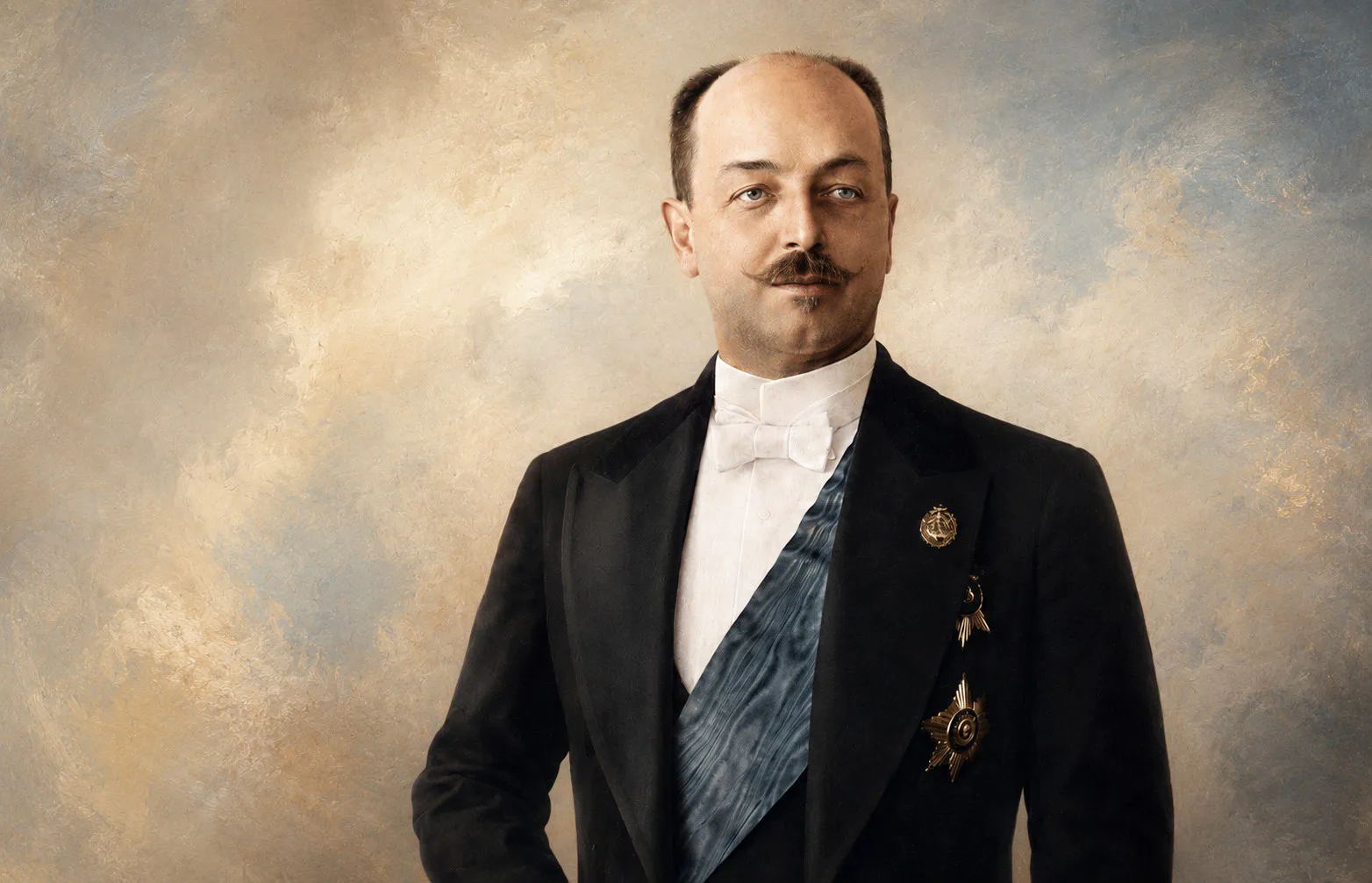
Count Vladimir Lamsdorf was a homosexual. Officials, diplomats, and journalists who knew the St. Petersburg elite from different angles all left records of it. His own diary contains no sexual confessions, yet even the diary makes clear that Lamsdorf’s strongest attachments were to men.
Lamsdorf served in the Ministry of Foreign Affairs for forty years and headed it from 1900 to 1906. He helped prepare the Hague Peace Conference, tried to prevent war with Japan, preserved Russia’s alliance with France, and averted a war with Britain after the Dogger Bank incident. Being homosexual did not keep him from rising to that post.
His closest colleague in the ministry was an official named Alexander Savinsky. They traveled together, Lamsdorf advanced his career, and contemporaries took them for lovers.
A Career in the Ministry of Foreign Affairs
Vladimir Nikolayevich Lamsdorf was born in St. Petersburg on January 6, 1845. He came from the Baltic German nobility in Russian service. According to the historian Anton Loshakov, the family descended from a German knight, Otto von Lamesdorpe, and had lived in Livonia and Courland since the fifteenth century. The comital title was earned by the minister’s grandfather: Matvei Lamsdorf served as the first governor of Courland after its annexation by Russia and, from November 1800, was tutor to the future Nicholas I.
The minister’s father, Nikolai Matveyevich, began his service in the Preobrazhensky Regiment, later headed the forestry department, and received the rank of adjutant general. With his elder brother Alexander, a Hofmeister at court, Vladimir Nikolayevich carried on a muted rivalry: Alexander was ten years older, yet the two advanced through the ranks at almost the same pace.
Lamsdorf was educated at the Corps of Pages, a privileged school where the sons of the nobility were trained for military and court service and where the senior pupils, the Kammerpages, also waited on the imperial family at levees and receptions. He completed the corps in 1862 and then studied at the Alexander Lyceum, formerly the Tsarskoye Selo Lyceum, which prepared officials for the highest departments of state. In 1866 he entered the Ministry of Foreign Affairs and never moved to another department.
Lamsdorf never held a permanent post abroad. He skipped the embassy and legation service customary for a diplomat, and his entire career unfolded in the central apparatus in St. Petersburg. He went abroad in the emperor’s suite and for negotiations.
During the Congress of Berlin in 1878 Lamsdorf worked in the entourage of Chancellor Alexander Gorchakov, and once the congress ended Gorchakov took him on as his own secretary—the beginning of a rapid ascent. In 1884 he prepared the meeting of Alexander III with the German emperor Wilhelm I and the Austro-Hungarian emperor Franz Joseph at Skierniewice. A year later he was preparing a bilateral meeting: Alexander III with Franz Joseph at Kroměříž in Moravia.
Foreign Minister Nikolay Giers made Lamsdorf his closest adviser. At first Lamsdorf held to the League of the Three Emperors, which bound Russia to Germany and Austria-Hungary. After Otto von Bismarck’s dismissal in 1890 Berlin declined to renew its secret treaty with St. Petersburg, and Lamsdorf came to accept the necessity of an alliance with France.
Colleagues called him a walking archive. He remembered the course of long-past negotiations, knew the old treaties by heart, and held the ministry’s entire secret correspondence in his hands: every single paper that left the department for the emperor and came back again passed across his desk.
In 1897 Lamsdorf became assistant minister of foreign affairs, Russia’s title at the time for the post just below the minister himself. He helped prepare the First Hague Peace Conference of 1899, where states discussed arms limitation, the laws of war, and the peaceful settlement of international disputes.
Lamsdorf remained the trusted subordinate of a succession of ministers: Gorchakov, Giers, Prince Alexey Lobanov-Rostovsky, and Count Mikhail Muravyov. Under Muravyov he handled a large share of the ministry’s daily business.
Lamsdorf’s eventual successor, Alexander Izvolsky, acknowledged his capacity for work:
“Possessing only the instruction acquired at the Corps de Pages, he lacked the advantages of a complete education, but he was gifted with an ensemble of qualities which made him from the start a functionary of the first order. Prodigiously industrious, discreet, never letting his work be interfered with by the usual distractions habitual to young people, he succeeded in making himself indispensable.”
— Alexander Izvolsky, Recollections of a Foreign Minister
The diplomat Yuri Solovyov, who entered the ministry in 1893 and published his memoirs in Soviet Moscow, described the same career with less sympathy. For him Lamsdorf was above all a man of a closed ministerial circle.
“Lamsdorf, like his deputy Obolensky, spent his whole life within the walls of the ministry, belonging to a small group of people close to the former minister N. K. Giers.”
— Yuri Solovyov, Memoirs of a Diplomat, 1893–1922
A more mocking story circulated in the department, and Solovyov wrote that down too:
“It was even said of Count Lamsdorf that he owed his career largely to his fine handwriting and his skill at sharpening pencils and quill pens for Chancellor Prince Gorchakov, under whom he began his service.”
— Yuri Solovyov, Memoirs of a Diplomat, 1893–1922
Muravyov died in June 1900, and Lamsdorf took charge of the ministry as its acting head. In January 1901 Nicholas II confirmed him as minister.
A Minister against War
Lamsdorf inherited a department facing danger in two directions, the Balkans and the Far East, and in both he tried to prevent a war.
In the Balkans Lamsdorf pressed for reforms inside Turkey while fearing that uprisings and rivalry with Austria-Hungary would drag Europe into a general war. In December 1902 he toured Belgrade, Niš, Sofia, and Vienna. King Alexander Obrenović of Serbia received him at Niš, where the court had moved for a time. The minister urged the king away from military preparations against Turkey and warned him that the population was unhappy with his policy and that the country was heading for revolution; six months later officers murdered the king along with the queen.
The central conflict of his ministry unfolded in the Far East. Lamsdorf believed Russia was not ready for war with Japan. The Trans-Siberian Railway was still unfinished, and supplying an army at such a distance would be difficult. Together with Finance Minister Sergei Witte and War Minister Aleksey Kuropatkin, he opposed the so-called Bezobrazov circle, the courtiers and entrepreneurs around Alexander Bezobrazov who defended timber concessions on the Yalu River and pushed Nicholas II toward expansion in Korea.
Lamsdorf proposed recognizing Japan’s predominant interests in Korea in exchange for guarantees of Russia’s position in Manchuria, where the Chinese Eastern Railway ran.
The tsar thought otherwise. As early as July 19, 1900, Alexey Suvorin—publisher of Novoye Vremya (New Times), the most influential conservative nationalist newspaper in the empire—recorded the words of Admiral Nikolai Skrydlov’s wife about the disagreements at court:
“The sovereign hates the Japanese and gives warning that they must be checked and given no advantages. Lamsdorf says they must on no account be touched.”
— Admiral Nikolai Skrydlov’s wife, as recorded by Alexey Suvorin, Diary
Savinsky, the minister’s closest aide, who traveled Europe with him for years, wrote that Lamsdorf was of a “very calm nature” and “usually most amiable.” In a conversation with Bezobrazov, whom Nicholas II had sent to him personally, the minister nonetheless lost his composure. Bezobrazov reproached the ministry for weakness and capitulation; Lamsdorf answered that such a policy “would be incompatible with the dignity of Russia” and that if the sovereign ordered him to pursue it, “you would not see me at this table.” On those words the minister struck the table with his fist.
Some days later the tsar himself began asking the minister about that visit. In Savinsky’s account, Lamsdorf placed conscience above obedience:
“I value one thing above all others that even you, Sire, cannot deprive me of.” “And that is?” “My conscience. It is that which forces me to speak, to tell Your Majesty the whole truth.”
— Vladimir Lamsdorf and Nicholas II, as recorded by Alexander Savinsky, Recollections of a Russian Diplomat
Lamsdorf believed in the divine right of kings, and an argument with the monarch cost him dearly, because loyalty to the tsar pulled against his sense of duty.
In 1903 Nicholas II effectively removed Far Eastern policy from the Ministry of Foreign Affairs. Izvolsky later accused Lamsdorf of failing to leave:
“[…] did not resign, but, when criticised for remaining in power under the circumstances, he advanced the stupefying theory that in Russia the Minister of Foreign Affairs could not quit his post until dismissed by his sovereign, and that his sole function was to study the questions pertaining to the Empire’s foreign relations and present his conclusions to the Emperor, who, in his quality of autocrat, would decide for or against, and his decision would thereupon be binding on the Minister.”
— Alexander Izvolsky, Recollections of a Foreign Minister
There was a request to resign all the same. Savinsky quoted its text:
“All these considerations give me the courage to beg you to accept my resignation. I leave your service, Sire, with a clear conscience. All my strength, all my life, has been consecrated exclusively to the honest accomplishment of my duty. The future may explain things.”
— Vladimir Lamsdorf, letter of resignation, as quoted by Alexander Savinsky, Recollections of a Russian Diplomat
Solovyov confirmed it. By his account, Lamsdorf, Kuropatkin, and Witte all submitted requests after the Far Eastern viceroyalty was established, but the tsar told Lamsdorf:
“You will go when I find it necessary.”
— Nicholas II, as recorded by Yuri Solovyov, Memoirs of a Diplomat, 1893–1922
The wait was short. In February 1904 the Russo-Japanese War began: Russia lost Port Arthur, lost the Battle of Mukden, and lost its fleet at Tsushima. Lamsdorf prepared the negotiating position, but Nicholas II named Witte as Russia’s chief representative at Portsmouth.
The war nearly turned into a second war, this time with Britain. In October 1904 the Russian squadron on its way to the Far East fired on British fishing vessels at the Dogger Bank in the North Sea, mistaking them for Japanese torpedo boats. In Russian the episode is called the Hull incident, after the English port the trawlers had sailed from. Lamsdorf agreed to an international inquiry and averted a war with Britain.
While the squadron sailed toward the Pacific, the empire was shaking from within. After Bloody Sunday on January 9, 1905, when troops fired on a workers’ demonstration marching to the Winter Palace, Lamsdorf, according to Savinsky’s memoirs, spoke to Nicholas II of “the blood of poor innocent people” and warned him: “No one will believe that being within a stone’s throw of the capital you were ignorant of what was going on.” Savinsky wrote that the minister “bravely insisted” on the tsar’s personal intervention.
Nicholas II also conducted diplomacy behind the ministry’s back. In July 1905, without his ministers’ knowledge, he signed the Treaty of Björkö, a mutual assistance pact concluded with Wilhelm II off the island of Björkö in the Gulf of Finland. It contradicted Russia’s alliance with France. Izvolsky described the minister’s reaction:
“Count Lamsdorff was literally appalled when he learned of it, and exerted himself with all the force at his command to show the Emperor the danger of the situation and the absolute necessity of taking immediate measures for the annulment of the treaty. The Czar saw that he had fallen into a trap and gave Count Lamsdorff carte blanche to take whatever steps might be necessary to get him out.”
— Alexander Izvolsky, Recollections of a Foreign Minister
Lamsdorf brought in Witte, approached Wilhelm II through private channels, and saw to it that the treaty never entered into force.
The French alliance held as well. In 1906 Russia backed France during the Moroccan crisis, and at the Algeciras Conference Lamsdorf reaffirmed his loyalty to the French alliance. Even Izvolsky granted that he had applied himself “with all his experience of affairs and with an energy worthy of the highest praise.”
One rule stood behind all these episodes. Russia, Lamsdorf held, must not fall into dependence on any single power. That caution irritated the advocates of expansion in St. Petersburg, and German newspapers attacked the minister for his fidelity to the French alliance.
On Loshakov’s reading, Lamsdorf was cautious to a fault: he thought the expansion of Russian influence possible only by peaceful means, and he proved too principled and too inflexible to keep Far Eastern affairs in his own hands once Bezobrazov and the viceroy, Admiral Yevgeny Alekseyev, had taken them from him. He could not prevent the war with Japan, but he avoided repeating the mistakes of 1876–77, damped down the Balkan crises, and kept Nicholas II from breaking with France. Lamsdorf disliked the English and saw Britain as Russia’s principal adversary, yet he considered an understanding with it necessary; the rapprochement that Izvolsky would complete began under him.
Appearance and Court Manners
While Lamsdorf negotiated and argued with the tsar, St. Petersburg was also studying the minister himself. In public he carried himself impeccably.
Izvolsky compared Lamsdorf with Witte and described the perfect courtier, down to the curled hair and the perfume:
“In contra-distinction to the rough, unpolished man of genius, Count Lamsdorff was a type of the most finished courtier; brought up, one might say, on the steps of the throne, he had inherited, from several generations of high functionaries at the imperial Court, the manners and ideas of another age, quite out of date even in the artificial environment of Nicholas II.”
“He was a little man, extremely young looking for his age, with light reddish hair and diminutive moustache, always dressed, prinked, and perfumed with the utmost care, and whose affected manner and falsetto voice gave no little chance for pleasantry.”
— Alexander Izvolsky, Recollections of a Foreign Minister
In 1901 Lamsdorf gave an evening reception at his own residence. Vladimir Lopukhin, then serving in the ministry and later the head of one of its departments, remembered a gracious host who performed the court ritual without a single slip:
“…Count Lamsdorf, smiling affably, moved from one group of guests to another and from one hall to the next. He would pause for a brief word with the most important persons. He did not fail, however, to bestow a firm handshake and a kind, almost joyful smile on each of us as well, his many colleagues.”
— Vladimir Lopukhin, Notes of a Former Head of a Department of the Ministry of Foreign Affairs
Solovyov saw the same manner at Peterhof in the summer of 1903, when Lamsdorf greeted Kuropatkin:
“What has stayed in my memory is that sweet smile so characteristic of Count Lamsdorf with which he met Kuropatkin, and his words: ‘I read your memorandum with delight, Aleksey Nikolayevich.’”
— Yuri Solovyov, Memoirs of a Diplomat, 1893–1922
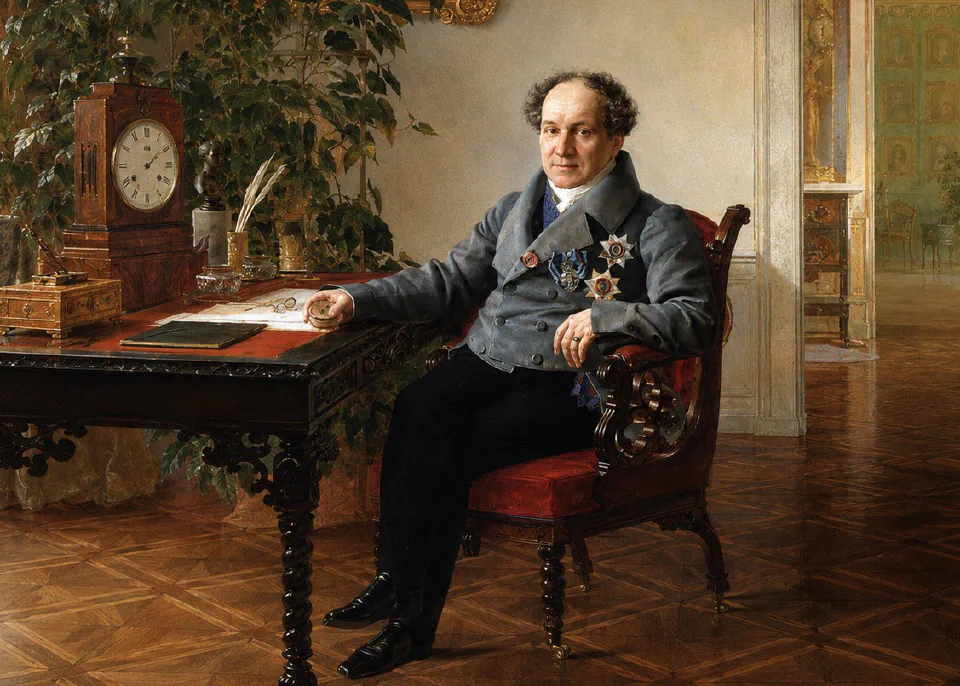
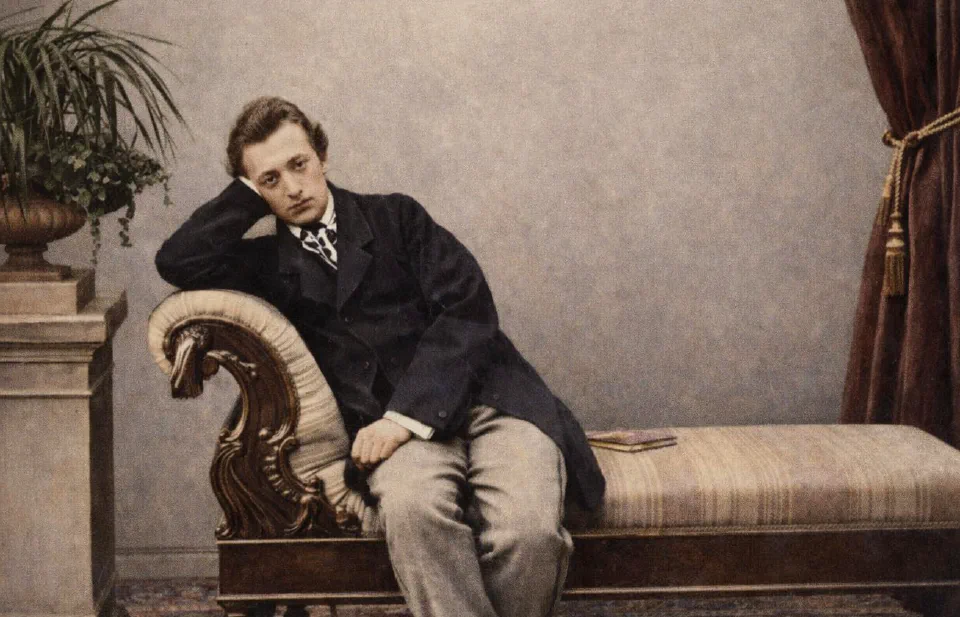
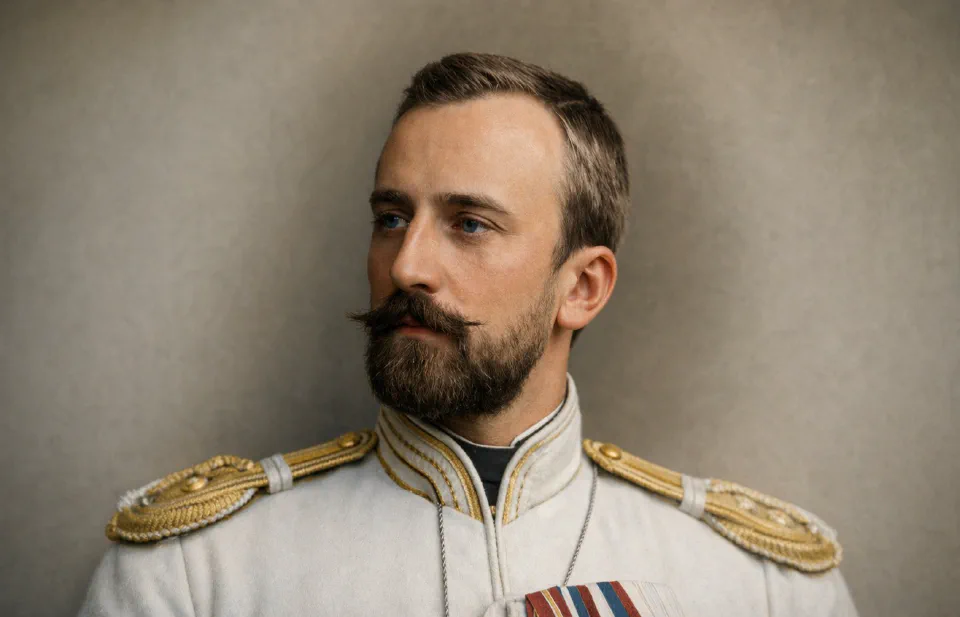
Lamsdorf left almost no likeness of himself behind. He was not a public man, and attention to his person embarrassed and annoyed him: unlike Witte and Izvolsky, who gave interviews readily, he avoided journalists and passed that duty to Savinsky. The press had only a couple of photographs of him, reprinted for years, and for want of a picture editors ran drawn portraits that resembled the minister only loosely.
Historians describe his character in much the same terms. Loshakov speaks of a mild temper, known to everyone who knew Lamsdorf, and of his reclusiveness: the minister avoided publicity and grew embarrassed when he had to speak before a large gathering. The scholar Irina Dyakonova singled out his solitude, a certain asceticism, his diligence, his industry, and his piety. The Canadian historian David Schimmelpenninck van der Oye called him a bureaucrat to the marrow, a man who lived for the interests of the service and sacrificed even his private life to it. Loshakov himself puts it more carefully in his conclusions: reclusiveness and a fear of publicity “left their mark in equal measure on the count’s private life and on his career.”
The Minister’s Way of Life
Loshakov reconstructed the minister’s day from the diary for 1886–96. The count rose no later than eight. He lived in an apartment inside the ministry building itself, so the working day began around eleven with a walk upstairs to Giers. If a matter was urgent, Giers sent the papers down to the apartment.
In the winter of 1890–91 a course of massage was added to the morning schedule for a little over a month, and the count’s masseur had wide connections among the clergy and passed on to him the rumors from the corridors of the Synod during the sessions. Lamsdorf also picked up society news from his barber.
He breakfasted with colleagues from the ministry, most often with Prince Valerian Obolensky-Neledinsky-Meletsky, the head of the ministry’s chancellery. He dined either alone, or again with Obolensky, or at the Giers home, where he felt free enough with the minister and his wife to see in the New Year with them.
In his free hours he walked about the city and looked into shops; once a week he went to the Volkovskiye baths or the bathhouse on Basseinaya Street; in summer he would take a day trip out of town, to Shlisselburg, say, or to swim at Peterhof.
He sat over his work late into the night, more often supped alone, and wrote his diary before bed. Besides the diary Lamsdorf also kept memoirs, but they have not survived.
He was a devout Orthodox believer. He attended services in the ministry church and at St. Isaac’s and Kazan cathedrals, and when the minister summoned him away from a service he could barely conceal his vexation. An extensive correspondence connected him with the monks of the Saint Sergius Hermitage on the coast near Peterhof; among his correspondents was the Kronstadt archpriest Ioann Sergiyev, canonized in 1990 as John of Kronstadt, who congratulated Lamsdorf on his appointment as minister in 1900. The count often spent the summer at that same hermitage, shared the monks’ modest table, and in 1892 sat out the St. Petersburg cholera outbreak there.
He confirmed his faith with money as well. Lamsdorf belonged to four charitable societies, from a “labor refuge for homeless girls” to a “Committee for Assisting Young Men in Achieving Moral and Physical Development,” and he helped petitioners out of his own funds: receipts for sums from fifteen rubles upward survive in his archival collection.
He read a great deal, both from duty and for himself: the government’s Journal de St.-Pétersbourg, Pravitelstvenny Vestnik (The Government Herald), historical works, and memoirs. He also belonged to the Imperial Russian Historical Society, chaired by the former imperial secretary Alexander Polovtsov, and delivered papers there alongside Vasily Klyuchevsky: on the Anglo-Russian negotiations during Nicholas I’s visit to London, and on the criticism of Peter the Great’s reforms by the emperor’s closest associates.
His taste was impeccable and expensive. The reception the new minister gave on December 31, 1900, for the European New Year was described by the newspapers with enthusiasm: an anteroom decked with exotic plants, a suite of rooms in the Empire style, champagne and fruit punch at the buffets, and the departure of guests beginning after midnight. The count furnished his working space in the same spirit: on August 25, 1904, he bought from Fabergé, jeweler to the court, a gold penholder set with stones, a pink enamel pen tray, and a red enamel dipper with jade and a ruble of Catherine II, for 325 rubles in all, and in November he added a cigarette case for 45.
Reclusiveness and the Love of Men
Lamsdorf never married and left no legitimate children. In his circle that stood out: marriage was almost an official duty for a high functionary, and a dignitary’s private life occupied the court no less than his career. What is known about how he lived instead of marrying comes from three kinds of source: his own diary, the testimony of colleagues, and the nicknames the court gave him.
Lamsdorf kept his diary for decades. The man in those entries bears little resemblance to the one who smiled at guests at receptions. On December 12, 1886, he wrote about his own withdrawal from people:
“[…] I decide: if he says anything to me on this subject, not to resort to evasions but to confess frankly that I have had great troubles and have shut myself up in my unsociability to such a degree that I can no longer overcome it.”
— Vladimir Lamsdorf, Diary, 1886–1890
Before a court ball in February 1889, the need to appear in society caused him something close to physical pain:
“All day I feel out of sorts at the thought that I must go to the court ball this evening… The mere thought of the necessity of being in society already causes me cruel suffering, so I make a great effort to dress…”
— Vladimir Lamsdorf, Diary, 1886–1890
Outside the ministry Lamsdorf could hardly imagine a life for himself. On March 9, 1889, he noted:
“My doubts concerning the service, which in essence fills my whole existence; uncertainty and lack of confidence outside that sphere.”
— Vladimir Lamsdorf, Diary, 1886–1890
On April 5, 1891, his self-description grew heavier still:
“[…] in the night I had a real attack of fever, and I am once again seized by a fit of unconquerable fear of people. Revulsion and a feeling of shame toward my own person; impossible to show myself in public.”
— Vladimir Lamsdorf, Diary, 1891–1892
Lamsdorf does not name the cause of that shame. What is visible is how far apart his days and his evenings stood: the same man who performed the court ritual without a slip wrote at home of “revulsion and a feeling of shame toward my own person” and of being unable to “show myself in public.” And it was not only a mood that had to be concealed. Desire for men, in his position, meant lifelong caution, and the price of a single lapse was the whole of his career.
Lamsdorf’s emotional world was concentrated in a narrow circle of men, and the few people he was attached to mattered all the more to him. He called Giers his “dearly beloved chief” in the diary, and at the end of 1890 he wrote:
“The friendliness and trust my dear chief shows toward me have been especially marked and touching since my return in the autumn; I am infinitely grateful to him for it, and when I remember that I did not always know how to value his kindness, or when I think of the possibility of parting from him, my heart bleeds.”
— Vladimir Lamsdorf, Diary, 1886–1890
A special place belonged to that same Obolensky with whom Lamsdorf breakfasted almost every day. Savinsky would head the ministry’s chancellery a few years later; Obolensky Lamsdorf would take on as his assistant minister in 1900. In the diary Lamsdorf called him “my Ola,” “my dear Ola,” and “my beloved Obolensky,” and in letters, as Loshakov found in the count’s archival collection, he addressed him in French as Cherissime Ami, “most precious friend.” On February 14, 1891, his love for Giers and Obolensky turned out to be the main argument for staying in the service:
“I love my old minister, it would be hard for me to part from him, and it costs me much to weary him with conversations that may always look like complaints and requests. One of the greatest joys of my life is the bond that unites me with my most precious Obolensky, to whom, as I flatter myself, I can be agreeable and useful so long as I remain in the service. To part from him would be infinitely hard for me.”
— Vladimir Lamsdorf, Diary, 1891–1892
On March 21, 1891, he called him “Obolensky, whom I love so tenderly,” and in the entries for 1892, “my beloved Obolensky.”
Lopukhin, a relative of Obolensky, saw the prince quite differently:
“Honest but limited, dry and stingy […] a pedantic official and a formalist of extremely narrow horizons.”
— Vladimir Lopukhin, Notes of a Former Head of a Department of the Ministry of Foreign Affairs
In the summer of 1892—the same summer the count spent at the Saint Sergius Hermitage—Pyotr Sipyagin, the monk Pimen, appeared in the diary; he soon left with an Orthodox mission for Beijing. “Despite the view of Count Lamsdorf as a recluse, he sometimes made friends very easily,” Loshakov remarks on this episode. Lamsdorf called him Petya:
“It is very hard for me to recover my equanimity and take up ordinary life again, the course of which was so sharply altered this summer by my serious illness, by my growing close to Petya, and by a whole series of new impressions carried away from my stay at the monastery and my journey abroad.”
— Vladimir Lamsdorf, Diary, 1891–1892
What lay behind that “growing close” the diary does not explain. At first Lamsdorf idealized his new acquaintance. Pimen thanked the count for his warm welcome and confessed that, as a man of humble origin, he had felt awe and shyness before a comital title; his decision to become a monk he explained as a search for some Absolute of goodness and justice. From Beijing he addressed the ministerial dignitary simply as “Volodya,” while the count in his letters called him “Petya” and “Petyusha.”
Less than two years later Pimen began pressing to be recalled from the Beijing mission, and Lamsdorf, who did not like it, went all the same to Vladimir Sabler, deputy chief procurator of the Synod, to smooth the matter over. An entry from that period, quoted by Loshakov, appeared in the diary:
“A year ago the return of my Petyusha would have made me perfectly happy. The letters received from him lately have stripped his image, in my eyes, of every poetic veil.”
— Vladimir Lamsdorf, Diary, 1894–1896
Pimen then decided to leave the monastery altogether, complained of his desperate situation, and spoke of suicide; the count was exasperated but saw in him a “poor fellow” who had “gone quite out of his wits,” and went on interceding. He obtained his release from monastic vows without the loss of civil rights that usually followed defrocking, and then a position in his own department: on November 9, 1895, Sipyagin passed the ministry examination, impressing even the international law scholar Professor Fyodor Martens with his capacity for work, married soon afterward, and was posted to Barcelona.
Lamsdorf’s circle of intimates was small but constant, Loshakov observes, and his long private correspondence was carried on above all with Giers. The tone within it shifted from one person to another. With Giers and Obolensky, Lamsdorf was deferential and sentimental; with Herman Stenbock, an old friend and relative, he was playful. On February 8, 1889, he recorded Stenbock’s joking assurance that “when his desire to see me becomes too strong,” he would arrange a meeting through Giers.
Contemporaries Called Him a Homosexual
There are no sexual confessions in the diary. But three men who knew Lamsdorf from different sides wrote about his homosexuality: an official of his own ministry, the publisher of Novoye Vremya, and a career diplomat.
The most direct statement came from Lopukhin. Listing exactly who had been put in charge of the department, he named “inclination” in the same breath as education and social standing: “a homosexual by inclination.” Lopukhin compiled his notes in 1927–33, two decades after the events, but he was writing about a man he had served under, whose receptions he had attended, and with whom he had spoken in person:
“The post of acting head of the department goes to the assistant minister, a desk man who never served the department abroad, a Kammerpage by education, a homosexual by inclination, a Baltic landowner, Count Vladimir Nikolayevich Lamsdorf.”
— Vladimir Lopukhin, Notes of a Former Head of a Department of the Ministry of Foreign Affairs
On August 9, 1904, Suvorin recorded the same thing far more coarsely. He began with the correspondence between Prince Vladimir Meshchersky, publisher of the far-right Grazhdanin (The Citizen), and an official named Nikolay Burdukov, found among the papers of Interior Minister Vyacheslav Plehve, and then turned to Lamsdorf, whom he called a pederast without any circumlocution:
“Prince Meshchersky’s correspondence with his lover Burdakov turned up at Plehve’s. The tsar read the correspondence. He is indifferent to this ‘party,’ calls Count Lamsdorf ‘Madame,’ and promotes his lover Savitsky in the court ranks. Lamsdorf boasts that he has spent thirty years in the corridors of the Ministry of Foreign Affairs. Since he is a pederast, and men are wenches to him, he has spent thirty years as if in a brothel. Useful and pleasant!”
— Alexey Suvorin, Diary, August 9, 1904
Suvorin filed Lamsdorf and Meshchersky—a homosexual whom St. Petersburg called “the Prince of Sodom and Gomorrah”—into a single “party.” No such party existed, of course. Lamsdorf was a monarchist of moderately liberal views, and the conservative papers of the “protective” tendency irritated him. Nothing linked the cautious minister and the far-right publicist except desire for men, and the two could not abide each other. In the diary Lamsdorf called one of Meshchersky’s articles “indecent” and the prince himself “repellent,” and of his newspaper he wrote: “I am outraged by the stupidities I read in Grazhdanin.”
Suvorin knew Lamsdorf personally and received him at home, though he took no pleasure in those visits. On March 7, 1901, he noted in his diary:
“The ministers were at my house: Witte, Lamsdorf, Yermolov, Muravyov, and Durnovo, the chairman of the State Council. I was merely embarrassed, and had no pleasure at all.”
— Alexey Suvorin, Diary, March 7, 1901
Suvorin’s reasons for disliking the minister were professional. His Novoye Vremya demanded a firmer policy in the Far East, while the ministry tried to control what the paper printed.
The third witness, the diplomat Solovyov, wrote about the same thing more cautiously. He avoided the word “homosexual,” but pointed plainly to the “unnatural sexual tastes” of the minister and his favorites:
“It slips out in Lamsdorf’s memoirs that he was satisfied with his role as the minister’s behind-the-scenes confidant, which gave him the chance to decide the fate of colleagues serving at posts abroad. Besides, justly or not, Lamsdorf and all his favorites enjoyed a certain reputation in St. Petersburg society for their unnatural sexual tastes.”
— Yuri Solovyov, Memoirs of a Diplomat, 1893–1922
So long as the matter rested in diaries and drawing-room conversation, the minister’s reputation remained a private affair. In May 1904 it spilled out into the street.
The Assault by Prince Dolgoruky
In May 1904 the minister was leaving a restaurant on Morskaya Street when Prince Alexey Dolgoruky set upon him with a cane. Accounts of the reason varied. On May 28, Pyotr Stolypin, then governor of Saratov and the future head of the government, wrote to his wife Olga Borisovna:
“Nesselrode came to see me. Pavlov dines with me tomorrow. He told me that Alexey Dolgoruky beat Lamsdorf on the street with a cane and that Dolgoruky was put into a madhouse. He declared that he had beaten him for being a bugr [a homosexual] and a bad minister.”
— Pyotr Stolypin, letter to Olga Stolypina, May 28, 1904
Bugr was the Russian rendering of the French bougre, an old term of abuse for a man credited with having sex with men. The rumor traveled along a chain: Stolypin was relaying to his wife the words of Pavlov, who in turn was relaying an explanation attributed to Dolgoruky.
The writer and bibliographer Sergey Mintslov recorded a different version: the attacker shouted “traitor” and blamed the minister for the military defeats. The prince was placed under medical observation and then exiled by administrative order to Arkhangelsk. The real motive was never established.
The very word with which Dolgoruky supposedly explained his act was one Lamsdorf knew well. On April 26, 1891, he recorded a court joke about Grand Duke Sergei Alexandrovich, brother of Alexander III, governor-general of Moscow, and himself a homosexual:
“Two new anecdotes are circulating in town. ‘Moscow has stood on seven hills until now, but henceforth it must stand on a single bugor’ (bougre). This is said in allusion to Grand Duke Sergei.”
— Vladimir Lamsdorf, Diary, 1891–1892
Lamsdorf noted down such jokes more than once. The grand duke’s marriage to Elizabeth Feodorovna remained childless, and when a rumor of the grand duchess’s pregnancy went round the city, another anecdote appeared in the diary:
“In view of certain peculiarities attributed to the grand duke, this pregnancy is explained as a miracle. Count Kapnist observed maliciously on this occasion that it could only be an ‘immaculate conception.’”
— Vladimir Lamsdorf, Diary, 1891–1892
There is no solidarity with a fellow homosexual in these entries: a shared desire for men did not stop Lamsdorf from repeating the cruelest anecdotes in town about the grand duke. As early as November 1, 1889, he wrote about the grand duke’s wife:
“I think the poor woman must also feel keenly at times the intellectual, moral, and physical wretchedness of her pitiful husband.”
— Vladimir Lamsdorf, Diary, 1886–1890
Lamsdorf and His Lover Savinsky
One name was mentioned beside Lamsdorf’s more often than any other. Alexander Savinsky was born in 1868 and entered the Ministry of Foreign Affairs in 1891. By the beginning of the twentieth century he had become first secretary, then deputy head, and then head of the ministry’s chancellery.
Lamsdorf advanced his career and took him along almost everywhere. Savinsky dated the beginning of their constant travels to 1899:
“In 1899 I was chosen to accompany the then Minister, Count Lamsdorff, on an official trip.”
— Alexander Savinsky, Recollections of a Russian Diplomat
Savinsky was mistaken here: Lamsdorf became minister only at the turn of 1900 and 1901. The rest of his chronology holds up: he did indeed accompany the minister to the Crimea, to the Finnish skerries, around Europe, and to the Balkan negotiations.
The trust went beyond travel. Lamsdorf entrusted Savinsky even with the personal secret cipher of Nicholas II and Wilhelm II:
“Emperor Nicholas gave the code to the Count Lamsdorff who, not having time for this work, asked the Emperor to confide the code to me to cipher and decipher. It was thus that I was the first person to learn the contents of those telegrams from the Kaiser.”
— Alexander Savinsky, Recollections of a Russian Diplomat
News of the Japanese attack on Port Arthur arrived at one in the morning. “Count Lamsdorff was awakened, and a few moments after he called me,” Savinsky recalled, to tell him what the envelope contained.
The historian Anton Loshakov called Savinsky one of the people closest to Lamsdorf and his personal secretary, and compared his position with Lamsdorf’s own under Giers: the same round-the-clock access to the papers, to the ciphers, and to the chief. Savinsky’s memoirs, which are “steeped in reverence for the person of Count Lamsdorf,” were introduced into scholarship by Loshakov, who also translated them into Russian and published them in 2022.
Lopukhin, serving in the same ministry at the time, described the two as a couple the department saw every day: the minister carried his secretary about with him and displayed him at receptions in the place of a hostess:
“With Lamsdorf’s appointment as minister, the path to a diplomatic career is insistently cleared for Savinsky. He is already first secretary of the chancellery, soon deputy head, and a little later head.
The minister brings him close in every way. Lamsdorf and Savinsky are inseparable. The minister gives a reception—Savinsky greets, welcomes, and sees off the guests. The minister travels to the tsar in the Crimea, to the Finnish skerries, or abroad with the tsar to attend official meetings between the tsar and foreign monarchs; Savinsky accompanies Lamsdorf everywhere.”
— Vladimir Lopukhin, Notes of a Former Head of a Department of the Ministry of Foreign Affairs
Lopukhin went on to explain that in the ministry this closeness was read in only one way, as an affair between the minister and his subordinate, and that Savinsky paid for it:
“In view of the minister’s particular inclination of a most intimate character, Savinsky’s closeness to Lamsdorf gives rise to malicious rumors. They spread widely and are used to create a deliberately hostile atmosphere around Savinsky. Some of Savinsky’s colleagues began to turn away from him. And in society many people began to avoid Savinsky.”
— Vladimir Lopukhin, Notes of a Former Head of a Department of the Ministry of Foreign Affairs
Savinsky, in Lopukhin’s words, had to steer clear of a “scandal that would have ruined his career.” In 1912, at a reception given by Foreign Minister Sergey Sazonov, Lopukhin recalled the pair once more, and showed precisely whose place Savinsky had occupied with Lamsdorf:
“I had not attended receptions of this kind at the Ministry of Foreign Affairs since the time of Count Lamsdorf. The winning difference was that, instead of the Savinsky whom Count Lamsdorf always and everywhere paraded before everyone, this time it was a pleasant and outwardly attractive lady who, together with Sazonov, met and welcomed the guests in the same anteroom.”
— Vladimir Lopukhin, Notes of a Former Head of a Department of the Ministry of Foreign Affairs
In that comparison, Savinsky occupied with Lamsdorf the place that at Sazonov’s reception fell to the minister’s wife. Lopukhin himself disliked Savinsky: “handsome, a nimble arriviste,” that is, a careerist.
In 1915 Solovyov met Savinsky, by then envoy in Sofia, and called him the minister’s favorite:
“After a seven-year interval I visited our legation in Sofia again. The envoy there was A. A. Savinsky, the former head of the ministry’s chancellery under Count Lamsdorf and his favorite.”
— Yuri Solovyov, Memoirs of a Diplomat, 1893–1922
Elsewhere Solovyov counted Savinsky among the former protégés of the old ministerial group. Hartwig, on the other hand, the same Solovyov called Lamsdorf’s “right hand” without any sexual insinuation. Not every man in the minister’s favor, then, was taken for his lover: a reputation of that kind attached specifically to Savinsky, and it held regardless of who was writing about him.
In his diary Izvolsky relayed the ministry’s talk about the relationship between Lamsdorf and Savinsky and concluded:
“Count Lamsdorf, if perhaps not an active pederast, is in any case an abnormal man.”
— Alexander Izvolsky, Diary for 1906. State Archive of the Russian Federation, f. 559, op. 1, d. 86
Izvolsky disliked his predecessor and was at the same time justifying his own personnel decisions, though he knew both Lamsdorf and Savinsky personally. Loshakov gave a separate warning about this bias:
“[…] in using Izvolsky’s testimony one should not forget his difficult relations with V. N. Lamsdorf.”
— Anton Loshakov, Count V. N. Lamsdorf: Statesman and Diplomat
One more witness was the former diplomat Eugene de Schelking. Until 1903 he served in European legations and rose to first secretary of an embassy, then left the ministry and became a journalist, writing for Novoye Vremya among other papers. He linked Lamsdorf’s sexual reputation to his patronage of young men:
“Women had never played any part in his life, and consequently rumour gave him the reputation of being a pervert. He lent colour to these rumours by showing great favouritism to some of the men about him, who were for the most part strikingly handsome young men.”
— Eugene de Schelking, The Game of Diplomacy, 133
Schelking then turned to Savinsky. Lamsdorf had taken the handsome young third secretary with him to the Crimea, and on their return the young man received the court title of Kammerjunker and moved swiftly up to second and then first secretary. Schelking also gave the court joke in full and named his source, Nicholas II’s flag captain, Admiral Nikolai Lomen:
“One day, at a gala performance in honour of the visit to Petrograd of the German Emperor, Savinsky fulfilled the duties of Master of Ceremonies. During one of the entr’actes, Emperor Nicholas, turning to Admiral Lomen, his aide-de-camp, who told me the story, said to him: ‘Point out Countess Lamsdorff to me.’ He meant Savinsky!”
— Eugene de Schelking, The Game of Diplomacy, 134
This talk had consequences in the service as well. In 1902 Savinsky, while keeping his post in the ministry, also received a court appointment as master of ceremonies, the officer in charge of palace ceremonial. His future superior at court, Chief Master of Ceremonies Count Vasily Gendrikov, objected to the appointment. What happened next was recorded in his diary on April 14, 1902, by Polovtsov:
“A major scandal over one of these favors is spreading within the walls of the Winter Palace. Several months ago the minister of foreign affairs, Lamsdorf, asked that a certain Savinsky, one of the secretaries of his chancellery, be appointed master of ceremonies. Lamsdorf was refused at the insistence of Count Gendrikov, the chief master of ceremonies. Gendrikov maintains that he knows for certain that Lamsdorf is in reprehensibly intimate relations with Savinsky, and that the sovereign consequently gave him, Gendrikov, a promise that such an appointment would never follow.
At seven in the evening on Saturday, Gendrikov received notice from the minister of the court that Savinsky had been appointed master of ceremonies. Gendrikov at once sent Freedericksz a request to be relieved of the office of chief master of ceremonies. All this on Gendrikov’s part was understandable, but he ought to have kept silent; instead he recounted this sad story in every detail without embarrassment, not omitting the fact that Lamsdorf, in a letter to Freedericksz, had threatened to resign if his wish were not granted.”
— Alexander Polovtsov, diary, April 14, 1902
How Lamsdorf placed his people was discussed apart from Savinsky too. Izvolsky described his predecessor’s personnel system this way:
“He was almost inaccessible to the majority of his subordinates, and shut himself up with a circle of personal friends, who were bound to each other by elective affinities of an extremely intimate nature, and among whom he distributed the most desirable positions at his command.”
— Alexander Izvolsky, Recollections of a Foreign Minister
Three months after the entry about “Madame,” Suvorin returned to the subject and wrote homosexual dignitaries into a general list of what was, in his view, ruining the state service, alongside thieves, bribe-takers, and informers:
“As to my being ready to ‘summon everyone to my own judgment and reckoning,’ that is true with the correction that it is not ‘my own judgment and reckoning’ but the judgment and reckoning of public opinion. And not ‘everyone’ in general, but all the incompetents who drive out gifted and independent people, all the thieves and bribe-takers, all the intriguers, all the lying informers, even certain pederasts who obtain positions for their male lovers or mistresses, in state service and in private employment, using their own standing and equating services to the state and to society with services rendered to themselves…”
— Alexey Suvorin, Diary
After Lamsdorf’s resignation, Savinsky kept his place. The new minister valued his abilities, his diligence, and his knowledge of the apparatus; patronage and competence did not cancel each other out. Lopukhin wrote that Savinsky’s position under the new minister even improved, and that “the ugly talk about the reasons for Savinsky’s successes fell silent.”
Savinsky himself described the journeys, the cipher work, and his conversations with the minister in detail, but wrote not a word about Lamsdorf’s homosexuality or the rumors about their relationship. After the count’s death he sorted his papers for transfer to the archive on the orders of Nicholas II.
Resignation and Death
At the end of April 1906, a day after the opening of the First State Duma, Lamsdorf left the ministry. Izvolsky succeeded him. As early as the end of 1905, Nicholas II had explained the coming change in political terms:
“[…] a typical functionary of the old regime, who could not and would not accommodate himself to the new order of things, would retire before the opening of the Duma.”
— Nicholas II, as recorded by Alexander Izvolsky, Recollections of a Foreign Minister
The resignation was no punishment for his private life, and, judging by the documents, it was not purely political either.
The Belgian envoy Count de Grelle Rogier reported on May 4, 1906, that a few months before he left, Lamsdorf had begun to suffer heart attacks that alarmed him greatly, but that the count followed his doctors’ instructions poorly, considering it “impossible to slacken his unremitting work.”
The same envoy wrote that no one denied the count’s honesty, loyalty, and directness of character, and that if he had not been pushed aside by “the strong party that had taken Far Eastern policy into its own hands,” the war with Japan could have been avoided. The French Le Temps observed that the French could feel “nothing but gratitude and respect” toward the departing minister.
Lamsdorf was appointed to the State Council, the upper chamber to which the emperor himself selected senior officials. In the summer of 1906 Nicholas II, as in previous years, placed the western half of the Yelagin Palace at his disposal. For his service he received the Order of St. Vladimir, second class; the Order of St. Stanislaus, first class; the Order of St. Anna, first class; the Order of the White Eagle; and the Order of St. Alexander Nevsky.
Savinsky wrote that after the resignation Lamsdorf’s health was undermined and that he was “morally depressed”:
“Count Lamsdorff was victim of his own honesty and constant devotion to his Sovereign.”
— Alexander Savinsky, Recollections of a Russian Diplomat
In December 1906 the seriously ill Lamsdorf was granted four months’ leave, and in January 1907 he left to take a cure on the Italian Riviera.
He died at San Remo on March 19, 1907, at the age of sixty-two. Contemporaries named a heart attack or angina as the cause; the count was found in his study. He was buried in St. Petersburg, at the Smolensky Lutheran Cemetery.
For six years the foreign policy of the Russian Empire was directed by a homosexual whom the emperor called “Madame” behind his back, and everyone at the top who needed to know did know. The criminal prohibition had not gone anywhere: article 995 of the Code of Criminal and Correctional Punishments threatened muzhelozhstvo—sex between men—with the loss of rights and imprisonment. But that law reached peasants, workers, and the urban poor, and never came near people with rank and title, so that same-sex desire at the summit of the empire turned out to be neither a rarity nor an obstacle to a career.
Lamsdorf’s life also breaks another durable stereotype, that homosexuality is incompatible with sincere faith and conservative convictions. The count was Orthodox, spent his summers at a monastery, corresponded with John of Kronstadt, and never doubted the divine right of kings—and at the same time had love affairs with men.
Russian LGBT history has every right to count him among its own names. Lamsdorf kept his country out of a war in the Balkans and out of a war with Britain, argued with an autocrat and put conscience above obedience, and supported charitable societies. He served the empire honestly, and even those who disliked him did not deny that honesty.
References and Sources
- Izvolsky, Alexander Petrovich [Извольский, Александр Петрович]. Vospominaniya [Recollections]. Translated from the English by A. Speransky. Petrograd; Moscow: Petrograd, 1924.
- Izvolsky, Alexander Petrovich [Извольский, Александр Петрович]. “Dnevnik za 1906 god” [Diary for 1906]. State Archive of the Russian Federation, f. 559, op. 1, d. 86, l. 47v, 48v, 50–50v.
- Lamsdorf, Vladimir Nikolayevich [Ламздорф, Владимир Николаевич]. Dnevnik. 1886–1890 [Diary, 1886–1890]. Moscow; Leningrad: Gosudarstvennoye izdatelstvo, 1926.
- Lamsdorf, Vladimir Nikolayevich [Ламздорф, Владимир Николаевич]. Dnevnik. 1891–1892 [Diary, 1891–1892]. Moscow; Leningrad: Academia, 1934.
- Lamsdorf, Vladimir Nikolayevich [Ламздорф, Владимир Николаевич]. Dnevnik. 1894–1896 [Diary, 1894–1896]. Moscow: Mezhdunarodnye otnosheniya, 1991.
- Lopukhin, Vladimir Borisovich [Лопухин, Владимир Борисович]. Zapiski byvshego direktora departamenta Ministerstva inostrannykh del [Notes of a Former Head of a Department of the Ministry of Foreign Affairs]. St. Petersburg: Nestor-Istoriya, 2008.
- Loshakov, Anton Yuryevich [Лошаков, Антон Юрьевич]. Graf V. N. Lamzdorf — gosudarstvenny deyatel i diplomat [Count V. N. Lamsdorf: Statesman and Diplomat]. PhD dissertation, Lomonosov Moscow State University, 2016.
- Loshakov, Anton Yuryevich [Лошаков, Антон Юрьевич]. “Graf Vladimir Nikolayevich Lamzdorf” [Count Vladimir Nikolayevich Lamsdorf]. Voprosy istorii, no. 3 (2014).
- Mintslov, Sergey Rudolfovich [Минцлов, Сергей Рудольфович]. Peterburg v 1903–1910 godakh [St. Petersburg in 1903–1910]. Salamandra P.V.V., 2012.
- Nabokov, Vladimir Dmitriyevich [Набоков, Владимир Дмитриевич]. Plotskiye prestupleniya po proyektu ugolovnogo ulozheniya [Carnal Crimes under the Draft Criminal Code]. St. Petersburg: Senatskaya tipografiya, 1902.
- Polovtsov, Alexander Alexandrovich [Половцов, Александр Александрович]. “Dnevnik, zapis ot 14 aprelya 1902 goda” [Diary, entry of April 14, 1902]. Krasny arkhiv [Red Archive], vol. 3 (1923): 137–38.
- Savinsky, Alexander Alexandrovich [Савинский, Александр Александрович]. Vospominaniya russkogo diplomata [Recollections of a Russian Diplomat]. Translated from the English by A. Yu. Loshakov. Moscow: Kuchkovo Pole Muzeon, 2022.
- Solovyov, Yuri Yakovlevich [Соловьёв, Юрий Яковлевич]. Vospominaniya diplomata. 1893–1922 [Memoirs of a Diplomat, 1893–1922]. Moscow: Sotsekgiz, 1959.
- Stolypin, Pyotr Arkadyevich [Столыпин, Пётр Аркадьевич]. “Pismo O. B. Stolypinoy, 28 maya 1904 goda” [Letter to O. B. Stolypina, May 28, 1904]. Russian State Historical Archive, f. 1662, op. 1, d. 230, 1904.
- Suvorin, Alexey Sergeyevich [Суворин, Алексей Сергеевич]. Dnevnik A. S. Suvorina [The Diary of A. S. Suvorin]. Moscow; Petrograd: Izdatelstvo L. D. Frenkelya, 1923.
- Ulozheniye o nakazaniyakh ugolovnykh i ispravitelnykh [Code of Criminal and Correctional Punishments]. 1885 edition. St. Petersburg, 1886.
- Alexander, Rustam. Regulating Homosexuality in Soviet Russia, 1956–91: A Different History. Manchester: Manchester University Press, 2021.
- Engelstein, Laura. The Keys to Happiness: Sex and the Search for Modernity in Fin-de-Siècle Russia. Ithaca; London: Cornell University Press, 1992.
- Healey, Dan. Homosexual Desire in Revolutionary Russia: The Regulation of Sexual and Gender Dissent. Chicago: University of Chicago Press, 2001.
- Kowner, Rotem. Historical Dictionary of the Russo-Japanese War. Lanham: Scarecrow Press, 2006.
- Petri, Olga. Places of Tenderness and Heat: The Queer Milieu of Fin-de-Siècle St. Petersburg. Ithaca; London: Cornell University Press, 2022.
- Poznansky, Alexander. Tchaikovsky’s Last Days: A Documentary Study. Oxford: Oxford University Press, 1996.
- Schelking, Eugene de. The Game of Diplomacy, by a European Diplomat. London: Hutchinson & Co, 1918, 133–34.