Accidental Soviet Drag under Stalin: Goldoni’s The Boors, with a Male Character in Women’s Clothing, Staged in Barnaul in 1950
What is known about the Altai Regional Drama Theater’s production.
Contents
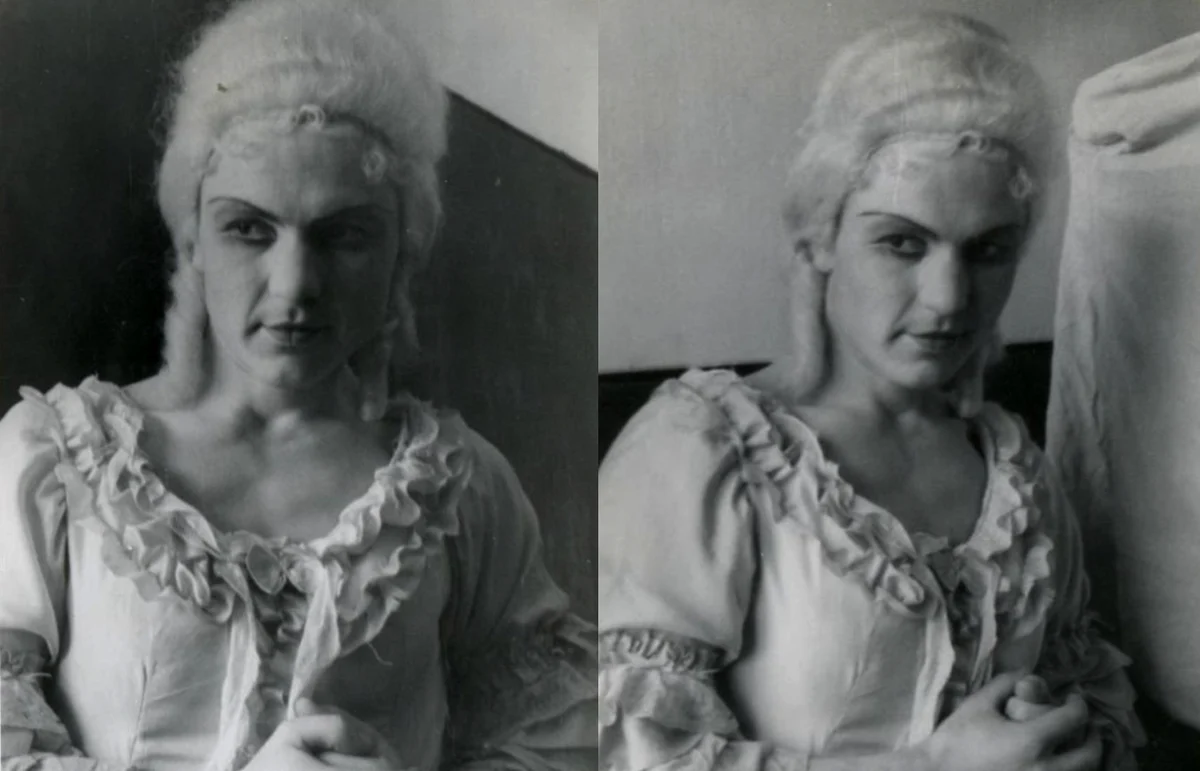
On May 26, 1950, the Altai Regional Drama Theater presented Carlo Goldoni’s comedy The Boors in Barnaul, in the USSR (the Union of Soviet Socialist Republics). In this Venetian play, a young man wearing women’s clothing and a carnival mask secretly meets his future fiancée. The 22-year-old Soviet actor Dementy Parotikov played Filippetto.
The production appeared in the first years after World War II, when Joseph Stalin led the USSR. Barnaul, the center of the Altai region, lay far from the capital, in southern Western Siberia, in the Asian part of Russia.
What Is Known about the Production
On the day of the premiere, the newspaper Altaiskaya pravda printed an announcement for a performance of The Boors at the club of the railroad car repair plant (VRZ). Art historian Aleksandr Zubov dated the premiere to May 26 and named A. N. Karmilov as the director and M. N. Nikolaev as the designer.
Factory clubs served as venues for concerts, film screenings, and plays. At the club of the Barnaul textile mill, for example, both amateur groups and professional performers appeared.
The leadership of the ruling All-Union Communist Party (Bolsheviks) influenced the choice of plays in the USSR. In 1946, its Central Committee required theaters to stage new productions about contemporary Soviet life every year. In the same resolution, the party leadership condemned an enthusiasm for contemporary Western drama.
Foreign classics nevertheless remained in the Barnaul theater’s repertoire, although there were noticeably fewer of them. In 1948, the theater staged Goldoni’s The Mistress of the Inn, and in the fall and winter of 1950 it produced Schiller’s Intrigue and Love and Shakespeare’s Romeo and Juliet.
Dementy Parotikov began studying acting at the theater’s studio in 1944 and later joined its company. Theater scholar Irina Svobodnaya wrote that early in his career he played supporting roles in works by Ostrovsky, Chekhov, and Goldoni. In 1951, he was cast as Baba Yaga, a witch from Russian fairy tales, in The Scarlet Flower. The theater calls his role as Andrei in Viktor Rozov’s play Good Luck, which he performed in the 1954–55 season, a turning point in his career.
Why the Character Wears Women’s Clothing
Goldoni was born in Venice, which in the 18th century was the capital of the independent Venetian Republic. The Boors (I rusteghi), a comedy in three acts written in the local Venetian dialect, was first performed on February 16, 1760, at the San Luca Theater and published in 1762. The Barnaul production appeared nearly two centuries later.
In his preface, Goldoni explained that in Venice a rustego was a coarse, uncouth person unfamiliar with courtesy and pleasant conversation. Several characters in the play fit this description: Lunardo, Maurizio, Simon, and Canciano.
The action takes place during carnival, the name Venetians gave to the festive season before Lent. During those months, people wore masks to celebrations, on visits, and to the theater.
Lunardo and Maurizio agree to marry off their children, Lucietta and Filippetto, but want to keep the young people in the dark until the engagement is announced and deliberately prevent them from seeing each other beforehand.
Filippetto’s aunt Marina and Canciano’s wife Felice help arrange a secret meeting at Lunardo’s house. To get in, Filippetto must dress as a woman: Felice expects that the host will not recognize him in women’s clothing and a mask. If she has to explain who the guest is, she will pass the young man off as her married sister from Milan.
Filippetto arrives with Count Riccardo. In a stage direction, Goldoni specifies that the young man appears in maschera da donna (“in a woman’s mask”). In disguise, Filippetto performs a lady’s curtsy — a bow made by bending the knees slightly — and Riccardo addresses him as a woman, saying “signora mask.” Felice quietly asks Filippetto whether he likes Lucietta. When Marina offers the young man a snuffbox, a small box for powdered tobacco, Felice finds a reason to lift his mask.
Felice. Who takes snuff in a mask?
Lucietta. Oh, how handsome he is!
Marina. What a pretty girl!
Felice. She’s my sister!
Carlo Goldoni, The Boors, translated from the Russian version by Tatyana Shchepkina-Kupernik.
Lucietta finally sees her fiancé’s face, while Marina and Felice continue to pretend that he is an unfamiliar woman. When the men of the house return, Filippetto and Riccardo hide. By the end of the second act, the fathers have learned of the meeting and taken the young people away from each other.
In the third act, Felice stands up for the young couple and explains to the fathers that their rough treatment of their wives and daughters undermines love and trust in the family. Thanks to her intervention, the wedding will go ahead after all.
Accidental Soviet Drag?
Today, drag refers to performances in which artists use clothing, makeup, voice, or gestures to play with conventional ideas of masculinity and femininity. In this sense, Filippetto’s disguise is close to drag: the dress, curtsy, and form of address “signora” create the image of a female guest, although the audience knows from the beginning who is behind the mask. The comedy of the scene rests on that knowledge.
The production ran while Article 154-a was in force. Added to Soviet Russia’s Criminal Code in 1934, it prescribed three to five years’ imprisonment for sexual intercourse between men, including consensual sex. The Soviet authorities also used the article as a pretext to persecute political opponents.
Under Stalin, the theater remained one of the few public places where a man could appear openly before an audience in women’s clothing. In Barnaul, the occasion for such an appearance was a classic play in which the disguise was part of the plot.
Fairy tales offered a similar opportunity in cinema. In Aleksandr Rou’s 1939 film Vasilisa the Beautiful, the actor Georgy Millyar played Baba Yaga. A year after The Boors, Parotikov played the same fairy-tale character onstage. In one production he portrayed a young man mistaken for a woman; in the other, he played a female character.
These roles show how classic comedy and fairy tales allowed performers to play with ideas of masculinity and femininity before an audience in a state that persecuted men for same-sex relations. For Soviet LGBT people, the theater could thus be a space where such play found a place onstage, even if it was confined to a role.
Literature and Sources
- Алтайская краевая универсальная научная библиотека имени В. Я. Шишкова [V. Ya. Shishkov Altai Regional Universal Research Library]. “Дом культуры Барнаульского меланжевого комбината (ДК БМК) [House of Culture of the Barnaul Melange Mill (DK BMK)].” Весь Алтай [All Altai].
- Алтайская правда [Altai Truth]. Theater notices, p. 4. No. 123 of May 26, no. 126 of May 30, and no. 127 of May 31, 1950.
- Алтайский краевой театр драмы [Altai Regional Drama Theater]. “Дементий Паротиков [Dementy Parotikov].” Theater website.
- Алтайский краевой театр драмы [Altai Regional Drama Theater]. “История театра. 1950-е годы [History of the Theater: The 1950s].” Theater website.
- ВЦИК и СНК РСФСР [All-Russian Central Executive Committee and Council of People’s Commissars of the RSFSR]. “О дополнении Уголовного кодекса РСФСР статьёй 154-а [On Adding Article 154-a to the Criminal Code of the RSFSR].” Resolution of April 1, 1934.
- Гольдони, Карло [Goldoni, Carlo]. “Самодуры [The Boors].” Translated by T. L. Shchepkina-Kupernik. In Комедии [Comedies], vol. 2, 3–74. Leningrad, Moscow: Искусство, 1959. Act 2, scenes 11–15. Act 3, scene 2.
- Государственный архив Российской Федерации [State Archive of the Russian Federation]. “Образование и распад СССР [The Formation and Dissolution of the USSR].” Archive website.
- Государственный музей истории литературы, искусства и культуры Алтая [State Museum of the History of Literature, Art, and Culture of Altai]. “Личный фонд актёра Дементия Гавриловича Паротикова [Personal Papers of the Actor Dementy Gavrilovich Parotikov].”
- Госфильмофонд России [Gosfilmofond of Russia]. “Сказки 1930-х–1940-х годов на YouTube-канале Госфильмофонда России [Fairy Tales of the 1930s–1940s on the Gosfilmofond of Russia YouTube Channel].” April 9, 2020.
- Зубов, Александр Евгеньевич [Zubov, Aleksandr Evgenievich]. Сценография театров Барнаула и Новосибирска 1945–1990 годов [Stage Design in the Theaters of Barnaul and Novosibirsk, 1945–1990]. Candidate’s dissertation. Barnaul, 2009. Appendix 4, pp. 183–184.
- Конституция (Основной Закон) Союза Советских Социалистических Республик [Constitution (Fundamental Law) of the Union of Soviet Socialist Republics]. December 5, 1936. Articles 13 and 126.
- “О Барнауле [About Barnaul].” Туристическая карта гостя города Барнаула [Barnaul Tourist Guest Map].
- Оргбюро ЦК ВКП(б) [Orgburo of the Central Committee of the All-Union Communist Party (Bolsheviks)]. “О репертуаре драматических театров и мерах по его улучшению [On the Repertoire of Drama Theaters and Measures to Improve It].” Resolution of August 26, 1946.
- Президиум ЦИК СССР [Presidium of the Central Executive Committee of the USSR]. “Об уголовной ответственности за мужеложство [On Criminal Liability for Male Same-Sex Intercourse].” Resolution of March 7, 1934.
- Свободная, Ирина [Svobodnaya, Irina]. “75 лет со дня рождения народного артиста России, актёра Алтайского краевого театра драмы, почётного гражданина Алтайского края Д. Г. Паротикова [75 Years since the Birth of D. G. Parotikov, People’s Artist of Russia, Actor of the Altai Regional Drama Theater, and Honorary Citizen of the Altai Region].” In Барнаульский хронограф. 2002 год [Barnaul Chronograph: 2002], 20–22. Barnaul, 2001.
- Уголовный кодекс РСФСР [Criminal Code of the RSFSR]. October 27, 1960.
- Bloomfield, Jacob. Drag: A British History. Oakland: University of California Press, 2023.
- Casa di Carlo Goldoni. “Carlo Goldoni.” Fondazione Musei Civici di Venezia.
- Goldoni, Carlo. “I rusteghi [The Boors].” In Opere complete di Carlo Goldoni [Complete Works of Carlo Goldoni], vol. 18, edited by Giuseppe Ortolani. Venezia: Municipio di Venezia, 1914. Preface, pp. 17–18. Acts 1 and 2, pp. 21–80. First published in Venice in 1762.
- Healey, Dan. Homosexual Desire in Revolutionary Russia: The Regulation of Sexual and Gender Dissent. Chicago: University of Chicago Press, 2001.
- Schmid, Vanessa. “Behind the mask in 18th-century Venice.” New Orleans Museum of Art, March 21, 2017.