The Story and Controversy Around the LGBT Military Unit TQILA During the War Against ISIS in Syria
In 2017, the first LGBT military unit appeared in Syria to fight ISIS. It drew both admiration and criticism.
Contents
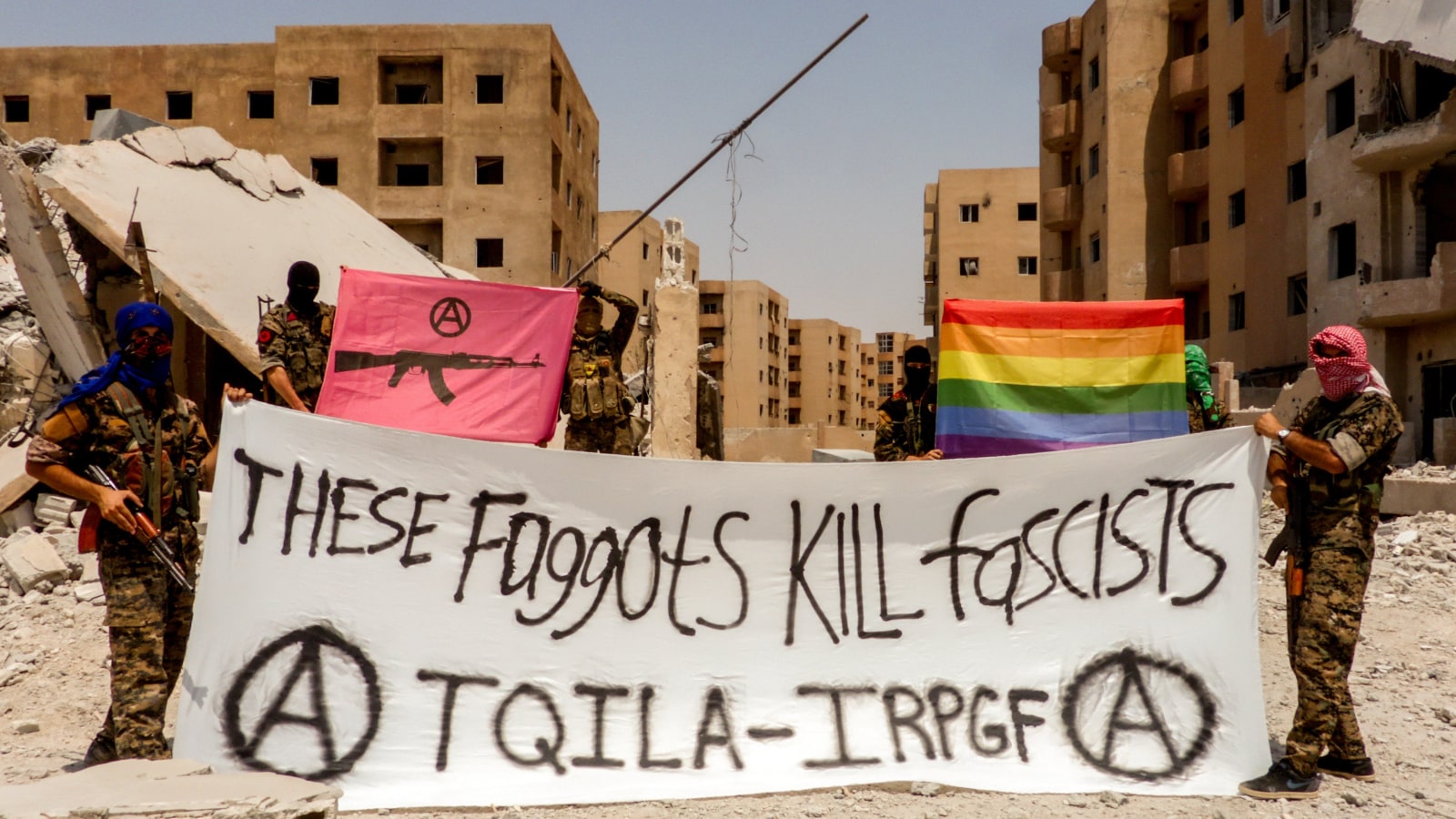
In 2017, an international group of volunteers fighting alongside the Kurdish-led Syrian Democratic Forces against the terrorist organization ISIS in northern Syria announced the creation of what it described as the first LGBT military unit in history. The unit was called the Queer Insurrection and Liberation Army (TQILA — pronounced like “tequila”) and was formed within the International Revolutionary People’s Guerrilla Forces (IRPGF).
The announcement quickly drew global attention and prompted strong public reactions. Responses were sharply divided: some welcomed the initiative with enthusiasm and support, while others met it with criticism and skepticism.
Before the Syrian civil war began in 2011, same-sex relationships were formally illegal, with penalties of up to three years in prison. In practice, enforcement was inconsistent, and LGBT people generally tried to remain out of sight.
Queer culture existed mostly in informal and hidden forms. In major cities such as Damascus and Aleppo, there were gay-friendly bars and gay hammams (traditional bathhouses).
The Start Of The Civil War And The Rise Of ISIS
The situation changed dramatically after the uprising against Bashar al-Assad’s regime began in 2011. Protests soon escalated into civil war, and by 2014 the conflict was further reshaped by the emergence of ISIS on Syrian territory.
Seeking to impose a strict version of Sharia rule, ISIS introduced particularly brutal repression against LGBT people. In areas under its control, homosexuality became punishable by death, and executions were often public and staged as intimidation.
After capturing people suspected of belonging to the LGBT community, ISIS members often searched their phones and contact lists to identify other presumed gay people.
One of the most infamous execution methods involved throwing convicted people from rooftops in front of crowds. If someone survived the fall, spectators would then stone them to death.
By 2017, the war in Syria had reached an extreme level of violence. Against this background, many international volunteers joined the fight against ISIS on the side of Kurdish armed formations.
Kurdish Forces And The Autonomous Region Of Rojava
Kurds in Syria are a significant minority, living mainly in the country’s north-eastern regions. Before the civil war began in 2011, their rights were often restricted. After the conflict started, Kurdish communities became more visible in efforts to defend their territories and pursue autonomy.
Rojava (from Kurdish — “the West”) is an autonomous region in north-eastern Syria proclaimed by Kurds in 2012. Officially, it is called the Autonomous Administration of North and East Syria. Within this system, principles of direct democracy, libertarian decentralization, and gender equality are publicly declared.
The region became a “third force” in the civil war, seeking to preserve its autonomy from both the Syrian government and Islamist opposition forces.
The Syrian Democratic Forces (SDF) are an armed coalition formed in 2015 under the leadership of the Kurdish People’s Protection Units (YPG) and the Women’s Protection Units (YPJ). Yes, the situation in Syria really is this confusing, with so many abbreviations.
The SDF includes members of various ethnic and religious groups, including Arabs, Assyrians, and Christians. Its main mission is to fight ISIS and defend Rojava’s autonomous territories.
Kurdish armed formations publicly declare equality between men and women. Women participate in combat and hold command positions, and separate women’s units were also created, including the YPJ.
The Creation Of “Gay Fighters”
In March 2017, a battalion called the International Revolutionary People’s Guerrilla Forces (IRPGF) was formed in Rojava. Using the symbol of an AK-47 on a pink flag, the group said it was inspired by the example of foreign volunteers during the Spanish Civil War. The IRPGF’s main goal was to support Kurdish forces fighting ISIS.
The battalion’s formation coincided with preparations for a major offensive that ended with the liberation of Raqqa in June 2017. The operation was carried out with support from a coalition led by the United States.
In July 2017, the IRPGF announced the creation of a unit called the Queer Insurrection and Liberation Army (TQILA). In a statement published on social media, participants said their goal was to fight for the destruction of the gender binary, promote the women’s revolution, and expand gender and sexual freedom.
According to participants, TQILA was created in response to ISIS’s brutal attacks on queer people worldwide. They said they could not remain passive as people were persecuted and killed on the pretext that their orientation was supposedly “abnormal” or “unnatural.”
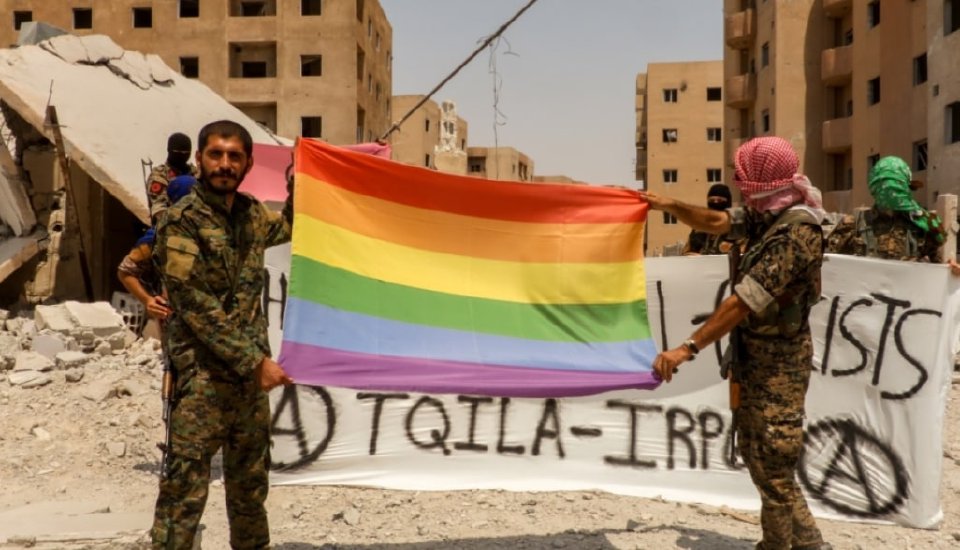
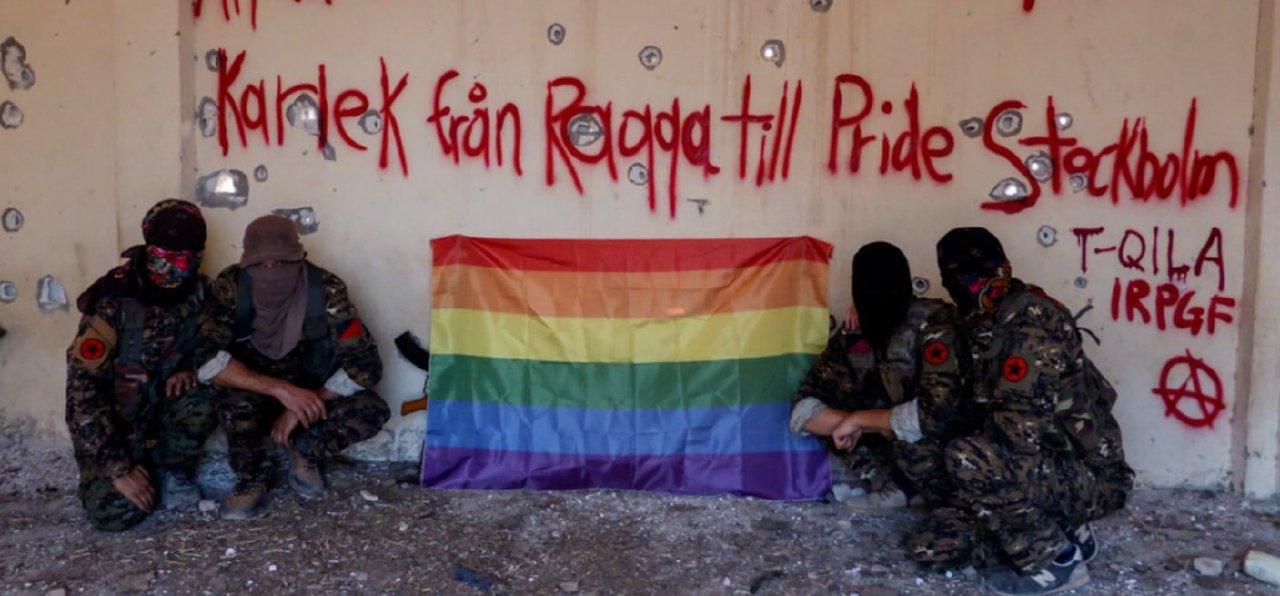
Despite public statements and the release of a few photographs taken in Raqqa, very little is known about TQILA’s actual activity. Information about the unit’s size, and about what share of its members identified as LGBT, remains unclear.
A group representative, Heval Rojhilat (heval — a Kurdish form of address meaning roughly “comrade”), told Newsweek in 2017 that he would not reveal the exact number of fighters for security reasons.
Allies’ Reactions And Internal Disputes
The creation of an LGBT unit prompted mixed reactions, including criticism from allies. The People’s Protection Units (YPG) and the Arab–Kurdish coalition of the Syrian Democratic Forces (SDF) reportedly expressed dissatisfaction.
It remained unclear how actively the unit participated in combat, particularly during the operation to liberate Raqqa — then the de facto capital of ISIS.
According to media reports, the SDF allegedly removed not only the LGBT unit TQILA but also their parent organization, the IRPGF, from participation in the offensive. As evidence, a purported SDF representative wrote on Twitter: “IRPGF were kicked out of Raqqa yesterday, and we hope they will soon leave Rojava as well. We need less empty propaganda and more real fighting.” That tweet was later deleted.
Later, SDF representatives officially denied both any connection to these groups and even their existence. The head of SDF media relations, Mustafa Bali, stated: “There are no units with such a structure within the SDF.” In response, the IRPGF emphasized its independence, saying it had the right to create its own sub-groups and did not need anyone’s permission.
In 2024, an anonymous Kurdish queer activist from Rojava told the Portuguese magazine Mapa that the photo was most likely part of a flash mob action (a staged, short public action meant to draw attention).
Criticism From Scholars And Activists
Al Jazeera published a piece by Syrian–Palestinian scholar and activist Razan Ghazzawi, in which she sharply criticized the very idea of creating this battalion. From a decolonial perspective, Ghazzawi argued that such initiatives — including so-called “gender and sexual revolutions” — erase other forms of resistance and distort how struggle in Syria is understood.
She also argued that the participation of foreigners in TQILA turns an armed conflict into a romanticized adventure and pushes local voices aside. In addition, Ghazzawi claimed that Kurdish forces that support such units represent an authoritarian structure.
Her position was reinforced in the same article by statements from Ziya Gorani, a trans woman of Kurdish origin:
We do not know who exactly is in this group [TQILA], and it is unknown whether its members are Kurds or Syrians. It is just a group of international fighters from the YPG trying to create the illusion that LGBT people can live peacefully in Rojava without fear of discrimination. But this is false. Things are not at all the way they are trying to show.
— Ziya Gorani
In response, Kurdish scholar and activist Hakan Sandal published an article accusing Ghazzawi herself of colonialism. He argued that her analysis, which describes TQILA as a colonial phenomenon, in fact reproduces Turkish and Arab colonial frameworks — making Kurdish resistance history, and Kurds’ experience of oppression by four different states, invisible.
Sandal wrote:
When it comes to the Kurdish struggle in Syria, the article reproduces colonial frameworks, making Kurds’ history of resistance, their memory of colonialism, and their experience of oppression by four different states invisible. Ghazzawi’s critique is directed not only at the colonial/white appropriation of queer struggle, but also at the Kurdish struggle in Syria. The author’s sharp turn from a decolonizing queer perspective to an anti-Rojava narrative makes the article’s intention ambiguous. Instead of undermining the colonial form of knowledge criticized in the piece, the author redirects the colonial gaze toward Kurds. As a result, the article itself, unfortunately, becomes a typical anti-Rojava interpretation disguised as a well-argued decolonial queer text.
— Hakan Sandal
In Sandal’s view, Ghazzawi’s approach echoes the rhetoric of the Turkish state, which has historically supported colonial domination over Kurds and has worked to prevent any change to the status quo in Syria.
In his article, Sandal also stressed that neither Kurdish nor international activists ever claimed that Rojava is a paradise for LGBT people:
We, as Kurdish LGBT activists, understand the reality of our societies and work to create space for our existence. At the same time, the discourse around TQILA and the IRPGF must remain a subject of critical analysis, but with attention to the historical context of different forms of struggle.
— Hakan Sandal
The Dissolution Of The IRPGF
On September 24, 2018, the IRPGF officially announced its dissolution. As a result, TQILA also ceased to exist.
It is possible that TQILA was part of the IRPGF’s media strategy — aimed at attracting global attention to Kurdish forces’ fight against ISIS.
But.
Raising the LGBT flag in Raqqa during active fighting became a visible symbol of solidarity even under the most extreme conditions.
It is reasonable to assume that LGBT people were present both in the ranks of the Syrian Democratic Forces and within the IRPGF. Some foreign volunteers spoke openly about their orientation and posted about it on social media.
At the same time, LGBT people were also present among Kurdish soldiers, but lower levels of acceptance in local society limited the ability to express identity openly.
Finally, the autonomous region of Rojava, despite the ongoing conflict, showed — and continues to show — a comparatively more accepting attitude toward LGBT people than ISIS, Islamist opposition forces, and Assad’s regime. For example, Rojava’s temporary constitution does not mention sexual orientation, and there is no separate punishment specified for it.
 Subscribe to our Telegram channel (in Russian): Urania. With Telegram Premium, you can translate posts in-app. Without it, many posts link to our website, where you can switch languages — most new articles are published in multiple languages from the start.