Why German Gay Men Vote for the Alternative for Germany
Results of a poll by the gay dating app Romeo.
Contents
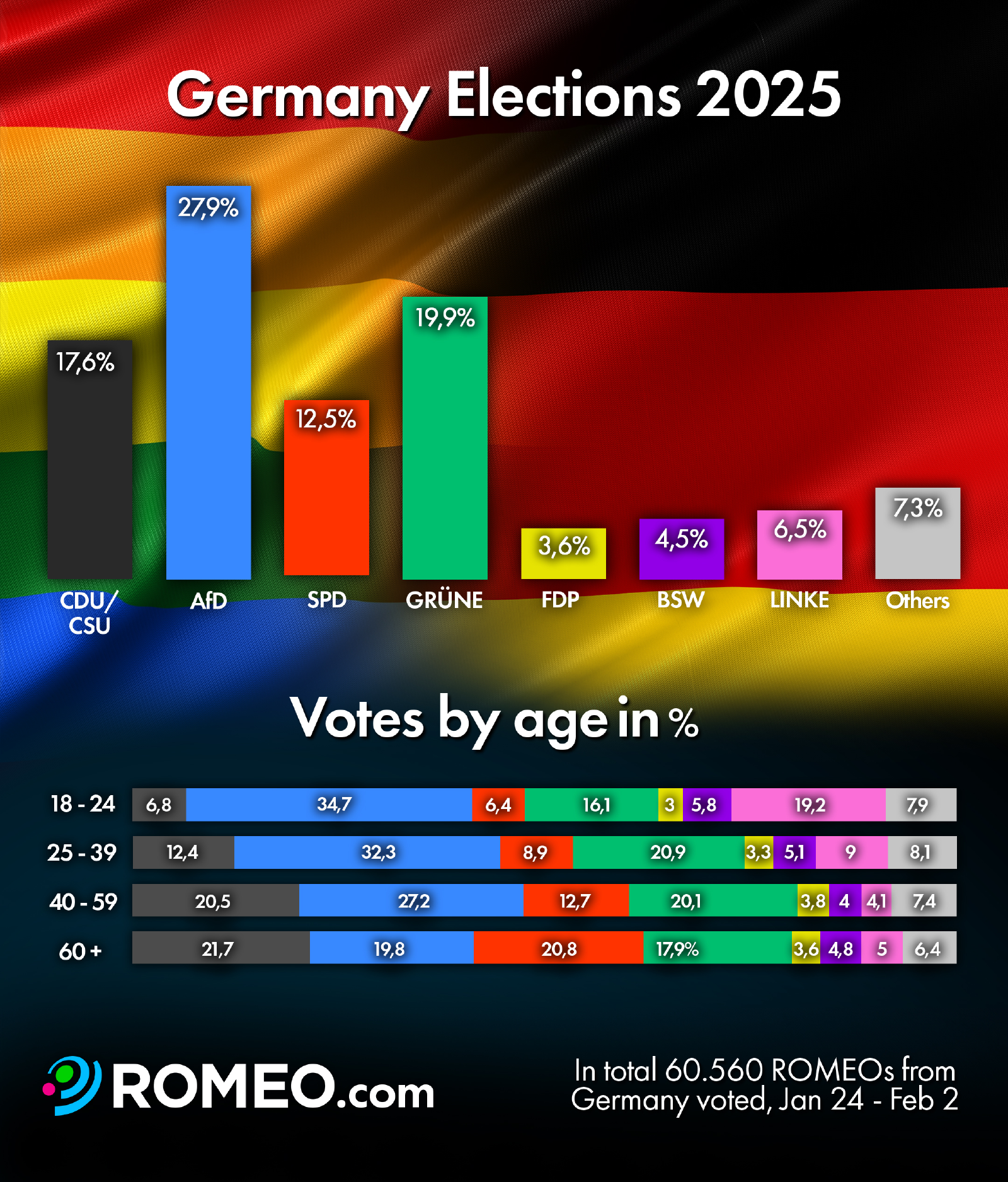
The Alternative for Germany (AfD) recorded the highest level of support among users of the Romeo dating platform, which is aimed at gay and bisexual men. In a poll conducted from January 24 to February 2, more than 60,000 respondents reported their preferences for the federal election. The AfD received 27.9% of the vote. At a clear distance were the Greens (19.9%), the Christian Democratic Union (17.6%), and the Social Democratic Party of Germany (12.5%).
The AfD performed most strongly among younger respondents. In the 18–24 age group, 34.7% supported the party. In the same group, the Left Party also posted a notable result – 19.2%. By contrast, the political center, represented by traditional parties, was less prominent in this age category.
In the 25–39 age group, the AfD remained high – 32.3%. Among older respondents, preferences shifted toward the CDU/CSU and the SPD. (CDU/CSU: the Christian Democratic Union and its Bavarian sister party, the Christian Social Union. SPD: the Social Democratic Party of Germany.)
Even so, the poll cannot be treated as fully representative or strictly scientific. Nevertheless, it raises a broader question: what makes the AfD appealing to some gay men, and why do some not only vote for it, but also join the party?
Why Do Gay Men Choose the AfD?
In addition to the widely known Alice Weidel, the party includes openly gay politicians. These include Kay Gottschalk and Sven Tritschler, as well as Alex Tassis, a historian who ran for the AfD in one of Potsdam’s constituencies. He was born in Athens in 1970 to a Greek father and a German mother and later moved to Germany. As a gay man with a migration background (i.e., someone with personal or family roots in immigration), he became an active supporter of the AfD.
“While right-wing nationalists and radicals such as Björn Höcke are openly homophobic, the AfD also has activists and groups who do not hide their homosexuality. Being gay and holding right-wing views are not mutually exclusive.”
– political scientist Katharina Haake
Katharina Haake argues that the AfD is not a monolithic organization, as different currents coexist within the party. On the one hand, it promotes traditional family values; on the other, it tolerates a range of life paths. At the same time, unlike the Greens or the Left Party, the party program does not set out a clearly defined policy on LGBT issues. (LGBT: lesbian, gay, bisexual, and transgender.)
Homonationalism
Haake also notes that after the events of “Cologne New Year’s Eve” in 2015 – when migrants were implicated in mass attacks on women – the AfD partly began to present itself as a defender of LGBT rights in the context of public safety. The party’s core narrative is that misogyny, sexual violence, and homophobia were allegedly brought into Germany primarily by migrants from Muslim-majority countries. From this perspective follow demands to tighten immigration policy and deport those considered a threat.
For some voters, it matters that politicians treat LGBT rights as a top priority. However, the poll suggests that a substantial share of gay men and lesbians place other political issues first.
In Berlin’s “Rainbow District” around Nollendorfplatz – known for its gay bars and pubs – attacks on LGBT people remain part of everyday life. The newspaper Berliner Tagesspiegel wrote back in 2009 that “perpetrators are often migrants.”
The newspaper Preußische Allgemeine Zeitung argues that the situation has not fundamentally changed since then. In its account, those responsible for violence in this area are most often young people with a migration background who were raised with conservative views. As a result, victims of such attacks may take a critical view of those who argue for uncontrolled immigration.
At the same time, other outlets argue that this picture does not reflect reality. For example, police data indicate that 1,051 hate crimes against lesbians, gay men, bisexual people, transgender people, and intersex people were recorded in 2021. Of these, only 20 were committed by foreigners.
On forums and social media, gay AfD supporters describe their own experiences, referring to attackers as “misogynists and homophobes from the Global South” (a broad term for less affluent regions, often contrasted with the “Global North”). They also speak of “hatred toward everything male and German” and describe themselves as “gay patriots.”
The outlet zdfheute quotes one gay man who supports the AfD:
Right-wingers or Germans have never attacked me, but Arabs, Turks, and refugees have. I think you can guess that I’m gay. And it’s precisely this group of people that has a problem with my sexuality.
— from an interview with a homosexual AfD supporter, quoted in a zdfheute article
In other words, many voters choose the AfD not because of its positions on LGBT issues, but because they believe the party will protect them more effectively than others from what they see as the most serious threats.
 Subscribe to our Telegram channel (in Russian): Urania. With Telegram Premium, you can translate posts in-app. Without it, many posts link to our website, where you can switch languages — most new articles are published in multiple languages from the start.