Saint Moses the Hungarian – One of the First Queer Figures in Russian History?
The life of a monk who rejected marriage, was castrated, and became a saint, and how Rozanov, Slavists, and other scholars read it.
Contents
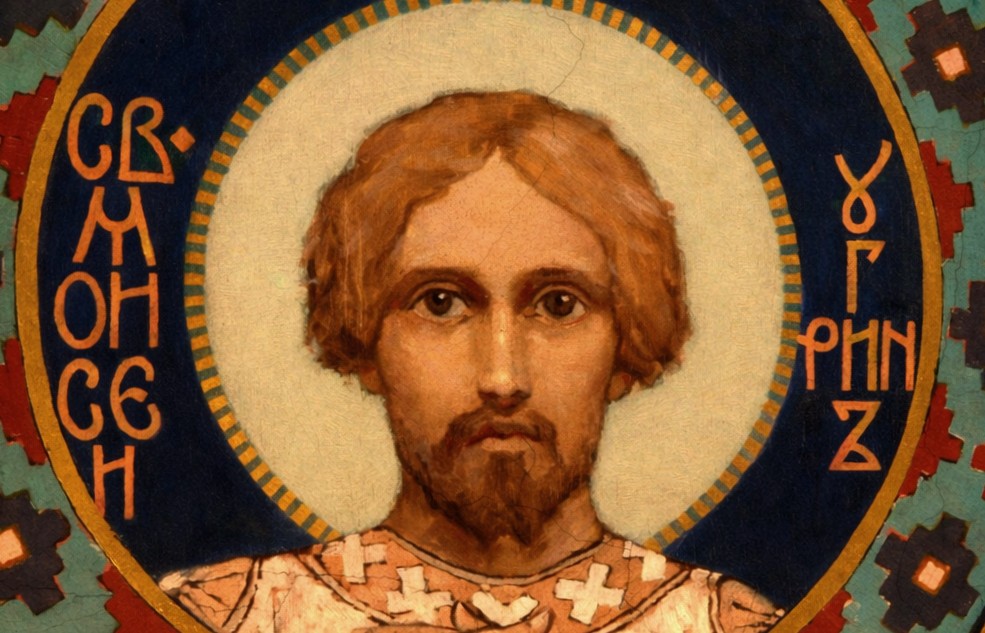
The Life of the Venerable Moses the Hungarian is one of the most unusual texts in Old Russian hagiography. A monk of the Kyiv Cave Monastery who was taken captive to Poland, he refused for years to marry a wealthy and powerful woman, was castrated for it, and was later canonized as a model of chastity.
For centuries, this story was read as a tale of the spirit triumphing over the flesh. In the early 20th century, the philosopher Vasily Rozanov saw something different: the biography of a person whose nature precluded heterosexual desire. Later, Western Slavicists and gender scholars proposed their own interpretations. Each challenges the conventional reading of this hagiography in its own way.
How Sexuality Was Understood at the Time
The Life cannot be read outside the context of sexual ethics in Old Rus’, particularly the Kyivan period of the 10th–13th centuries.
The Orthodox Church condemned above all the act of extramarital sex itself – fornication – rather than the sex of the participants. The historian Eve Levin emphasizes: Old Russian society described sexuality through the category of action – sin or virtue – rather than through the category of identity. The concept of “the homosexual” as a distinct human type did not exist in Kyivan Rus'.
This did not amount to tolerance in the modern sense. Violations of sexual norms were condemned, but they generally did not lead to physical destruction. The punishments were penance and abstinence, not execution. Compared with England, France, or Spain during the same period, the conditions for people with non-normative sexuality were different.
Monastic literary culture was developing its own ideal: a complete renunciation of all carnal passion, whether heterosexual or homosexual. It is at the intersection of this ascetic ideal and the diversity of human inclinations that the story of Moses the Hungarian unfolds.
The Life of Moses the Hungarian
The main source of information about Moses is the Kyiv Cave Paterikon, a collection of the lives of the earliest Russian monks. As a unified text, the Paterikon took shape in the 1220s, but drew on oral traditions and written records from the 11th century. The Life was later reworked by Saint Dimitry of Rostov in his Menaion. Both versions stand out for their focus on corporeality, sexual coercion, and physical violence.
According to the Paterikon, Moses came from Hungary – hence his epithet “the Hungarian.” Together with his brothers Ephraim and George, he entered service at the court of the Kyivan prince. George served as a squire to Prince Boris. In Dimitry of Rostov’s version, Moses is called the “favorite” of the holy Prince Boris, and George wore a golden torque bestowed on him by Boris himself – a detail underscoring the unusual closeness between servant and lord.
In 1015, during the fratricidal war launched by Sviatopolk the Accursed, hired assassins killed Boris and his retinue. George died defending the prince. Of the entire entourage, only Moses survived. He found refuge in Kyiv, at the court of Predslava, sister of Yaroslav the Wise.
In 1018, the Polish king Bolesław I the Brave intervened in the Russian civil strife. He captured Kyiv and carried off many captives to Poland – among them Moses, reduced from a courtier to a slave without rights.
Captivity in Poland and the Campaign of Seduction
The Polish period forms the core of the narrative. Tall, strong, and physically attractive, Moses became the object of an obsessive passion on the part of a wealthy Polish widow. She purchased him for a great sum and mounted a prolonged campaign of seduction.
The Paterikon presents this as an inversion of the usual gender roles: a woman endowed with wealth, status, and absolute power forces a male slave.
The widow offered Moses freedom, riches, authority over her estates, and the status of a lawful husband. She dressed him in fine clothes, fed him lavish food, tried to win him over through tenderness. The Paterikon records her words:
“I shall redeem you, make you a man of rank, set you as lord over my whole household, and you shall be my husband – only do my will, satisfy the desire of my soul, let me take pleasure in your beauty.”
Moses responded with unwavering refusal. He rejected not only intimacy but the very possibility of heterosexual marriage – invoking the fear of God and his intention to take monastic vows, tearing off the fine clothes, choosing hunger.
“What man ever took a woman, submitted to her, and was saved? Adam the first man submitted to a woman and was driven from Paradise. […] How then shall I, a free man, make myself a slave to a woman, when from the day of my birth I have never been intimate with women?”
Other captives urged Moses to submit: he was not a monk, the widow was beautiful and rich, and marriage was sanctioned by the apostles themselves. Moses answered, comparing their persuasion to the whispers of the serpent in Paradise:
“Let all the righteous have been saved with wives – I alone am a sinner and cannot be saved with a wife.”
And concluded with a direct challenge:
“Let it be known to you who care for me that never shall the beauty of a woman beguile me, never shall it separate me from the love of Christ.”
When neither bribery nor caresses produced any effect, the widow turned to violence. Moses was beaten, locked in a dungeon, and starved.
Castration and Return
The climax came when the widow, driven to a frenzy, resorted to extreme cruelty. The Paterikon describes the punishment with unusual graphic detail:
“The widow ordered that he be given a hundred lashes every day, and then commanded that his private parts be cut off, saying: ‘I will not spare his beauty, so that others may not enjoy it.’ And Moses lay as dead, bleeding profusely, barely breathing.”
The mutilation paradoxically resolved the conflict: Moses was permanently removed from the marriage market.
In 1025, Bolesław the Brave died, uprisings broke out in Poland, and Moses gained his freedom. He returned to Kyiv, took monastic vows at the Kyiv Cave Monastery, and spent about ten years there. In total, he had been in captivity for eleven years: five in chains under his first owner and six in the widow’s house.
The Paterikon presents Moses as an ascetic who received from God the gift of healing monks of carnal temptation. Because of his wounds, he could not walk without a staff. The Paterikon records a characteristic episode:
“One of the brethren, seized by carnal passion, came to this venerable one and begged him for help, saying: ‘I vow to keep until death everything you command me.’ The blessed one said to him: ‘Never in all your life speak a single word to any woman.’ He promised with love to fulfil this.”
Moses struck the brother with his staff in the groin – “and at once his members grew numb, and from that time there was no more temptation for that brother.”
Moses died on July 26, 1043. The Church canonized him. His relics were venerated as wonder-working: the Venerable John the Long-Suffering, fighting carnal temptations, buried himself up to his shoulders opposite the relics of Moses and after praying was delivered from the “impure warfare.”
How Rozanov Read This
Until the 20th century, the Life of Moses was read in strictly orthodox terms: as an example of the Christian will’s victory over fleshly temptation. A radical reassessment came from the philosopher Vasily Rozanov.
In 1911 he published People of Moonlight: The Metaphysics of Christianity – an unusually frank treatise for its time on same-sex love, the psychology of celibacy, and a critique of Christian asceticism.
Rozanov was full of contradictions. A passionate champion of the family, Old Testament fecundity, and reproductive sex, he attacked Christian asceticism and monastic celibacy – while simultaneously defending the “naturalness” of same-sex love for a certain category of people.
To describe this category he borrowed the idea of a “third sex” from European sexologists Karl Heinrich Ulrichs and Magnus Hirschfeld, calling such people “people of moonlight.” He was convinced that homosexuality had often been historically hidden behind the mask of religious celibacy.
The Initial Interpretation: The “Third Sex”
This is precisely how Rozanov initially read the Life of Moses. He saw in it no ascetic feat. Moses, in Rozanov’s reading, was not overcoming desire for a woman – he had no such desire to begin with.
Rozanov was struck by the logic of the act. Why would a young, strong, healthy male slave refuse freedom, wealth, high status, and intimacy with a woman – choosing instead starvation, torture, and castration? The answer: contact with the female body was physiologically and psychologically impossible for Moses.
“This entire story, in its pattern, coincides to a striking degree with what biologists report about attempts to couple a man-maiden with a woman. The insuperable revulsion is the same as that which actus sodomiticus [a homosexual act] provokes in us, the normal, ordinary people. And one cannot fail to point out, for the benefit of legislators, physicians, and parents, that attempts to ‘marry off’ […] these subjects of the ’third sex’ are exactly equivalent to criminal and horrifying attempts to sodomize them.”
Rozanov asserted: for Moses – a representative of the “third sex” – a heterosexual act was an impossibility that provoked the same revulsion a heterosexual man would feel if forced into homosexual contact.
In Moses’s story, Rozanov saw the key to the entire institution of monasticism:
“The story of Moses the Hungarian, naively and sincerely told, with his so clearly expressed physiological nature, lifts the veil over the whole matter. This ‘story’ ought to be engraved on copper and nailed to the gates of every monastery.”
Moses became proof of Rozanov’s central thesis: monastic celibacy was not a victory of the will over nature, but a refuge for people whose nature made marriage to a woman impossible. By stripping Moses’s act of its halo of martyrdom, Rozanov shifted his tragedy into the domain of biological predetermination and social cruelty.
Rozanov Revises His Position
In the same edition – in the section “Corrections and Additions by an Anonymous Correspondent” – Rozanov published criticism from an anonymous correspondent and, in a move rare for him, fully agreed with it.
The anonymous correspondent addressed Rozanov directly: “Are you certain of your interpretation? Is it not too much – to disbelieve his own direct testimony, ‘I can, but I will not,’ and to maintain instead that he ‘cannot’?” Moses’s resistance was an ordinary masculine reaction to female aggression, not a manifestation of homosexuality. A real man does not tolerate a woman seizing the initiative; the more insistently she demands, the more unyielding his resistance – not because he is incapable of intimacy, but because his masculine pride has been wounded. The correspondent cited psychopathology: an obsessive idea can paralyze any natural drive – hunger, thirst, sexual desire – for months, years, and even an entire lifetime.
The correspondent also noted: had that woman treated Moses differently – calmly and without coercion – the outcome might have been different. But when a person is grabbed, ordered, bribed, beaten – “what, tell me, was left for him to do, other than what he did?” He drew a parallel with Joseph: he too tore himself away from Potiphar’s wife – in indignation, not from lack of desire; when he acted on his own initiative, he had children. The correspondent appealed even to Rozanov’s personal experience: if Rozanov himself were “seized on the street by some woman who, now offering money, now beating him over the head with an umbrella, began demanding” his favors, he too “would have cursed and spat, preferring to end up at the police station on the woman’s complaint rather than in her boudoir.”
Rozanov responded with a detailed note:
“I am in deep agreement with the entire explanation regarding the venerable Moses the Hungarian. First of all, let us honor his suffering […] I myself found it unpleasant to write this, and I am glad to withdraw from any reproach or suspicion of abnormality in the Venerable One.”
Having abandoned his diagnosis of Moses himself, Rozanov redirected criticism to the author of the hagiography. A case of natural masculine resistance “before a brazen woman” had been turned by the pious writer into “a kind of Uranistic confession of enmity toward womanliness, toward femaleness, toward femininity” – Rozanov called this “positively unbearable, heretical, and historically deeply harmful.”
Rozanov’s final judgment carried a new contradiction: “And Moses was truly beautiful. […] The righteous are righteous – whether they ‘do’ something, it is good, and if they ‘do not,’ it is also good. And in general things are ‘good’ with them and around them, and this is the essence of righteousness.” For a philosopher who considered “the beautiful” inseparable from “the righteous,” this was the highest praise – but it moves Moses from the category of a “clinical case” into the category of a “saint,” undermining his own original theory.
How Karlinsky Read This
The historian Simon Karlinsky placed the story of the Hungarian brothers within a broader, hidden homoerotic tradition in Russian culture. He noted the influence of the biblical story of Joseph and Potiphar’s wife and observed that the Life is pervaded by hostility toward women and toward sexuality in general – a feature typical of medieval monastic texts.
Karlinsky regarded Rozanov’s method as speculative, but his conclusions as important. The story of Moses matters not as proof of innate physiology, but as an example of a violent clash between an individual and the social and gender role imposed on him.
Moses – a slave deprived of agency – reclaims it through a total refusal to participate in the reproductive system. Karlinsky wrote that the castration was an act of revenge by the owner for “his preference for male partners and the accompanying lack of interest in conventional marriage.” Moses appears as a person whose resistance to the heteronormative order was so uncompromising that it ended in physical mutilation.
Levin’s Interpretation
Eve Levin offers a methodological counterweight to overly modern interpretations. Orthodox theology read Moses’s refusal solely as the highest expression of willpower and grace. What mattered was not what a person’s “nature” might have been, but what he did.
Within the framework of medieval religious thought, Moses is above all an exemplar of ascetic achievement, regardless of his possible inclinations.
Levin acknowledges the social function of monasticism. The monastery provided a legitimate refuge for people who, for psychological, physiological, or social reasons, could not or did not wish to enter the system of heterosexual marriage. The fate of Moses, who found peace in the monastery after his castration, illustrates how this niche operated.
How Mayhew Reads This
An analysis of the Life within the framework of modern gender studies was proposed by the historian Nick Mayhew in his article “Eunuchs and Ascetic Masculinity in Kievan Rus.” He reads the Paterikon as a text in which new forms of gender are constructed.
According to Mayhew, in the story of Moses the classical Christian scheme of imitatio Christi – the imitation of Christ – undergoes a radical transformation. Ideal masculinity is defined here not by authority, marriage, and procreation, but by emasculation and a state in which sexual desire has been entirely eliminated.
Mayhew draws attention to a detail that contradicts Rozanov’s idea of innate predetermination. In conversations with the widow, Moses repeatedly emphasizes that he is physiologically capable of having sex with her but refuses out of the fear of God. For the hagiographer this is crucial: if a person does not desire sin by nature, the refusal cannot count as the highest virtue. The text deliberately stresses that the capacity was present and the refusal was conscious.
In this interpretation, castration becomes a paradoxical act of liberation. The mutilation transfers Moses to the borderline position of a eunuch, removes the tension between flesh and spirit, and makes him the embodiment of a bodiless masculinity. Mayhew writes:
“The castration of Moses the Hungarian subordinates the imitatio Christi schema to ‘castrate’ masculinity in the Paterikon – constructing a form of masculinity defined by the absence of sexual desire. […] Since the castration is effectively caused by Moses’ negation of the flesh, manifest in his consistent refusal to fornicate with the Polish princess, he effectively performs an ultimate act of ‘crucifixion’ upon himself without incurring the guilt of self-castration.”
After his return to the Kyiv Cave Monastery, Moses, according to the Paterikon, acquires the ability to transmit celibacy to others. A monk beset by carnal passion comes for help – Moses touches him with his staff, and the man forever loses all sensation in the genital area.
Mayhew sees here a ritual transmission of “castrate masculinity”: the secular model of manhood based on procreation is subjected to a symbolic castration. Fatherhood in the Paterikon becomes the glorification of impotence: Moses is described as the “father” of his flock, but this patriarchal structure contradicts the patriarchal structure of the secular world.
Can Moses Be Considered a Queer Figure?
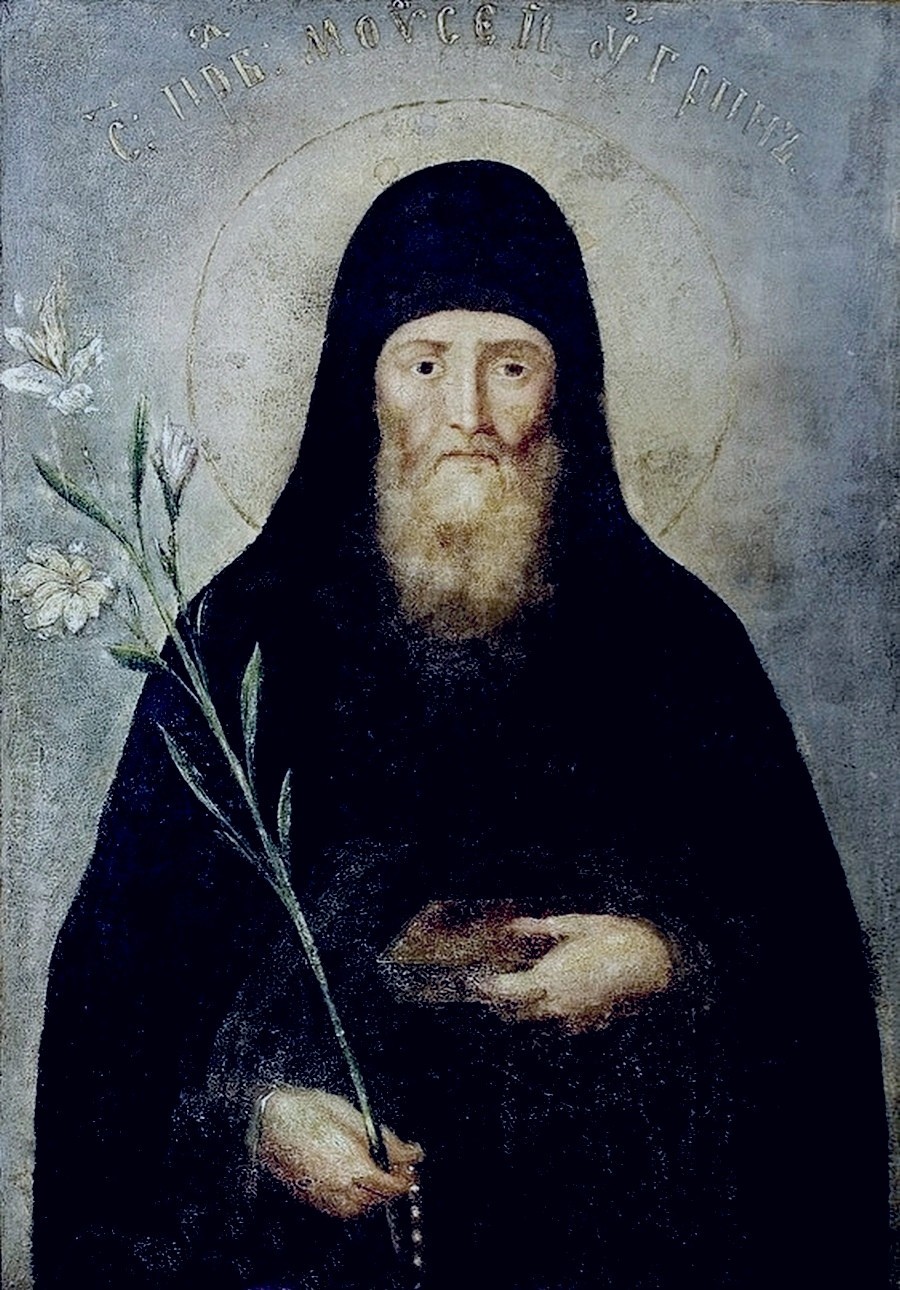
The question requires methodological precision. From the standpoint of historical sexology – the work of Michel Foucault and David Halperin – the answer is negative. Identities such as “homosexual” or “queer person” formed within medical, legal, and social discourses no earlier than the late 19th century. In Kyivan Rus’, sexual practices and social roles existed, but not sexual identities in the modern psychological sense. To call an 11th-century monk a “queer person” is to project modern categories onto the distant past.
In a broader sense, however, the Life of Moses does lend itself to a queer reading.
First, Moses radically refuses the system in which a person is expected to marry and have children. By rejecting the widow’s offer, he rejects not only sexual intercourse but integration into the system of inheritance, the exchange of capital, and the continuation of the line. In a society where dynastic and marital ties were the basic mechanism of survival, this was a violation of the social norm.
Second, his story breaks down the rigid division into male and female. After castration, Moses exits the “man/woman” framework and occupies the position of a eunuch. As Mayhew shows, this does not render him sexless; rather, it creates an alternative masculinity grounded not in phallic dominance but in imperviousness to passion.
Third, the Life demonstrates alternative kinship. Having severed blood ties and refused marriage, Moses finds a new family in the homosocial space of the Kyiv Cave Monastery, where spiritual bonds – between teacher and disciple, between brothers in Christ – are valued above biological ones.
The conclusion: it is impossible to reconstruct Moses’s actual psychosexual profile from a hagiographic text. His refusal may have been driven by religious conviction, as the Paterikon asserts. But for the history of ideas what matters more is how this plot functioned within culture. For centuries, the figure of Moses the Hungarian served as a screen onto which society projected its conceptions of corporeality, sex, and sexuality – from the medieval horror of carnal sin to Rozanov’s theory of the “third sex” and the idea that gender manifests through roles and behavior.
Full text of the Life of Moses the Hungarian (from the Kyiv Cave Paterikon)
This is what is known about the blessed Moses the Hungarian, whom the holy Boris loved. He was Hungarian by birth, brother of that George upon whom the holy Boris had placed a golden torque and who was killed alongside the holy Boris on the Alta, his head severed for the sake of the golden torque. This same Moses alone escaped death at that time, fleeing a bitter end, and he came to Predslava, the sister of Yaroslav, and remained there. And since at that time it was impossible to go anywhere, he, strong of soul, remained here and abode in prayer to God until the pious prince Yaroslav, moved by ardent love for his murdered brothers, marched against their killer and defeated the godless, cruel, and accursed Sviatopolk. But Sviatopolk fled to Poland, and returned again with Bolesław, and drove out Yaroslav, and himself sat in Kyiv. Bolesław, returning to Poland, took with him both of Yaroslav’s sisters and many of his boyars, and among them this blessed Moses, and they led him bound hand and foot in heavy irons, and guarded him closely, for he was strong of body and fair of face.
And a certain noblewoman saw him, beautiful and young, possessed of great wealth and power. And she was struck by the beauty of this youth, and her heart was wounded with desire, and she wished to draw the venerable one into the same. And she began to persuade him with flattering words, saying: “Young man, why do you endure such torments in vain, when you have the wit that could deliver you from these sufferings and pains?” Moses answered her: “It is God’s will.” She said to him: “If you submit to me, I will deliver you and make you great in all the land of Poland, and you shall rule over me and all my estates.”
The blessed one understood her impure desire and said to her: “What man, having taken a woman and submitted to her, was saved? Adam, the first created, submitted to a woman and was driven from Paradise. Samson surpassed all in strength and overcame all enemies, but was afterwards betrayed by a woman to foreigners. And Solomon attained the depths of wisdom, yet, obeying a woman, worshipped idols. And Herod won many victories, but, having enslaved himself to a woman, beheaded John the Baptist. How then shall I, a free man, become a slave to a woman, when from the day of my birth I have never had relations with women?” She said: “I will buy your freedom, make you a nobleman, set you as lord over all my household, and you shall be my husband – only fulfil my will, quench the desire of my soul, let me delight in your beauty. Your consent alone is enough for me; I cannot bear that your beauty should perish in vain, and the flame in my heart that burns me will subside. The thoughts that torment me will cease, and my passion will be calmed, and you shall enjoy my beauty and be master of all my wealth, heir to my power, the first among the boyars.” The blessed Moses said to her: “Know firmly that I shall not fulfil your will; I desire neither your power nor your riches, for to me above all these things is the purity of my soul, and even more of my body. The five years that the Lord has granted me to endure in these fetters shall not be lost to me in vain. I did not deserve such torments, and therefore I hope that through them I shall be delivered from eternal torment.”
When the woman saw that she was deprived of such beauty, she conceived, by the devil’s prompting, the following plan: “If I buy him, he will be forced to submit to me.” And she sent word to the youth’s owner to take as much money as he wished, only to sell Moses to her. He, seeing a fit occasion to acquire wealth, took from her about a thousand silver grivnas and surrendered Moses to her. And shamelessly, by force, they dragged him to the impure deed. Having gained power over him, this woman commanded him to lie with her; she freed him from his chains, dressed him in costly garments, fed him exquisite foods, and with embraces and amorous enticements urged him to satisfy her passion.
But the venerable one, seeing the frenzy of this woman, began to pray still more fervently and to exhaust himself with fasting, preferring, for God’s sake, to eat dry bread and drink water in purity rather than costly food and wine in defilement. And he cast off not just a single tunic, as Joseph had, but all his garments, fleeing from sin, and counted for nothing the life of this present world; and he drove this woman to such fury that she wished to starve him to death.
But God does not forsake His servants who trust in Him. He moved one of the woman’s attendants to mercy, and that man secretly gave Moses food. Others urged the venerable one, saying: “Brother Moses, what prevents you from marrying? You are still young, and this widow, who lived with her husband only one year, is fairer than many other women, and has immeasurable wealth and great power in Poland. If she wished to marry some prince, even he would not disdain her; yet you, a captive and slave of this woman, do not wish to become her lord! If you say, ‘I cannot transgress Christ’s commandment,’ does not Christ say in the Gospel: ‘A man shall leave his father and mother and be joined to his wife, and the two shall become one flesh’? And the Apostle says: ‘It is better to marry than to burn.’ And he bids widows to marry again. Why then, when you are not a monk and are free, do you give yourself over to evil and bitter torments? For what do you suffer? If you should die in this misery, what praise will you receive? And who from the first people until now has shunned women, save monks? Abraham and Isaac and Jacob? And Joseph at first conquered womanly love, but afterwards he too submitted to a woman. And you, if you survive now, will marry all the same later, and who then will not laugh at your folly? Better for you to submit to this woman and be free, and be lord over all.”
He answered them: “Indeed, brothers and good friends of mine, good counsel you give me! I understand that your words are better than those whispered by the serpent to Eve in Paradise. You urge me to submit to this woman, but I shall in no way accept your counsel. Even if I must die in these chains and terrible torments – I know that for this I shall receive mercy from God. Let all the righteous have been saved with wives – I alone am a sinner and cannot be saved with a wife. For if Joseph had submitted to the wife of Potiphar, he would not have reigned afterwards: God, seeing his steadfastness, granted him a kingdom; for this his glory passed down through the generations, that he remained chaste, even though he afterwards had children. But I desire not the kingdom of Egypt nor power; I do not wish to be great among the Poles nor honoured throughout all the Russian land – for the sake of the heavenly Kingdom I have scorned all these things. If I am delivered alive from this woman’s hand, then I shall become a monk. And what does Christ say in the Gospel? ‘Everyone who has left father, and mother, and wife, and children, and home, that one is my disciple.’ Should I obey Christ more, or you? The Apostle says: ‘He who is married cares about how to please his wife, but the unmarried man thinks about how to please God.’ I ask you: whom should one serve more – Christ or a wife? For it is written: ‘Servants should obey their masters for good, not for evil.’ Let it be known to you who care for me that never shall the beauty of a woman beguile me, never shall it separate me from the love of Christ.”
The widow heard of this and, concealing a cunning design in her heart, ordered that Moses be given horses and, accompanied by numerous servants, taken around the towns and villages belonging to her, saying to him: “All this that pleases you is yours; do with it all as you wish.” And to the people she said: “This is your lord and my husband; when you meet him, bow to him.” And she had in her service a multitude of male and female slaves. The blessed one laughed at the folly of this woman and said to her: “You labour in vain: you cannot beguile me with the perishable things of this world, nor take from me my spiritual riches. Understand this and labour not in vain.”
She said to him: “Do you not know that you have been sold to me? Who will deliver you from my hands? I will never let you go alive; after many torments I will put you to death.” He answered her without fear: “I do not fear what you say; but upon the one who delivered me to you there is greater sin. But from this day forth, if it please God, I shall become a monk.”
In those days a certain monk came from the Holy Mountain, a priest in rank; by God’s direction he came to the blessed one and invested him with the monastic habit, and, having instructed him at length about purity and about how to escape from this foul woman so as not to surrender himself to the power of the enemy, he departed. They searched for him but could not find him anywhere.
Then this woman, having lost all hope, subjected Moses to heavy beatings: she ordered him to be stretched out and beaten with staves until the very earth was soaked with blood. While beating him, they said: “Submit to your mistress and do her will. If you disobey, we shall tear your body to pieces; do not think you will escape these torments. No, in many and bitter torments you shall yield up your soul. Have pity on yourself, cast off these tattered rags and put on costly garments, save yourself from the tortures that await you while we have not yet begun to tear your body apart.” And Moses answered: “Brothers, carry out what has been commanded you – do not delay. But I can in no way renounce the monastic life nor the love of God. No tortures, no fire, no sword, no wounds can separate me from God and from the great angelic habit. And this shameless and senseless woman has shown her shamelessness, not only having no fear of God, but casting aside human decency as well, shamelessly compelling me to defilement and adultery. I will not submit to her; I will not do the will of the accursed one!”
Long pondering how to avenge her dishonour, this woman sent word to Prince Bolesław, saying: “You yourself know that my husband was killed on campaign with you, and you gave me leave to marry whom I choose. I fell in love with a certain handsome youth among your captives, and, having paid much gold for him, I bought him, took him into my house, and all that I possessed – gold, silver, and all my power – I gave to him. But he counted all this as nothing. Many times I tormented him with beatings and hunger, but even that was not enough for him. Five years he spent in chains with the one who had captured him, and now he is in his sixth year with me, and for his disobedience he has suffered many torments from me, which he has brought upon himself through the stubbornness of his heart; and now some monk has tonsured him. What do you command me to do with him? So I shall do.”
The prince commanded her to come to him and to bring Moses with her. She came to Bolesław and brought Moses with her. Seeing the venerable one, Bolesław long urged him to take this widow as his wife, but could not persuade him. And he said to him: “Can anyone be as heartless as you? You deprive yourself of such blessings and such honour and give yourself over to bitter torments! From this day know that either life or death awaits you: if you fulfil the will of your mistress, you shall be held in honour by us and receive great power; if you disobey, then after many torments you shall receive death.” To her he said: “Let none of the captives you have bought be free, but do with them what you will, as a mistress with her slaves, so that others too shall not dare to disobey their masters.”
And Moses answered: “What does the Lord say? ‘What profit is it to a man if he gains the whole world yet harms his own soul, or what shall a man give in exchange for his soul?’ Why do you promise me glory and honour, of which you yourself will soon be deprived, and the grave shall receive you, possessing nothing! And this foul woman shall be cruelly slain.” So afterwards it came to pass, just as the venerable one had foretold.
This woman, having acquired even greater power over him, shamelessly dragged him toward sin. One day she commanded that he be forcibly laid upon the bed beside her, and kissed and embraced him; but even with this enticement she could not draw him to her. The blessed one said to her: “Your labour is in vain. Do not think that I am mad or that I am unable to do this thing: it is out of the fear of God that I shun you as unclean.” Hearing this, the widow ordered that he be given a hundred lashes each day, and then she commanded them to cut off his private parts, saying: “I will not spare his beauty, lest others enjoy it.” And Moses lay as though dead, pouring out blood, barely breathing.
Bolesław, out of his former affection for this woman and to gratify her, raised a great persecution against monks and drove them all from his land. But God soon avenged His servants. One night Bolesław suddenly died, and a great uprising broke out throughout the land of Poland: the people rose and slew their bishops and boyars, as is also told in the Chronicle. At that time this widow too was killed.
The venerable Moses, having recovered from his wounds, came to the Holy Mother of God, to the holy Monastery of the Caves, bearing upon himself the wounds of a martyr and the crown of confession, as a victor and warrior of Christ. And the Lord granted him power against the passions.
One of the brethren, seized by carnal passion, came to this venerable one and begged him for help, saying: “I vow to keep until death everything you command me.” The blessed one said to him: “Never in all your life speak a single word to any woman.” He promised with love to fulfil this. The saint had in his hand a staff, without which he could not walk because of his wounds; he struck the brother who had come to him in the groin, and at once that man’s members grew numb, and from that time there was no more temptation for that brother.
What happened to Moses is also recorded in the life of our holy father Antony, for the blessed one came in the time of the holy Antony; and he departed to the Lord in good confession, having spent ten years in the monastery, and having suffered five years in captivity in chains, and a sixth year for the sake of purity.
I have also mentioned the expulsion of the monks from Poland, on account of the tonsuring of the venerable one who had given himself to God, whom he loved. This is told in the life of our holy father Theodosius. When our holy father Antony was banished by Prince Iziaslav on account of Varlaam and Ephrem, the prince’s wife, a Polish woman, restrained him, saying: “Do not even think of doing this. The same thing happened once in our land: monks were driven out of our land for a certain reason, and a great evil befell Poland!” It was because of Moses that this happened, as has been told before. And so everything that we have learned we have written down about Moses the Hungarian and John the Recluse, about what the Lord did through them to His glory, glorifying them for their endurance and endowing them with the gifts of wonder-working. Glory to Him now, and ever, and unto the ages of ages. Amen.
References
- Киево-Печерский патерик // Библиотека литературы Древней Руси. Т. 4: 12 век. Под ред. Д. С. Лихачёва и др. 1997. [Kyiv Cave Paterikon // Library of Old Russian Literature. Vol. 4: 12th Century]
- Димитрий Ростовский. Жития святых. Москва: «Ковчег». 2010. [Dimitry of Rostov. Lives of the Saints]
- Розанов В. В. Люди лунного света. Метафизика христианства. 1911. [Rozanov V. V. People of Moonlight: The Metaphysics of Christianity]
- Karlinsky S. Russia’s Gay Literature and History. Gay Sunshine. 1976.
- Levin E. Sex and Society in the World of the Orthodox Slavs, 900–1700. Cornell University Press. 1989.
- Mayhew N. Eunuchs and Ascetic Masculinity in Kievan Rus. The Medieval History Journal, 21(1). 2018.
🇷🇺 LGBT History of Russia
General history
- Homosexuality in Ancient and Medieval Russia
- The Story of a Medieval Arabic Source in Which the Women of the 'Rus' Were Called the World's First Lesbians
- The Homosexuality of Russian Tsars Vasily III and Ivan IV the Terrible
- Peter the Great’s Sexuality: Wives, Mistresses, Men, and His Connection to Menshikov
- Homosexuality in the 18th-Century Russian Empire — Homophobic Laws Borrowed From Europe and How They Were Enforced
- Russian Empress Anna Leopoldovna and the Maid of Honour Juliana: Possibly the First Documented Lesbian Relationship in Russian History
Folklore
Biographies
- Saint Moses the Hungarian – One of the First Queer Figures in Russian History?
- Grigory Teplov and the Sodomy Case in 18th-Century Russia
- Russian Poet Ivan Dmitriev, Boy Favourites, and Same-Sex Desire His the Fables 'The Two Doves' and 'The Two Friends'
- The Diary of the Moscow Bisexual Merchant Pyotr Medvedev in the 1860s
- Sergei Romanov: A Homosexual Member of the Imperial Family
- The Possible Homosexuality of Grand Duke Nikolai Mikhailovich of the Romanov Family
- Andrey Avinoff: A Russian Émigré Artist, Gay Man, and Scientist
 Subscribe to our Telegram channel (in Russian): Urania. With Telegram Premium, you can translate posts in-app. Without it, many posts link to our website, where you can switch languages — most new articles are published in multiple languages from the start.