The History of Mandatory Nude Swimming for Men in the US
How 20th-century sanitary rules turned YMCA pools and schools into legal spaces for gay men.
Contents
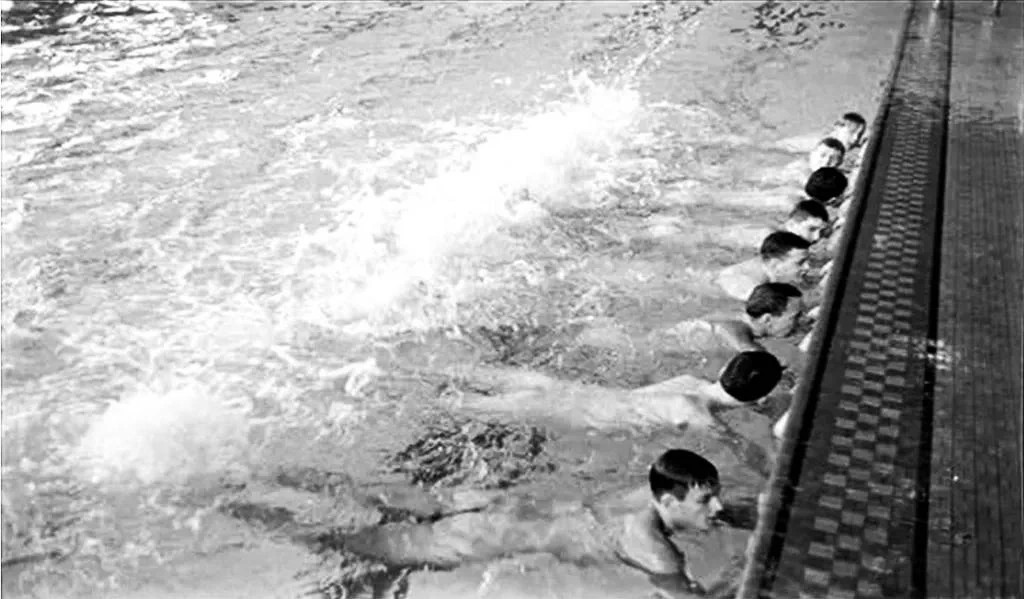
In the United States, from the late 19th century until the 1970s (and in some places the 1980s), boys and men were required to swim naked in indoor pools.
This tradition began as a strict hygiene measure and eventually spread to regular schools, elite universities, and YMCA (Young Men’s Christian Association) sports centers. Over time, medical rules became intertwined with the ideology of “muscular Christianity” and patriotic slogans.
But the most surprising part is that this exclusively male environment with its mandatory nudity unwittingly created a vast network for homosexual men to meet – and this happened during a time when same-sex relationships were severely prosecuted by law in the US.
Men Swam Naked in the US Before Pools Existed
Before indoor pools appeared, American men usually swam naked in rivers and lakes. Even politicians enjoyed this: for example, in the 1820s, 55-year-old US President John Quincy Adams regularly took long nude swims in the Potomac River.
This was reflected in art: in 1885, American painter Thomas Eakins created the painting The Swimming Hole, depicting naked men at a lake. At the time, this homoerotic subject cost him dearly: the sponsor rejected the painting, and the artist was fired from the academy of fine arts.
Early Pools Were Dirty
With the growth of cities in the 19th century, workers brought this habit to the metropolis: in New York, they swam naked en masse right in the Hudson River. Authorities tried to bring this practice under control and move it indoors.
In 1868, the first municipal pool opened in Boston. And the first indoor recreational pool appeared in Brooklyn in 1885 – in a YMCA building. The YMCA was one of the largest religious organizations in the US, whose buildings historically housed gyms, pools, and cheap dormitories for young newcomers.
Early pools were dangerous to health: the water wasn’t filtered, just drained a couple of times a week. Water purification pumps only began to appear around 1910, and chlorination starting in 1913. Before that, stagnant dirty water threatened outbreaks of cholera and polio, requiring strict safety measures.
Why Swimsuits Were Banned
The main enemy of the filters turned out to be the woolen swimsuits common in those years. Wool carried street bacteria, and its shedding fibers quickly clogged the pumps. Cotton fabrics were also unsuitable because they absorbed too much chlorine and ruined the water’s chemical balance.
The simplest and cheapest solution was a complete ban on men’s swim trunks. In 1926, the American Public Health Association issued an official rule:
“In indoor pools used exclusively by men, nude swimming should be required. In indoor pools used exclusively by women, bathing suits should be of the simplest type.”
— American Public Health Association
Before entering the water, all swimmers had to wash with soap while naked. Design engineer William Paul Gerhard wrote in 1922 that medical inspections of naked visitors for skin diseases were easiest to organize in schools, army bathhouses, and YMCA centers.
However, a completely different approach was applied to women. Girls were given modest cotton swimsuits, which schools thoroughly sterilized in laundries after classes. One 1958 physical education textbook stated plainly: “Girls are permitted to wear sterilized bathing suits… nude swimming is required for boys.”
How Nudity Was Linked to Masculinity
Medical arguments conveniently coincided with the then-popular ideology of “muscular Christianity.” This was a prominent Protestant movement that believed sports and strict physical discipline purified the soul, and that a healthy body was the temple of God.
Organizers saw pools as a way to instill Christian values and self-control in city dwellers. Modern American researcher Brian Hoffman explains in his 2015 book Naked: A Cultural History of American Nudism:
“The naked body and swimming without clothes were not considered sinful in and of themselves. And all of this existed under a Christian banner.”
— Brian Hoffman
In schools, such strict rules were justified as “hardening male character” before military service. And during World War II, nude swimming even became a patriotic duty: due to fabric shortages, materials went toward military uniforms and parachutes, so refusing swim trunks was presented as helping the war effort.
A Widespread Practice: Schools and the Ivy League
Swimming without clothes became commonplace for many US schools. Local newspapers in the 1930s–1950s wrote about it in a mundane tone, publishing photos of swimmers and reminding readers that swim trunks were strictly forbidden in class.
Often, this norm was maintained by a simple reluctance to spend money. For instance, in 1973, a school board in a Minnesota town refused to abolish the rule for younger students, deciding that buying swim trunks for two and a half thousand boys was simply too expensive.
In America’s top elite universities – Yale, Harvard, and Cornell (in the so-called Ivy League) – this rule became a mandatory test for freshmen: to be admitted to classes, they had to swim a certain distance naked, proving their readiness to survive in the navy in an emergency.
At Yale University, students were required to pass over a special device before entering the pool, which shot water upward between their legs under pressure as a hygiene treatment. At Cornell, the nude swimming test was administered at least until the late 1970s. There was even a student myth that the famous chemist and Nobel laureate Linus Pauling, unable to swim, hired a naked double to take the test for him.
How the YMCA Became a Secret Place for Gay Men
Ironically, it was the Christian YMCA centers – with their communal showers, locker rooms, and inexpensive rooms – that accidentally became the main “safe haven” for homosexual men in America at a time when same-sex relationships carried the threat of prison.
Even at the turn of the century, some association leaders lived together for years, forming strong same-sex partnerships (then called “Boston marriages”).
The showers, with their mandatory nudity, served as an excellent cover for finding casual hookups (known as cruising). Scandals erupted from time to time: in 1912, the press in Portland openly accused respected YMCA patrons of mass “sodomy,” and in 1919, a similar scandal broke out at the Newport Naval Base. YMCA management tried to catch and evict gay men, but front desk staff (who included many homosexuals themselves) often turned a blind eye.
This hidden culture is detailed in historian George Chauncey’s book Gay New York. Patrons jokingly deciphered the YMCA acronym as “Why I’m So Gay,” and in 1978, the legendary disco group The Village People released the song “Y.M.C.A.,” turning this underground gay symbol into a global pop hit and Donald Trump’s favorite song.
This image haunted the association for decades. Even in 2012, a patron named Michael Keister filed a lawsuit against a YMCA branch in North Carolina. He complained that behind the facade of “Christian family values” hid a “gay brothel,” where he personally witnessed open sex in the men’s locker rooms (the court later dismissed the case).
Why It All Ended
The tradition of nude swimming finally began to decline in the 1960s. By that time, scientists had learned to precisely regulate chlorine in the water, and shedding wool was replaced by lightweight synthetic nylon, which dried quickly and didn’t ruin the filters. The main sanitary argument fell away on its own, and in 1962, medical professionals removed the recommendation for nude swimming from national guidelines.
Another major blow was struck by the 1972 US federal law on gender equality in education (known as Title IX). It required schools to hold coeducational physical education classes for boys and girls, making nude swimming simply impossible: all students had to put on swimsuits.
By 1980, public schools in major cities (like Chicago) had completely abolished the practice. However, in some private boys’ clubs, the norm survived until the mid-1980s – which sometimes ended tragically: in closed communities, children’s nudity facilitated abuse by coaches.
Furthermore, in the 1960s and 1970s, society’s attitude toward the body changed significantly. While a group of naked teenagers was previously seen as a symbol of athletic innocence, with the growing popularity of men’s adult glossy magazines, public nudity became firmly associated with sex.
Around the same time, the LGBT movement began fighting for its rights and came out of the underground: legal gay bars started opening across the country, and men no longer needed to hide in YMCA showers. In the 1990s, the last conservative universities and elite clubs finally abandoned mandatory male nudity.
Literature and sources
- Adiv N. M. The Amphibious Public: A Historical Geography of Municipal Swimming and Bathing New York City, 1870–2013. (CUNY Graduate Center). 2014.
- American Public Health Association. Guidelines for swimming pool management. 1926.
- Chauncey G. Gay New York: Gender, Urban Culture, and the Making of the Gay Male World, 1890-1940. 1994.
- Creech J. The Price of Eternal Honor: Independent White Christian Manhood in the Late Nineteenth-Century South. 2004.
- Eng M. Baring It All: Why Boys Swam Naked In Chicago High Schools. (WBEZ). 2017.
- Gerhard W. P. The Sanitation of Bath Houses. 1922.
- Hoffman B. Naked: A Cultural History of American Nudism. 2015.
- Luehring F. W. Swimming Pool Standards. 1939.
- Lupkin P. Manhood Factories: YMCA Architecture and the Making of Modern Urban Culture. 2010.
- McAlmon R. Miss Knight. (Distinguished Air). 1925.
- Pilcher A. A Queer Little History of Art. 2017.
- Rosenbaum R. The Great Ivy League Nude Posture Photo Scandal. (The New York Times Magazine). 1995.
- Stelzer A. Remember when swimsuits weren’t allowed? A history of nude swimming. (WHYY). 2025.
- Williams J. F., Brownell C. L., Vernier E. L. The Administration of Health Education and Physical Education. 1958.
- Wiltse J. Contested Waters: A Social History of Swimming Pools in America. 2007.
- Winter T. Making Men, Making Class: The YMCA and Workingmen, 1877–1920. 2002.