Three Ottoman Homosexual Miniatures from the Manuscript of Atâyî's Poems
An 18th-century Ottoman manuscript: how love between men was judged, mocked, and celebrated in the empire.
Contents
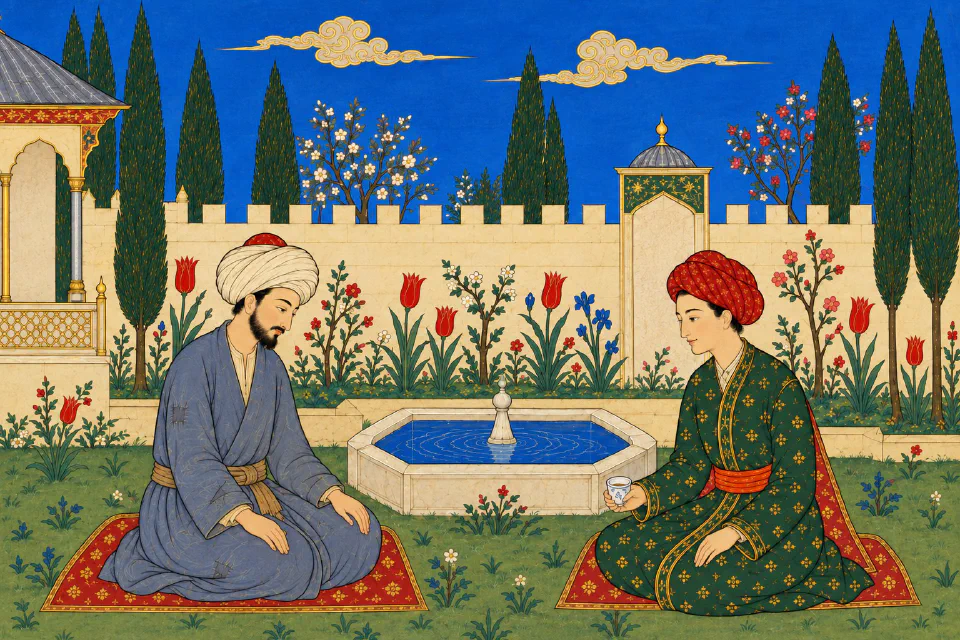
For the modern reader, the Ottoman Empire often appears as a strict conservative world. However, surviving documents reveal a much more complex picture. One such piece of evidence is a richly illustrated 18th-century manuscript containing the poems of the Ottoman poet Nev’îzâde Atâyî. This book features miniatures depicting homosexual subjects.
The History of Manuscript W.666
The manuscript is known to historians under the code W.666. It was created in 1721. In the early 20th century, the book was purchased by the American collector Henry Walters. Today, it is housed in the Walters Art Museum in Baltimore, USA.
The book contains two colophons – authorial afterwords providing technical information in Ottoman Turkish and Arabic. From these, we learn the name of the calligrapher. The text was transcribed by Hayrullah Hayri Çavuşzâde, who completed the work in May 1721.
Formally, this manuscript is a Khamsa (or Hamse), meaning a classic collection of five poems. However, the transcriber broke with tradition. Instead of five long mesnevi poems (rhyming couplets), he included only four: Sakinâme (Book of the Cupbearer), Nefhatü’l-Ezhâr (Breath of Flowers), Sohbetü’l-Ebkâr (Conversation of Virgins), and Heft Hân (Seven Stories). In place of the fifth poem, the transcriber added Atâyî’s own lyric poetry – his Divan, or collection of poems. This was likely the patron’s request. In that era, short ghazal poems were valued just as highly as large epic forms.
The book appears luxurious. It features 38 color illustrations on thick paper and an original leather binding with gold stamping. An entire workshop collaborated on the manuscript.
A Brief Biography of the Poet
The poet Nev’îzâde Ataullah ibn Yahya Atâyî (1583–1634/35) came from the family of a prominent Islamic theologian with Uzbek roots.
He fundamentally changed the approach to Ottoman poetry. Typically, authors of a Hamse imitated Persian classics. They wrote about great rulers and mystical love. Atâyî chose an entirely different path.
He created a style that could be called urban realism. The poet was inspired by the streets of Istanbul, its coffeehouses, taverns, and squares. The heroes of his poems became swindlers, respectable scholars, and naive youths. Atâyî’s texts are full of satire, comical situations, and erotic scenes.
This realism grew out of the author’s profession. In 1605, Atâyî began working as a teacher at the Canbaziye Islamic school (medrese) in Istanbul. Five years later, tired of waiting for a promotion, he moved into the judicial system. For the rest of his life, Atâyî served as a judge (kadi) in various cities of the empire in the Balkans and Thrace.
The people he describes in the poem Nefhatü’l-Ezhâr (1625) are not fictional. Adulterers, seducers, and tricksters were typical characters from real court cases. Atâyî dealt with them personally.
The era in which Atâyî wrote was troubled. In the early 17th century, the puritanical Kadızadeli religious movement was gaining power in Istanbul. Its supporters destroyed coffeehouses and attacked Sufis – Islamic mystics. The fanatics accused the Sufis of gazing at beautiful youths during their prayer trances. Against this backdrop, Atâyî’s deeply sympathetic and humorous poems resonate as a bold cultural response to the radicals.
Punishment and Shame in the Poem Nefhatü’l-Ezhâr
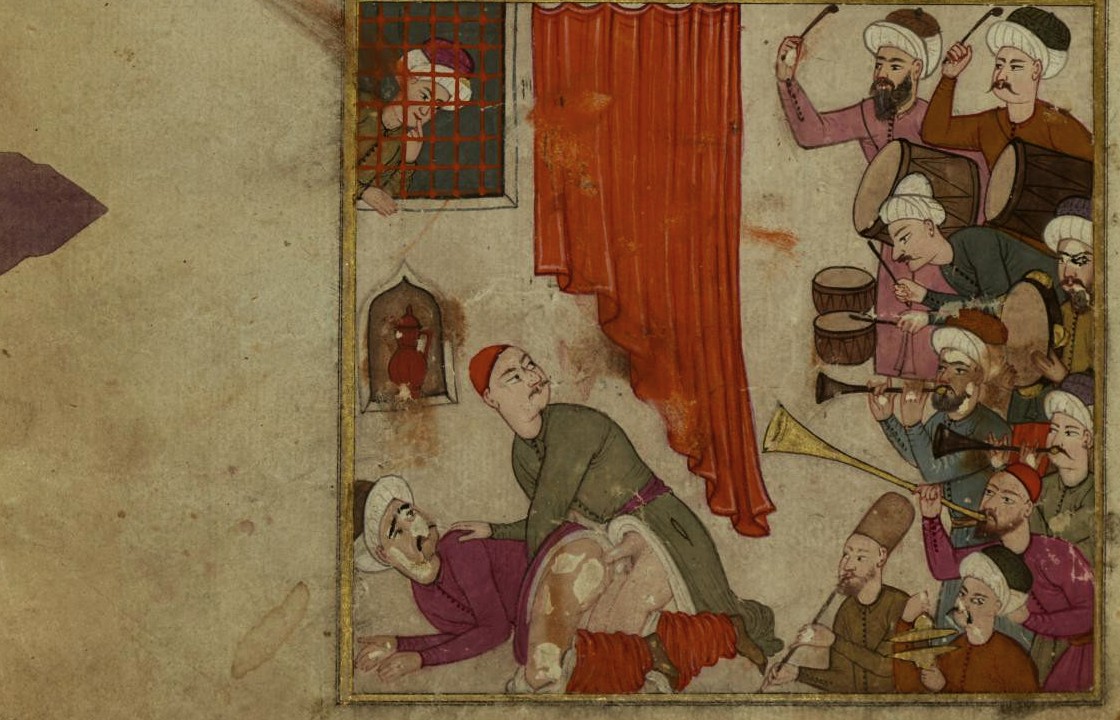
Folio 59a features a miniature accompanying the poem Nefhatü’l-Ezhâr. In the museum catalog, it is titled “A Sodomite Disgraced.” It depicts a scene of public shaming of a man accused of same-sex relations.
A historical clarification is needed here. The modern concept of “homosexuality” as an identity did not exist in the Ottoman Empire. However, the urban environment, with its male bathhouses (hammams) and coffeehouses, fostered deep male attachments, and literature openly celebrated the attraction of an adult man to a beardless youth.
So why is the hero of the miniature being punished so harshly? The answer lies in the structure of Ottoman law. The empire lived not only by the Hanafi madhhab – one of the four major schools of Islamic jurisprudence – but also by the sultanic kanun, that is, administrative and criminal codes. In this system, hadd (strict punishments prescribed by the Quran) coexisted with ta’zir (punishments imposed at the discretion of a judge or the authorities).
Hanafi jurists did not equate a same-sex act, or liwat, with ordinary zina. It did not fall under the hadd crimes punishable by death. But that does not mean it went unpunished in Atâyî’s time: already in the sixteenth-century sultanic code in force under Suleiman the Magnificent, liwat could be punished with monetary fines, and a kadi could additionally impose ta’zir such as flogging, imprisonment, or public shaming.
In practice, the authorities were most likely to intervene when the affair became public and disturbed social order. The state rarely intruded into private life behind closed doors, but a public scandal or a complaint from neighbors could already bring punishment.
The neighbors did not wait for an official trial. People burst into the house and, as it were, pulled aside the screen behind which two men were making love. The artist underscored this visually: in the miniature, a huge red curtain literally cuts the composition in two, separating the “hidden” from the “visible.” Its being drawn back becomes a metaphor for the instant loss of honor (namus).
The illustration also shows the procedure of teşhir – a formalized public shaming. The main power of teşhir lay in the spectators. Without the crowd’s condemnation, the punishment did not work.
A striking detail of the drawing is the musicians. The criminal was caught to the beat of drums and the sound of the zurna (an Eastern wind instrument). Typically, this music was played at joyous weddings or during the marches of the elite infantry – the Janissaries. Here, instruments of joy became tools of torture. The noise disoriented the person and drew onlookers and all the neighbors.
Atâyî conveys the tension of this scene in his verses. First, the neighbors prepare an ambush:
"Immediately they bring several musicians
And hide them behind the curtain."
(Bir niçe mehter getürürler hemân
Perdenüñ ardında iderler nihân)
Then they wait in silence:
"They stand in complete silence, holding their zurnas ready."
(Zurnaları elde tururlar hamûş)
And suddenly, the silence is shattered by the music of the procession of shame:
"The deafening roar of drums and the wail of trumpets."
(Tantana-i tabl u dem-i kerre-nây)
"And they made him the laughingstock of the city, leading him in a shameful procession,
Exposing his bottom, to the sound of drums and zurna."
(Şöhre-i şehr itdiler alay ile
Götin açup tabl ile sürnây ile)
A Comical Episode from the Poem Nefhatü’l-Ezhâr
In the second miniature, same-sex contact becomes not a reason for trial, but material for a light urban comedy.
Folio 56a illustrates the scene “Two Men Caught in Bed Together.” This is another story from the same poem. In a wealthy house, guests suddenly discover two men in the same bed. The artist captured the moment of awkwardness and comical exposure. Pay attention to the figure of the man with a candle in the foreground. The candle in his hand becomes both the “spark” that will ignite the scandal and the light that illuminates the caught lovers, creating the effect of sudden exposure.
Atâyî adored such amusing mishaps. On an adjacent page of the manuscript, there is a similar episode. There, a domestic ram bursts into the room of a cheating husband and his mistress, pushing them right out to the unsuspecting wife.
Ottoman comic culture, such as the popular shadow theater Karagöz, had an equalizing effect. As historian Dror Ze’evi notes, laughter deflated the pomp of religious authorities. It showed that all people are equally vulnerable to passions.
Atâyî does the same. He equates a same-sex erotic affair with ordinary heterosexual infidelity. In his poem, both are equally ridiculous.
The poet looks at his characters with irony, yet justifies them by the suddenness of emotion:
"If the blade of love's sorrow touches you,
Even a heart of stone will strike sparks."
(Tîğ-ı gam-ı 'ışk dokunsa yine
Seng ise de dil olur âteş-zene)
"Love is an elixir for the body,
Love is a mirror that reveals the truth."
('Işkdır iksîr-i berâ-yı vücûd
'Işkdır âyîne-güşâ-yı şühûd)
In the last couplet, Atâyî masterfully uses the metaphor of the “mirror” (âyîne) and “contemplation/truth” (şühûd), characteristic of classical Turkish lyric poetry. On one hand, he parodies the lofty Sufi style, where love acts as a mirror of divine truth. On the other hand, he abruptly lowers this metaphor to a purely mundane level: in a comic context, the “mirror of love” literally exposed the carefully hidden secret of the two lovers for all to see.
Spiritual Love in the Poem Heft Hân
Folio 127a contains the third homosexual miniature, this time from the poem Heft Hân (Seven Stories). It is titled “A King Looking at a Picture of His Son and His Tutor, who Fell in Love with Him.”
The plot is as follows: a wise tutor (lala) burned with a secret and forbidden passion for his pupil, the prince. Lacking the courage to reveal himself in reality, he hires an artist and asks him to paint a portrait where he is depicted in a tender embrace with the prince.
Eventually, the painting is hung on a tree in the garden. At this moment, the king (the prince’s father), looking out of the window of his pavilion, notices the portrait. The artist conveyed the gazes and feelings so accurately that the tutor’s secret passion becomes clear to the ruler without words.
The text above the miniature, written in an elegant nasta’liq script, ironically describes how the painting gave away the secret:
"...becoming manifest [appearing] on the canvas,
It revealed the secret of the lover.
The image of a kiss and embrace with the beloved...
That is how this lifeless picture shows [the whole truth]."
(...safha üzere hüveydâ
Eyledi keşf-i râz-ı aşk-bâz
Resm-i bûs u kenâr-ı cânâne
Şöyle gösterir nakş-ı bî-cân)
Atâyî’s verses here emphasize a paradox: the “lifeless portrait” (nakş-ı bî-cân), painted by the artist “hair by hair,” turned out to be the loudest informer.
Scholar of Ottoman literature Selim Kuru explains that Ottoman culture had two distinct vocabularies for describing such relationships. The first term is mahbub-perest (admirer of the beloved). This describes an intellectual who admires the beauty of a youth but does not stoop to physical possession. Such love required tremendous self-control. It was expressed in refined poetry.
The second term is gulam-pare (obsessed with boys). This was a derogatory word for those who gave in to carnal pleasures and lost their dignity.
Literature and Sources
- Walter G. Andrews, Mehmet Kalpaklı. The Age of Beloveds: Love and the Beloved in Early-Modern Ottoman and European Culture and Society. 2005.
- Tunca Kortantamer. Nev’î-zâde Atâyî ve Hamse’si. 1997.
- Muhammet Kuzubaş. Nev’izâde Atâyî’nin Nefhatü’l-Ezhâr Mesnevisi. 2005.
- Muhammet Kuzubaş. Within the context of sociological criticism theory, a literary work from the 17th century; Nefhatü’l-Ezhâr. (Technium Social Sciences Journal). 2020.
- Günsel Renda. An Illuminated 18th-Century Ottoman Hamse in the Walters Art Gallery. (Journal of the Walters Art Gallery). 1981.
- Şerife Yalçınkaya. Nev’î-zâde Atâyî’nin Nefhatü’l-Ezhâr Mesnevisindeki Mevsimler Hikâyesi. (Turkish Studies). 2018.
- Khaled El-Rouayheb. Before Homosexuality in the Arab-Islamic World, 1500–1800. 2005.
- Dror Ze’evi. Producing Desire: Changing Sexual Discourse in the Ottoman Middle East, 1500–1900. 2006.
- Uriel Heyd. Studies in Old Ottoman Criminal Law. 1973.
- Elif Ceylan Ozsoy. Decolonizing Decriminalization Analyses: Did the Ottomans Decriminalize Homosexuality in 1858? (Journal of Homosexuality). 2020.
- Selim S. Kuru. Desire Before Sexuality: An Interview. (JHI Blog). 2026.
- Walters Art Museum. Description of manuscript W.666 (1721) and folios 51b, 56a, 57b, 59a, 127a.