The Same-Sex Attraction of 15th-Century Turkish Official and Poet Ahmed Pasha to a Sultan's Page
How a scandal at the court of Mehmed II destroyed the career of an Ottoman Empire vizier.
Contents
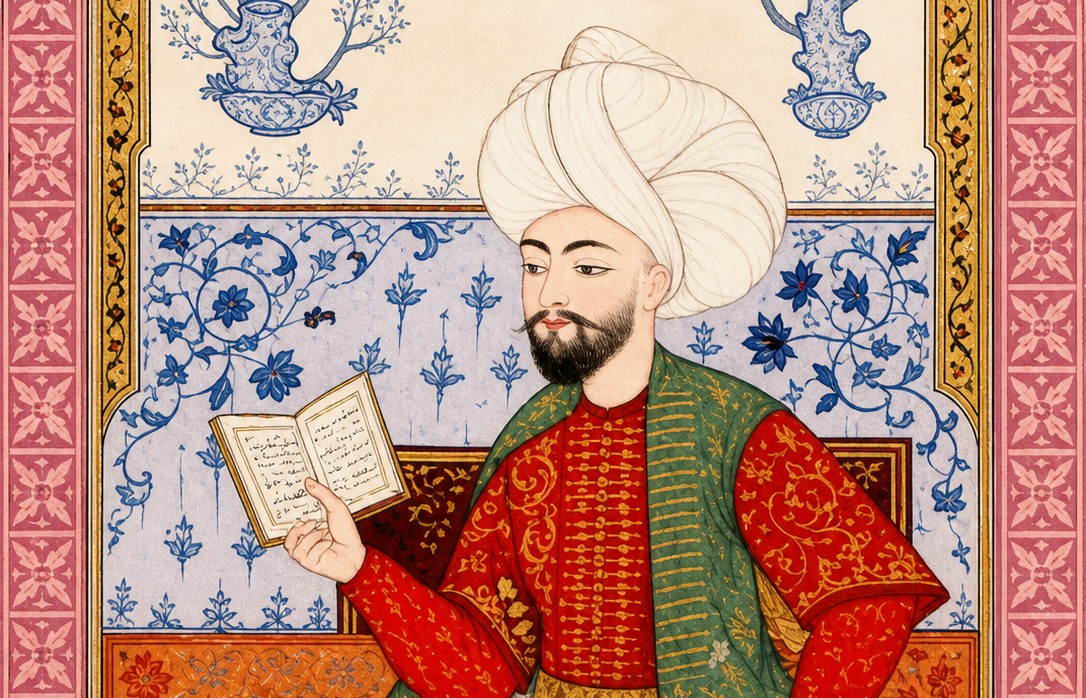
In the 15th century, poetry and politics were closely intertwined at the Ottoman court. The vizier and poet Ahmed Pasha built a brilliant career under Sultan Mehmed II the Conqueror. However, he soon lost his position due to a palace scandal. At the center of the intrigue was an accusation of same-sex attraction to a young page.
Rapid Rise and Service to the Sultan
Ahmed Pasha came from a family of Islamic scholars – the ulema. According to family tradition, his father traced their lineage back to the Prophet Muhammad.
The future vizier was born around 1426, presumably in Edirne, but went down in history under the epithet Bursalı, as he spent a significant part of his life in Bursa.
His career developed rapidly. After receiving his education, he served as a professor and a qadi (judge) in Bursa and Edirne. Contemporaries noted his intelligence and brilliant sense of humor.
These qualities attracted the young Mehmed II: in his service, Ahmed became a musahib (a particularly close companion and confidant) and the sultan’s teacher. He soon received the rank of vizier and the position of chief military judge. In 1453, he was beside the sultan during the siege of Constantinople, inspiring the soldiers.
Mehmed II himself, according to several historical sources, also experienced attraction to young men. We have an article about this:
His closeness to the ruler secured Ahmed Pasha’s influence but made him a target for envy. Sources point to his unspoken rivalry with the Grand Vizier Mahmud Pasha Angelović, who led the empire’s military and naval campaigns.
Family and Personal Life
The biographer Âşık Çelebi, relying on the words of the poet’s cousin, preserved information about Ahmed Pasha’s personal life. Even before his fall from grace, Mehmed II gave him an enslaved woman named Tûtî Kadın (“Lady Parrot”) and granted her a village near Edirne as a dowry. Ahmed Pasha married her.
They had an only daughter. The girl died at the age of seven or eight. This tragedy deeply shook the poet. Following the child’s death, he completely ceased contact with women for the rest of his days.
Three Versions of One Scandal
At the center of the intrigue that destroyed Ahmed Pasha’s career was a favorite of Mehmed II – a young page (içoğlan). Ottoman biographers of the 16th and 17th centuries left several versions of the events. All of them agree on one thing: the vizier was accused of passion for this young man.
The biographer Latîfî, in his 1546 work Tezkiretü’ş-Şuarâ (Memoirs of the Poets), claimed that the page made a mistake for which the sultan ordered him to be put in chains. The enamored Ahmed Pasha wrote a sorrowful quatrain about it. Envious rivals reported this to the sultan, presenting the verses as a criticism of the monarch’s right to punish his slaves.
The 17th-century historian Riyâzî described an incident during a hunt. Mud flew from beneath a horse’s hooves and soiled the page’s cheek. Seeing this, the poet muttered: “If only I were that dust!” The words reached the sultan and provoked his anger.
The most dramatic version belongs to Âşık Çelebi, who described it in 1568 in his work Meşâirü’ş-Şuarâ (Gathering of the Poets). Rumors reached the sultan about the vizier’s attraction to a page with incredibly beautiful long locks. In classical Ottoman poetry, a young man’s hair symbolized a snare for the lover, and its black color signified the beloved’s cruelty.
To test the rumors, Mehmed II ordered the page’s hair to be cut off. He then invited Ahmed Pasha to the hammam (bathhouse) along with the young man and sent the vizier a sherbet – a sweet fruit drink – into which he had dropped the severed locks.
Ahmed Pasha understood the signal. Taken by surprise, he replied with an impromptu verse:
This idol has lost his locks, but still has not abandoned his disbelief,
He cut his zunnar [Christian belt], but still has not become a Muslim.
Zülfün gidermiş ol sanem kâfirligün komaz henüz
Zünnârını kesmiş velî dahı müselmân olmamış.
The poet used an allegory: cutting one’s hair is like removing a Christian belt to accept Islam. But even after losing his locks, the young man did not become a “Muslim,” meaning he did not become submissive and gentle in a poetic sense. This poem only confirmed the sultan’s suspicions.
Politics, Not Morals
The late 16th-century Ottoman historian Gelibolulu Mustafa Âlî, in his chronicle Künhü’l-Ahbâr (Essence of News), calls these accusations political slander. In his assessment, high positions made the vizier the primary target for envious rivals.
The modern historian Halil İnalcık believes that the cause of the disgrace could have been either a real romance or simply a whim of the sultan. At the same time, biographers usually tried not to write about things that could cast the ruler in a bad light. The fact that they preserved the story of this scandal indicates its enormous resonance.
The suspicion of attraction to a page carried the threat of the death penalty, but the issue was not homosexuality itself. In the secular laws of the empire at that time, there was no death penalty for same-sex intercourse. Execution was a threat because of the structure of the court.
Pages were selected from Christian boys, lived in the inner courtyard, and were trained for the highest positions. Their behavior was strictly monitored. Pages were considered the personal property of the sultan, so a vizier’s romance with a young man was perceived as an encroachment on the monarch’s authority and an undermining of state discipline.
Verses That Saved a Life
Mehmed II imprisoned the vizier. His place of confinement was the palace guard room or the Yedikule Fortress. According to Âşık Çelebi’s version, the sultan initially even ordered the poet’s execution but later changed his mind.
In prison, Ahmed Pasha wrote a eulogistic ode – a qasida. In every line, the word kerem (grace, generosity) was repeated. Before his disgrace, he had already written a similar ode to another vizier to glorify his wealth. In the dungeon, he imbued this word with a new meaning – the supreme mercy of the sultan as God’s vicegerent on earth.
In the 26th couplet, the poet asked Mehmed II not to listen to informers:
You are the most noble of people, O center of the necklace of grace,
Do not listen to the words of every scoundrel – this is true greatness.
Ekremü'l-halksın iy vâsıta-i 'ıkd-ı kerem
Her le'îmün sözin işitme budur şân-ı kerem.
In the 27th couplet, he admitted his weakness and declared that the ruler’s mercy surpasses any guilt:
What if a slave makes a mistake – where is the forgiveness of the shahanshah?
Let us even assume that both my hands are in blood – where is the grace?
Kul hata kılsa n'ola 'afv-ı şehenşâh kanı
Tutalum iki elüm kanda imiş kanı kerem.
The sincerity of the qasida saved the poet’s life. Mehmed II pardoned Ahmed Pasha but banished him from the court forever.
Years in Exile
After his exile, Ahmed Pasha became the trustee of the sultan’s madrasas in Bursa, receiving a small salary. Later, he was appointed governor of the Eskişehir province.
In 1481, the new sultan, Bayezid II, who highly valued Ahmed’s poetry, transferred him as governor to the empire’s old capital – Bursa. There, the poet spent the rest of his life. He built a madrasa at his own expense. When Bayezid II sent him 33 ghazals – lyrical love poems – by the outstanding Turkic poet Ali-Shir Nava’i, Ahmed Pasha wrote brilliant poetic responses (nazire) to them.
Until his death (around 1496 or 1497), he bore the stigma of an “exiled poet” (sürgün şair) and deeply suffered from the collapse of his political career. He was buried in a mausoleum near the Muradiye Mosque in Bursa.
Literature and Sources
- Âşık Çelebi. Meşâirü’ş-Şuarâ. 1568.
- Gelibolulu Mustafa Âlî. Künhü’l-Ahbâr. 16th century.
- İnalcık, H. “Ahmad Pasha, called Bursali” (Encyclopaedia of Islam). 1986.
- Latîfî. Tezkiretü’ş-Şuarâ. 1546.
- Riyâzî. Riyâzü’ş-Şuarâ. 17th century.
- Coşkun, M. 16. Yüzyıl Şuara Tezkirelerinde Suç ve Ceza. 2011.
🇹🇷 LGBT History of Turkey
- The Homosexuality of Sultan Mehmed II
- Homoerotic Themes in Taşlıcalı Yahya Bey’s Ottoman Poem “Shah and the Beggar”
- Was Atatürk Gay or Bisexual?
- The Same-Sex Attraction of 15th-Century Turkish Official and Poet Ahmed Pasha to a Sultan's Page
- Three Ottoman Homosexual Miniatures from the Manuscript of Atâyî's Poems
 Subscribe to our Telegram channel (in Russian): Urania. With Telegram Premium, you can translate posts in-app. Without it, many posts link to our website, where you can switch languages — most new articles are published in multiple languages from the start.