Vladimir Nabokov and the First Attempt to Decriminalize Same-Sex Relationships in Russia
How a Russian liberal and the father of the great writer tried to abolish discriminatory legislation
At the turn of the century, Europe faced a new, hitherto unfamiliar phenomenon. Fin de siècle brought with it many new conflicts and questions that had previously been considered taboo. Disintegrating and decaying, the old, traditional world gave way to a world of progress and technology. Naturally, many rules of human existence, hitherto considered inviolable, were re-evaluated.
“Unmanly” men and “unwomanly” women appeared everywhere, challenging traditional gender roles. Women were the first to question the patriarchal order and articulated their demands in the form of the so-called “woman question,” which quickly became politicized. Naturally, homosexual behavior was deeply beyond the bounds of what was permissible; public discussion of this issue was extremely rare and most often accompanied by condemnation and shame.
However, the democratization of morals allowed discussions about homosexuality to emerge from the deep underground for the first time. From the fields of art and philosophy, where such topics were also rarely raised, they gradually shifted to the realm of science and law. Cautious and sometimes inconsistent, yet still supportive voices for homosexuals began to be heard in Europe, the loudest of which was perhaps the voice of the German sexologist Magnus Hirschfeld.
But while the European context is fairly well-studied and widely known, much less is said about the struggle for the rights of Russian homosexuals. At best, one might recall the writer Mikhail Kuzmin, who was openly homosexual, which was reflected in his texts. But there were also politicians and lawyers in Russian history who were not afraid to speak out on the emancipation of queer people.
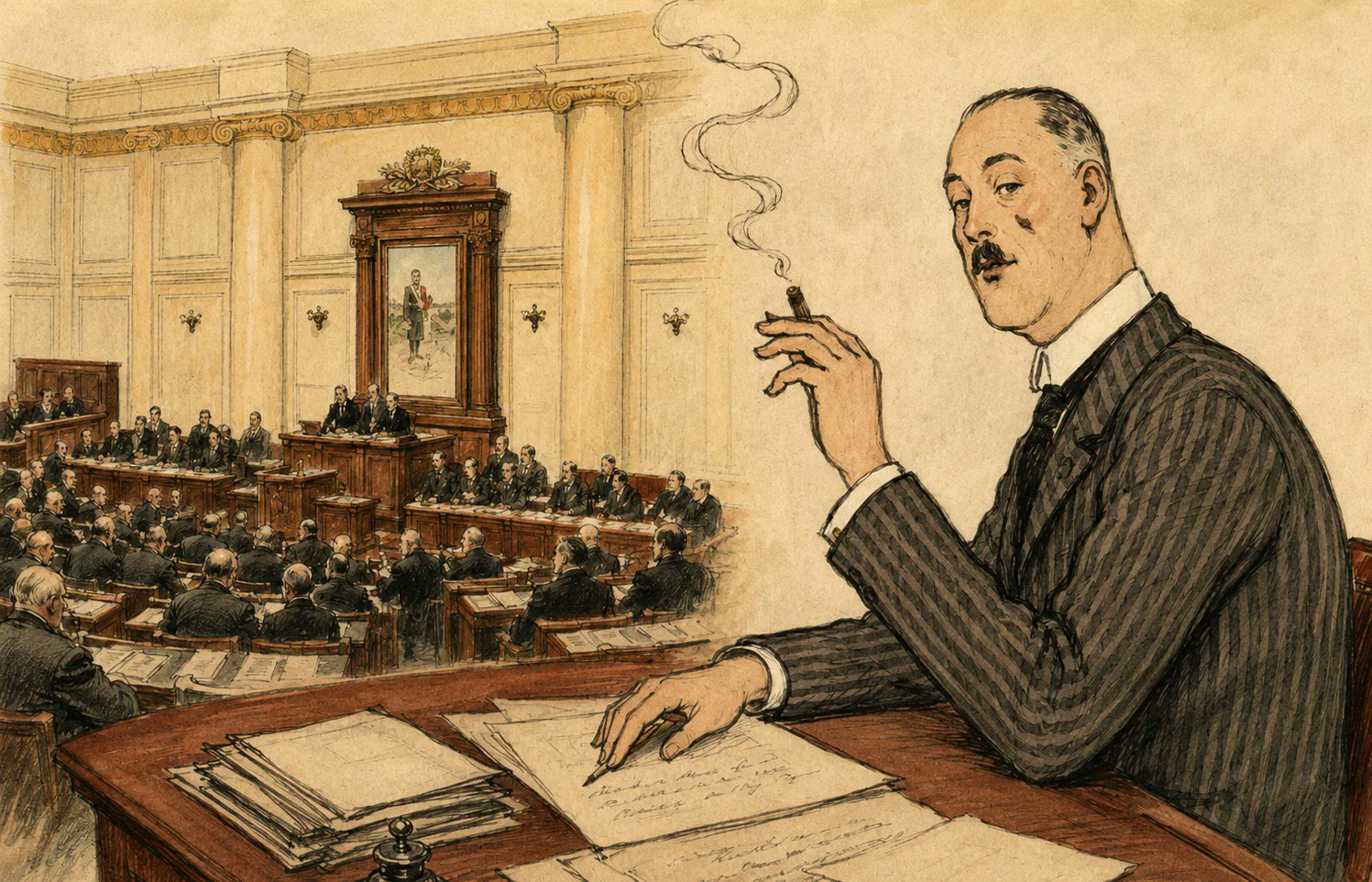
The surname of our hero is well known to everyone. Vladimir Dmitrievich Nabokov is indeed the father of the great writer, but it would be highly unfair to reduce his significance to this modest role. Vladimir Dmitrievich was a highly educated lawyer and stood at the origins of the liberation movement in Russia and the largest liberal opposition party of Constitutional Democrats (Cadets). He was actively involved in legislative issues on both a theoretical and practical level and was one of the empire’s leading lawyers; after the February Revolution of 1917, he participated in the work of the Provisional Government (the government formed after the abdication of the Tsar), and after the Bolshevik coup, he even managed to get into the Constituent Assembly (a democratically elected body convened to write a constitution).
In 1902, Vladimir Dmitrievich published a legal pamphlet titled “Carnal Crimes” (Plotskiye prestupleniya), in which he proposed modernizing laws in the spirit of liberal values. What is remarkable for us is that in this pamphlet, unlike many of his colleagues, Nabokov not only did not shy away from the issues of homosexuality but even devoted a significant part of his work to it, citing the arguments of lawyers, psychiatrists, and even philosophers. It will be useful for us to familiarize ourselves with the content of this text as well.
“It is precisely by considering the question from a criminal-political point of view that we will have to… come to the conclusion that there are significantly more grounds for a negative answer regarding the punishability of sodomy (naturally, voluntary, between adults) than for a positive one.”
- – Vladimir Nabokov. “Carnal Crimes” (1902)*
In the Russian Empire, sodomy was legally prohibited, although from the sources available to us, we can confidently assume that in Russia, homosexual behavior was treated with relative indifference compared to most other European countries. Nabokov begins his analysis of the problem with this comparison. Studying the European experience in detail and finding it deeply flawed, he welcomes those foreign lawyers who call for the abolition of discriminatory legislation and speaks highly positively of the work of activists, particularly highlighting the aforementioned Magnus Hirschfeld.
Nabokov’s own conclusions may seem obvious to us (though, alas, not to everyone), but for the early 20th century, they sound truly revolutionary: a voluntary union of two persons of the same sex does not and cannot violate anyone’s rights, and as a result, the legislative ban must be lifted. Furthermore, since the purpose of criminal punishment in Russia is not to penalize the criminal but only to correct him, in the context of same-sex attraction this seems impossible, as homosexual orientation cannot be changed.
At the same time, by leaving this non-legal article in the criminal code, the legislator provides ample room for blackmail. Since proving the act of “sodomy” in practice is very difficult, opportunities open up for law enforcement to accuse almost anyone of homosexuality (alas, we see something similar in modern Russia). However, not satisfied with purely legal grounds, the politician moves on to medicine, biology, and even the sphere of state administration.
Having carefully familiarized himself with the view of medical science, he finds that there are different views on homosexuality: some scientists (v. Erkelens) consider it innate, others acquired, and still others recognize a combination of innate and acquired. However, this is of no particular importance for the law: from a legal point of view, same-sex relationships must be excluded from the list of crimes.
And although the disposal of one’s own body cannot be punishable, nevertheless, some conservatives believed that the “act of unnatural satisfaction” should be subject to legal prosecution, as it offends public morality. Nabokov shatters this argument as well: public morality is very heterogeneous, and what stagnant reactionaries will consider a “perversion,” the cultural strata of society will call a variant of the permissible.
It should not be forgotten that the 1900s coincided with the Silver Age of Russian culture (a flourishing period in Russian poetry and arts), within which the boundaries of the real and the mystical, the beautiful and the ugly, the masculine and the feminine became blurred and permeable in art. Great writers and poets, artists, choreographers, directors, and actors accepted the homosexual poetry and prose of the already mentioned Kuzmin with almost unanimous admiration; suffice it to say that the entire print run of the magazine featuring the novella “Wings” (Krylya) was sold out almost immediately.
The final argument used by the future Cadet relates more to the field of economics and administration. Uranism, which poses a threat neither to society nor to the homosexual himself, by remaining punishable, drains a lot of resources from the state. Instead of catching adults who in no way violate the rights of others, it would be much more expedient for the police and the judicial system to focus on working with real criminals: thieves, murderers, rapists.
“…by punishing the Uranian, the state unjustly, and most importantly, pointlessly and uselessly wastes both strength and means that could be spent in a more productive manner.”
- – Vladimir Nabokov. “Carnal Crimes” (1902)*
And yet, despite the emancipatory rhetoric, Nabokov allows for what by modern standards is stigma. In his words, it is a “pathology” or a “vice,” but it inspires “deep disgust in the normal part of society.” Alas, it is hardly appropriate to judge Nabokov’s speech from a modern standpoint: he is a representative of a completely different society, a completely different culture, when speaking directly about same-sex relationships was almost impossible, and voices calling for universal equality and non-discrimination were not heard at all, except for isolated, random cases. We should focus on something else: how in such conditions, despite the homophobia that reigned supreme throughout the world, a lawyer and politician was found who unequivocally spoke out for the decriminalization of same-sex relationships.
“Even without any criminal law, sodomy in the eyes of the healthy and normal part of the population will always and everywhere seem to be what it really is: an act inspiring deep disgust…”
- – Vladimir Nabokov. “Carnal Crimes” (1902)*
For Vladimir Dmitrievich, homosexual relationships were not an abstraction, a line from legal treatises and medical directories. His brothers, Konstantin and Vasily, were homosexuals. Vladimir Dmitrievich himself was married and had many sons, but one of them, Seryozha Nabokov, was homosexual. He was personally acquainted with the famous Magnus Hirschfeld, about whom his father wrote in the pamphlet of interest to us. Sergey was unfortunate enough to find himself in Paris, occupied by the Nazis, during the Second World War. Because of his homosexuality, he died in Germany in 1945, 4 months before the liberation of the concentration camp in which he was placed.
After the collapse of the thousand-year monarchy, the liberals managed to take power into their own hands for a short time. Our hero took several major posts in 1917, continuing to work on improving the legislation of the revolutionary fatherland. We do not know how the work in the commission progressed. Was the issue of decriminalizing homosexuality raised? Was at least an interim decision made on this issue? Nabokov was forced to flee with his family from Bolshevik Russia. It is unknown to what extent the new masters of the country relied on the works of Vladimir Dmitrievich, but the prosecution of same-sex attraction was not provided for by Soviet criminal law. However, like many other liberties, this point was revised during the Stalinist era.
Russian queer history, it seems, has not yet been written in such a way that one can confidently recall its main heroes, its main dates and events. Many of us will easily remember Magnus Hirschfeld, the Stonewall riots, and 1968. But due to the taboo nature of the topic in the Russian political field, alas, domestic heroes rarely receive such attention. And yet, it seems that the memory of the brave pioneers who struck the first blows against discrimination deserves our attention and our gratitude.
Literature and Sources
- Nabokov V. D. Carnal Crimes. From the journal “Vestnik Prava”, November – December 1902 // St. Petersburg: Senate Printing House, 1903.