Polmuzhichye and Razmuzhichye in the Russian North: A History of Female Masculinity
How women who lived 'like men' were perceived in northern Russian villages.
Contents
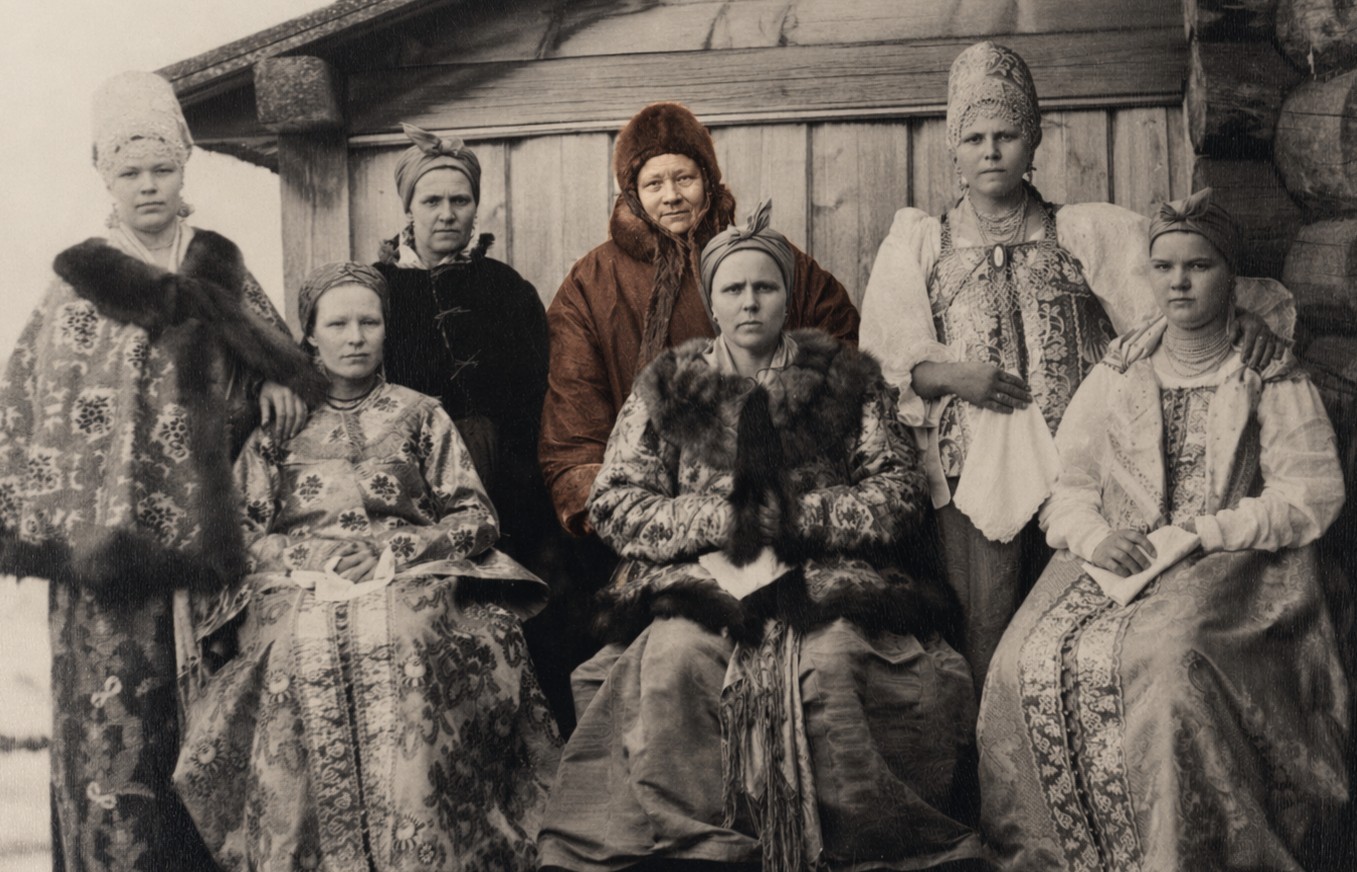
“Polmuzhichye” and “razmuzhichye” – this is how northern Russian villages referred to women who took on men’s work, wore men’s clothes, and behaved emphatically “like men.”
Almost no official documents remain about such women, but their memory has been preserved in the language: in dialect dictionaries, village nicknames, gossip, and folklore.
How It Was Discussed in the Village
Vladimir Dal defined razmuzhichye as a northern word meaning “half-guy, a woman resembling a man in appearance, manners, voice, and so on,” and provided a cross-reference to another similar entry – “hermaphrodite.”
Alexander Podvysotsky, in his Dictionary of the Regional Arkhangelsk Dialect (1885), provides a more precise explanation: “a woman with bold, man-like manners.” He clarifies that in Kola (a town on the Kola Peninsula), this was the term used for unmarried women who were past marriageable age, had adopted men’s habits and manners, and wore men’s clothing.
Dictionaries of Arkhangelsk dialects contain examples of how the word razmuzhichye was used: “Here in the village, Dunka the razmuzhichye was a team leader.” Or like this: “That Lenka walks like a rozmuzhyche. Bold as a boy.” And another: “Polmuzhycho? Well, women who walk around in trousers, play the accordion, you know.”
Famous northern storytellers also spoke about this phenomenon. For example, when the renowned storyteller Marfa Kryukova narrated the epic poem (bylina) “Kostryuk,” where a heroine disguised as a man defeats a boastful warrior, she gave this enthusiastic commentary:
“A woman, but with the men! She went about in all men’s clothes. What things they did! Our razmuzhichyo.”
Thus, in the Russian North, these nicknames became a label for various deviations from the prescribed female norm. Yet, within the village itself, such women were usually treated quite normally. Men particularly respected them for their skills and abilities in “men’s” affairs. Of course, behind their backs, there was no shortage of gossip and rumors, but to their faces, they were accepted as strong and equal workers.
Why Specifically the North: Economics and “Bolshukhas”
Why were such women most commonly found in the Russian North? The answer lies in the harsh living conditions. Survival here depended on fishing, forestry, and hunting. Men would leave home for work for many months, and sometimes they never returned at all.
While they were away, women had to manage the household. The senior woman in the house – the bolshukha – managed the finances, distributed the work, and could even represent the family at the village assembly. Historian Maxim Pulkin notes that in the 19th century, northern women rowed vigorously, performed heavy physical labor, and mastered traditionally male occupations.
In the book Tradition, Transgression, Compromise, Svetlana Adonyeva and Laura Olson describe how girls were prepared for strict roles from an early age: they had to know how to sew, weave, and seamlessly integrate into their husband’s home. The peasant dwelling itself was strictly divided into male and female halves.
The main feature of northern life was that society demanded conventional “femininity” from a woman even when she was carrying a massive burden of men’s work. She could be an incredibly strong head of the household, but she still had to maintain a female appearance in clothing, hairstyle, and manners. And that is exactly why any stepping outside these invisible boundaries immediately caught the eye.
How One Became a “Polmuzhichye”
As Adonyeva and Olson note, a polmuzhichye was usually the nickname given to a single woman or widow who took on men’s work and constantly wore men’s clothes. Left without a breadwinner, a woman began to perform male duties, and over time this became her established reputation.
Folklorist Inna Veselova provides an excellent example from a village on the upper Mezen (a river in northern Russia). There, the villagers dubbed a woman polmuzhichye because she was engaged in construction, wore trousers, and went hunting alone with a rifle. The trousers themselves didn’t mean much – many women wore them during haymaking for convenience. The decisive factor was rifle hunting. In peasant culture, the forest was always considered a male space, and hunting was an exclusively male privilege. By taking up a rifle and going into the forest, the woman broke the strict rules of the village.
19th-century ethnographers described similar scenes in the Kola North. Some elderly women internalized male habits so deeply that they constantly wore men’s clothing and even formed separate groups – that very razmuzhichye.
In the 20th century, after two devastating world wars, taking up men’s trades became a massive and forced necessity. Having lost men at the front and becoming widows, women took on all the heavy labor simply to survive. What in the 19th century was perceived as the lot of individual widows or a northern oddity, turned into the harsh reality of entire villages after the wars.
Besides hard labor, the tradition of dressing in men’s clothing was also part of village festivities.
The Spiritual Authority of Old Believer Women
There was one more factor that laid the groundwork for strong female roles – religion. The Russian North, particularly Pomorye (a historical region by the White Sea) and the Olonets Governorate (a province in northwestern Russia), historically served as the main refuge for Old Believers (traditionalist Eastern Orthodox Christians). These were believers who, in the 17th century, refused to accept church reforms and separated from the official Orthodox Church.
The radical “Bezpopovtsy” (priestless Old Believers) movement took root particularly well in the North. They believed that true priesthood on earth had disappeared along with the old order.
“The rejection of the institution of marriage, the communal way of life, and the transfer of spiritual authority from ordained to unordained leaders allowed women to realize unusual and ambitious roles.”
– Irina Paert. Old Believers, Religious Dissent and Gender in Russia (2003)
Since the Bezpopovtsy had no priests left, there was no one to marry couples, and believers massively rejected official marriage. Spiritual authority passed to simple elected mentors, and women quickly took on these roles. They began to lead prayers, read sacred texts, and manage religious settlements (sketes).
Thus, the culture of the Russian North became accustomed to authoritative, unmarried women who rejected marriage for the sake of faith and held spiritual power on par with men. Because of this, the region was much more accepting of those who did not follow the classic family script.
Were They Lesbians?
When modern researchers encounter stories of women who wore trousers, went hunting, and lived with other women, it is tempting to immediately label them hidden lesbians. But historians warn against such hasty conclusions.
The phenomenon of razmuzhichye did not necessarily challenge the traditional division between the sexes – in many ways, it actually confirmed it. Village society believed that there was strictly men’s work and strictly women’s work. And if a woman – due to widowhood, orphanhood, or the absence of men in the house – had to perform heavy men’s work, then, according to peasant logic, she also had to look the part. By putting on trousers and taking up a rifle, she wasn’t so much destroying gender boundaries as she was honestly marking her new social role. The village saw: this woman is now performing the functions of a man, so it is logical that she looks like a polmuzhichye.
Undoubtedly, it cannot be ruled out that for some women, such a social niche became an excellent cover. It is quite possible that some of those called razmuzhichye really were lesbians who found in this status a legal way not to marry a man and to live as they wanted. But to reduce the entire phenomenon exclusively to hidden homosexuality would be a mistake.
Parallels in the World
Looking more broadly, the northern phenomenon has many parallels in other countries.
Judith (Jack) Halberstam in the classic book Female Masculinity (1998) convincingly proves that masculinity does not belong only to men. Halberstam urges us not to reduce the male behavior of historical women exclusively to everyday necessity or hidden homosexuality: in the 19th century, it existed and was understood in a completely different coordinate system.
The most striking and closest parallel to us is found in the Balkans. Anthropologists Antonia Young, Lada Stevanović, and Mladena Prelić detail the phenomenon of “sworn virgins” (burrneshë, virdžina, tobelija, ostajnica) in the mountain villages of Albania, Kosovo, and Montenegro.
“[Sworn virgins] took vows of celibacy and assumed the social position of a man within their families, tribes, and villages… appropriated the male gender… wore men’s clothing, smoked, and took on traditionally male duties, including warfare.”
– T. Hiergeist et al. Ladies in Arms: Women & Guns (2024)
Literature and Sources
- Adonyeva S., Olson L. Tradition, Transgression, Compromise: The Worlds of the Russian Peasant Woman. 2016.
- Dal V. Explanatory Dictionary of the Living Great Russian Language. 1863–1866.
- Podvysotsky A. Dictionary of the Regional Arkhangelsk Dialect in its Everyday and Ethnographic Application. 1885.
- Pulkin M. The Evolution of Gender Relations in Traditional Culture of the 18th-19th Centuries: Based on the Materials of the European North of Russia.
- Halberstam J. Female Masculinity. 1998.
- Hiergeist T. et al. Ladies in Arms: Women & Guns. 2024.
- Paert I. Old Believers, Religious Dissent and Gender in Russia, 1760-1850. 2003.
- Stevanović L., Prelić M. Becoming a Woman-Man: Notes on the Phenomenon of Sworn Virgins in the Balkans. 2023.
- Young A. Women Who Become Men.