
The 1916 Corruption Case of a Secret Society of Gay Officials Who Wore a Golden Winged Penis Badge
How an investigation into wartime embezzlement during the First World War led to the exposure of a secret club of men who loved antiquity and other men.
Contents
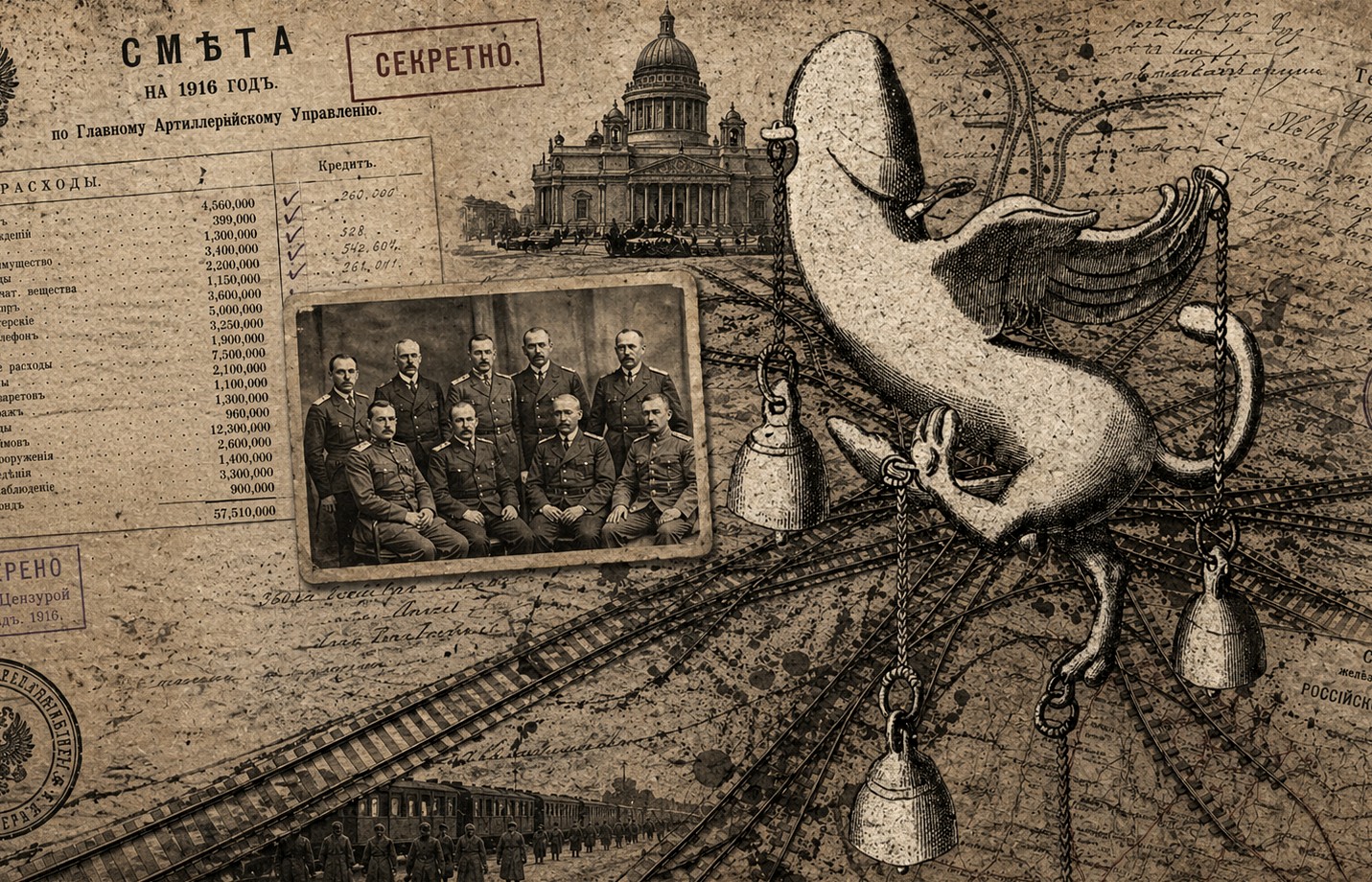
In the spring of 1916, the Russian Empire was going through a severe logistical crisis. After the Great Retreat of 1915 (a strategic withdrawal of the Russian army from Galicia and Poland), hundreds of thousands of civilians became refugees. They flooded the railway lines, leaving the country’s transport network paralysed. On the fronts of the First World War, soldiers lacked shells, food, and fodder. Cavalry horses received only two pounds of hay a day and died in huge numbers.
It was against this backdrop of national catastrophe that an unprecedented scandal broke out in Petrograd. Pyotr Nikolaevich Yakobi, prosecutor of the Riga District Court, uncovered a vast corruption scheme in the Main Artillery Directorate – the agency responsible for distributing multimillion-ruble military contracts.
The investigation revealed not only large-scale theft from the state budget. Inside the ministry, investigators found a secret, rigidly structured homosexual community.
We know about the course of this case thanks to the diaries of Mikhail Konstantinovich Lemke, a historian and journalist. His notes record a surreal picture: while the army was bleeding out, high-ranking officials spent stolen money on golden pagan amulets and the life of a closed elite club.
How Officials Stole From Artillery Contracts
During the war, the Artillery Department received enormous budgets for work with private contractors. The system for distributing orders was opaque and depended on personal connections. For example, the salon of the prima ballerina Mathilde Kschessinska served as an unofficial “exchange” for the defence industry, where the interests of major foreign arms factories were lobbied.
At the level of the highest military bureaucracy, the case quickly came up against Nikolai Pavlovich Garin, a senator, member of the State Council (the supreme state advisory body to the Tsar), and Assistant Minister of War in 1916–1917. Officials like him awarded contracts for shrapnel and metals to shell companies at prices inflated many times over. Dmitry Savelyevich Shuvaev, Minister of War of the Russian Empire from March 1916, sent investigator Pyotr Nikolaevich Yakobi to Garin.
When investigator Yakobi came to search Garin’s premises, Garin tried to destroy evidence right in front of the investigation. He tore up a paper proving that many of the people involved had already been investigated for embezzlement before. The official blackmailed the investigator: he said that a public scandal would provoke a revolution in the country and strongly advised him to close the case.
“The state of the investigation into abuses in the artillery department is as follows. Shuvaev sent investigator Yakobi to Garin. The latter first of all tore a paper out of the file which said that many of those implicated had already once been under his investigation, but, having escaped punishment and having been left in the work of supplying the army with artillery munitions, had been caught again.
Then Garin began telling Yakobi that he did not understand how Yakobi could essentially create such an enormous case, involving so many people, out of nothing; he advised him not to go too far; hinted that a more modest piece of work had been expected of him; and finally said that he was astonished the Ministry of Justice did not understand that exposing such a large case would only benefit all enemies of the government and the supreme authority, given the growing revolutionary ferment in the country…
The outraged Yakobi reported this to the Minister of Justice, Khvostov, and it was decided to draw up a huge report on everything already investigated and present it to the tsar, in order to receive instructions on what to do next. The report, 54 typewritten pages long, was presented, and the tsar wrote on it that such a vile case had to be pursued to the end. Now it has started up again.”
- – Mikhail Lemke, diary entry of 4 May 1916*
The criminals were protected by Grand Duke Sergei Mikhailovich Romanov. He held the post of inspector general of artillery. Because of such high-level patronage, investigator Yakobi had to appeal directly to Emperor Nicholas II.
Further searches led to unexpected discoveries. Investigators found a specific emblem in the possession of every member of the corruption circle: a golden male penis with wings.
The Secret Gay Circle Inside the Department
For officials of the Artillery Department, homosexuality became a powerful tool of internal discipline. The shared violation of the criminal code (embezzlement) and of moral and legal norms (same-sex relations) created a perfectly sealed circle. Betrayal would have meant the immediate loss of status, freedom, and honour for each of them. The sexual secret guaranteed absolute loyalty inside the criminal syndicate.
At the same time, their seized correspondence, as Lemke writes, showed that relations within the group were not limited to cold calculation. The letters of the circle’s participants were full of jealousy, infatuation, and complex interpersonal dramas.
Their correspondence established that the members of the circle had relations on the basis of infatuation, and wrote such jealous letters that not every healthy person is capable of such jealousy toward a beloved woman… Yes, we are going downhill; we are rolling down it at the speed of a European train… Truly an age of the fall of the Roman Empire…
- – Mikhail Lemke, diary entry of 4 May 1916*
The Golden Phallus With Wings
The choice of a golden winged phallus as a secret sign was no accident. Imperial officials received a classical gymnasium (an elite secondary school) education and knew ancient culture very well. Garin, for example, completed the course of the Imperial School of Jurisprudence (a prestigious school for civil servants) and then attended lectures at the law faculty in Paris.
In ancient Rome there was a deity called Fascinus, the embodiment of masculine force and protection. During triumphs, Roman commanders used amulets in the form of a winged phallus to guard themselves against the envy of the crowd and the anger of the gods. The English word fascinate itself comes from the Latin verb fascinare, which meant “to bewitch” through this symbol.
What, then, did all these scoundrels need the money for? Partly for the satisfaction of the lowest and most perverted passions. It turns out that the gentlemen thieves had formed a circle of pederasts, something like an organisation, each member of which possessed an emblem found during the searches: a golden male penis with wings…
- – Mikhail Lemke, diary entry of 4 May 1916*
The corrupt officials of the Artillery Department adopted this magical shield. They possessed enormous hidden funds and lived in fear of investigators. The golden amulet, it seems, was meant to ward off the “evil eye” of justice.
In addition, ordering such paraphernalia in an Orthodox empire became an act of decadent rebellion. The officials probably positioned themselves as new patricians who had thrown off the shackles of Christian morality and stood above the laws of the state.
This aesthetic had precedents in Europe. The use of the winged phallus alludes to the traditions of closed libertine societies. Libertines were aristocrats and intellectuals of the early modern period who demonstratively rejected religious and moral restrictions in matters of conduct, pleasure, and private life. The Russian aristocracy was in close contact with British elites and, as we can see, placed itself within this transnational tradition of male associations.
In addition, intellectual circles of the time knew a heraldic joke invented by the publicist Isaac Vladimirovich Shklovsky, who wrote under the pseudonym Dioneo. He suggested that the cannon on the old coat of arms of Smolensk had appeared because of a mistake by medieval craftsmen. Supposedly, they mistook the image of a winged phallus on an ancient seal for an artillery piece. Modern heraldry refutes this hypothesis: the original image was a heraldic staff or bend.
But the very popularity of this myth shows how ironically educated society treated state symbols. In 1916, the reverse transformation took place: state millions allocated for cannons turned into golden phalluses in the hands of thieves.
The Case Came to Nothing
So far, no final court verdict has been found in the published materials. It is possible that the Artillery Department case never reached court because of the revolutionary upheavals of 1917.
Garin’s later fate is not known for certain. In 1919, V. S. Khesin recalled that he had been with Garin in a Moscow concentration camp, after which Garin was released. In 1935, state security agencies carried out Operation “Former People” (a Soviet campaign of mass arrests and deportations of the pre-revolutionary elite) in Leningrad. Its goal was to clear the “cradle of the revolution” (a common Soviet epithet for the city) of representatives of the old regime. In the list of those arrested, Garin, the former director of the Police Department, was listed first. He was sentenced to five years in prison in Ufa (a city in the Ural Mountains). After that, Garin’s traces disappear.
References and Sources
- Lemke, M. K. 250 Days at the Tsar’s Headquarters. 1920.
- Polivanov, A. A. From Diaries and Memoirs From My Time as Minister of War and Assistant Minister of War. 1924.
- Healey, Dan. Homosexual Desire in Revolutionary Russia: The Regulation of Sexual and Gender Dissent. (University of Chicago Press). 2001.
- Engelstein, Laura. The Keys to Happiness: Sex and the Search for Modernity in Fin-de-Siècle Russia. (Cornell University Press). 1992.
- Kon, I. S. Moonlight at Dawn: Faces and Masks of Same-Sex Love. 1998.


