The medieval Arabic source that called the women of the Rus the world's first lesbians
It was all a translation error. The original text refers to a mythological people from the Quran.
- Editorial team
§
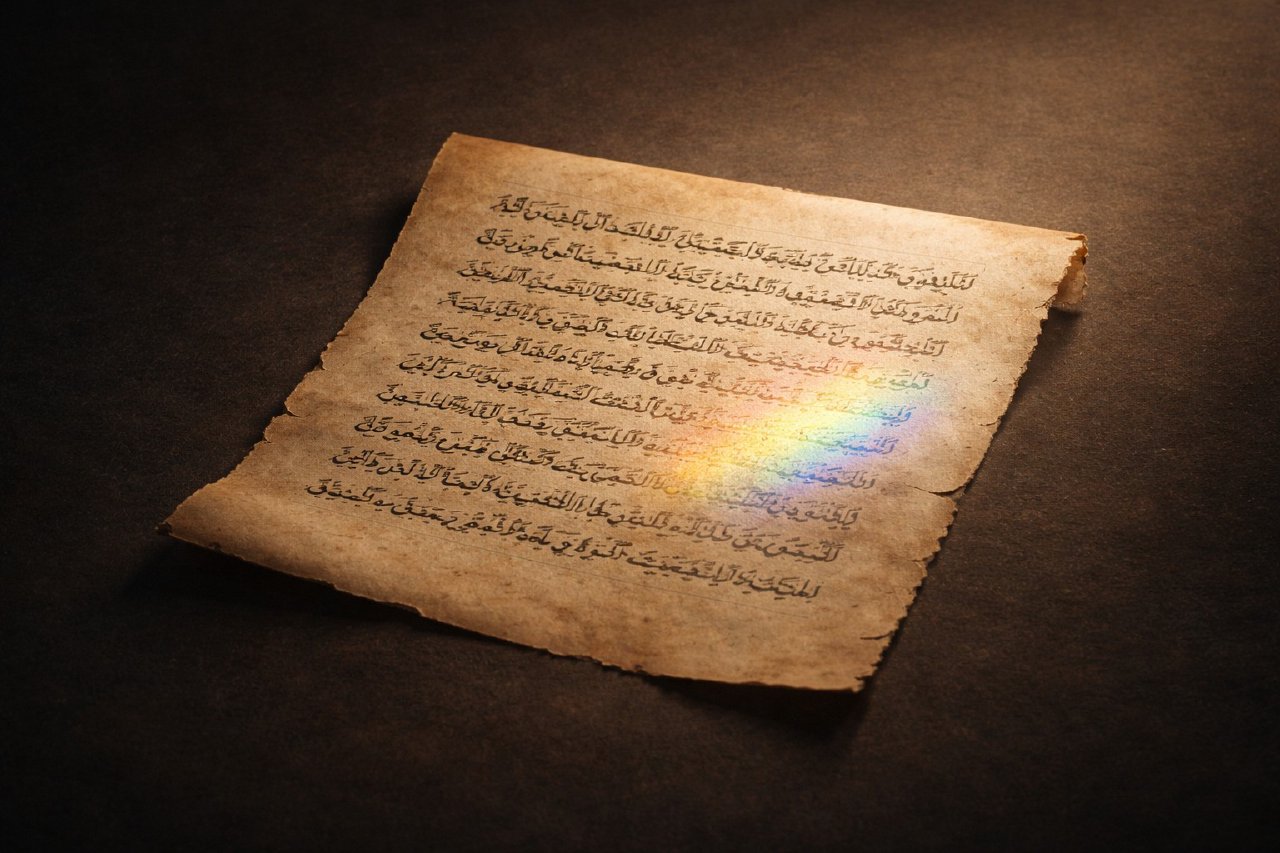
In English-language academic and popular literature on the history of sexuality in the Middle East, one occasionally encounters the claim that the medieval Arab encyclopedist Shihab al-Din al-Nuwayri wrote that the women of the “Rus” practiced same-sex love, and that those women were the first in human history to engage in such practices.
This claim is not supported by the primary source. A closer look at the Arabic text reveals that the passage is not an ethnographic account of the Rus, but the product of a translation error. Al-Nuwayri was writing not about Slavs or Scandinavians, but about a Quranic mythological people associated with demonology.
Who was al-Nuwayri, and when did he live?
The confusion surrounding this passage in Western scholarship extends beyond its content to its dating. In several modern works that cite this text, including those by the scholar Samar Habib, the author’s lifetime or the text’s date of composition is given as “c. 1241.”
This is incorrect. The author of the text is Shihab al-Din Ahmad ibn Abd al-Wahhab al-Nuwayri, a Mamluk historian, civil servant, and encyclopedist. He was born in 1279 in Egypt and died in 1333 in Cairo. The passage in question appears in his major work, Nihāyat al-arab fī funūn al-adab (“The Ultimate Ambition in the Arts of Erudition”).
This is an encyclopedia of 33 volumes, spanning more than 4,000 pages in modern editions. It covers a wide range of subjects: cosmology, geography, zoology, the history of the prophets, poetry, and the political history of the Islamic world. The date “1241” in later scholarship likely arose from a typographical error, a careless conversion from the Hijri calendar, or the uncritical reproduction of someone else’s mistake.
Anatomy of a philological catastrophe: how the “Rus” came to be
The key figure behind the appearance of the “Rus lesbians” narrative was Samar Habib. She is a scholar and editor known for her work on the history and representation of female same-sex sexuality in the Arab and Islamic context.
In 2007, she published the book Female Homosexuality in the Middle East: Histories and Representations and a number of English translations of medieval Arabic texts, including a selection in the journal EnterText.
In her translation of al-Nuwayri, the passage reads as follows:
“Kassi said that Ka’b said: The people of the Rus were plentiful in number and they built a city spanning forty miles and they named it Rassan, which was also the name of their king. They lived in their country for a long time worshipping God Almighty as he deserves to be worshipped and then they deviated from this and started to worship statues and started to commit sodomy on women and exchange them. Every man would send his woman to another man. This became unbearable for the women, and so the devil came to them in the guise of a woman and taught them grinding, and they did it. And they are the first people to commit sodomy upon women, and whose women rubbed upon one another.”
The error lies in the translation of a single word. Habib rendered the Arabic الرس (al-Rass) as “Rus.” However, in Arabic script these are two different words:
- الرس (Alif-Lam-Ra-Sin) — this is al-Rass (Rass)
- الروس (Alif-Lam-Ra-Waw-Sin) — this is al-Rus (the Rus)
Al-Nuwayri is writing specifically about al-Rass, not the Rus. His text contains a separate chapter on Ashab al-Rass (أصحاب الرس) — the “Companions of the Rass” or “dwellers of al-Rass.” These are a mythological people, briefly mentioned twice in the Quran — in Surahs 25:38 and 50:12 — among other nations destroyed for their sins, such as the ʿAd and the Thamud.
In Islamic exegesis and in the Qisas al-anbiya (“Tales of the Prophets”) tradition, a large body of legends grew around this brief Quranic mention. The name Rassan (رسان), which Habib preserves in transliteration, likewise points to this mythological narrative. It is connected to the people of al-Rass, not to historical Rus.
Where the story came from, and what the myth is about
Habib also distorts the chain of transmission. The formula “Kassi said that Ka’b said” points to a religious tradition. “Kassi” here is most likely Abu al-Hasan al-Kisa’i (الكسائي), the author of a Tales of the Prophets collection. “Ka’b” is Ka’b al-Ahbar (كعب الأحبار), one of the early Jews who converted to Islam in the 7th century and became an important transmitter of Isra’iliyyat — Judeo-Christian narratives that entered Islamic tradition.
In other words, al-Nuwayri is not reporting information about a real people. He is retelling an old religious myth that had been recorded long before him.
The myth follows the standard model of a religious cautionary tale. The people of al-Rass first lived righteously, then fell into idolatry. This was followed by moral degradation: men began to practice anal sex with women and to exchange their wives. The women found themselves in a situation that the myth describes as unbearable. Then the devil, taking the form of a woman, taught them female same-sex practice.
The Arabic tradition uses the term sihaq (سحاق) or sahq (سحق) for this practice. The root S-H-Q means “to rub,” “to grind,” “to crush.” In legal and erotic contexts, the word became associated with female homosexuality, specifically tribadism — mutual genital rubbing. Habib’s use of grinding in her translation generally conveys the meaning correctly. Women who practiced sihaq were called sahiqat (سحاقات) or musahiqat (مساحقات).
The statement that the women of al-Rass were the “first people” or “first nation” (awwal umma) to practice sihaq should not be understood as a historical report. It is part of a literary-religious model.
In Arabic historiography and literature, there existed a genre known as awa’il (أوائل) — tales of “firsts,” that is, accounts of who first performed a given action. These texts catalogued who first sewed clothing, who first drank wine, who first wielded a sword, and so on. In religious mythology, the origin of male same-sex practice was firmly linked to the people of Lot. For female same-sex practice, an analogous etiological narrative was needed. In the folkloric-exegetical tradition, this role was given to the women of al-Rass.
How Arab authors actually wrote about the Rus
This error is especially conspicuous against the backdrop of how the actual Rus are described in medieval Arab geography. In the works of Ibn Fadlan, al-Mas’udi, Ibn Hawqal, and other authors, the Rus (الروس) are a northern people of merchants and warriors.
Arab authors took note of their appearance, weapons, and physicality. The Rus were described as tall people, “like palm trees,” with references to their tattoos and martial bearing. But it was their sexual customs and hygiene that provoked disgust and shock among Muslim observers. Ibn Fadlan in the 10th century wrote that the Rus publicly engaged in heterosexual intercourse with their slave women in full view of their companions. He also gave a detailed account of a funeral rite that included human sacrifice: at the burial of a Rus nobleman, a young woman was killed.
Female same-sex sexuality in the medieval Arab world
The translation error does not negate another fact: the subject of female same-sex sexuality is genuinely present in medieval Arabic literature and is well documented.
As research has shown — including the work of Sahar Amer — Arab physicians, jurists, and literary figures discussed sihaq as early as the 9th century. Attitudes toward it were ambivalent, but within Islamic jurisprudence it was regarded as sinful. At the same time, sihaq was not equated with zina, since it did not involve penetration by a male organ. Therefore, the death penalty did not apply; punishment was assigned to the category of ta’zir, that is, discretionary corporal or disciplinary measures.
References and Sources
- Al-Nuwayri, Shihab al-Din. The Ultimate Ambition in the Arts of Erudition. Penguin Books, 2016.
- Habib, Samar. Female Homosexuality in the Middle East: Histories and Representations. Routledge, 2007.
- Amer, Sahar. Crossing Borders: Love Between Women in Medieval French and Arabic Literatures. University of Pennsylvania Press, 2008.
🇷🇺 LGBT History of Russia
General history
- Homosexuality in Ancient and Medieval Russia
- The medieval Arabic source that called the women of the Rus the world's first lesbians
- The Homosexuality of Russian Tsars Vasily III and Ivan IV the Terrible”
- Peter the Great’s Sexuality: Wives, Mistresses, Men, and His Connection to Menshikov
- Homosexuality in the 18th-Century Russian Empire — Europe-Imported Homophobic Laws and How They Were Enforced
- Russian Empress Anna Leopoldovna and the Maid of Honour Juliana: Possibly the First Documented Lesbian Relationship in Russian History
Folklore
Biographies
- Grigory Teplov and the Sodomy Case in 18th-Century Russia
- Russian Poet Ivan Dmitriev, Boy Favourites, and Same-Sex Desire in the Fables 'The Two Doves' and 'The Two Friends'
- The Diary of the Moscow Bisexual Merchant Pyotr Medvedev in the 1860s
- Sergei Romanov: A Homosexual Member of the Imperial Family
- The Possible Homosexuality of Grand Duke Nikolai Mikhailovich of the Romanov Family
- Andrey Avinoff: A Russian Émigré Artist, Gay Man, and Scientist
 Subscribe to our Telegram channel (in Russian): Urania. With Telegram Premium, you can translate posts in-app. Without it, many posts link to our website, where you can switch languages — most new articles are published in multiple languages from the start.