Female Images of God in the Old Testament
Traces of the Asherah cult, maternal metaphors of the prophets, and the female face of biblical Wisdom.
Contents
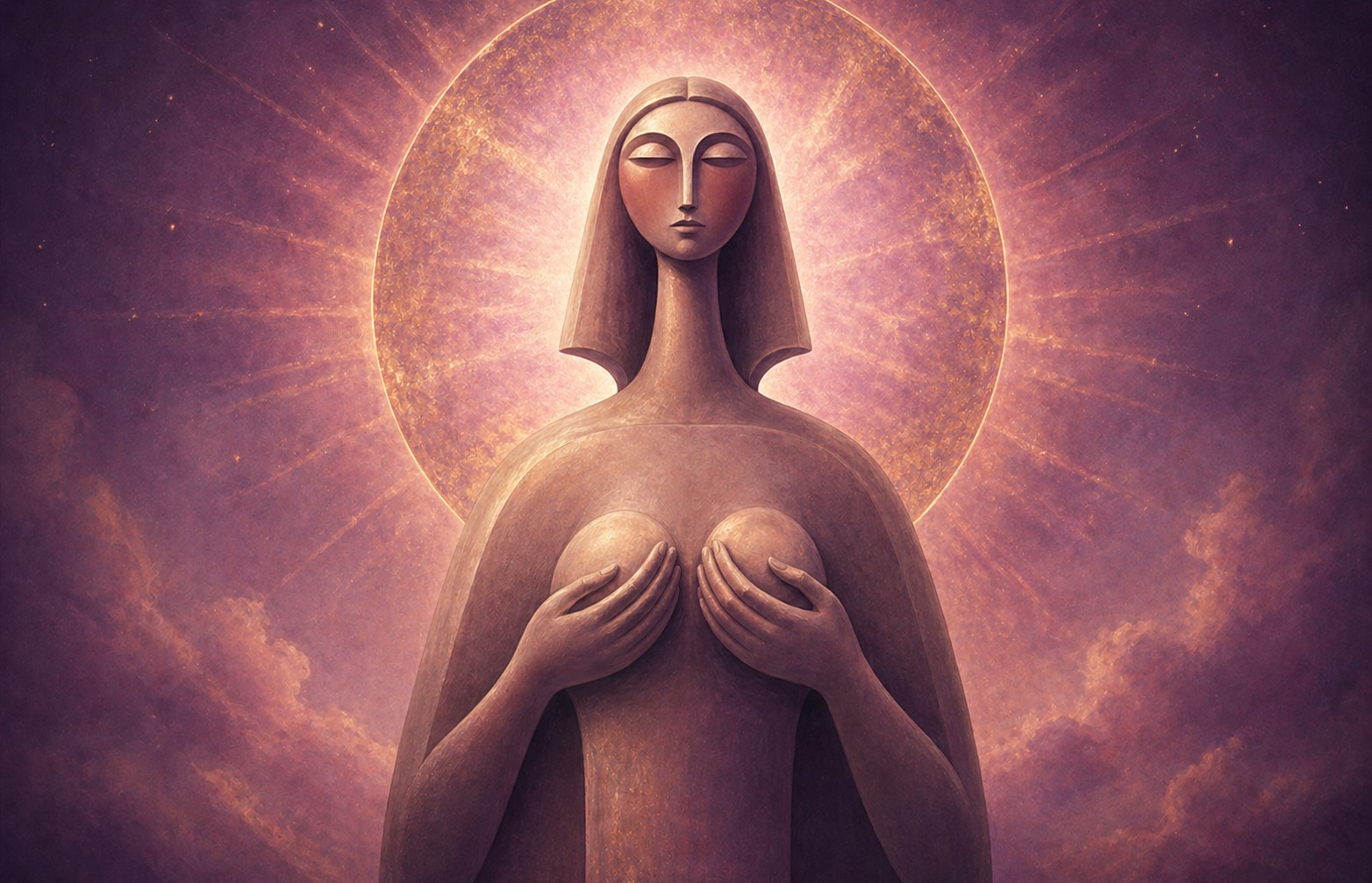
In biblical and ecclesiastical tradition, God is most often described using masculine imagery: Father, King, Judge, Warrior. However, the text of the Old Testament itself is more complex. It preserves maternal metaphors, feminine grammatical forms, and traces of the earlier religious world of the Ancient Near East.
The purpose of this article is to understand exactly which female images of God are found in the biblical text and its ancient context and how they are connected to the history of the religion of Israel. The goal is not to declare any single theory as the final answer, but rather to see the material itself more clearly.
To do this, it is important to understand the historical background. The transition from ancient Near Eastern polytheism to the strict belief in one God (monotheism) did not happen overnight. It was a long and complex process. As the cults of ancient goddesses disappeared, religious language and the ways of speaking about God changed.
From Polytheism to Monotheism
The religion of ancient Israel was formed in the diverse, polytheistic world of the Ancient Near East. This vast region included Egypt, Mesopotamia, the neighboring powerful kingdom of Urartu (in the territory of the modern Armenian Highlands), and the Levant – the lands of modern Syria, Lebanon, and Israel.
As scholar John Akwei notes, the transition from polytheism to monotheism was gradual. In ancient pantheons, gods formed a hierarchy. At the head usually stood a supreme father god (for example, El), and beside him – his divine consort.
German Egyptologist and historian of religion Jan Assmann emphasizes that ancient polytheism was a coherent system where different deities were responsible for various aspects of the world: the sky, the sea, war, fertility, royal power, childbirth, death.
In this world, the Israelite God, Yahweh, was originally one of the deities of the Levantine pantheon. British biblical scholar Francesca Stavrakopoulou wrote that in those distant times of the Late Bronze and Early Iron Ages, Yahweh was rooted in a world where gods were conceived of as one large heavenly family.
Over time, Yahweh gradually absorbed the roles of other deities. He took on not only the functions of male gods (such as the storm god Baal) but also the traits of powerful female goddesses of the Near East. Strict monotheism, having finally rejected other gods and divine consorts, transferred feminine, creative, and maternal traits to the single Old Testament God.
Yahweh and His Asherah
One of the main plotlines in this history is the figure of Asherah (or Athirat). In Canaanite religion – the ancient faith of the peoples who inhabited the lands of Canaan before the arrival of the Israelites – she was the great mother goddess and consort of the supreme god El. Since in the minds of the ancient Israelites the images of El and Yahweh merged over time, Asherah in folk religion came to be perceived as the consort of Yahweh.
For a long time, it was believed that biblical monotheism was always the original and only faith of Israel. But archaeological excavations changed this view. In 1975–1976, Israeli archaeologist Ze’ev Meshel investigated the ruins of the ancient fortress of Kuntillet Ajrud from the turn of the 9th to 8th centuries BCE. On the clay jars found there, there is an inscription: “I bless you by Yahweh of Samaria and his Asherah.” A little later, American archaeologist William Dever discovered a similar inscription in a Judean burial cave near Hebron: “Blessed is Uriyahu by Yahweh and his Asherah; from his enemies he has saved him.”
A scholarly debate arose: what exactly does the word “Asherah” mean? In traditional interpretation (for example, in the commentaries of the Russian biblical scholar A. P. Lopukhin on 2 Kings 23:6), Asherah was described as a wooden idol-pole. Linguists also had doubts: in ancient Hebrew, possessive pronouns like “his” are usually not attached to proper names. Therefore, many decided that it was not about a goddess, but about her symbol – a sacred tree or pole. The Old Testament mentions this object many times next to the altars of Yahweh.
However, recent studies have offered a different explanation. Ancient Amorite-Akkadian texts published in 2023 showed that the suffix -h in the word “Asherah” ʾšrth might not be the pronoun “his,” but an archaic feminine marker.
Scholar Richard Hess connects these data with earlier forms of the name Athirat/Asherah and believes that such forms are better understood as the name of a goddess, and only then as the name of a cultic object. Korean biblical scholar Sung Jin Park also suggests that later biblical editors might have intentionally distorted the grammar to hide traces of goddess worship.
In any case, as scholars William Dever and Susan Ackerman note, even if the inscriptions refer to a wooden pole, for the common people the boundary between the symbol and the goddess herself was blurred – Asherah acted as an independent source of blessing on a par with Yahweh. This is also indicated by drawings on the jars from Kuntillet Ajrud, which feature human-like figures of Yahweh and Asherah.
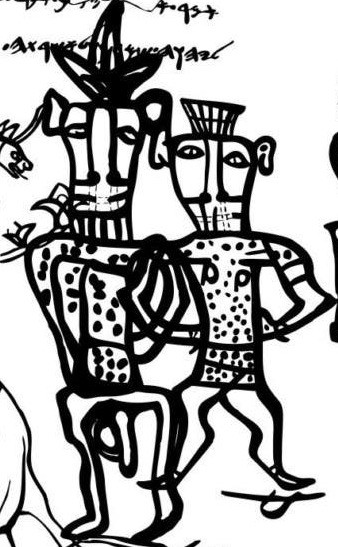
This picture is complemented by texts from Ugarit – an ancient port city-state in Syria whose cuneiform archives revealed the myths of the Canaanites. In the Ugaritic pantheon, Asherah bore the title “Mother of the gods” and was described as a cosmic wet nurse. The texts say that newborn deities suckle at her breasts. This is an important parallel to later biblical images of a nurturing and birthing God.
The cult of Asherah is mentioned in Deuteronomy 12, where Yahweh commands the destruction of her sanctuaries to preserve the purity of his worship.
The material culture of Judah also shows that in the private homes of ancient Jerusalem there were thousands of clay female figurines with emphasized breasts, associated with maternal protection and childbearing. These were domestic amulets and part of folk religion. Women kept them in their bedrooms, believing that Asherah would help them get pregnant, give birth safely, and nurse a child.
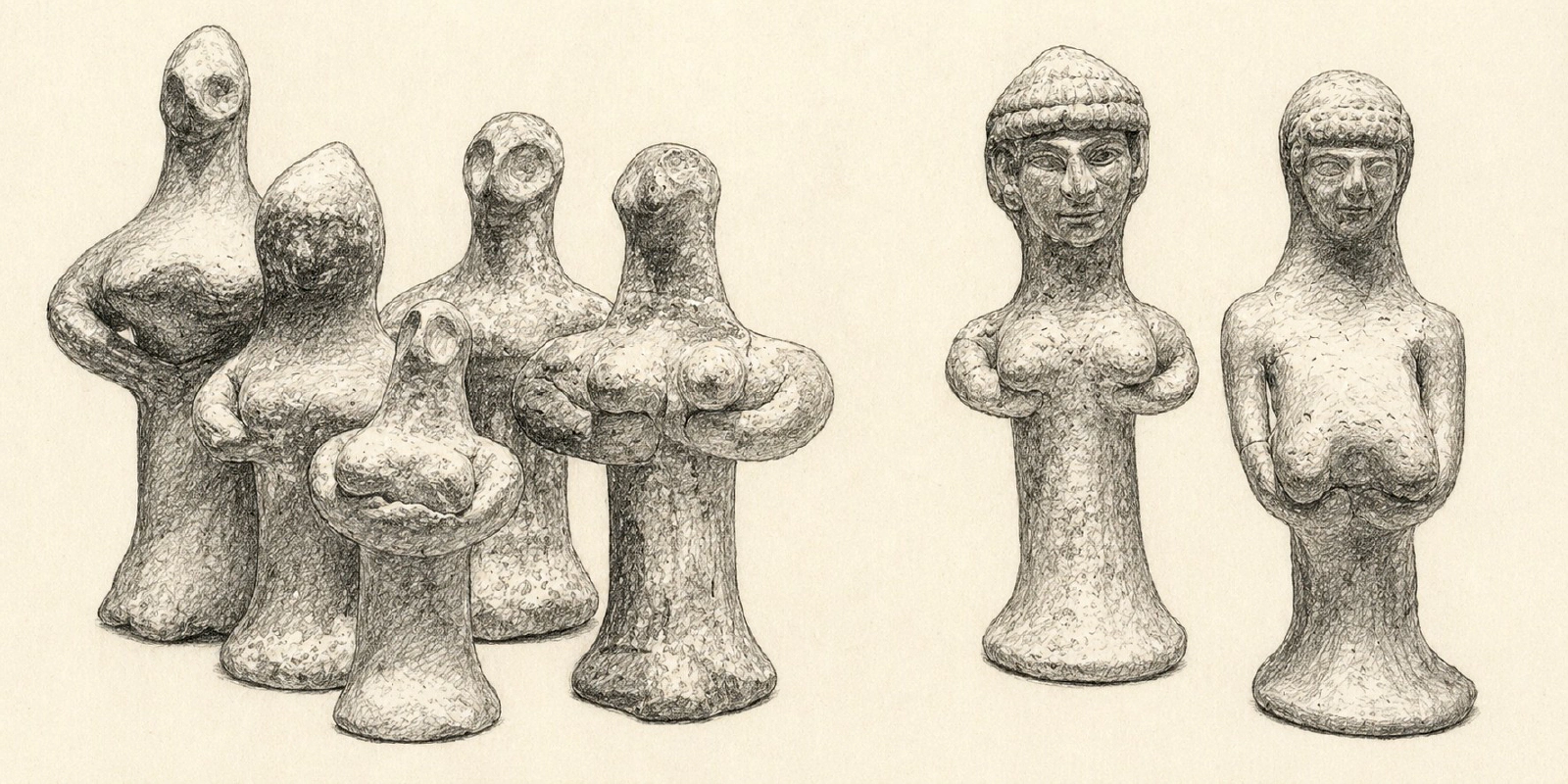
The name Asherah appears in the Hebrew Bible forty times, but in translations, it is significantly reduced: for example, in the English translation, the word “grove” is used instead of the name Asherah, and in Russian translations, the words “Astarte,” “pole,” or “tree” are used.
The cult of Asherah was official and recognized by the state. The Bible has preserved evidence that her statue stood in the main Jerusalem temple for decades. For example, King Manasseh officially installed her symbol there, believing that this did not contradict the holiness of the place at all:
“He took the carved Asherah pole he had made and put it in the temple, of which the Lord had said to David and to his son Solomon, ‘In this temple and in Jerusalem, which I have chosen out of all the tribes of Israel, I will put my Name forever.’”
– 2 Kings 21:7, NIV
Only centuries later, during the reforms of the 7th century BCE, was the worship of the goddess declared a sin, and her images began to be destroyed.
Josiah’s Reform and the “Silence on Asherah”
If the feminine divine principle was so popular, why does the surviving text of the Bible speak of God almost exclusively in the masculine gender? Historians link this to the religious reform of King Josiah at the end of the 7th century BCE.
Scholars often call this reform “Deuteronomistic” because it was based on the ideas of the Book of Deuteronomy. The goal of the reform was political and religious: to centralize power and worship in the Jerusalem temple by destroying local sanctuaries.
The supporters of the reform, a group of priests and scribes, not only changed the worship but also reinterpreted Israel’s past. Now any departure from strict monotheism was declared idolatry and explained future national disasters. British scholar Margaret Barker even called this reform a kind of “apostasy,” when the ancient tradition of worshiping the Mother Goddess was forcibly ousted from the temple.
German theologian Christian Frevel uses the term “silence on Asherah.” According to his thought, prophetic and editorial circles deliberately silenced the goddess and linked her name with the hostile god Baal. Therefore, the prophet Jeremiah speaks out so sharply against women who worshiped the goddess:
“The children gather wood, the fathers light the fire, and the women knead the dough and make cakes to offer to the Queen of Heaven. They pour out drink offerings to other gods to arouse my anger.”
– Jeremiah 7:18, NIV
Jeremiah’s text shows that the displacement of the female deity did not go without resistance. Thus, after the destruction of Jerusalem by the Babylonians in 586 BCE, Jewish female refugees in Egypt argued with the prophet and stated that it was precisely the refusal to worship the “Queen of Heaven” – a deity who absorbed the traits of Asherah, Astarte, and Ishtar – that led to the catastrophe:
“The women added, ‘When we burned incense to the Queen of Heaven and poured out drink offerings to her, did not our husbands know that we were making cakes impressed with her image and pouring out drink offerings to her?’”
– Jeremiah 44:19, NIV
This is a rare biblical testimony of open female disagreement with the official religious line. A. P. Lopukhin noted in his commentary that Jewish women defended the cult publicly and emphasized: they performed the rituals with the consent of their husbands.
But, ultimately, it was the Deuteronomistic version of the religion that became normative, and in the final text of the Old Testament, masculine designations of God came to predominate.
The Language of Female Images of God
Even after editorial revision, the ancient Hebrew text retained linguistic traces of female images of God. Hebrew strictly distinguishes between masculine and feminine genders, and therefore such places are especially noticeable.
The Name El Shaddai
One of the most famous examples is the divine name El Shaddai. It is usually translated as “God Almighty,” which immediately paints the image of a stern sovereign.
But American historian David Biale links this name to the Akkadian word šadû – “mountain,” which, according to his version, goes back to a root meaning female breast – and to the Hebrew šad, that is, “breast.” In the dual form, šāḏayim means “female breasts.” If this etymology is correct, the original meaning of this title is “the God who nurses,” “the God with maternal breasts.”
The name El Shaddai often appears in the Book of Genesis precisely in scenes related to birth and the blessing of offspring. The clearest example is the blessing of the patriarch Jacob, who wishes his son Joseph help from the Almighty (Shaddai), poetically linking His name with “blessings of the breasts and of the womb” and using wordplay:
“…because of your father’s God, who helps you, because of the Almighty (El Shaddai), who blesses you with blessings of the skies above, blessings of the deep springs below, blessings of the breasts and womb (birḵōt šāḏayim wā-rāḥam).”
– Genesis 49:25, NIV
Here God is far from the image of an abstract king and sovereign. He is the one who nourishes and gives life. Our translation “Almighty” makes this bodily image much less noticeable.
At the same time, the image of Shaddai is not limited to just a nursing, caregiving function. The biblical text masterfully plays with consonances, paradoxically linking this name with the roots šōḏ – “destruction,” “violence” – and day – “sufficiency.” As a result, two opposing elements merge in the name El Shaddai: life-giving and destructive.
This terrifying aspect is clearly visible in the prophet Joel, when he predicts a national catastrophe, using the phonetic wordplay kəšōḏ miššadday (“like destruction from Shaddai”):
“Alas for that day! For the day of the Lord is near; it will come like destruction from the Almighty.”
– Joel 1:15, NIV
Some scholars see in this paradoxical duality a direct echo of ancient Near Eastern female deities.
The great goddesses of the Near East, such as the Mesopotamian Ishtar or the Canaanite Anat, were never merely gentle mothers. They commanded not only fertility, sexuality, and birth, but also fierce war, bloodshed, and storms. This formidable, militant maternal energy, capable of both giving life and fiercely taking it away, could have become part of the biblical image of Shaddai.
The Vocabulary of Compassion
Female corporeality also permeates the language of God’s mercy. The ancient Hebrew word raḥămîm – “mercy,” “compassion” – comes from the root reḥem, that is, “womb,” “uterus.” When the Old Testament speaks of God’s mercy, it uses a word related to the maternal womb. The prophet Jeremiah conveys this especially vividly:
“Is not Ephraim my dear son, the child in whom I delight? Though I often speak against him, I still remember him. Therefore my heart yearns for him (hāmû mēʿay lô; raḥēm ʾăraḥămennû); I have great compassion for him,” declares the Lord.
– Jeremiah 31:20, NIV
In the Hebrew text, in place of “heart” stands the word raḥēm, which literally means “inward parts” or “womb.” In other words, God’s compassion is described through maternal experience.
The Spirit of God (Ruach)
At the very beginning of the Bible, in Genesis 1:2, the Spirit of God “hovers over the waters” of the primordial chaos:
“Now the earth was formless and empty, darkness was over the surface of the deep, and the Spirit (rûaḥ) of God was hovering (mĕraḥep̱eṯ) over the waters.”
– Genesis 1:2, NIV
But the ancient word rûaḥ – “spirit,” “breath,” “wind” – is feminine in Hebrew, which affects the form of the verbs associated with it. The verb “was hovering” (mĕraḥep̱eṯ) is also used in the feminine form. Grammatically, this means that the Spirit acts as a female subject, and in a literal translation, the phrase sounds like “the Spirit [she] was hovering over the waters.”
This gives the opening lines of the Book of Genesis a specific nuance of meaning, presenting the Divine presence in a feminine aspect already at the moment of the creation of the world.
The use of this exact verb emphasizes the maternal aspect of the Deity through the metaphor of a bird. In biblical Hebrew, this word also describes the action of a bird that warms its nest or protects its offspring, for example, in Deuteronomy 32:11:
“Like an eagle that stirs up its nest and hovers (mĕraḥep̱eṯ) over its young, that spreads its wings to catch them and carries them aloft.”
– Deuteronomy 32:11, NIV
The connection between these texts allows scholars to interpret the process of creation as an act of “incubating” life out of chaos. The image of the Mother-Spirit, warming the primordial waters like a bird in a nest, presents God as a creative and protecting force.
Later, when translating the Bible into Greek and Latin, this grammatical feature disappeared.
Poetic and Prophetic Metaphors
The patriarchal structure of the Ancient Near East and the strict male hierarchy of the temple cult largely determined the official language of religion, where God was described as King, Lord, and Warrior. However, during periods of severe national crises – such as the destruction of Jerusalem, the Babylonian exile, and the threat of the people’s annihilation – the official language proved insufficient.
To express the depth of divine compassion, unconditional love, and the very process of agonizing historical rebirth, prophets and psalmists used poetic metaphors based on female bodily and social experience.
The Metaphor of Labor Pains
In texts describing the Babylonian exile, historical upheavals are depicted as the agonizing process of the emergence of new life. In the 42nd chapter of the Book of Isaiah, this contrast is expressed as sharply as possible. In the 13th verse, God acts in the image of a warrior, but in the very next verse, He speaks the language of a woman in labor:
“The Lord will march out like a champion, like a warrior he will stir up his zeal; with a shout he will raise the battle cry and will triumph over his enemies. ‘For a long time I have kept silent, I have been quiet and held myself back. But now, like a woman in childbirth, I cry out, I gasp and pant (kay-yōlēḏâ ʾep̄ʿeh; ʾeššōm wə-ʾešʾap̄ yaḥad).’”
– Isaiah 42:13-14, NIV
Biblical scholar Patricia Tull points out that here God describes His action through the image of labor pains. A new historical order, that is, liberation from Babylon, is born through a painful effort. The power of this metaphor is also recognized by Orthodox exegesis. A. P. Lopukhin in the “Explanatory Bible” (Tolkovaya Bibliya, a landmark Russian Orthodox commentary) comments on this verse as follows:
“The very image to express this thought is taken from a comparison with a woman giving birth, who silently endures her pre-labor pains for a long time, but finally, at the last moment, is no longer able to restrain herself and betrays them with loud cries.”
– Lopukhin’s Explanatory Bible
The combination of a warrior’s cry and the heavy breathing of a woman in labor in one passage demonstrates the versatility of the biblical God, uniting within Himself crushing power and life-giving suffering.
The Image of the Comforting Mother
Turning to maternal metaphors was necessary for the prophets to deal with the trauma of the exiles. When the people felt abandoned and forgotten by their Lord, Isaiah appealed to the strongest biological and emotional bond – the attachment of a nursing mother to an infant. An earthly king or father might reject rebellious subjects, but a mother and God act differently:
“Can a mother forget the baby at her breast and have no compassion on the child she has borne? Though she may forget, I will not forget you!”
– Isaiah 49:15, NIV
And:
“As a mother comforts her child, so will I comfort you; and you will be comforted over Jerusalem.”
– Isaiah 66:13, NIV
Commenting on these lines, A. P. Lopukhin points out that maternal care is the highest form of earthly love. It is with this absolute, bodily conditioned attachment that the Lord compares His relationship with the faithful people, guaranteeing the impossibility of a final break.
God in the Image of a Midwife
In the Psalms, God appears in the image of a midwife – a woman delivering a baby. In the ancient world, the birth of a child was a moment of supreme danger and balancing on the brink of death. The midwife was the main saving figure at this moment.
The psalmist, describing his extreme vulnerability and helplessness in the world, appeals to this fact:
“Yet you brought me out of the womb; you made me trust in you, even at my mother’s breast. From birth I was cast on you; from my mother’s womb you have been my God.”
– Psalm 22:9-10, NIV
Biblical scholar L. Juliana Claassens calls this image “muscular midwifery.” Since in ancient Israel midwives were exclusively women, the metaphor of God receiving a child from the womb emphasizes His immediate presence next to a person in moments of physical vulnerability. God saves life with His own hands, like an experienced midwife.
Images of a Nursemaid and Wet Nurse
Gender boundaries are blurred especially vividly in the Book of the prophet Hosea. This text contains an amazing theological paradox: within a single book, God appears before the reader as a deceived jealous husband, as a ferocious mother bear protecting her offspring, and as a tender mother or nursemaid teaching a child to walk:
“When Israel was a child, I loved him, and out of Egypt I called my son. <…> It was I who taught Ephraim to walk, taking them by the arms; but they did not realize it was I who healed them. I led them with cords of human kindness, with ties of love. To them I was like one who lifts a little child to the cheek, and I bent down to feed them.”
– Hosea 11:1-4, NIV
Here the prophet personifies an entire nation (calling it Ephraim) and presents it as an ignorant toddler. God describes His relationship with His people through an extremely intimate metaphor of maternal care for an infant.
There are similar images in other books. In the Book of Numbers, the prophet Moses, exhausted by the burden of governing the people in the desert, addresses God with a reproach. In his complaint, he uses metaphors of pregnancy, childbirth, and nursing, directly indicating that it is God, and not he, who bears maternal responsibility for Israel:
“Did I conceive all these people? Did I give birth to them? Why do you tell me to carry them in my arms, as a nurse carries an infant, to the land you promised on oath to their ancestors?”
– Numbers 11:12, NIV
In this passage, the immense burden of caring for a whole nation is equated with the hard, daily labor of a wet nurse. Moses emphasizes that this role rightfully belongs to the Creator.
A similar image of complete trust in God, expressed through the bodily connection of an infant and a nursing mother, is present in the Psalms:
“But I have calmed and quieted myself, I am like a weaned child with its mother; like a weaned child I am content.”
– Psalm 131:2, NIV
Everyday Female Labor
In addition to extreme situations like childbirth, biblical texts conceptualize divine care through routine, everyday female labor. Writer and scholar Lauren Winner draws attention to the fact that God often performs traditionally female household chores. For example, He acts as a seamstress, making clothes for Adam and Eve:
“The Lord God made garments of skin for Adam and his wife and clothed them.”
– Genesis 3:21, NIV
In the New Testament, this tradition continues in the parables of Jesus Christ. One of the most famous comparisons of the Kingdom of God is the parable of the yeast. In it, the divine presence and the transformation of the world are likened to everyday female labor in the kitchen:
“Again he asked, ‘What shall I compare the kingdom of God to?
It is like yeast that a woman took and mixed into about sixty pounds of flour until it worked all through the dough.’”
– Luke 13:20-21, NIV
Here the invisible process of the spiritual change of the world is compared to the unnoticeable, but absolutely necessary work of a woman.
A noteworthy detail: “sixty pounds of flour” (about 40 liters) is a huge volume, enough to bake bread for a hundred people. Thus, the domestic labor of a woman at the kneading trough becomes a large-scale theological metaphor: just as a woman feeds a large family or a whole community, God secretly, but comprehensively and inevitably, nourishes and transforms all of creation.
Aggressive Protection of Offspring
Female images of God in the Old Testament are associated not only with tenderness, but also with the manifestation of extreme fury and aggression directed at protecting offspring. In the prophet Hosea, God is compared to a bear robbed of her cubs, ready to tear apart anyone who threatens her offspring:
“Like a bear robbed of her cubs, I will attack them and rip them open; like a lion I will devour them – a wild animal will tear them apart.”
– Hosea 13:8, NIV
This also includes the mentioned image of the mother eagle in Deuteronomy 32:11 and the image of a bird providing absolute safety to chicks under her wings:
“He will cover you with his feathers, and under his wings you will find refuge; his faithfulness will be your shield and rampart.”
– Psalm 91:4, NIV
Chokhmah and Sophia
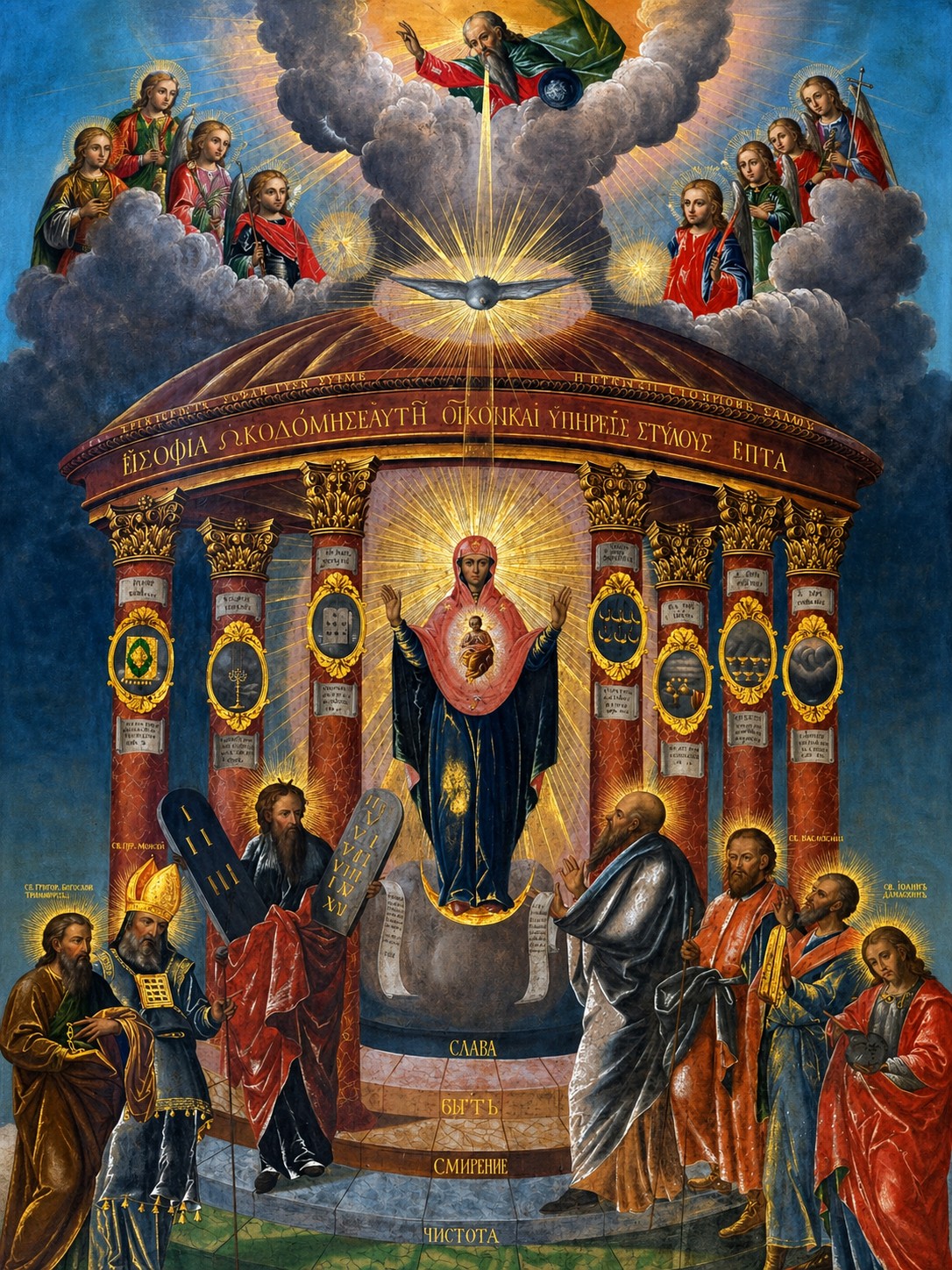
One of the most developed female figures in the biblical tradition is Wisdom: Chokhmah in Hebrew and Sophia in Greek. Both words are feminine.
In the so-called wisdom literature (Book of Proverbs, Ecclesiastes), wisdom ceases to be simply an abstract quality or human trait and becomes an independent female figure, an interlocutor and companion of God Himself.
In the 8th chapter of the Book of Proverbs, Chokhmah delivers a first-person monologue, declaring that she existed even before the creation of the world:
“The Lord brought me forth as the first of his works, before his deeds of old; I was formed long ages ago, at the very beginning, when the world came to be. When there were no watery depths, I was given birth, when there were no springs overflowing with water; before the mountains were settled in place, before the hills, I was given birth, before he made the world or its fields or any of the dust of the earth. I was there when he set the heavens in place, when he marked out the horizon on the face of the deep, when he established the clouds above and fixed securely the fountains of the deep, when he gave the sea its boundary so the waters would not overstep his command, and when he marked out the foundations of the earth. Then I was constantly at his side. I was filled with delight day after day, rejoicing always in his presence.”
– Proverbs 8:22-30, NIV
Later, in the Hellenistic era, this image received colossal development. Written in Alexandria in Greek, the Book of the Wisdom of Solomon, which Orthodox and Catholics include in the Bible as edifying, and Protestants consider an apocryphon, endows the figure of Sophia with a cosmic scale. She is no longer just a helper, but a direct reflection of the Divine essence itself:
“For she is a breath of the power of God, and a pure emanation of the glory of the Almighty; therefore nothing defiled gains entrance into her. For she is a reflection of eternal light, a spotless mirror of the working of God, and an image of his goodness.”
– Wisdom of Solomon 7:25-26, NRSV
In this book, Sophia appears as a mystical bride whom the seeker of wisdom longs to find. Many scholars believe that Sophia acts here as a powerful divine subjectivity, effectively as a feminine aspect of the one God, participating in the governance of the Universe.
This idea became deeply rooted in subsequent religious traditions. In Judaism, it evolved into the Kabbalistic doctrine of the Shekhinah (Divine presence), which came to be perceived as the Bride of God and the cosmic Mother. In Kabbalah, the Shekhinah shares the exile with her people and mourns with them, and the mystical goal of humanity is conceived as the reunification of the male principle of God with His feminine hypostasis – the Shekhinah.
In the Christian context, biblical Sophia had a huge influence on Russian religious philosophy in the late 19th and early 20th centuries.
Philosopher Vladimir Solovyov turned this image into a central element of his system – the concept of “Eternal Femininity” (or the Soul of the world). For Solovyov, Sophia was not a speculative allegory; he perceived her as a real, living spiritual being, the feminine principle in God Himself. He even left poetic descriptions of his own mystical experience of encounters with Sophia, who appeared to him in visions.
Solovyov’s ideas gave rise to a whole philosophical movement – sophiology, which was further developed by priests and thinkers Pavel Florensky and Sergius Bulgakov. Bulgakov, in particular, wrote of Sophia as God’s pre-eternal design for the world, His creative love.
And although in 1935 the Moscow Patriarchate officially condemned Bulgakov’s sophiology (seeing in it a dangerous attempt to introduce a “fourth hypostasis” into Christianity), the doctrine of Sophia remained one of the most vivid pages in the history of Orthodox thought, showing how far the conceptualization of the feminine principle in the Divine can go.
Conclusion
The Old Testament is not limited to a single set of male images of God. Yes, the patriarchal designations of the Creator as Warrior, King, and Lord predominate in it. But, as we have seen, the biblical text is much more complex. Alongside the male images, other equally important layers are preserved: the historical memory of the Asherah cult, the paradoxical etymology of El Shaddai, the grammatically feminine gender of the Spirit (ruach), profound maternal metaphors in prophetic literature, and the independent cosmic figure of Wisdom-Sophia.
That is exactly why scholars of feminist and queer theology turn to these texts today. An honest historical and philological reading of the Bible itself destroys overly simple patriarchal schemes. It shows that the Divine presence cannot fit into any human gender categories.
The biblical tradition knows far more nuances in the conversation about the Divine than is often assumed by later simplified interpretations. The God of the Old Testament is not only a stern heavenly ruler but also a nursing mother, a midwife, and creative Wisdom – a power that transcends and unites any of our conceptions of gender.
Literature and Sources
- Ackerman S. At Home with the Goddess. In Symbiosis, Symbolism, and the Power of the Past. 2003.
- Akwei J. A Comparative and Evolutionary Theory of the Transition from Polytheism to Monotheism.
- Assmann J. Of God and Gods: Egypt, Israel, and the Rise of Monotheism. 2008.
- Barker M. The Mother of the Lord. Volume 1: The Lady in the Temple. 2012.
- Biale D. The God with Breasts: El Shaddai in the Bible. History of Religions. 1982.
- Bulgakov S. Sophia, the Wisdom of God: An Outline of Sophiology. 1993.
- Claassens L. J. Mourner, Mother, Midwife: Reimagining God’s Liberating Presence in the Old Testament.
- Davidson R. M. Flame of Yahweh: Sexuality in the Old Testament. 2007.
- Dever W. G. Did God Have a Wife? Archaeology and Folk Religion in Ancient Israel. 2005.
- Florensky P. The Pillar and Ground of the Truth.
- Frevel C. Aschera und der Ausschließlichkeitsanspruch YHWHs. 1995.
- Lopukhin A. P. Explanatory Bible.
- Meshel Z. Kuntillet Ajrud: A Religious Centre from the Time of the Judaean Monarchy. 1976.
- Park S. J. The Cultic Identity of Asherah in Deuteronomistic Ideology of Israel. ZAW. 2011.
- Solovyov V. Divine Sophia: The Wisdom Writings of Vladimir Solovyov. 2009.
- Stavrakopoulou F. God: An Anatomy. 2021.
- Tull P. Fortress Commentary on the Old Testament and Apocrypha.
- Winner L. F. Wearing God: Clothing, Laughter, Fire, and Other Overlooked Ways of Meeting God. 2015.
- The Zohar.
- Ugaritic Mythological Corpus (KTU 1.23).
🙏 Queer Theology of Christianity
Introduction
 Subscribe to our Telegram channel (in Russian): Urania. With Telegram Premium, you can translate posts in-app. Without it, many posts link to our website, where you can switch languages — most new articles are published in multiple languages from the start.