The Hermitage's 'Amorous Couple': An Iranian Painting with Gender Ambiguity
An anonymous early 19th-century Iranian painting in which a beauty and a beardless youth are nearly indistinguishable.
- Editorial team
§
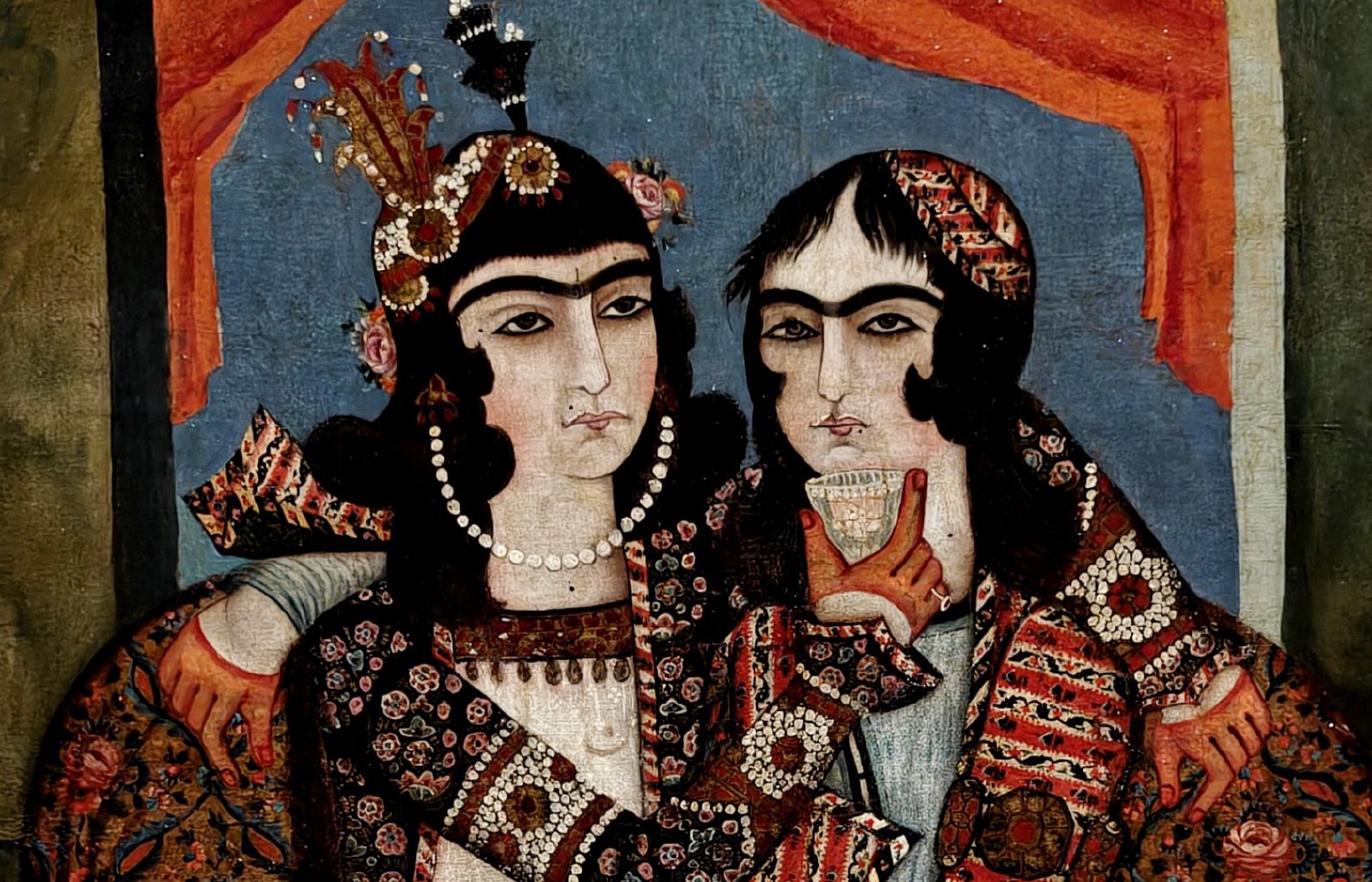
The painting Amorous Couple is an anonymous early 19th-century Iranian work from the collection of the State Hermitage Museum, inventory number VP-1156. It is painted in oil on canvas and measures 131.5 × 77 cm. Museum descriptions date it to the early 19th century.
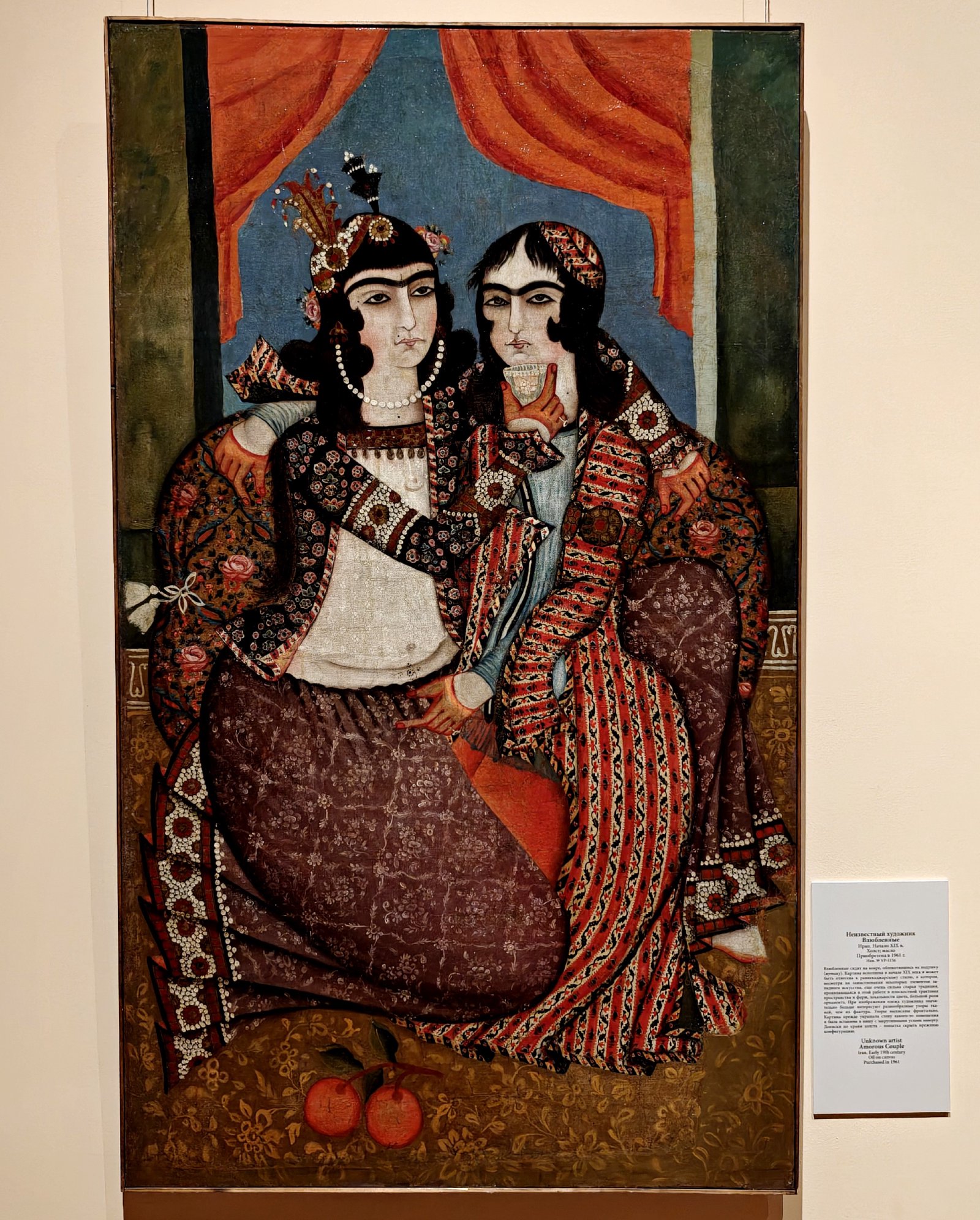
The painting was originally made for one of the halls of a palace. Its format corresponded to a niche with rounded upper corners. The upper part of the canvas was later extended to make it rectangular.
The painting is displayed in Hall 397 of the museum’s Persian collection.
A Courtly Love Scene
The subject is a typical early Qajar court scene depicting a pair of lovers. Qajar art refers to Iranian art from the era of the Qajar dynasty, which ruled from the late 18th to the early 20th century.
Court painting of this period characteristically depicts lovers seated on a carpet in a conventional decorative setting. The Hermitage attributes this painting to precisely this early 19th-century Iranian court tradition.
The faces of both figures are idealised, turned toward the viewer, and nearly mirror each other. The museum description notes a detail: the beauty offers her companion a glass of wine, but the direction of their gazes seems unrelated to the action itself.
The Beardless Youth and Gender Ambiguity
The painting’s key iconographic feature concerns the male figure. In the museum description, this character is identified as a birish — a beardless, effeminate young man. He has long curls, lined eyelashes, and henna-stained hands. The birish is depicted on the right, and the woman on the left.
This relates to a broader feature of Qajar Iranian visual culture: male and female beauty were rendered in nearly identical ways, and the viewer determined a figure’s sex not from the face but from context, pose, and details of clothing. In the case of the Hermitage painting, the museum states that the viewer sees a pair of lovers in which one figure is a beardless youth — a birish.
A modern viewer may perceive this scene as depicting two women, and such a queer interpretation is possible. However, it is more accurate in scholarly terms to speak of a gender-ambiguous love scene.
 Subscribe to our Telegram channel (in Russian): Urania. With Telegram Premium, you can translate posts in-app. Without it, many posts link to our website, where you can switch languages — most new articles are published in multiple languages from the start.