How Duke Xian of Jin Sent a Beautiful Youth to Another Ruler to Weaken His Court and Then Conquer His Country
A historical episode about diplomacy through a favorite at the court in Ancient China.
Contents
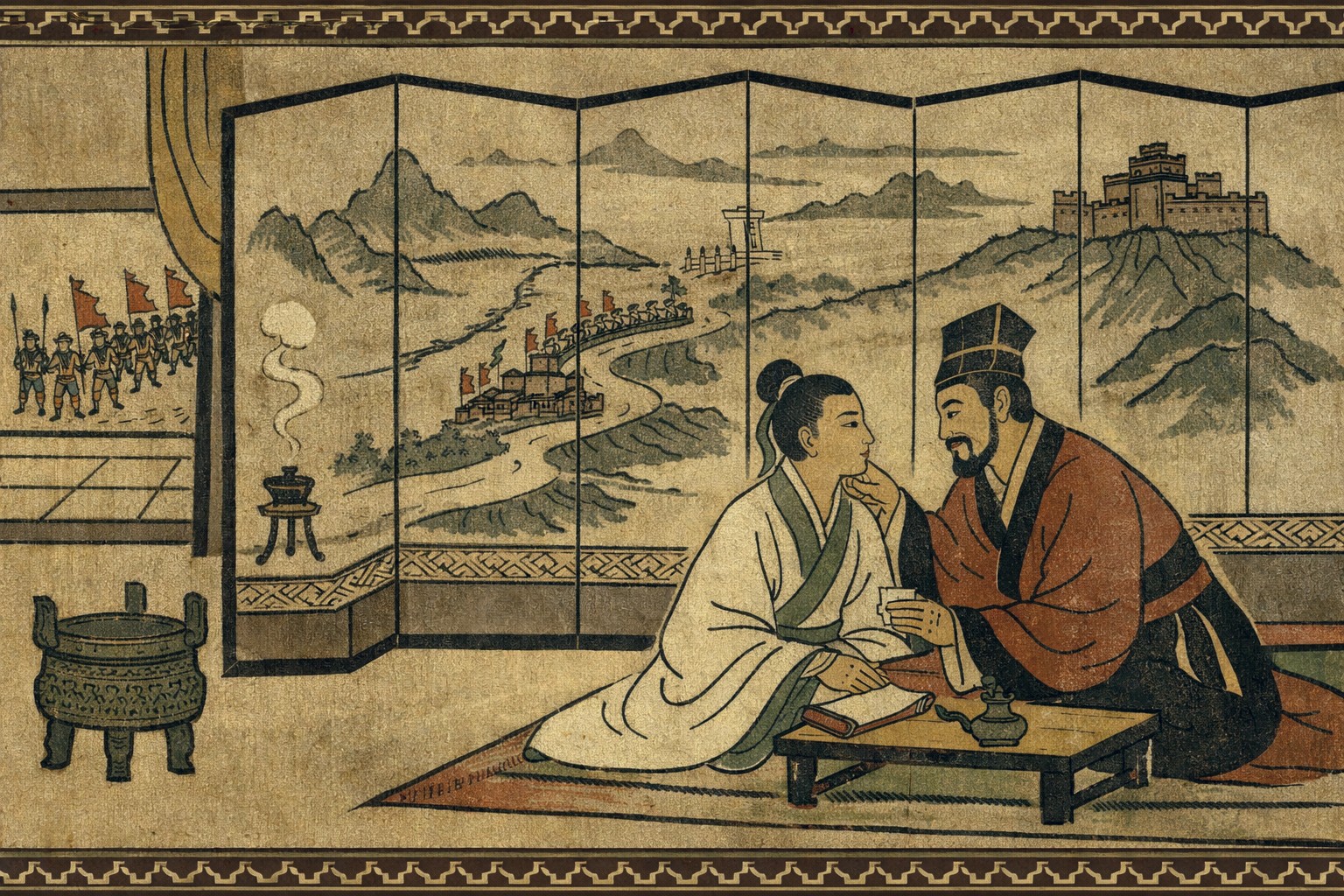
In the ancient Chinese text Zhanguo ce, there is a story about the ruler of Jin, Duke Xian-gong, to whom especially cunning diplomatic methods are attributed. One of them was pressure on a rival through the placement of an attractive young man in his inner circle.
Zhanguo ce (战国策) is usually translated as Intrigues of the Warring States. It is a historical work about Ancient China in the 5th–3rd centuries BCE — an age of fragmentation, interstate conflict, and complex diplomacy that preceded the unification of the country. The text is a collection of speeches, anecdotes, dialogues, and letters attributed to real historical figures: rulers, advisers, and diplomats.
Who Xian-gong Was and How Jin Grew Stronger Under Him
The state of Jin existed during the Spring and Autumn period, when China was divided into a multitude of domains. Formally, they recognized the supremacy of the house of Zhou, but in practice they conducted independent politics.
Jin was situated north of the Huang He, mainly in what is now Shanxi Province. Amid constant struggle between neighbors, this state became one of the most powerful in its region and gained considerable military and political weight.
Xian-gong (晋献公) ruled for 26 years — from 676 to 651 BCE. He played a key role in strengthening Jin. At the beginning of his reign, Xian-gong carried out a military reform and by the fifth year had already crushed the nomadic Li Rong tribe on the borders. New campaigns followed: he subdued Geng, Huo, and the ancient Wei, and also brought the Rong Di tribes under submission. According to tradition, 17 states were annexed to his domains, while another 38 fell into dependence.
The antiquity of these events can be felt by comparing dates. Xian-gong ruled roughly a century before the Athenian laws of Draco and about half a century after the traditional date of Rome’s founding. In the same era, Assyria was strengthening in the Near East, and in Egypt the Saite dynasty would begin a little later.
By 652 BCE, Jin had become one of the largest states in Ancient China. In 651 BCE, Xian-gong died after a serious illness. After that, a struggle for the throne broke out at court among his sons by different mothers. It was accompanied by the killing of claimants and complicated intrigues.
Xian-gong achieved his power not only through military force but also through calculated politics.
A Beautiful Youth as an Instrument of Political Pressure
One of the best-known episodes of Xian-gong’s foreign policy involved the states of Guo and Yu. Guo threatened Jin’s borders, but the route to it passed through the lands of Yu, Guo’s ally.
On the advice of the official Xun Xi, Xian-gong decided to act through deception. Beautiful women were sent to the ruler of Guo, and an attractive young man was sent to the prince of Yu, whose task was to win his trust and divert his attention. It was known that the prince preferred men to women.
In Zhanguo ce, the episode is presented as follows:
Xian-gong wished to attack Yu but feared the presence of Gong Zhiqi. Xun Xi said: “In the Book of Zhou it is said: ‘A beautiful youth can ruin an old head.’ Send the prince a comely boy whom you have instructed to ruin Gong Zhiqi. Then his admonitions will go unheeded and he will flee.” Having done this, Xian-gong attacked Yu and took it.
At the same time, provocations were organized on Guo’s border. After that, Xian-gong, citing the insult that had been inflicted, asked the prince of Yu to let his troops pass through his territory in order to punish Guo.
The official Xun Xi arrived in Yu bearing gifts — jade and horses — and requested passage. All the officials of Yu tried to dissuade their prince, but apparently without success. The text attributes this to the influence of the young man. Having received permission, in 658 BCE Jin’s army invaded Guo, and in the winter of 655 BCE that state was finally conquered.
Gong Zhiqi in this story is a wise official of Yu. He warned the prince that after the fall of Guo, the next blow would fall on Yu itself. The prince ignored this warning, and Gong Zhiqi secretly left the country, foreseeing its destruction. Before long, Jin did indeed conquer Yu as well.
However, before that Xian-gong made use of Yu several more times. When it became clear that the conquest of Guo was going in Jin’s favor, the ruler of Yu not only did not obstruct it but even helped the invasion. He sent his own troops to seize the Xiayan Pass for Jin, claiming he was pacifying a rebellious tribe. After the fall of Guo, the prince of Yu received a share of the treasures looted from that state.
Then the Jin commander obtained permission to station troops near Yu’s capital — “for rest.” A few days later, the prince of Yu was suddenly informed that Duke Xian-gong was already standing by the city wall. He hurried out to meet him, and Xian-gong invited him on a hunt in the mountains. In a demonstrative gesture — perhaps still under the influence of the favorite planted at court — the prince of Yu took nearly the entire military force stationed in the capital out on the hunt.
During the hunt, one of the officials reported unrest in the city. But by the time the prince of Yu reached the outskirts, the capital had already been seized by Jin troops. The prince himself was taken prisoner and carried off to Jin, and the state of Yu ceased to exist.
From this episode it follows that same-sex preferences in the courtly and official circles of Ancient China were apparently a sufficiently visible phenomenon to be mentioned in a text such as Zhanguo ce. The success of the scheme also shows what political role male favorites could play.
Xun Xi, moreover, invokes a widespread saying: “a beautiful youth can ruin a gray head.” But the formula itself does not necessarily sound like a condemnation of homosexuality. In the original expression it says: “A beautiful youth can ruin a gray head; a beautiful woman can entangle the tongue.” Two objects of desire — a man and a woman — are placed side by side. The point of the formula is that passion for either can blind a person and drive him to decisions he would not have made under ordinary circumstances.
Later, this episode entered the collection Thirty-Six Stratagems as an example of a method in which one state is used to destroy another. This shows how diplomatic cunning and means of indirect influence were understood in the Chinese political tradition.
References and Sources
- Hinsch, Bret. Passions of the Cut Sleeve, 1990.
🇨🇳 LGBT History of China
 Subscribe to our Telegram channel (in Russian): Urania. With Telegram Premium, you can translate posts in-app. Without it, many posts link to our website, where you can switch languages — most new articles are published in multiple languages from the start.