Two Scenes of Sex Between Men in the Etruscan Tomb of the Chariots
Lovers beneath the stadium stands, a bearded onlooker, and the Etruscan philosophy of the "eternal banquet."
Contents
Who Were the Etruscans
The Etruscans lived during the 1st millennium BCE in the region of Etruria – the territory of present-day central Italy. They had their own cities, religion, language, and a sophisticated culture. Early Rome developed alongside the Etruscans and under their influence.
Their language is still only partially understood. Many inscriptions have been found, the letters can be read, but the meaning of most texts remains unclear. As a result, we know less about the Etruscans than about the Romans and Greeks.
Over time, Etruscan cities fell under Roman control. The Etruscans did not vanish overnight – they were absorbed by Roman culture. The people dissolved, and the language fell out of use.
The Monterozzi Necropolis and the Tomb of the Chariots
For the Etruscans, death was not an occasion of unrelenting grief. They perceived it as a passage to another world, one that should be no worse than life on earth. This philosophy of the “eternal banquet” shaped the character of Etruscan burials.
The Tomb of the Chariots (Tomba delle Bighe) is located in the Monterozzi necropolis in Tarquinia – one of the largest and wealthiest cities of Etruria. The Monterozzi necropolis is an underground city of the dead, inscribed on the UNESCO World Heritage List in 2004. The tomb dates to approximately 490–480 BCE and was built for an aristocratic family.
The walls are covered with paintings containing more than two hundred human figures – making it one of the most “populated” tombs of the ancient world. Its name derives from images of bigae – two-wheeled chariots drawn by a pair of horses, taking part in funeral races.
Architecturally, the tomb imitates a residential house. The gabled ceiling is painted to resemble the beam framework of an Etruscan mansion, creating a domestic atmosphere for the soul of the deceased. The walls are divided into two decorative bands – friezes – devoted to the two great passions of the Etruscan elite: sport and banquets.
Among Etruscan tombs, the Tomb of the Chariots stands apart. It combines a grand banquet, elaborate athletic contests, and everyday vignettes beneath the stands – a kind of encyclopedia of Etruscan life at the height of its power.
Discovery and Fate of the Frescoes
The tomb was discovered in the spring of 1827. As soon as fresh air and moisture entered, the pigments began to deteriorate. The researchers present – the archaeologist and painter Otto Magnus von Stackelberg and the architect Friedrich Thürmer – worked by the dim light of torches in the damp, cold chamber, recording the frescoes. Stackelberg produced five watercolours; Thürmer made 11 drawings with the exact position of each figure.
Later, the artist Carlo Ruspi used a special copying technique that preserved details already lost due to degradation of the original. It is his drawings, held by the British Museum, that serve as one of the key pieces of evidence: they capture the contours and gestures of figures that today appear on the museum walls in Tarquinia as barely discernible shadows.
In 1916, the German archaeologist Fritz Weege published a study that brought together earlier drawings, photographs, and his own observations, restoring the Tomb of the Chariots to scholarly prominence.
The Artistic Programme of the Tomb
The frescoes present a cross-section of Etruscan society – from the aristocracy to the common people.
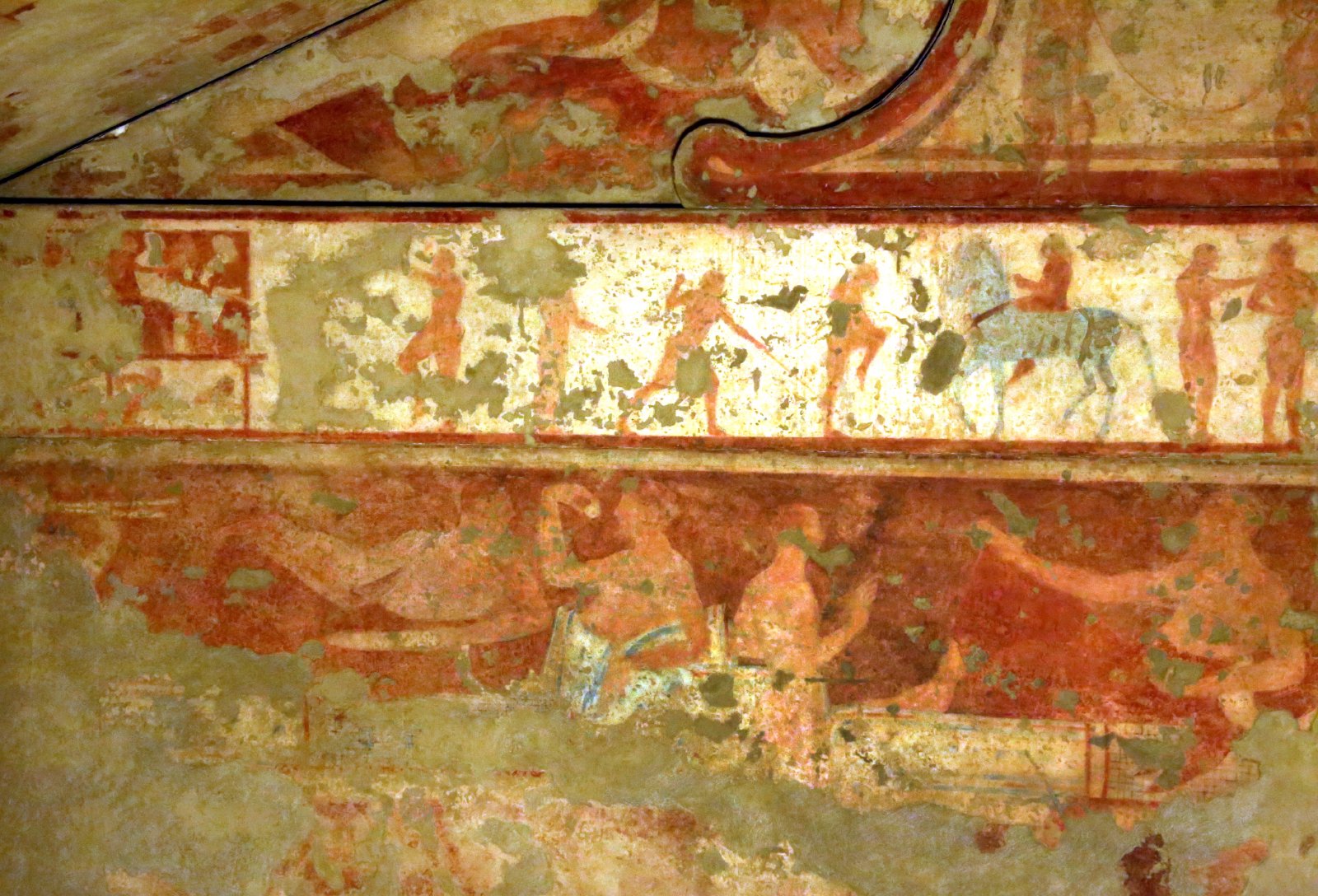
The lower frieze – broad, on a red background – depicts a ceremonial feast (symposium). Aristocrats recline on special couches known as klinai. Nude young cup-bearers attend them, while dancers and musicians playing flutes and kitharas perform around them. The frieze has suffered greatly from the passage of time, yet even its fragments convey an atmosphere of luxury. A detail crucial to understanding Etruscan society: women dined alongside their husbands. For the Greeks and Romans this was shocking – at their banquets, only hetairai were admitted, never wives.
The upper frieze – narrow, on a white background – is a kind of report on the funeral games. Athletes compete in running, long jump, discus throwing, and boxing. The centrepiece is the chariot races with bigae.
But the most remarkable action takes place not in the arena, but in the stands. The artist depicted wooden platforms with canopies where spectators sit – one of the rare depictions of ancient sporting infrastructure. On the upper tiers, elegantly dressed nobles discuss the competitions. Beneath the stands, however, in the space between the support columns, an entirely different life unfolds.
The Male Lovers and the Bearded Man
The scene for which the Tomb of the Chariots enters LGBT history is situated precisely in this “marginal” space – beneath the spectators’ stands of the upper frieze. To see it today, one must turn to Carlo Ruspi’s drawings: the original on the wall in Tarquinia has severely faded.
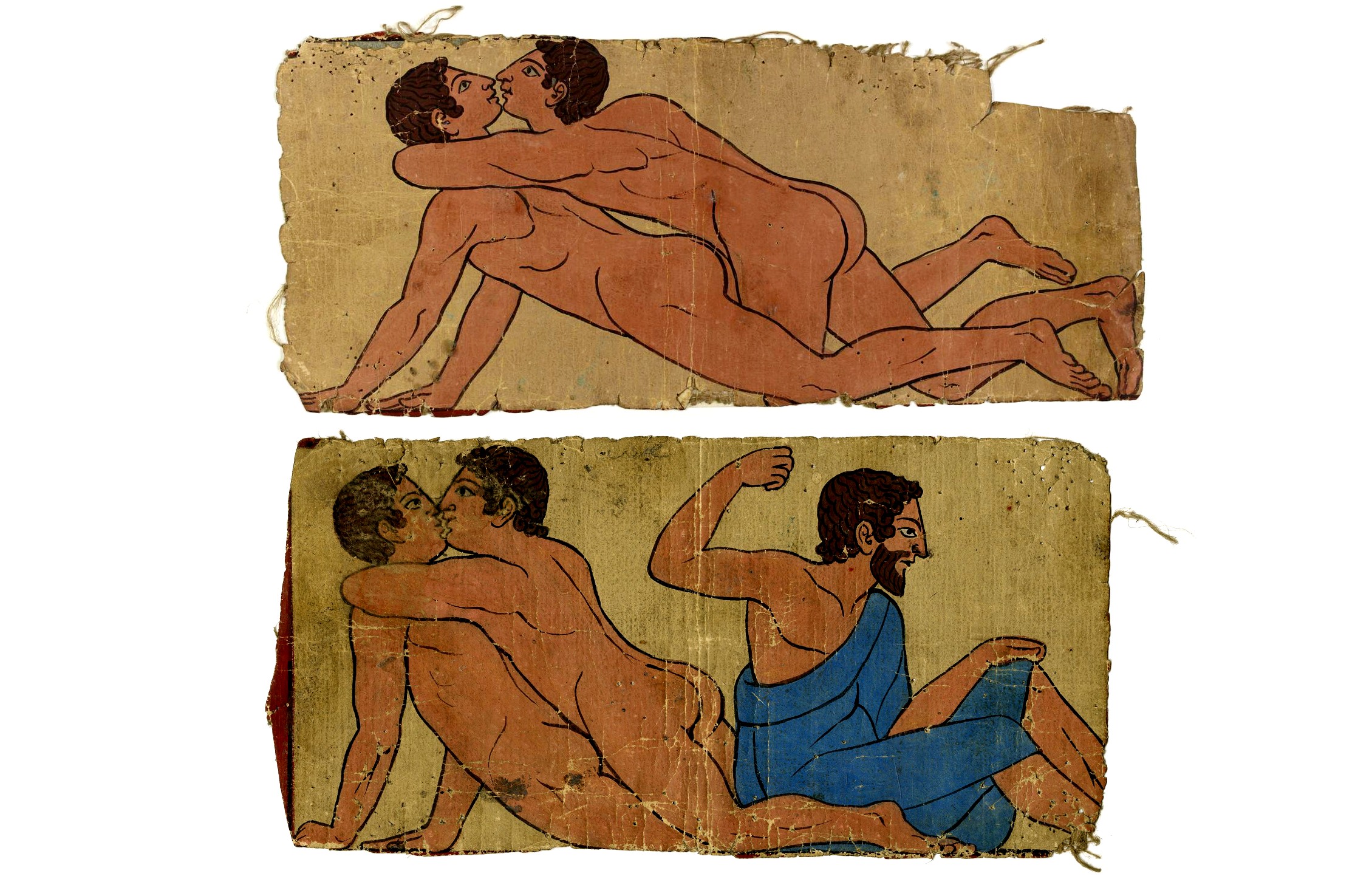
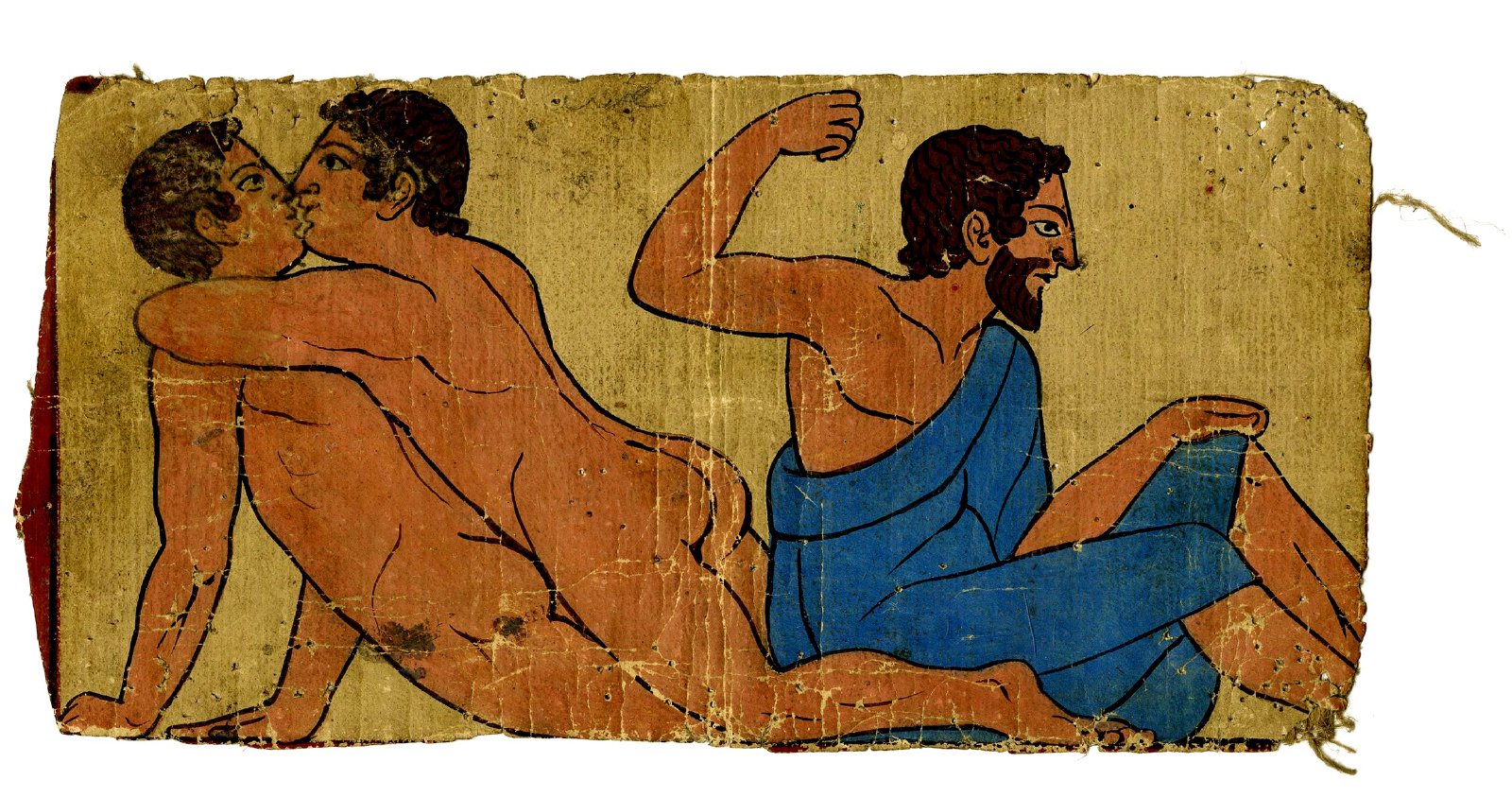
The British Museum holds a drawing made after 1827 (inventory number 2010,5006.610). It is a small fragment measuring 12.1 by 24.1 centimetres, executed on paper. It depicts a group of three figures.
Two young men are shown in a moment of sexual intimacy. The youths are athletically built, echoing the theme of the sporting games taking place above their heads. The artist employs complex angles to fit the figures into the narrow space beneath the benches of the stands.
A bearded man is positioned next to the couple. Unlike the youths, he is depicted with a beard – in Etruscan painting of this period, a beard served as a marker of age and social standing. His gaze is directed towards the athletic contests. He is calm, as if unaware of or ignoring the intimate scene beside him.
The Figure of the Bearded Man
In the Etruscan tradition of this period, a beard was often associated with Ionian (Greek) influence and indicated a mature, distinguished person – a head of household or an ancestor figure. The identity of the bearded man in the Tomb of the Chariots is debated among historians. The main theories:
He may be a master of ceremonies or a high-ranking servant overseeing order and resting in the shade of the platform. His beard underscores his authority among the other attendants.
He may represent a mature, calm figure juxtaposed with the impulsive young couple. In art, this device can symbolise the passage of time and the succession of generations – from active youth to contemplative maturity.
Or he may be a commoner whose presence makes the scene realistic and everyday. He is so engrossed in the chariot races that the erotic act beside him becomes mere background noise of life.
In the Tomb of the Baron (Tomba del Barone), discovered in the same year of 1827 by the same researchers, a bearded man also appears, but in a different context – he stands beside a woman and a young flute player, possibly in a scene of family farewell.
The Male Lovers Without the Bearded Man
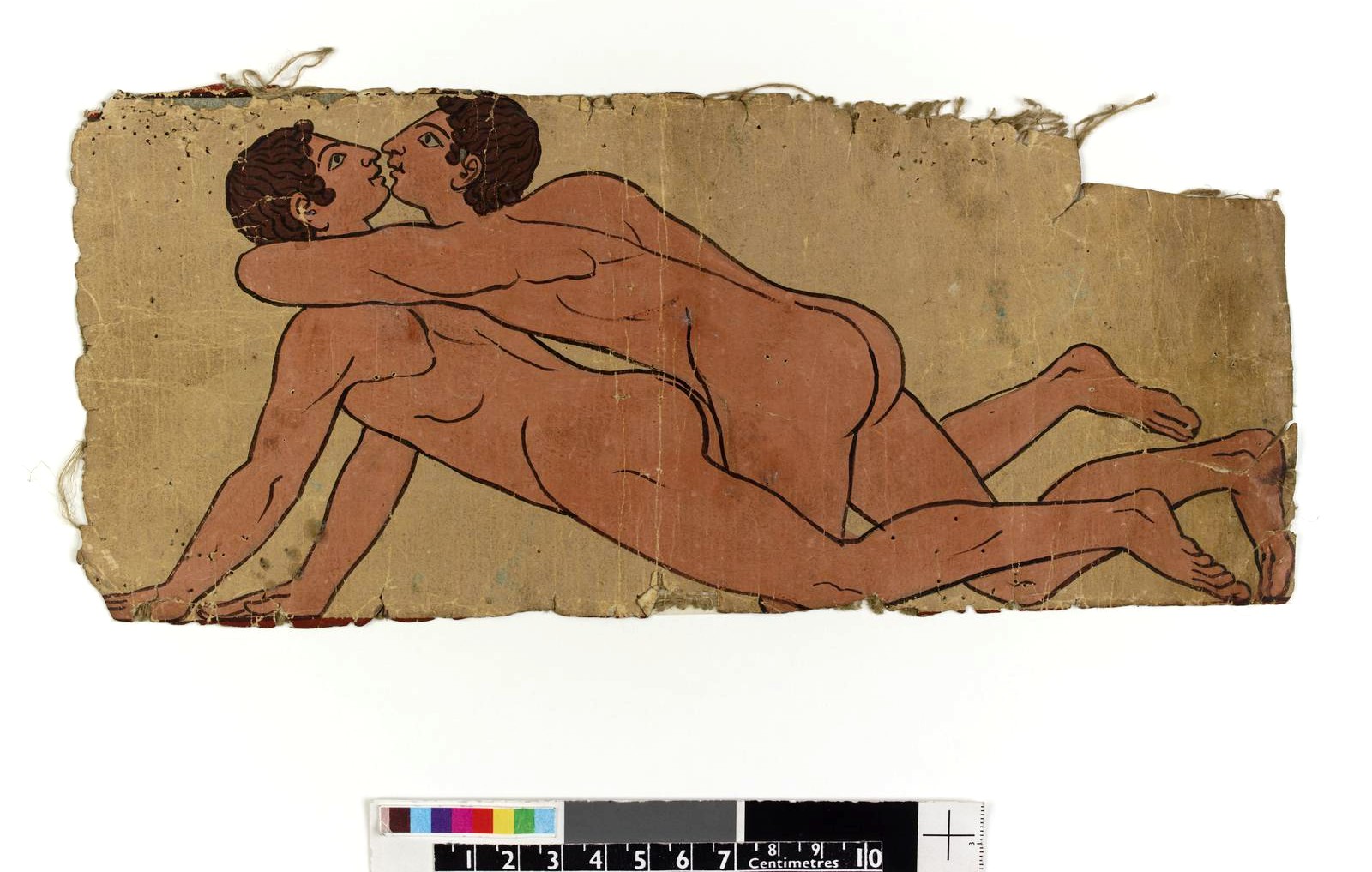
The British Museum holds another drawing from the same series – under inventory number 2010,5006.611. Unlike the previous fragment, it depicts only two male lovers, without the bearded man. In the museum’s official description, the object is listed as “male lovers.”
The drawing was made on paper, in the same manner as the other copies produced shortly after the tomb’s discovery to record the vanishing colours. The object belongs to the collection of the British Museum’s Department of Greece and Rome.
This second image confirms that the homoerotic scene occupied more space on the frescoes than a single fragment: the painter of the Tomb of the Chariots placed at least two pairs of male lovers beneath the stands – one beside the bearded man, and another separately.
Why Paint Sex in a Tomb
To understand the meaning of the lovers’ scene, one must set aside modern notions of decorum. The space beneath the stands is the zone of the “common people” – servants, grooms, and slaves. While the aristocrats above observe etiquette, the people below behave more naturally. The Etruscans used erotic imagery in burials for three main reasons.
Depictions of sexual acts, in Etruscan belief, possessed magical power: they warded off demons of death and protected the deceased from the “evil eye.” Erotica in this context is not pornography but a weapon against oblivion. A burst of life energy was meant to blind the forces of darkness.
The Etruscans believed in hinthial – the “shadow” or “reflection” of a living person. For this reflection to feel comfortable in the tomb, it had to be surrounded by familiar and pleasant things. If a person in life loved sport, feasting, and carnal pleasures with men, all of this had to be present on the walls of his final dwelling.
The sexual act is an act of creating life. In the context of death, it symbolises hope for rebirth. Similar scenes are found in the earlier Tomb of the Bulls (Tomba dei Tori, c. 540–520 BCE). In the Tomb of the Chariots, this motif becomes more “social”: it shifts from a mythological space into the thick of a popular crowd at the stadium.
The Scene in the Context of Etruscan Culture
The scene beneath the stands is a manifestation of Etruscan joie de vivre. In the Etruscan imagination, death was so bleak that it had to be “diluted” with the most vivid expressions of life: the fury of sport, the excess of feasts, and sexual passion.
The image also contains a certain irony about the social hierarchy: while the lords above decorously watch the chariot races, below, in the dust and shade, life goes on as it always does.
The discovery of 1827 and the subsequent efforts of Stackelberg, Weege, and Ruspi preserved this world for us.
Literature and Sources
- British Museum. Detail from the frescoes of the Tomba delle Bighe, Tarquinia: male lovers and a bearded man. Drawing 2010,5006.610.
- British Museum. Detail from the frescoes of the Tomba delle Bighe, Tarquinia: male lovers. Drawing 2010,5006.611.
- Museo Archeologico Nazionale di Tarquinia. Affreschi staccati della Tomba delle Bighe (c. 490–480 BCE).
- UNESCO World Heritage Centre. Etruscan Necropolises of Cerveteri and Tarquinia. Nomination File 1158. 2004.
- Weege F. Tomba delle Bighe. Archäologisches Jahrbuch. 1916.
- Poulsen F. Etruscan Tomb Paintings: Their Subjects and Significance. 1922.
- Steingräber S. Etruscan Painting: Catalogue Raisonné of Etruscan Wall Paintings. 1985.
- Dennis G. The Cities and Cemeteries of Etruria. 1878.
- Blanck H., Weber-Lehmann C. Malerei der Etrusker in Zeichnungen des 19. Jahrhunderts: Dokumentation vor der Photographie. 1987.
- Brandt J. R. The Tomba dei Tori at Tarquinia: A Ritual Approach. Nordlit 33. 2014.
- Weege F. Etruskische Malerei. 1921.
- Massa-Pairault F.-H. La tombe des lionnes à Tarquinia. Studi Etruschi. 2001.
 Subscribe to our Telegram channel (in Russian): Urania. With Telegram Premium, you can translate posts in-app. Without it, many posts link to our website, where you can switch languages — most new articles are published in multiple languages from the start.