An Ancient Punishment for Adultery – Inserting Fish and Radish into the Anus (Rhaphanidosis)
What we know about it and how it surfaces in literature – from Aristophanes to Juvenal.
Contents
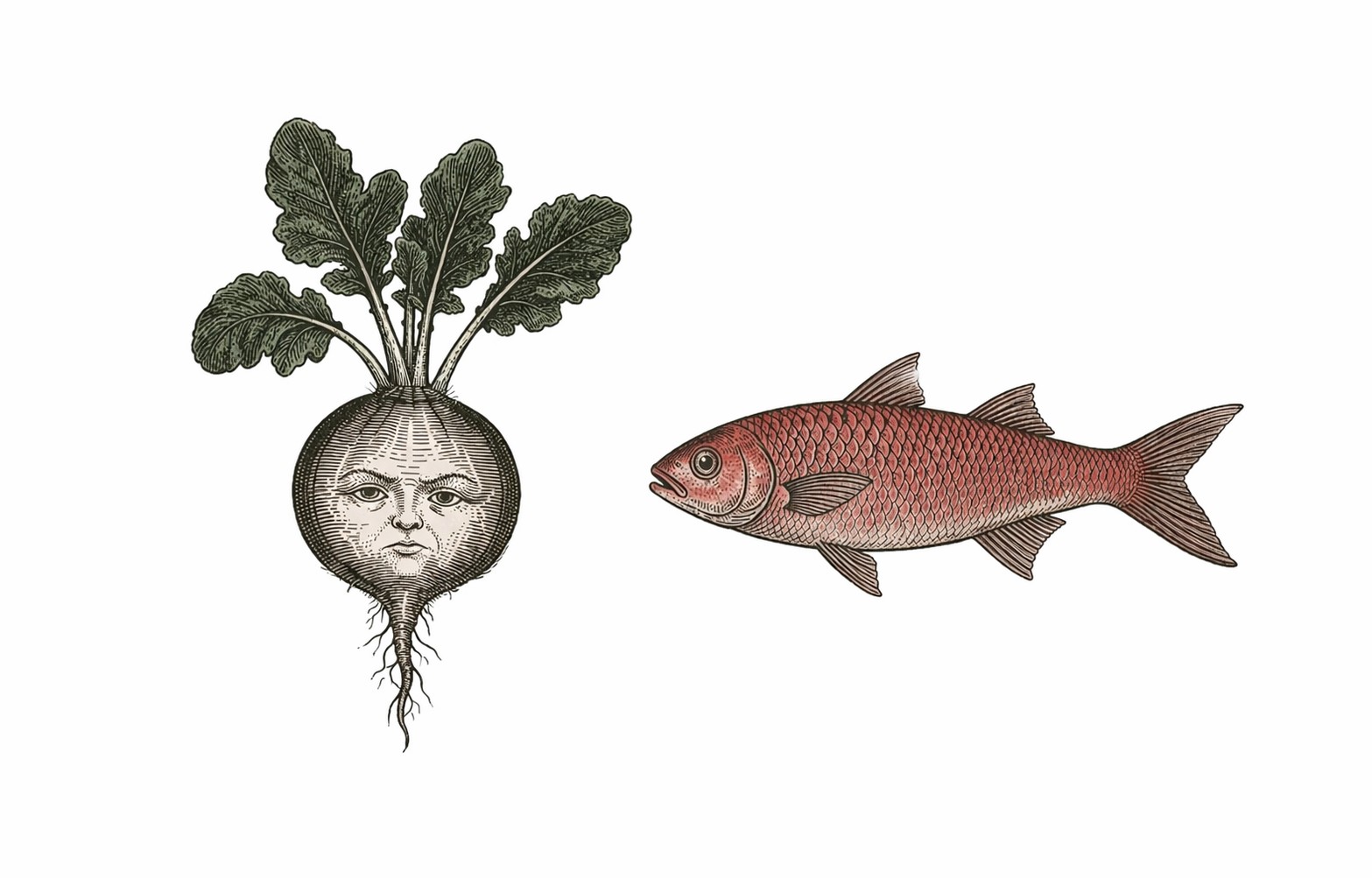
Rhaphanidosis (ῥαφανίδωσις) in classical Athens of the fifth to fourth centuries BCE was the forcible insertion of a radish root into the anus.
In Athens it was a form of public humiliation tied to punishment for moicheia – adultery understood as a breach of marital fidelity. Such a penalty fit ancient notions of masculinity: the man subjected to it symbolically lost the markers of a “true” free citizen and part of the rights that went with that status.
Similar motifs – with a vegetable or a fish – appear among the Romans and in Byzantium as well.
Ancient Greek Sexual Roles and the Language of Humiliation
In Athens and Rome sexual conduct was understood differently from today. More important than a partner’s biological sex were social hierarchy, age, and the distribution of active and passive roles.
In Athens one recognized form of homoerotic relationship was pederasty: a bond between an adult citizen – the erastês – and a youth, the erômenos. The age and status gap was considered normal; such relationships were tolerated until the youth reached physical maturity. Once grown, the young man became the head of a new household with a wife and a citizen in full standing.
A passive role for a free adult male was seen as violating the norm; voluntary passivity was read as subordination and could bring grave consequences, including atimia – the complete loss of civic rights, including the right to speak in court and hold public office.
This also shaped language. Ancient Greek had the word εὐρύπρωκτος (euryprôktos, literally “wide-arsed”). It referred to a man thought to have forfeited proper dignity.
Adultery as an Assault on the Household
In ancient Greece adultery was understood as an attack on the household and on the authority of its male head. Forbidden were not only liaisons with a married woman but also with an unmarried daughter, sister, or mother of a citizen under his guardianship.
Seduction was judged more harshly than rape: in rape the woman was seen as the rapist’s enemy, whereas in adultery she was cast as “corrupted” and unfaithful to her husband. For the Greek polis this also had political weight: doubts about paternity undermined citizenship, where status was transmitted by descent.
The scholar Danielle S. Allen, in The World of Prometheus, reminds us that the bodies of Athenian citizens were protected from torture and corporal punishment, unlike those of slaves, whose testimony was often extracted under torture. Yet an adulterer caught in the act became “corporeally vulnerable”: the wronged husband could kill him on the spot, and if he spared his life, he could torture and humiliate him. This is where rhaphanidosis could enter the picture.
Comparison with other poleis highlights Athens’ distinctiveness. Under the laws of Gortyn on Crete, adultery was punished with fines. In Epizephyrian Locri, the archaic laws of Zaleucus prescribed blinding the adulterer. Elsewhere one finds public exposure for several days.
What Was Inserted: Radish and Fish
Modern ideas about radishes can be misleading here. Ancient radishes (Raphanus) could produce long, coarse, dense roots – up to about twenty-five centimetres – closer in shape and toughness to a large carrot or elongated white cultivars such as the British “Icicle” type than to a small, tender table radish.
Alongside the radish, sources mention the sea mullet (mugil). It has a large head, a tapering tail, and a dorsal fin with rigid, sharp rays pointing backward. The rays are the thin supporting elements inside the fin – like splines or spines that hold its shape. Inserting the fish head-first is easier than removing it; on the way out those projections could cause injury.
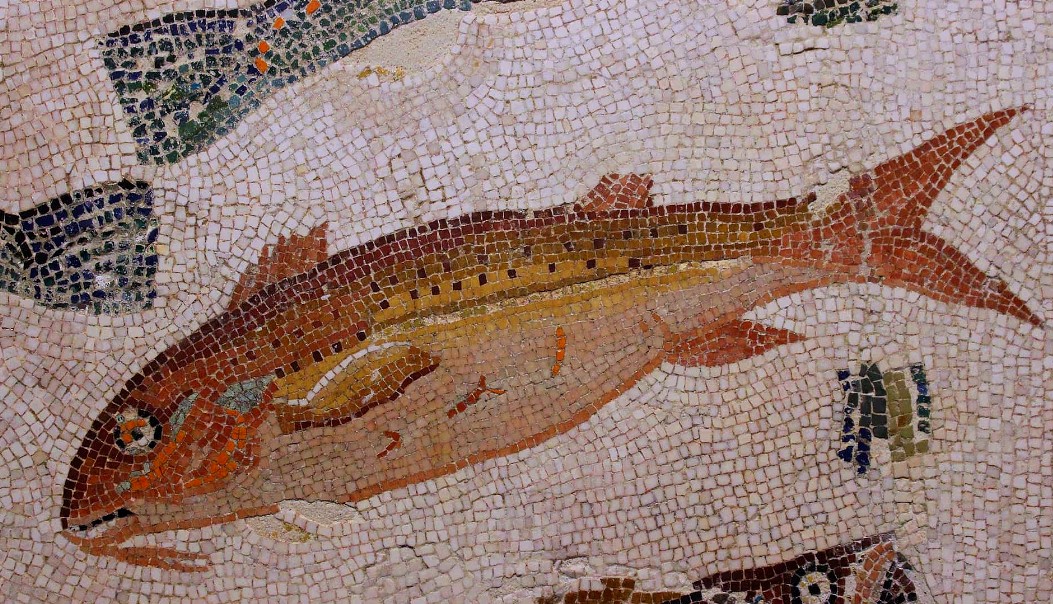
Ancient and Byzantine texts describe rhaphanidosis not as an isolated penalty but as part of a wider set of punitive practices.
Also attested is paratillmos (παρατίλμος) – tearing out pubic and scrotal hair with hot ash (τέφρα) sprinkled on the skin.
For an adult Athenian citizen, pubic hair was a sign of maturity and status, marking the shift from subordinate youth to head of household. Depilation of the intimate area was associated with the female body. Forcible removal stripped away outward signs of adulthood and symbolically “demoted” the man. In gymnasia and baths, where men were naked, the absence of pubic hair on an adult could long advertise past disgrace.
Rhaphanidosis in Literature
The best-known early reference is in Aristophanes. In The Clouds, in the debate between the “Just” and “Unjust” arguments, the “Just” logos warns a youth about the consequences of marital infidelity – including the radish, hair-plucking, and hot ash:
“What if they stick a radish up his arse because he trusted you, then tear out his hairs with hot ash? What argument could he offer, not to be wide-arsed?”
– Aristophanes, The Clouds, 1083–1084
In the encyclopedic lexicon Suda – a tenth-century Byzantine Greek reference work – the verb rhaphanidóô (ῥαφανιδόω) is recorded with a retelling of the same punishment: adulterers were seized, subjected to rhaphanidosis, dusted with hot ash, and depilated:
“[Rhaphanidosis] was the way adulterers were punished when caught. They were seized, a radish was thrust into their anuses, then they were sprinkled with hot ash while their hair was torn out and they were subjected to considerable torment.”
– Suda, entry ῥαφανιδόω*
The Byzantine scholar John Tzetzes, in twelfth-century scholia on The Clouds, writes that rich adulterers could buy their way out, while poor men were led to the middle of the agora – the city’s main public square – where the hair on their scrotum was torn out with hot ash and long radishes were driven into the rectum.
Modern researchers allow that the contrast between rich and poor may reflect Tzetzes’ observations in Constantinople in his own day, yet the description itself coheres with the ancient Greek tradition – known from Solon’s laws – of a monetary ransom for an adulterer’s life: the outcome depended on means.
“Adulterers, if they were rich and were caught, could pay their way out; but the poor were truly savagely avenged. They were publicly led to the middle of the agora, the hair on their testicles was plucked out with hot ash from the brazier, and long radishes were thrust deep into their bowels, and they were punished in many other ways besides.”
– John Tzetzes, scholia on The Clouds
In the second century CE, the Roman writer Lucian of Samosata, in The Death of Peregrinus (chapter 9), mentions a philosopher caught in adultery in Armenia. After the assault he flees from a roof “with a radish plugging his anus.” This grotesque vignette suggests the audience still knew the punishment centuries after Aristophanes:
“For this Proteus received a very handsome number of blows, but in the end he escaped danger by jumping off the roof and getting a radish where the sun doesn’t shine.”
– Lucian, The Death of Peregrinus, ch. 9
That the Greek motif was known in Rome is clear, among other evidence, from poem 15 of the Roman poet Catullus. The poet warns Aurelius not to approach the youth Juventius, Catullus’ beloved. The climax is a threat in a “Greek” vein:
Ah, how I shall pity you and your cruel fate!
When, feet bound, through the open door
Radish and mullet pass through you
– Catullus, Carmen 15
In Roman literature the image shifts in meaning: the threat of rhaphanidosis or something like it is no longer necessarily punishment for adultery but becomes part of rivalry over a youth – the object of desire for two men.
The Roman satirist Juvenal, author of sixteen Satires on Roman manners, in Satire 10 (314–317), listing dangers that threaten handsome men, also mentions the mullet:
One kills with the sword, another flogs till the blood flows:
Some adulterers get a mullet driven through the rear.
In the Republican period a husband in the Roman family had broad powers in domestic justice. Under Octavian Augustus the state tried to bring this sphere under control. The Lex Iulia de adulteriis coercendis made adultery a public crime. Typical penalties were relegation to an island and confiscation of property. Neither radish nor mullet appears in the law.
Was It “Legal”?
Historians disagree over how far rhaphanidosis was a real Athenian practice rather than a literary trope.
The historian David Cohen relied on an argument from silence: in surviving courtroom speeches on adultery there are no mentions of radish, mullet, or ash. From this he inferred that Aristophanes’ scenes might be comic invention that later hardened into a fixed image.
The scholar Christopher Carey objected in a 1993 note, stressing generic difference: ancient orators observed euphêmia – the norm of verbal restraint and avoidance of coarse diction in public speech – whereas comedy traded in bodily specificity. In his view, the radish threat would work on stage only if spectators recognized in it a marginal yet real extrajudicial reprisal.
Danielle Allen also suggests an explanation for the orators’ silence: if an adulterer was punished quickly, without a full trial, such episodes would not enter the corpus of “high” speeches by figures like Lysias or Demosthenes.
Literature and sources
- Allen, D. S. The World of Prometheus: The Politics of Punishing in Democratic Athens. 2002.
- Aristophanes. The Clouds (Nephelai). Produced 423 BCE; lines cited 1083–1084.
- Carey, C. “Return of the radish or just when you thought it safe to go back into the kitchen.” Liverpool Classical Monthly 18, no. 4 (1993).
- Catullus, G. V. Carmen 15. 1st century BCE.
- Cohen, D. “A note on Aristophanes and the punishment of adultery in Athenian law.” Zeitschrift der Savigny-Stiftung für Rechtsgeschichte: Romanistische Abteilung 102 (1985).
- Inscriptiones Creticae IV 72 (Law Code of Gortyn). 5th century BCE.
- Juvenal, D. I. Satire 10, lines 314–317. Late 1st–early 2nd century CE.
- Lucian of Samosata. The Death of Peregrinus, chapter 9. 2nd century CE.
- Suda On Line. Entry ῥαφανιδόω. 10th century.
- Tzetzes, J. Commentary on Aristophanes’ The Clouds (scholia). 12th century.
 Subscribe to our Telegram channel (in Russian): Urania. With Telegram Premium, you can translate posts in-app. Without it, many posts link to our website, where you can switch languages — most new articles are published in multiple languages from the start.