The Stela of the Soldiers Ramose and Wepmose: Evidence of a Same-Sex Union in Ancient Egypt?
An analysis of stela CM004 – two men without wives and an abundance of phallic symbols of male fertility.
Contents
For a long time, Egyptologists considered heterosexual marriage to be the only norm in Ancient Egypt. However, modern researchers are finding monuments that go beyond this familiar picture.
One such monument is the votive stela CM004 (Cairo JE 47381). Ancient Egyptians created such stelae to address a deity with a request, express gratitude, or fulfill a vow. This particular stela was commissioned and dedicated to the gods by two soldiers: Ramose (Re-mose) and Wepmose (Wepwawet-mose).
The unusual nature of the monument lies in its combination of details. There are no wives or children on the relief, and the two men are presented as participants in a single sacred act. The entire composition is built around gods, animals, and symbols associated with male power, fertility, martial energy, and rebirth.
Asyut and the Salakhana Cache
The stela was found in the necropolis of Asyut (known as Sauty in antiquity and Lycopolis in the Greco-Roman period). The city was the capital of the 13th Upper Egyptian nome – an administrative region similar to a province.
Asyut stood on caravan routes and had strategic importance. Historians call it a “wounded city”: it regularly found itself in the center of conflicts and changed hands, but it retained its role as a major cultural and religious center.
The main patron of the region was Wepwawet – an ancient deity in the form of a standing jackal or wolf. His name translates as “Opener of the Ways.” Wepwawet had a pronounced military character: his standard was carried before the pharaoh during battle.
In 1922, the British archaeologist Gerald Wainwright was clearing the tomb of the nomarch Djefaihapi III in Asyut. In the debris of the pillared hall, he found a large complex of votive objects. In Egyptology, this discovery is known as the “Salakhana Cache,” because the tomb was located near a modern slaughterhouse (the Arabic word salakhana is related to the butchering of carcasses).
The cache contained over 500 votive stelae, at least 100 figurines, papyri, and other artifacts. Some of the finds date to the New Kingdom (from the 18th to the 21st Dynasty). The tomb of Djefaihapi III was built several centuries before these dedications. It is likely that during the New Kingdom, it was used as a local sanctuary for Wepwawet, Anubis, Osiris, Hathor, and other gods.
The stelae from Salakhana reflect both official temple religion and the personal piety of ordinary people. They were commissioned by priests, soldiers, craftsmen, temple singers, and other commoners. This is where stela CM004 was discovered.
Today the stela is held at the Grand Egyptian Museum (GEM): the museum catalogue lists it as GEM no. 4288 and places it in the Main Galleries. This means it can be seen in GEM’s main galleries.
Stela CM004
CM004 is a massive limestone stela with a rounded top, measuring 43.5 cm in height, 24.5 cm in width, and 7 cm in thickness. In museum descriptions, its surface is called “burnt.” This could be a trace of fire during a ritual, a conflagration, or later damage in the necropolis.
Most researchers date the stela to the 19th Dynasty (the era of Ramesses II). The researcher Terence DuQuesne proposes an earlier date – the end of the 18th Dynasty, based on the men’s clothing and hairstyles. Short kilts with heart-shaped or triangular pleats were worn by infantrymen and charioteers, whereas officers were depicted in longer garments. The “feathered haircut” was popular during the Amarna Period and disappeared by the 19th Dynasty. The small number of layers in the hairstyle also indicates the relatively low status of the owners.
At the same time, the stela is well-crafted. DuQuesne notes: Ramose and Wepmose were unlikely to have served as high-ranking officers, but they had the means to commission work from a good workshop. Perhaps they intentionally dressed more modestly to worship the gods.
The composition is divided into three horizontal zones (registers). In the upper semicircular part – the lunette – the space is left empty or depicts the Primeval Mound, the mythical place where creation began.
Upper Register: Wepwawet and the Bull of His Mother
In the upper register on the left, Ramose kneels. He raises his hands in a gesture of prayer before the god Wepwawet. His short kilt and “feathered haircut” link him to the military profession.
Wepwawet is depicted as a jackal on a standard resembling a ritual sled. Between the jackal’s front paws rises a uraeus – a sacred cobra, a sign of divine authority. Above the god, a title is carved: “Wepwawet of Upper Egypt, Controller of the Two Lands.”
Behind Wepwawet stands the bull Amun-Re Kamutef. The epithet “Kamutef” translates as “Bull of his mother.” In Egyptian theology, it denoted a deity who resurrects himself by impregnating his own mother. The Kamutef bull was a powerful symbol of male fertile power, and this male creative principle is shown without a paired female figure.
Middle Register: Two Jackals and the Eels of Atum
The middle register depicts the second man – Wepmose. He stands in a pose of adoration (prayerful worship). Before him, two jackal gods are shown in mirror image: Wepwawet of Upper and Lower Egypt.
Beneath the jackals is an offering table. Below that, an unusual motif is carved: small eels or fish swimming above a large eel or snake. In Egyptian cosmogony, the eel was a sacred animal of Atum – the demiurge god who created the world from the primeval waters. Atum creates alone without a woman, so the motif is again connected to the idea of self-sufficient male creation.
Lower Register: The Phallic Goose
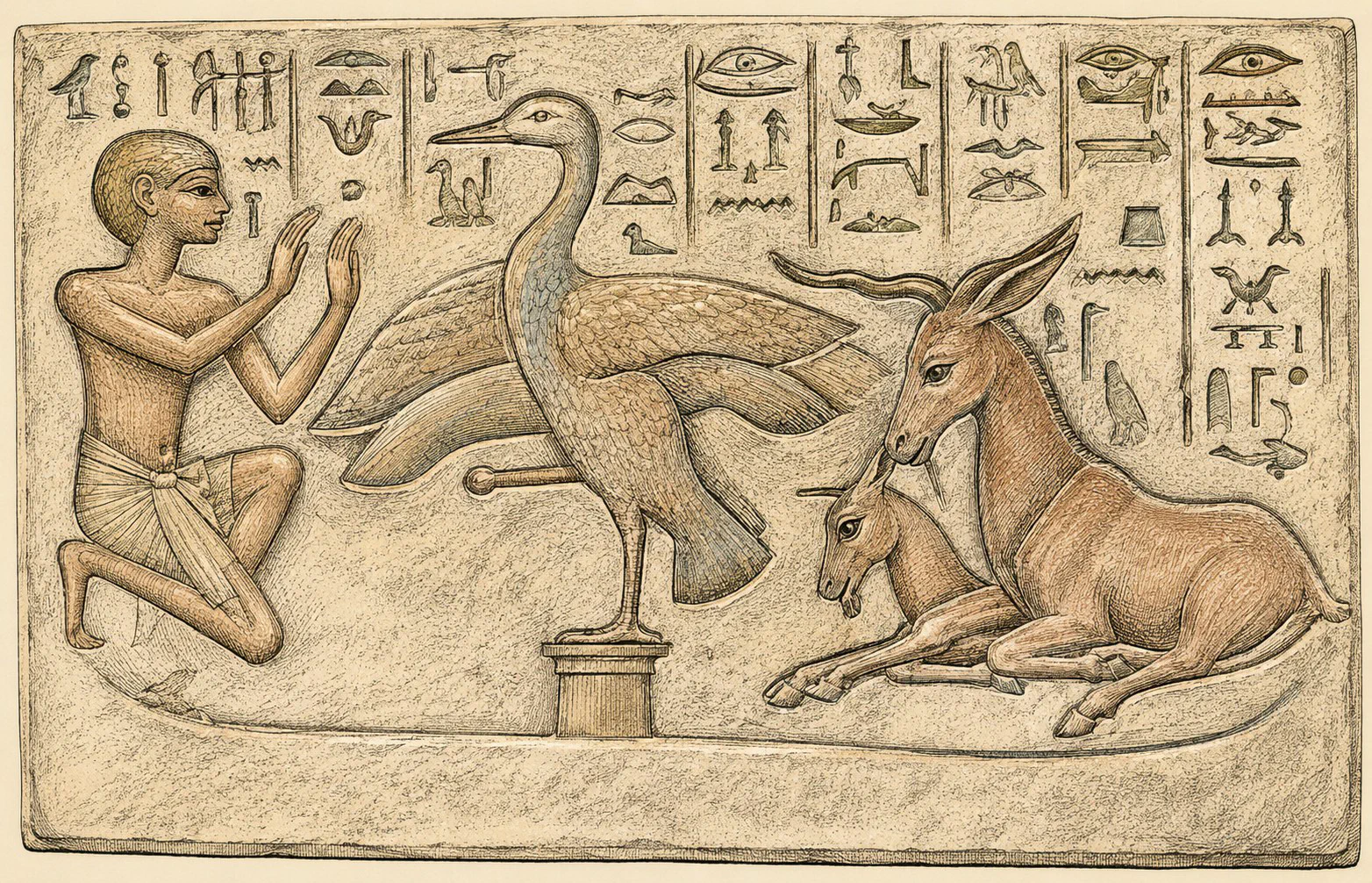
In the lower register, Wepmose, who appears for a second time, kneels before a goose flapping its wings. Behind the bird lie two goats. A notable detail of this register is the goose’s erect phallus. Egyptologists call such depictions ithyphallic: the phallus emphasizes creative and fertilizing male power.
The Nile goose (the Great Honker) was a sacred form of the god Amun. It was associated with the first act of creation and appeared as a cosmic bird whose sound opens the world. On other votive stelae, the goose is found separately, but on CM004 it is included in a complex program of male and fertility symbols.
The two goats behind the goose also relate to fertility cults. Zoologists identify them as bezoar goats (Capra aegagrus). These animals were sacrificed to Wepwawet in Asyut as early as the Middle Kingdom. In Egyptian and Mediterranean symbolism, the goat was associated with male potency (similar to the Greek Pan or the god of Mendes).
DuQuesne pointed out that almost all the animals on the stela, except for the jackals of Wepwawet, act as sacred animals of Amun or Amun-Re. The Kamutef bull, the phallic goose, the goats, eels, and snakes create a rare concentration of male fertile imagery. Most likely, this is not a random decorative mixture, but a carefully chosen religious language.
The Reverse Side
On the reverse side of the stela, a text of six lines is carved. It consists of letters of the Greek alphabet but does not form meaningful words. These are voces magicae – magical sound formulas.
Such texts were used by priests and magicians of the Ptolemaic era and Roman rule. They worked with the numerical values of Greek letters (isopsephy) and composed incantation sequences. The inscription on the back appeared centuries after the stela was created. As of yet, it is unknown who made it.
Who Were Ramose and Wepmose?
Most of the dedications in Salakhana were made by a single man, a single woman, or a family group. Stela CM004 stands out because it was commissioned by two men of the same generation. This is not a family scene with a husband, wife, and children, not a father with a son, and not a double depiction of the same person.
Ramose and Wepmose are shown as military men. This is indicated by their clothing, hairstyles, and the style of depiction. Neither of them is named with an official title.
Wepmose is depicted twice, and special epithets stand next to his name. One of them is Hsy-aA (“highly praised”). Another is mAA bw-nfr (“seeing the good”). The researcher DuQuesne proposes another interpretation of these words, closer to “arranger of joy” or “arranger of pleasure.”
Why they commissioned this particular stela with these specific images remains unknown. DuQuesne believes it is hard to imagine it as a ready-made item bought “off the shelf.” It is too individual. It lacks a royal cartouche linking it to the official cult, and it shows no signs of a typical temple composition. Most likely, it is a private votive monument created for a personal purpose and made to order.
The most cautious version in scholarship is that Ramose and Wepmose were comrades-in-arms. But even this is unusual: DuQuesne found no similar votive stelae in ancient Egyptian art created by two peers serving together.
A bolder version is that they were lovers or a couple. This interpretation is supported by a combination of features: the joint commission, the absence of wives and children, the military profession (i.e., a close male environment), the equality of the participants in the sacred space, and the saturation of the composition with male phallic and fertile symbols. Individually, each feature could be explained otherwise, but together they create a context that is difficult to reduce to ordinary friendship.
The Theology of Male Creation
Why did two military men choose so many symbols of male power and fertility for their commission? The matter is not only in their personal relationship but also in the specifics of Egyptian religion at that time.
The Egyptians believed that male gods were capable of creating life and resurrecting themselves alone. For example, the god Atum created the world from himself. The divine bull Kamutef impregnated his own mother in order to be born anew. In these myths, goddesses helped and protected, but the main creative power belonged to men.
Egyptian religion was flexible regarding sex when it came to life after death. Researcher Kathlyn Cooney notes: in order to resurrect in the afterlife, a deceased woman needed male energy. To achieve this, she was temporarily identified with the god Osiris, and male traits were added to her funerary texts. Only after rebirth did she become a woman again. That is, male power was considered the universal key to immortality.
If Ramose and Wepmose wanted to show their personal union, they chose precise symbols. The standard picture with wives and children did not suit them. Instead, they used images of gods who create life without the participation of women: Atum, the Kamutef bull, the goose with an erect phallus, and the goats. Through these symbols, the two men could sanctify their bond before the gods.
Stela CM004 does not prove that same-sex marriages existed in Ancient Egypt in the modern sense. But it shows something else: two men could commission a joint monument and express their intimacy through images of male power and rebirth.
The stela of Ramose and Wepmose is valuable precisely because it breaks familiar patterns and shows that ancient Egyptian religion and relationships between people were more complex than the “husband, wife, and children” scheme. In this complex culture, there was a place for such male intimacy.
Literature and Sources
- Cooney K. M. The Problem of Female Rebirth in New Kingdom Egypt. 2008.
- Dowson T. A. Queering Sex and Gender in Ancient Egypt. 2008.
- DuQuesne T. An Extraordinary Votive Stela for Amun and Upwawet (CM004; Cairo JE 47381). 2008.
- DuQuesne T. Gender, Class, and Devotion: Social and Demographic Aspects of the Salakhana Stelae. 2007.
- DuQuesne T. Power on Their Own: Gender and Social Roles in Provincial New Kingdom Egypt. 2008.
- DuQuesne T. The Salakhana Stelae: A Unique Trove of Votive Objects from Asyut. 2006.
- Grand Egyptian Museum. Official Ticketing Website. https://tickets.gem.eg/
- Grand Egyptian Museum. Votive Stela of Ramose and Wepmose. https://gem.eg/en/collection/artefacts/votive-stela-of-ramose-and-wepmose
- Kahl J. Asyut and The Asyut Project. 2012.
- Kessler D. Die kultische Bindung der Ba-Konzeption II: Die Ba-Zitate aus den Kultstelen und Ostraka des Neuen Reiches. 2001.
- Parkinson R. B. Boasting about Hardness: Constructions of Middle Kingdom Masculinity. 2008.
- Reeder G. Queer Egyptologies of Niankhkhnum and Khnumhotep. 2008.
- Revez J. The Metaphorical Use of the Kinship Term sn “Brother”. 2003.
- Shubert S. B. Double Entendre in the Stela of Suty and Hor. 2004.