Crabs With Both Male and Female Traits Found in Indian National Park
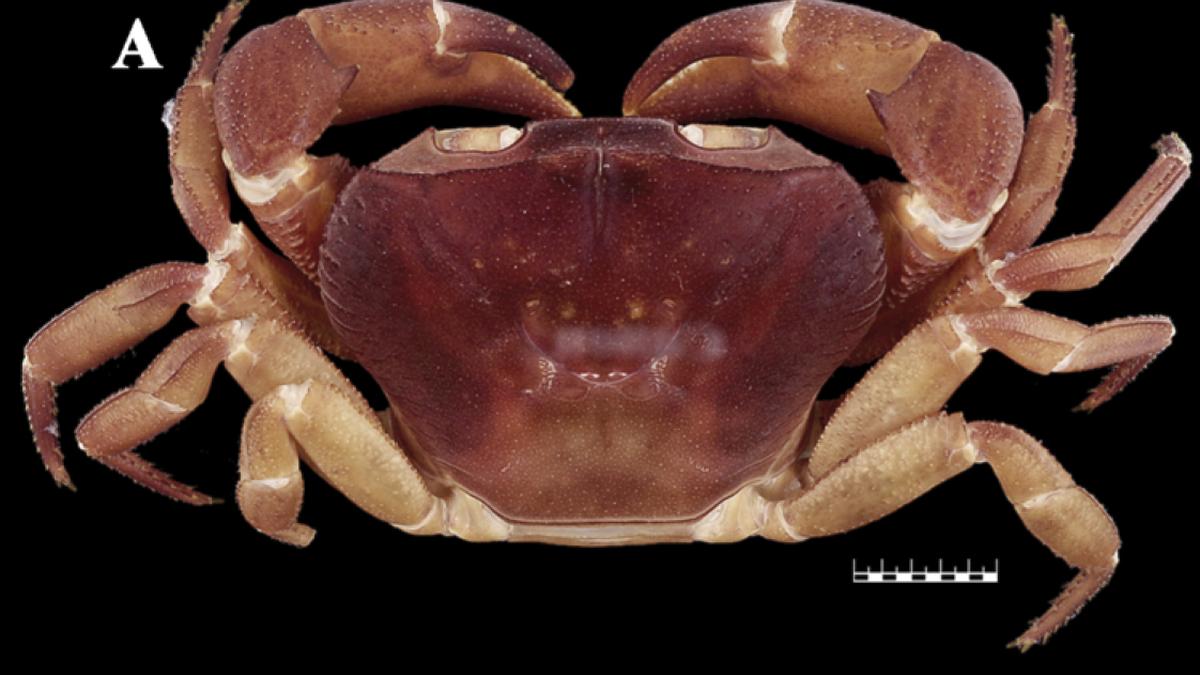
Freshwater crabs of the species Vela carli displaying both male and female biological traits in a single body have been discovered in Silent Valley National Park in the Indian state of Kerala. The condition is known as gynandromorphy — a rare phenomenon in which an individual simultaneously exhibits characteristics of both sexes. The findings have been published in the international journal Crustaceana.
Three such crabs were found inside tree holes during biodiversity surveys in the park’s forests. In total, the researchers examined more than 120 specimens. The affected crabs displayed male reproductive structures alongside female features, including gonopores — reproductive openings.
Vela carli is an endemic freshwater crab found only in the forests and streams of the Central Western Ghats. According to the researchers, this is the first known instance of gynandromorphy in this species. The condition is rare among crustaceans in general and had never been reported in the freshwater crab family Gecarcinucidae, to which Vela carli belongs.
The study was carried out by K.S. Anoop Das and K.T. Fahis from the Centre for Conservation Ecology at MES Mampad College, in collaboration with crab specialist Sameer K. Pati and Purnima Kumari from the Zoological Survey of India. According to Das, who heads the centre, gynandromorphy has been documented in several marine and freshwater crab families, but not in Gecarcinucidae.
Das believes the most likely cause is linked to intrinsic developmental processes rather than environmental pollution: the crabs’ habitat was free of pollutants. The researchers suggest that gynandromorphy may be connected to survival strategies, enabling a crab to reproduce even in the absence of individuals of the opposite sex.
The discovery of the crabs in tree holes was itself unusual, as this species typically inhabits areas near streams. According to Das, this points to the richness of ecosystems within tree cavities.
The study was funded by the Department of Science and Technology and the Science and Engineering Research Board of India (now the Anusandhan National Research Foundation).