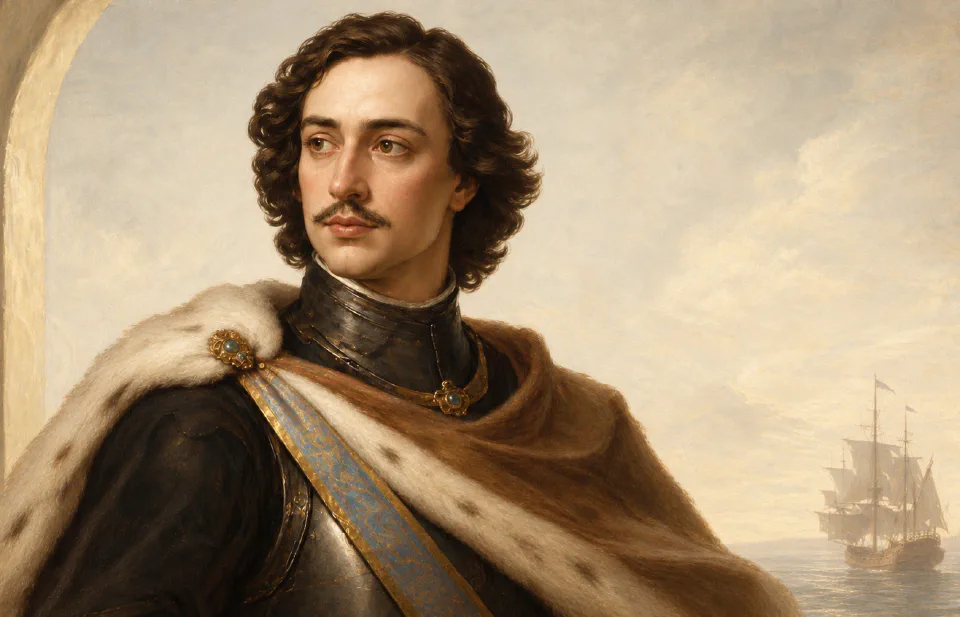
The 1616 Swedish Report on the Homosexuality of Russian Tsar Mikhail Fyodorovich Romanov
“…more inclined to godless and vile deeds of a sodomitic kind than to Christian virtues”
Contents
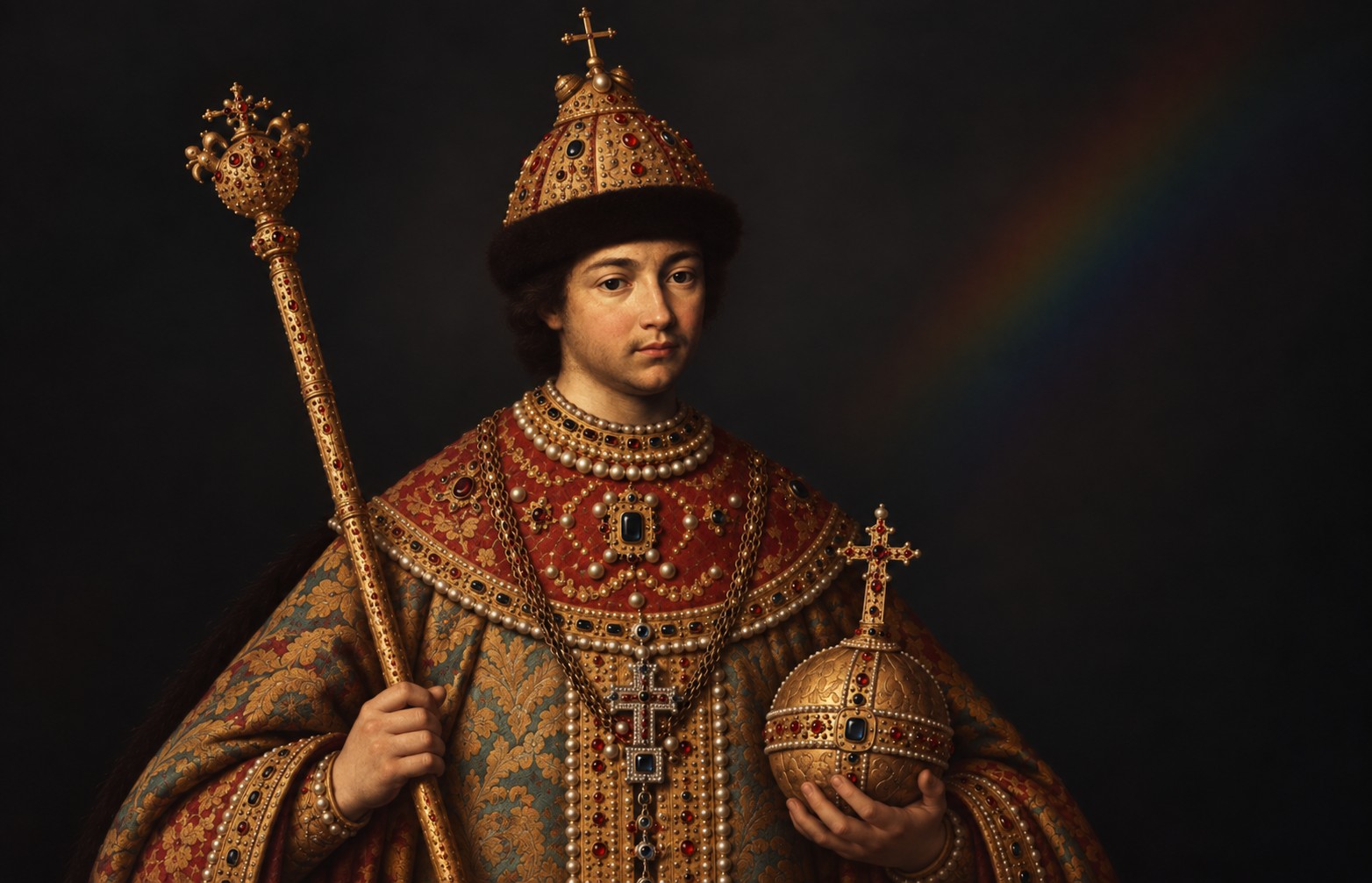
Mikhail Fyodorovich was the first Russian tsar of the Romanov dynasty. His personal life was under strict control, as the young monarch’s main task was to produce an heir and consolidate the power of the new dynasty.
However, history knows of a 1616 Swedish diplomatic report compiled from the words of a Russian defector, Mikhail Klementyev. It asserts that the young sovereign was inclined to “sodomitic deeds.” This is one of the first documented cases in Russian history where a monarch’s sexuality became the subject of international espionage and diplomatic reports, even if these rumors were never put into action.
A Sixteen-Year-Old Monarch at the Head of a Ruined Country
In 1613, the Zemsky Sobor (Assembly of the Land)—the country’s highest estate-representative institution—elected Mikhail Romanov to the throne. The sixteen-year-old youth took power at the end of the Time of Troubles, when the country was in a deep crisis.
In the early years, enormous power was held by his mother, Nun Martha (born Kseniya Ivanovna Shestova). From 1619, the tsar’s father, Patriarch Filaret (Fyodor Nikitich Romanov), who had returned from Polish captivity, became the de facto co-ruler.
The government had to restore the economy and make peace with its neighbors. Russia concluded the Treaty of Stolbovo with Sweden (1617) and the Truce of Deulino with the Polish–Lithuanian Commonwealth (1618), ceding some territories. Inside the country, order was gradually restored, the army was reassembled, and new cities were built in Siberia.
The Duty of Succession and the Tragic Fates of the First Brides
The tsar’s personal life was subordinated to state interests. Traditional bride-shows, as noted by American historian Russell E. Martin, helped reconcile boyar families vying for influence at court. The future tsaritsa was primarily required to have good health and the ability to bear children.
In 1616, the twenty-year-old Mikhail chose a representative of the untitled nobility, Maria Ivanovna Khlopova. But this choice did not please Nun Martha. Soon after the betrothal, the bride fell ill. Doctors from the court medical department examined the girl and declared her healthy. However, the tsaritsa-mother’s relatives distorted the doctors’ words. Under pressure from his mother, Mikhail yielded, and Khlopova was exiled to Tobolsk.
Eight years later, in 1624, Martha insisted on her son’s marriage to Princess Maria Vladimirovna Dolgorukova. This union with the noble Rurikid family was meant to strengthen the Romanovs’ ties with the old aristocracy. The marriage lasted only a few months: the young tsaritsa fell ill the day after the wedding and died. At court, it was suspected that she had been poisoned by political enemies.
The 1626 bride-show proved successful. The tsar insisted on his decision and married the daughter of a modest nobleman, Yevdokiya Lukyanovna Streshneva. She bore Mikhail ten children, including the future heir, Aleksey Mikhailovich.
A Tsar of “Melancholic Disposition”
Pre-revolutionary Russian historians described Mikhail Romanov as a weak-willed ruler.
Nikolai Kostomarov called him a man of “good but melancholic disposition,” not endowed with brilliant abilities and barely able to read upon ascending the throne. Vasily Klyuchevsky wrote that the youth did not stand out in any way.
Contemporary researcher Vyacheslav Kozlyakov suggests looking at this differently: the lack of bright charisma and natural mildness made the tsar a convenient compromise figure for a Russian society exhausted by the Time of Troubles.
Mikhail Fyodorovich indeed did not have robust health: he suffered from scurvy, dropsy, and due to a leg disease, he could hardly walk at the end of his life. The monarch’s illnesses and the sudden deaths of his wives were explained at court by witchcraft (porcha). As American researcher Valerie A. Kivelson notes, love magic in Russia was equated with treason, and the sovereign’s inability to conceive an heir threatened the entire dynasty.
The Testimony of Defector Mikhail Klementyev
Enemies used rumors about the tsar’s personal life even before his marriage, while the power of the new dynasty remained fragile.
In the winter of 1616, while the war was still ongoing, Swedish troops commanded by Jacob De la Gardie held Veliky Novgorod and the coast of the Gulf of Finland in the northwest of the country. In January, peace negotiations began through the mediation of English diplomat John Merrick.
The Russian delegation, led by Prince Daniil Ivanovich Mezetsky and Duma clerk (a high-ranking state official) Pyotr Alekseyevich Tretyakov, settled in the village of Dederino, while the Swedish commissioners stayed in neighboring Glebovo. The Russian ambassadors refused to give up Novgorod, and the Swedes wanted to secure the captured lands.
On January 23, 1616, a Novgorod nobleman, Mikhail Funikovich Klementyev, defected to the Swedes. He lived in Tretyakov’s house and had access to state secrets. The defector gave the enemy a detailed report on the state of the Russian troops and Moscow’s plans.
The first point of the denunciation concerned the personal life of the nineteen-year-old Tsar Mikhail Fyodorovich:
“…by his minority and childish nature he does not particularly engage in matters of governance, and by nature he has a coarse and limited mind, and moreover is more inclined to godless and vile deeds of a sodomitic kind than to Christian virtues; therefore they say that these unheard-of sodomitic deeds are becoming part of daily custom here.”
— From Mikhail Klementyev’s report to the Swedish commissioners (1616)
It is worth noting that in Russia in 17th-century language, the concept of “sodomitic deeds” was broad: it could refer to any non-traditional fornication, debauchery, or even political freethinking. However, in the context of a closed male court and the specifics of the accusations, it most likely referred precisely to homosexual relations.
It is important to emphasize that these accusations were recorded from the words of a Russian defector, and did not originate from the Swedes themselves. Although the Swedes, being Protestants, were hostile to Orthodox Russians and considered them heretics, it cannot be definitively proven or disproven that they attributed these words to Klementyev themselves. In historical scholarship, it is customary to trust this document as the testimony of a Russian nobleman about the tsar and the inner life of the Moscow court.
Swedish diplomats carefully recorded this testimony. But despite its explosive nature, it seems the Swedes did not use it as an instrument of political blackmail. Klementyev’s report simply settled in the Swedish National Archives (Riksarkivet) in Stockholm. The negotiations ended with the signing of the Treaty of Stolbovo: Russia regained Novgorod but lost access to the Baltic Sea.
This document was first published in Sweden in 1671 in the work of historiographer Johan Widekindi, Thet Swenska i Ryßland Tijo åhrs Krijgz-Historie [The History of the Ten-Year Swedish-Russian War]. For Russian researchers, the text remained unknown for more than three hundred years. In domestic historiography, the full text of the document was published by historian Gennady Kovalenko only in 1993:
M. Klementyev’s Report (1616)
“On January 23, 1616, one of the Novgorod boyars named Mikhail Klementyev, who had previously been with the Muscovites, fled from the Russian embassy and, arriving at the royal commissioners’ quarters in Glebovo, recounted the following:
First, regarding the qualities of the currently ruling Grand Prince and his governance, that by his minority and childish nature he does not particularly engage in matters of governance, and by nature he has a coarse and limited mind, and moreover is more inclined to godless and vile deeds of a sodomitic kind than to Christian virtues; therefore they say that these unheard-of sodomitic deeds are becoming part of daily custom here.
He said that his mother, a nun, lives at this time in Moscow in the palace, in the quarters where the former Grand Princesses lived, and there leads a godless, shameful, and luxurious secular life, so that the subjects speak all evil of her, with mockery and derision.
He said that the Russian state is governed not by the noble state estates, as was previously customary, but by his mother and other frivolous women and men who enjoy special favor with her and the Grand Prince. Chief among them are the two brothers Boris and Mikhail Saltykov, then Prince Afanasy Lobanov-Rostovsky, and their eminent chancellor or clerk Pyotr Tretyakov have power in their hands. For this reason alone, the noblest estates of the state and the majority of the subjects must feel aversion toward him.
He said that not only the noble estates but also his living uncle Ivan Nikitich Romanov are not trusted to advise; that moreover, whatever the Grand Prince and his mother force the Duma members to decide among themselves, they will unquestioningly execute, and if even the state estates agree among themselves, they will immediately be overthrown and destroyed by the others, and everything will be executed according to their whim.
Regarding the negotiations between H. R. M. [His Royal Majesty] of Sweden and the currently ruling Grand Prince, he recounts that the Grand Prince and all the Russian estates are more inclined to conclude peace with H. R. M., rather than with the Poles. And since the country is so poor at this time and so weakened, that they cannot pay such a large sum (which H. R. M. probably desires). So they must undoubtedly cede to H. R. M. many more fortresses, since he heard a conversation about this proposal from the aforementioned chancellor in Moscow.
He recounted regarding the peace negotiations between Poland and the Muscovites, that both ambassadors first arrived at an area by the Dnieper River and set up camp opposite each other. But since they did not divide things among themselves and fought with each other, so that more than 200 people were killed on both sides, the Russian commissioners went to the stockade where their troops were located near Smolensk, and the Polish ones into the Smolensk fortress itself, from where they were to re-enter negotiations from both sides. But so far they have not reached an agreement, and remained of the opinion that, in order not to disrupt the peace negotiations between H. R. M. and the Grand Prince, the Russians must cede a large part of the country (neighboring Smolensk, which in past times moreover belonged to the Polish crown), as soon as they want to obtain peace from them, which the Moscow boyars usually talk about.
He also recounts that the Nogai Tatars hostilely attacked many places in Russia last summer and ruined and took captive many thousands of Russians. They need to free themselves from them next summer, and besides, expecting the arrival of the Crimean Tatars in Russia, they equipped their embassy to the Crimean Tatars headed by Ivan Izmailov with presents and gifts to prevent their venture.
He recounts about the Polish colonel Lisovsky. After he passed with 1,500 men between Moscow and Ostashkov through Torzhok, Gorodishche, Yaroslavl, Kostroma, and so on to Nizhny Novgorod, Murom, and Kasimov, Suzdal, Ryazan, and Severin to Bryansk, and thus caused great harm to the country by death and fire. No less harm was caused by the local Russian Cossacks, who are in regular service here, several gangs of which roam around in search of booty, destroying and devastating the country, so that the ruin and desolation are greater than one can imagine.
As for their military strength, they have more troops ready than those 8 or 9 thousand who are near Smolensk, and due to the country’s incapacity, they cannot bring more troops into action.”
The Homosocial World of the Moscow Court
Klementyev’s testimony relied on the actual structure of the Moscow court, where the elite’s life was strictly divided into the women’s terem and the men’s half. Politics was conducted exclusively in the male environment, and influence depended directly on physical access to the monarch.
The tsar’s inner circle consisted of chamber stolniks (komnatnye stolniki) and bedchamber attendants (spalniki). These young noblemen accompanied Mikhail to the bathhouse, helped him dress, and slept in the same chambers with him. In conditions of constant domestic proximity, an intimate connection with the sovereign opened a direct path to the highest posts.
The situation was exacerbated by the consequences of the Time of Troubles. While previously only high-born princes and boyars were admitted to the tsar’s bedchamber, under Mikhail, young men from less noble families broke through to power.
The old aristocracy was losing ground. The rapid rise of “low-born” youths caused envy, and political competition escalated into rumors about the tsar’s sexual relations with favorites. An accusation of sodomy could be an effective weapon against rivals.
Different Perceptions of Sodomy in Russia and Europe
Swedish diplomats could easily believe the denunciation, as a stereotype about rampant sodomy in the Muscovite state had already formed in Europe. Foreign travelers and merchants of that time wrote home that Russian men openly engaged in same-sex relations and did not suffer severe punishment for it.
In Western Europe in the 17th century, homosexual contacts were punishable by death. For example, Charles V’s criminal code prescribed burning the guilty at the stake; similar laws operated in France and Sweden. In Russia, however, right up to the era of Peter I, there was no secular punishment for sodomy—such cases were handled by the Church.
Klementyev’s report itself is a rare 17th-century document that confirms that the sexuality of Russian monarchs could be a topic for political and international life.
Literature and Sources
- Коваленко, Геннадий. «Сообщение М. Клементьева: (Русское государство после Смуты глазами новгородского дворянина)» [Gennady Kovalenko, “M. Klementyev’s Report: (The Russian State After the Time of Troubles Through the Eyes of a Novgorod Nobleman)”]. Новгородский исторический сборник [Novgorod Historical Collection] 4, № 14 (1993): 128–131.
- Козляков, Вячеслав. Михаил Фёдорович [Vyacheslav Kozlyakov, Mikhail Fyodorovich]. Москва: Молодая гвардия, 2004.
- Олеарий, Адам. Описание путешествия в Московию [Adam Olearius, Description of a Journey to Muscovy]. 1647.
- Павлов, Андрей. «Комнатные стольники царя Михаила Романова» [Andrey Pavlov, “Chamber Stolniks of Tsar Mikhail Romanov”]. В: Мининские чтения [Minin Readings], 2006.
- Петрей, Пётр. Историческое описание Московии [Peter Petreius, Historical Description of Muscovy]. 1620.
- Пушкарёва, Наталья. Женщины Древней Руси [Natalia Pushkareva, Women of Ancient Russia]. Москва: Мысль, 1989.
- Стоглав [Stoglav]. 1551.
- Тимофеев, Иван. Временник [Ivan Timofeyev, Vremennik].
- Тэрбервилл, Джордж. Послания из Московии [George Turberville, Epistles from Muscovy]. 1568.
- Healey, Dan. Homosexual Desire in Revolutionary Russia: The Regulation of Sexual and Gender Dissent. Chicago: University of Chicago Press, 2001.
- Kivelson, Valerie A. Desperate Magic: The Moral Economy of Witchcraft in Seventeenth-Century Russia. Ithaca: Cornell University Press, 2013.
- Kollmann, Nancy Shields. By Honor Bound: State and Society in Early Modern Russia. Ithaca: Cornell University Press, 1999.
- Levin, Eve. Sex and Society in the World of the Orthodox Slavs, 900–1700. Ithaca: Cornell University Press, 1989.
- Martin, Russell E. A Bride for the Tsar: Bride-Shows and Marriage Politics in Early Modern Russia. DeKalb: Northern Illinois University Press, 2012.
- Mayhew, Nick. Queering Sodomy: A History of Same-Sex Desire in Russia. Amherst: Amherst College Press, 2020.
- Mayhew, Nick. Queerness in the Early Modern Russian Orthodox Church. Cham: Palgrave Macmillan, 2025.
- Widekindi, Johan. Thet Swenska i Ryßland Tijo åhrs Krijgz-Historie [Johan Widekindi, The History of the Ten-Year Swedish-Russian War]. Stockholm, 1671.