Russian Tsar Ivan the Terrible and His Lover Fyodor Basmanov
A courtier close to the tsar, as seen in contemporary accounts, literature, and film.
Contents
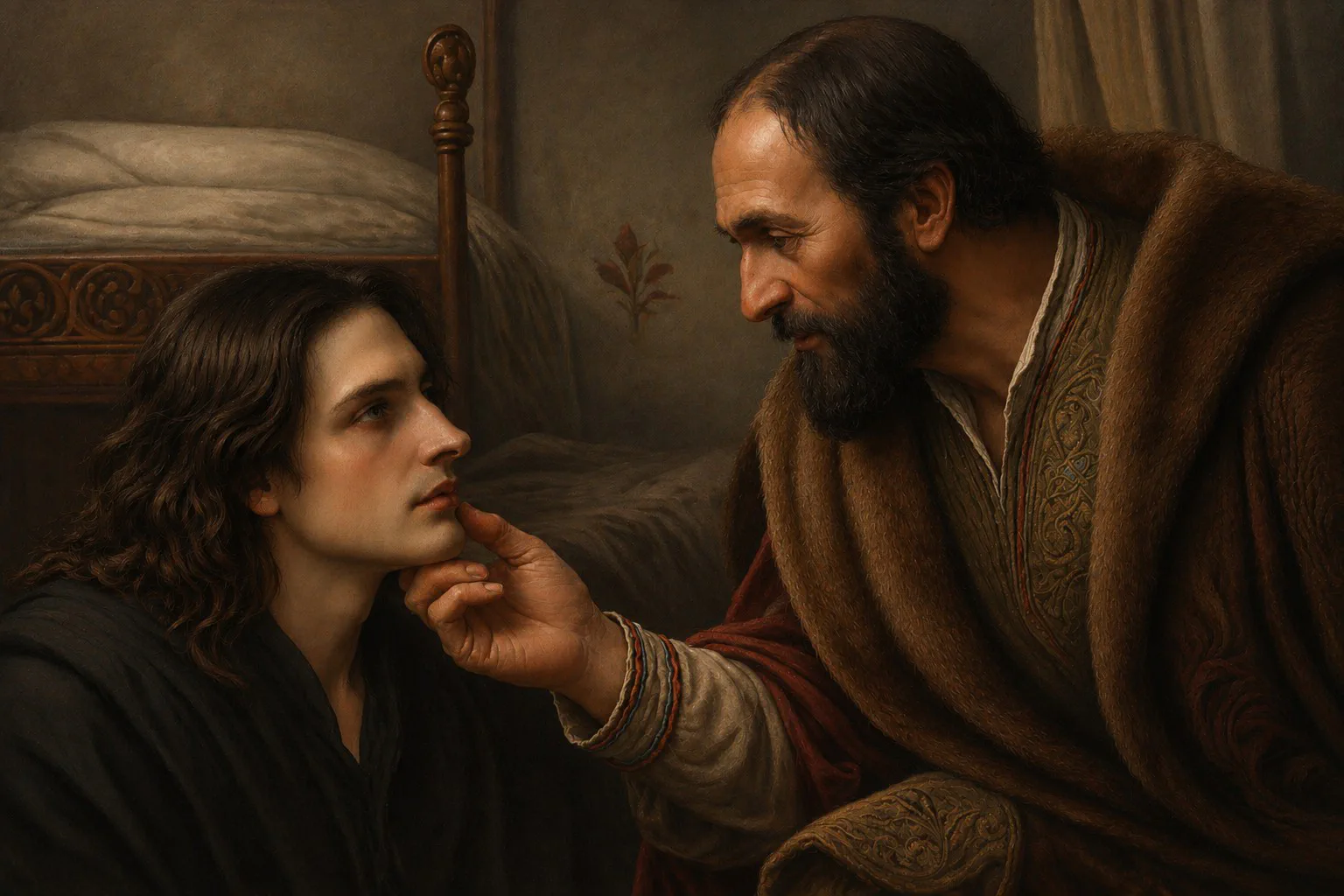
“The tsar’s lover”—that was what the Russian prince Andrei Kurbsky called the nobleman Fyodor Basmanov. By many accounts, Basmanov was the lover of the Russian tsar Ivan IV, known as Ivan the Terrible. Here is everything we know about their relationship.
Russian Tsar Ivan the Terrible
When Tsar Vasily III died in 1533, his son Ivan was only three. Ivan was already sovereign in name, but he could not rule in practice, so power passed to regents who governed on his behalf. In mid-16th-century Muscovy, senior nobles known as boyars, Ivan’s mother, and members of the clergy took turns in that role and sometimes shared it.
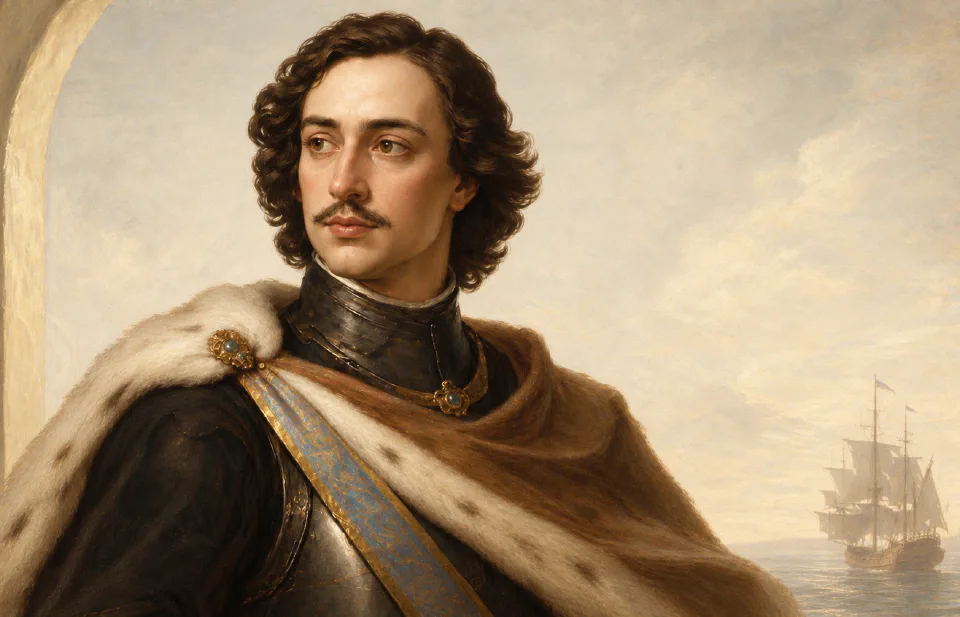
In 1545, at the age of 15, Ivan began to rule in his own right. Two years later, he was crowned and took the title of tsar. By the standards of other European courts at the time, the title was closer in meaning to that of emperor.
“Handsome in appearance.”
—Marco Foscarino, the Venetian ambassador, on Ivan the Terrible’s appearance at the age of 27
As soon as Ivan the Terrible began to rule in his own right, he pursued reforms aimed at centralizing power and strengthening the state. Under his rule, Russia gained a standing force, the streltsy, infantrymen armed with firearms. He overhauled the systems of administration, justice, and taxation.
Among the greatest military successes of his reign was the annexation of Kazan and Astrakhan. Russia also established trade relations with England during his reign.
Tsar Ivan the Terrible was well educated by the standards of his time. He read widely and wrote a great deal, including poetry.
“… no sovereign in our early history showed such eagerness or such skill in speaking and debating, aloud or in writing, in the public square, at a church council, with a boyar who had left his service, or with foreign envoys. This earned him a reputation as a master of rhetoric.”
—Sergei Mikhailovich Solovyov, Russian historian, on Ivan the Terrible
Ivan the Terrible’s marital history is complicated. He was formally married four times, while some accounts put the number of his unofficial wives as high as seven.
The English traveler Jerome Horsey, who claimed to have known the tsar personally, wrote that Ivan once boasted of having seduced a thousand young women and killed a thousand of his own children.
At the same time, there were rumors that Ivan’s interests extended beyond women.
Fyodor Basmanov, Ivan the Terrible’s Lover
Fyodor Basmanov came from a noble family. His father, Aleksei Basmanov, served Ivan the Terrible from an early age as a voivode, or military commander. He took part in most of the tsar’s military campaigns, including the capture of Kazan, expeditions to Crimea, and operations near Narva.
When Fyodor grew up, he too took part in military campaigns. On one occasion, he and his father repelled a Tatar attack near Ryazan.
In 1555, Aleksei Basmanov was made a boyar, joined the upper ranks of the nobility, and became one of the tsar’s trusted associates. It was Aleksei who introduced his son to the tsar. Fyodor soon became a boyar himself, and in 1566 he was appointed cupbearer (kravchii).
In the 16th century, the cupbearer’s duties went far beyond serving food at court. It was one of the most important offices for the sovereign’s safety. The cupbearer ran the tsar’s table, checked his food and drink, and was responsible for the tableware and the orderly conduct of meals. The tsar’s health and life were thus in his hands. Ivan the Terrible lived in constant fear of being poisoned, so only those closest to him were given the post.
The position also came with considerable privileges. For example, Fyodor was granted ownership of the town of Gorokhovets in what is now Vladimir Oblast.
Basmanov in the Oprichnina
Fyodor Basmanov was also an oprichnik, a member of the oprichnina. The oprichnina was both a special system of government and a means of repression that Ivan the Terrible created to fight the boyar nobility, whom he suspected of treason and conspiracy. The country was divided in two. One part was under the tsar’s direct control and was called the oprichnina. The other continued to be governed in the more familiar way, but suffered confiscations, violence, and raids by the oprichniki.
Historians disagree about what primarily drove this system: the tsar’s fear and suspicion, or a deliberate attempt to break the old elite and create a new one loyal to him personally.
Fyodor Basmanov was part of this system of terror, and the tsar’s personal authority protected him.
“He is so given to anger that when enraged he foams at the mouth like a horse and seems to go mad. In that state, he rages even at those who happen to cross his path.”
—Daniel Prinz von Buchau, ambassador, on Ivan the Terrible
Over time, Fyodor Basmanov became one of the people closest to the tsar. Alongside his duties as cupbearer, he took part in the execution of boyars on Ivan the Terrible’s orders and led some military operations. In the summer of 1568, for example, he was sent to Dankov, in what is now Lipetsk Oblast, to deal ruthlessly with two military commanders.
“… Fyodor the cupbearer, handsome of face, vile of soul, without whom Ivan could neither make merry at feasts nor rage in murder.”
—Nikolai Mikhailovich Karamzin, Russian historian, on Fyodor Basmanov and Ivan the Terrible
The Tsar Executes a Prince for Insulting Basmanov
Basmanov’s name has also been linked to the death of Prince Dmitry Ovchinin, who is called Obolensky-Ovchinin or simply Ovchina in various retellings. Ovchina once fell out with Basmanov and, according to the Russian historian Solovyov, accused him of serving the tsar through “vile sodomy.” In any case, Ivan the Terrible decided to kill Ovchina:
“According to one account, the young Prince Dmitry Obolensky-Ovchinin […] was executed because he quarreled with young Fyodor Basmanov, Ivan’s favorite, and told him, ‘My ancestors and I have always served our sovereign to his benefit, but you serve him through vile sodomy.’”
—Sergei Mikhailovich Solovyov, Russian historian
Ivan the Terrible chose a way to kill him that was true to form. At a feast, the tsar ordered the prince to drink a large cup of wine “to the sovereign’s health.” He then told him to go down to the wine cellar and drink more, “whatever he likes and as much as he wants.” The tsar’s hounds were waiting in the cellar and tore Ovchinin apart. A German nobleman who served as an interpreter at court described the episode:
“So Ovchina enters the wine cellars with the men who, on the tyrant’s orders, were to treat him to so splendid a feast. Waiting for him there were the kennelmen, whom the tyrant had prepared and instructed to strangle Prince Ovchina as soon as he came in. […] The reason for his secret death was that, amid his quarrels and exchanges of insults with Fyodor, the son of Basman, Ovchina reproached him for the dishonorable act he habitually committed with the tyrant. To be precise, the tyrant took advantage of this Fyodor’s love, and Fyodor habitually brought the tyrant’s wrath down on everyone. This was why, when Prince Ovchina cursed him for it […], Fyodor flew into a rage, went weeping to the tyrant, and accused Ovchina.”
—Albert Schlichting, from “A Brief Account of the Character and Cruel Rule of the Muscovite Tyrant Vasilyevich”
The Deposition of Metropolitan Philip
Basmanov’s closeness to the tsar was also evident in the case of Metropolitan Philip, one of the most influential churchmen in the country. At the time, the metropolitan of Moscow and All Rus’ headed the Russian Church, which did not yet have a patriarch. Metropolitan Philip openly opposed Ivan the Terrible’s repression and called for an end to the terror.
Naturally, Ivan the Terrible decided to go after him too, but killing the head of the Church would have been going too far. So the tsar decided simply to remove him from office.
One day, during a service at the Assumption Cathedral in the Moscow Kremlin, the metropolitan publicly asked the tsar to “stop shedding Christian blood.” Ivan the Terrible did not stop. Instead, he intensified the repression some time later.
Soon afterward, during another service, Fyodor Basmanov announced on the tsar’s orders that Metropolitan Philip had been stripped of his ecclesiastical rank and authority. Philip was then imprisoned and later strangled, when it would no longer cause much public outrage.
The Basmanovs Fall from Grace
History has many examples of people who took part in executions and violent reprisals only to fall victim to the same system. The end of the Basmanov family remains somewhat unclear. There are several accounts of how they died. In one version, father and son fell from favor because they were suspected of conspiring with the king of Lithuania and betraying the tsar:
“Aleksei [Basmanov] and his son [Fyodor], with whom the grand prince indulged in debauchery (pflegte Unzucht mitzutreiben), were killed.”
—Heinrich von Staden, German author of notes on Muscovy
Andrei Kurbsky, a former commander under Ivan the Terrible who fled to the Grand Duchy of Lithuania and began his famous correspondence with the tsar from there, gives a different, grimmer account. He says that Fyodor killed his own father:
“… the commander of the demonic host of darkness, the tsar’s lover Fyodor Basmanov, stabbed his own father Aleksei to death with his own hand. Aleksei was a renowned flatterer and in truth a madman who brought ruin upon himself and the land of Holy Rus’. O righteous God! How just are your judgments, Lord! What he prepared for his brothers, he soon tasted himself!”
—Andrei Kurbsky
One detail in these texts is striking. In his replies to Kurbsky’s accusations, Ivan the Terrible made no mention of the “tsar’s lover.” The tsar saw no need to deny or discuss that particular part of the accusations.
According to yet another version, the Basmanovs were exiled to Belozero, in what is now Vologda Oblast, where they died in disgrace.
In any case, Fyodor Basmanov was most likely already dead by January 1571. Counting from his appointment as cupbearer in 1566, he held the position for about five years, remaining one of the tsar’s closest associates throughout.
After Fyodor’s death, the tsar made what was known as a monastic endowment for him and his relatives. It paid for perpetual commemoration during services and for an annual korm men’shoi, a modest memorial meal:
“In the year 7091 (1583), the tsar and sovereign, Grand Prince Ivan Vasilyevich of All Rus’, gave 455 rubles for the eternal remembrance of Aleksei Fyodorovich Basmanov and his children Fyodor and Pyotr, so that a lesser memorial meal might be served for them year after year, for as long as this holy monastery stands.”
—“Historical Description of the Trinity Lavra of St. Sergius”
Basmanov in Literature and Film
Fyodor Basmanov became an established figure in Russian literature and film, where his connection to Ivan the Terrible was depicted especially vividly.
In Aleksei Tolstoy’s novel Prince Serebryany, part of the Russian school curriculum, Basmanov is portrayed as the tsar’s favorite and a capable warrior, but also as a depraved man who makes a show of his femininity. In one passage from a tense exchange with the main character, Prince Serebryany himself, Basmanov is said to have “danced like a girl in a letnik (a Russian women’s outer garment)”:
“And where,” Basmanov went on, as if egged on to even greater insolence, “could he find a servant handsomer than me? Have you ever seen eyebrows like mine? Aren’t they just like sable fur? And the hair? Touch it, Prince, feel it. It’s silk… really, it’s silk!”
Disgust showed on Serebryany’s face. Basmanov noticed and went on, as though he meant to tease his guest:
“And my hands, Prince, look at them. Aren’t they like a girl’s? I did get them a little blistered today, though. That’s just my nature. I never spare myself in anything!”
“You certainly don’t,” said Serebryany, no longer able to contain his indignation. “If all they say about you is true…”
“And what do they say about me?” Basmanov broke in with a sly squint.
“What you say yourself would be quite enough, but they say that you dance before the tsar, God forgive me, like a girl in a letnik!”
Basmanov flushed, but summoned his usual shamelessness to his aid.
“Well, then,” he said, putting on a carefree air, “what if I do dance?”
—Aleksei Tolstoy, the novel Prince Serebryany
Of course, historical sources do not corroborate the scene in which Basmanov dances before the tsar. But the gay Soviet director Sergei Eisenstein used that very motif in his film Ivan the Terrible. As in Tolstoy’s novel, the film conveys Basmanov’s closeness to the tsar through hints and a tension that can be read as implicit homoeroticism.
Similar motifs appear in the 1991 film Tsar Ivan the Terrible. A still from it appears on the cover of this article. One of the film’s most memorable scenes is Basmanov’s arrest, when he calls after the tsar, “But you and I have the same sins!”
References and Sources
- Gorsky, Aleksandr. Историческое описание Свято-Троицкой Сергиевой лавры [Historical Description of the Trinity Lavra of St. Sergius]. With appendixes by Archimandrite Leonid. Part 2. Moscow: Imperial Society of Russian History and Antiquities at Moscow University, 1879. P. 52.
- Karamzin, Nikolai. История государства Российского [History of the Russian State]. Vol. 9. St. Petersburg: N. Grech Press, 1821.
- Kurbsky, Andrei. История о великом князе Московском [History of the Grand Prince of Moscow]. Moscow: URAO Press, 2001.
- Prinz von Buchau, Daniel. Начало и возвышение Московии [The Origins and Rise of Muscovy]. Translated by Ivan Tikhomirov. Moscow: Society of Russian History and Antiquities at Moscow University, 1877.
- Solovyov, Sergei. История России с древнейших времён [History of Russia from the Earliest Times]. Vol. 6. Moscow: University Press, 1887.
- Tolstoy, Aleksei Konstantinovich. “Князь Серебряный. Повесть времён Иоанна Грозного [Prince Serebryany: A Tale of the Times of Ivan the Terrible].” Русский вестник [The Russian Messenger], August–October 1862.
- Florya, Boris. Иван Грозный [Ivan the Terrible]. Moscow: Molodaya Gvardiya, 1999.
- Schlichting, Albert. “Краткое сказание о характере и жестоком правлении московского тирана Васильевича [A Brief Account of the Character and Cruel Rule of the Muscovite Tyrant Vasilyevich].” In Новое известие о России времени Ивана Грозного [New Information about Russia in the Time of Ivan the Terrible], translated by A. I. Malein. Leningrad: Academy of Sciences of the USSR Press, 1934.
- Staden, Heinrich von. Записки о Московии [Notes on Muscovy]. Vol. 1, Публикация и перевод текста [Edition and Translation of the Text]. Moscow: Drevlekhranilishche, 2008.