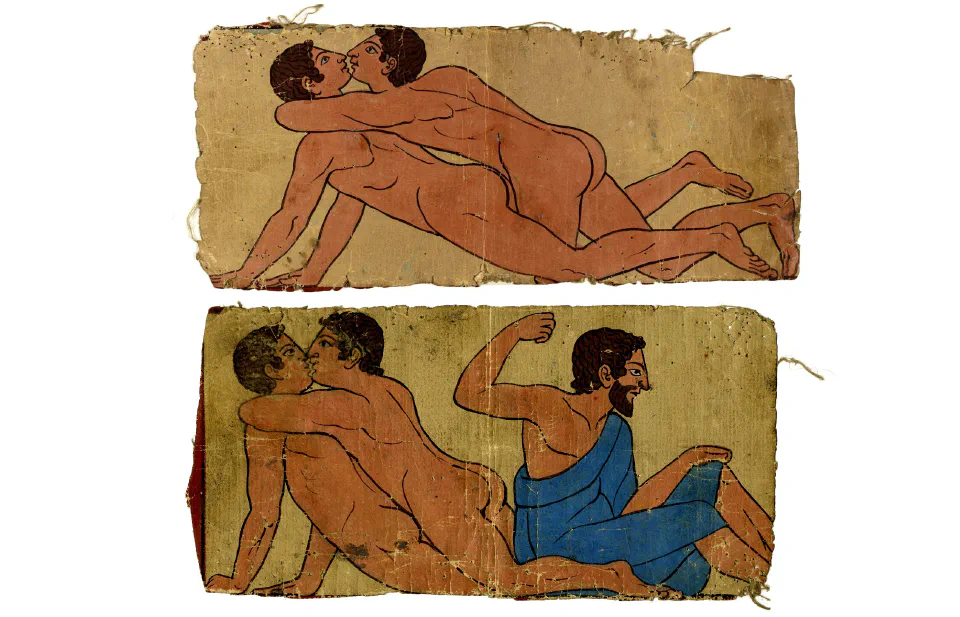
A Jug from Ancient Italy with a Greek Inscription about Sex between Two Men
A fifth-century BCE find from Salerno that names a Greek and an Etruscan as sexual partners.
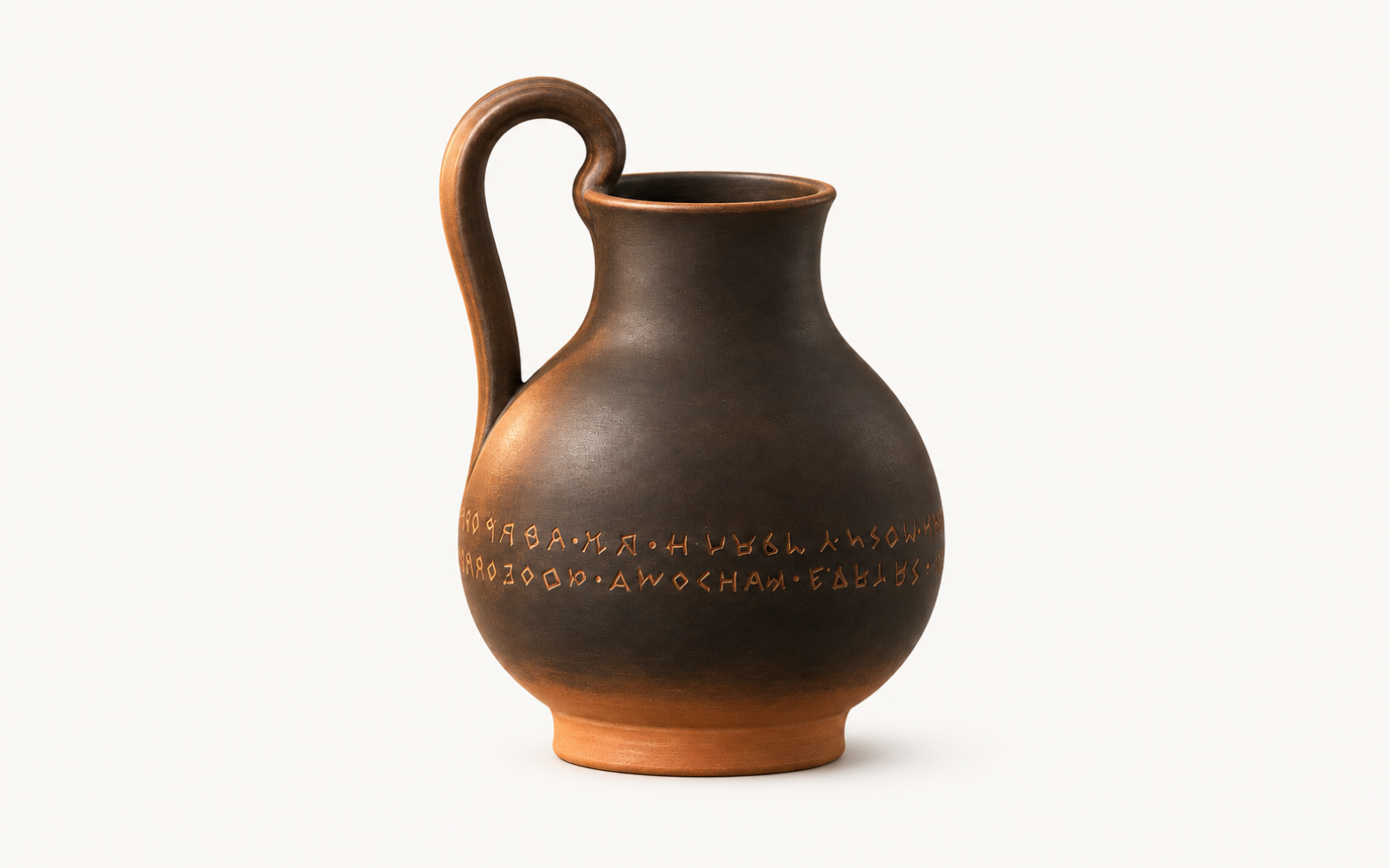
In 1963, excavators found a small clay wine jug called an olpe in the burial ground of Fratte, an ancient settlement in what is now Salerno in southern Italy. Four short phrases scratched into the jug in Greek say who loves whom and who wants whom. One says that a man named Wolchas is having anal sex with another man, Apollodorus.
The olpe was made in the first half of the fifth century BCE in the Greek city of Poseidonia. It was found in a grave in a neighboring settlement where Etruscans lived. The inscription offers a rare glimpse of how Greeks, Etruscans, and local Italic peoples lived side by side.
What Does the Jug Say?
The inscription runs around the body of the jug in two lines. The letters are written from right to left. Sophie Pérard, a scholar of Etruscan culture, describes how the inscription is laid out. Each line is divided in half, and the two halves read outward from the middle in opposite directions, mirroring each other.
Here is the reading by Luigi Vecchio, a specialist in ancient inscriptions, in standard Greek letters, with each phrase on its own line.
Ἀπολλόδωρος · Ξύλλας · ἔραται
Ϝόλχας · ἀπύγιζε · Ἀπολλόδωρον
Ὀνάτας · Νιξῶς · ἔραται
Ὕβριχος · Παρμύνιος · ἤραται
In the Latin-letter transcription below, w represents the ancient Greek letter Ϝ (digamma), and the bar over ē and ō marks a long vowel.
Apollodōros · Xyllas · eratai
Wolchas · apygize · Apollodōron
Onatas · Nixōs · eratai
Hybrichos · Parmynios · ēratai
The translation below follows the reading by archaeologist Angela Pontrandolfo, as cited by Airton Pollini, a historian of ancient Greece.
Apollodorus desires Xylla.
Wolchas penetrates Apollodorus.
Onatas desires Nixo.
Hybrichos loved Parmynis.
The verb ἔραται (eratai) in the first and third phrases expresses romantic or sexual desire and is translated as “loves” or “desires.” In the fourth phrase, the verb takes the form ἤραται (ēratai), which Pollini and Pérard render in the past tense as “loved” or “desired.”
The crudest word in the inscription, ἀπύγιζε (apygize), appears in the second phrase. The classical philologist Giovanni Cerri took it to be a rare form of the verb πυγίζω (pygizō), meaning “to penetrate anally.” He attributed the unusual form to a shortened prefix and subsequent sound changes. Cerri considered this form part of the vulgar everyday speech of the time.
The grammar determines who does what. Wolchas does the penetrating, and Apollodorus, whose name is in the accusative case, is the receptive partner.
Who Are These Seven People?
The four phrases name seven people. Apart from their names, nothing is known about them. They may all have known the person who commissioned the jug.
Apollodorus is named twice, and the first two phrases make up a little story. The other names appear once each. Pollini counts five men and two women.
The names make it clear that Apollodorus and Onatas are Greek and Wolchas is Etruscan. His name is a Greek rendering of the Etruscan name Vulca. According to tradition, a craftsman of that name from the city of Veii made the cult statue of Jupiter for the temple on Rome’s Capitoline Hill around 520–510 BCE.
Xylla and Nixo appear to be women from local Italic peoples. Pérard thinks their names are of local Samnite origin, but that they were written in Greek letters and adapted to Greek pronunciation. On that reading, the first and third phrases are about Greeks who desire local women.
Hybrichos and Parmynis are harder to place. Pollini found no reliable Greek parallels for their names. He takes the names to be local and Italic and reads both people as men. On that interpretation, the last phrase adds a second pairing between men to the story of Wolchas and Apollodorus.
The philologist Renato Arena proposed a different reading in 2006. In his view, Parmynis (Πάρμυνις) is a woman, Hybrichos’s beloved. He derived her name from Greek names such as Paramone and attributed its unusual sound to the local dialect. In that case, the last phrase describes a man’s love for a woman. Whether the inscription contains one or two pairs of men depends on whose reading one accepts.
The Joke about Apollodorus
Cerri drew attention to the way the first two phrases are constructed. In the first, Apollodorus desires Xylla. In the second, his name comes at the end, this time as the man Wolchas penetrates. The passage begins and ends with Apollodorus. Over the course of two phrases, he goes from doing the pursuing to being taken.
Cerri took this to be a joke. He started from an ancient Greek norm that deemed it fitting for a free man to be the active partner and shameful for him to be the receptive one. The joke, then, is that Apollodorus pursues a woman but ends up underneath Wolchas. Cerri thought such a joke might have been told aloud at a symposium, a Greek drinking party.
Cerri compared the inscription with poem 56 by Catullus, a Roman poet who lived in the first century BCE. The speaker catches a young man with a girl and immediately has sex with the young man himself. The device is the same. The man who took the initiative is himself on the receiving end. Cerri explained the similarity by pointing to a shared oral stock of obscene sayings, songs, and jokes that sometimes made their way into written texts. If so, the olpe preserves one of the earliest examples.
Pérard also mentions a similar Latin motif, fututor fututus, “the one who fucked and got fucked himself.”
Cerri suggested reading the first two phrases as verse as well. Each divides into two rhythmic halves, and the meters resemble those of folk songs and the choral passages in Aristophanes’s comedies. If he is right, the jug records a bawdy drinking verse about same-sex acts.
The Jug and the Feast
The olpe is small, with a rounded body, a narrow neck, a base, and a single tall handle that rises above the mouth. Archaeologist Edward Robinson describes the jug as partly coated with gloss. Other scholars specify that the gloss is black. The vessel bears no images. All of its erotic content is in the words.
Scholars determined where the jug was made from its clay and shape, both of which point to Poseidonia. The lettering confirms this. The inscription uses the Achaean form of the Greek alphabet, the local variant used in the city.
The letters were scratched into the clay while it was still wet, before firing. That means the inscription was planned in the workshop, and the jug was meant to be used with the words on it.
At a feast, a jug like this most likely passed from hand to hand. People took it by the handle, turned it, and poured the wine. The inscription encircles the body of the jug, so readers had to turn the vessel to read it.
The art historian François Lissarrague suggested that the wine itself might have reflected the inscription like a mirror, allowing it to be read.
Where Was the Olpe Found?
The Etruscans ruled much of Italy before the rise of Rome. They had their own cities, religion, and language, which was unrelated to either Greek or Latin. Many of their inscriptions survive. Their letters can be read, but their meaning is only partly understood.
Rome borrowed much from the Etruscans and later seized their cities.
In the sixth and fifth centuries BCE, Etruscans also lived in Campania, the region around present-day Naples and Salerno.
Their neighbors were Greeks and Italic peoples. From the eighth century BCE onward, Greeks founded cities in southern Italy and Sicily, lands later called Magna Graecia, or Greater Greece. Around 600 BCE, settlers from the Greek colony of Sybaris founded Poseidonia here. The Romans called it Paestum.
The Italic peoples, such as the Oscans and Samnites, were the other small peoples native to Italy and spoke languages related to Latin.
Fratte stood on a low hill by the Irno River, about four kilometers from its mouth, where roads to the Campanian Plain, the Italian interior, and the southern coast met. Its principal neighbors were Etruscan Pontecagnano and Greek Poseidonia.
Fratte arose in the early sixth century BCE and remained a prominent settlement until the end of the fifth century CE. Its ancient name is unknown, but scholars suggest it may have been Marcina or Tyrseta.
The olpe lay in the burial known in the scholarly literature as tomb 26/1963 or 26/63 (the second part of the number is the year of excavation). Other drinking vessels lay nearby, including a cup and a skyphos, a deep wine vessel with two handles.
Pontrandolfo first published a detailed account of the inscription in 1987. Specialists in Greek dialects, classical literature, Etruscan culture, and the history of sexuality later wrote about it.
The olpe is now held at the Provincial Archaeological Museum of Salerno.
The olpe is dated to the first half of the fifth century BCE. Based on the other objects from the burial, Cerri dated it to between 480 and 460 BCE. Pollini dated it to the first quarter of the century. In 2025, Vecchio dated it to 480–470 BCE.
What Does the Inscription Tell Us about Campania?
For Pollini, the olpe is evidence of close contact among the different peoples of Campania. The jug was made in Poseidonia and brought to Fratte. The inscription is in Greek, and the names on it are Greek, Etruscan, and Italic.
Pérard sees the inscription as a distinctly Greek joke with one non-Greek feature. Greek norms drew distinctions about where, when, and with whom a man was allowed to take his pleasure. Here, love for women and for men and the roles of “top” and “bottom” appear in a single scene without any transition. Apollodorus gets to be both the one who desires and the one who is penetrated. Pérard thinks this may reflect the influence of the Etruscans or the Italic peoples, whose mores were less restrictive than those of the Greeks.
Why Did the Olpe End Up in a Grave?
In the end, the olpe went into the grave with the other vessels. That is how it survived. Vecchio suggests that the person buried there was one of the people named in the inscription. That would explain why a jug with familiar names was laid beside him. We do not know whose burial it was. The vessel gives no name for the deceased.
The inscription shows no obvious religious meaning either. There is no appeal to the gods or mention of death, only desire and sex.
Bibliography and Sources
- Catullus. “Poem 56.”
- Pliny the Elder. Naturalis historia [Natural History], 35.157. On Vulca, the craftsman from Veii.
- Arena, Renato. “Appunti di onomastica greca [Notes on Greek Onomastics].” ACME — Annali della Facoltà di Lettere e Filosofia dell’Università degli Studi di Milano 59, no. 1 (2006): 239–241. On Parmynis, p. 239.
- Arena, Renato. Iscrizioni greche arcaiche di Sicilia e Magna Grecia [Archaic Greek Inscriptions of Sicily and Magna Graecia]. Vol. 4, Iscrizioni delle colonie achee [Inscriptions of the Achaean Colonies]. Alessandria: Edizioni dell’Orso, 1996. Inscription no. 33.
- Cerri, Giovanni. “Il carme 56 di Catullo e un’iscrizione greca di recente pubblicazione [Catullus’s Poem 56 and a Recently Published Greek Inscription].” Quaderni Urbinati di Cultura Classica, new series, 31, no. 1 (1989): 59–65. DOI 10.2307/20546979.
- Dubois, Laurent. Inscriptions grecques dialectales de Grande Grèce [Greek Dialect Inscriptions of Magna Graecia]. Vol. 2, Colonies achéennes [Achaean Colonies]. Genève: Droz, 2002. Inscription no. 28, pp. 72–73.
- Greco, Giovanna, and Angela Pontrandolfo, eds. Fratte. Un insediamento etrusco-campano [Fratte: An Etruscan-Campanian Settlement]. Modena: Franco Cosimo Panini, 1990. Foundational publication of material from the settlement and its burial ground.
- OpenMapTiles. “Attribution.” OpenMapTiles Documentation.
- OpenStreetMap. “Copyright and License.” OpenStreetMap.
- Pérard, Sophie. “Regards homoérotiques étrusques : une archéologie impossible ? [Etruscan Homoerotic Gazes: An Impossible Archaeology?].” Images Re-vues, no. 17 (2020). On the olpe, sections 14–20. F. Lissarrague’s hypothesis, note 19. On Vulca, note 18. DOI 10.4000/imagesrevues.7379.
- Pollini, Airton. “Inscriptions grecques et les peuples italiques, quelques cas d’étude [Greek Inscriptions and the Italic Peoples: A Few Case Studies].” Heródoto 2, no. 1 (2017): 128–146. On the Fratte olpe, pp. 139–140. DOI 10.31669/herodoto.v2i1.170.
- Pontrandolfo, Angela. “Un’iscrizione posidoniate in una tomba di Fratte di Salerno [An Inscription from Poseidonia in a Tomb at Fratte, Salerno].” Annali dell’Istituto Universitario Orientale di Napoli. Sezione di Archeologia e Storia Antica 9 (1987): 55–63. First publication devoted to the inscription.
- Robinson, Edward Guy Dalkeith. “Identity in the Tomb of the Diver at Poseidonia.” In Communicating Identity in Italic Iron Age Communities, edited by Margarita Gleba and Helle W. Horsnæs, 50–72. Oxford: Oxbow Books, 2011. On the Fratte olpe, p. 65, fig. 4.12.
- Vecchio, Luigi. “Officina di IG XIV² – Una dedica per Herakles da Fratte (Salerno) [IG XIV² Workshop: A Dedication to Herakles from Fratte (Salerno)].” Axon 9 (2025): 93–106. On the settlement and the olpe, sections 1–2, especially note 25. DOI 10.30687/Axon/2532-6848/2025/01/006.