“All Alone, in a Room of My Very Own” — A Book by Aya Mizukami on Queer and Feminist Literary Criticism
An essay collection examining embodiment, lesbian desire, and trans solidarity in modern fiction.
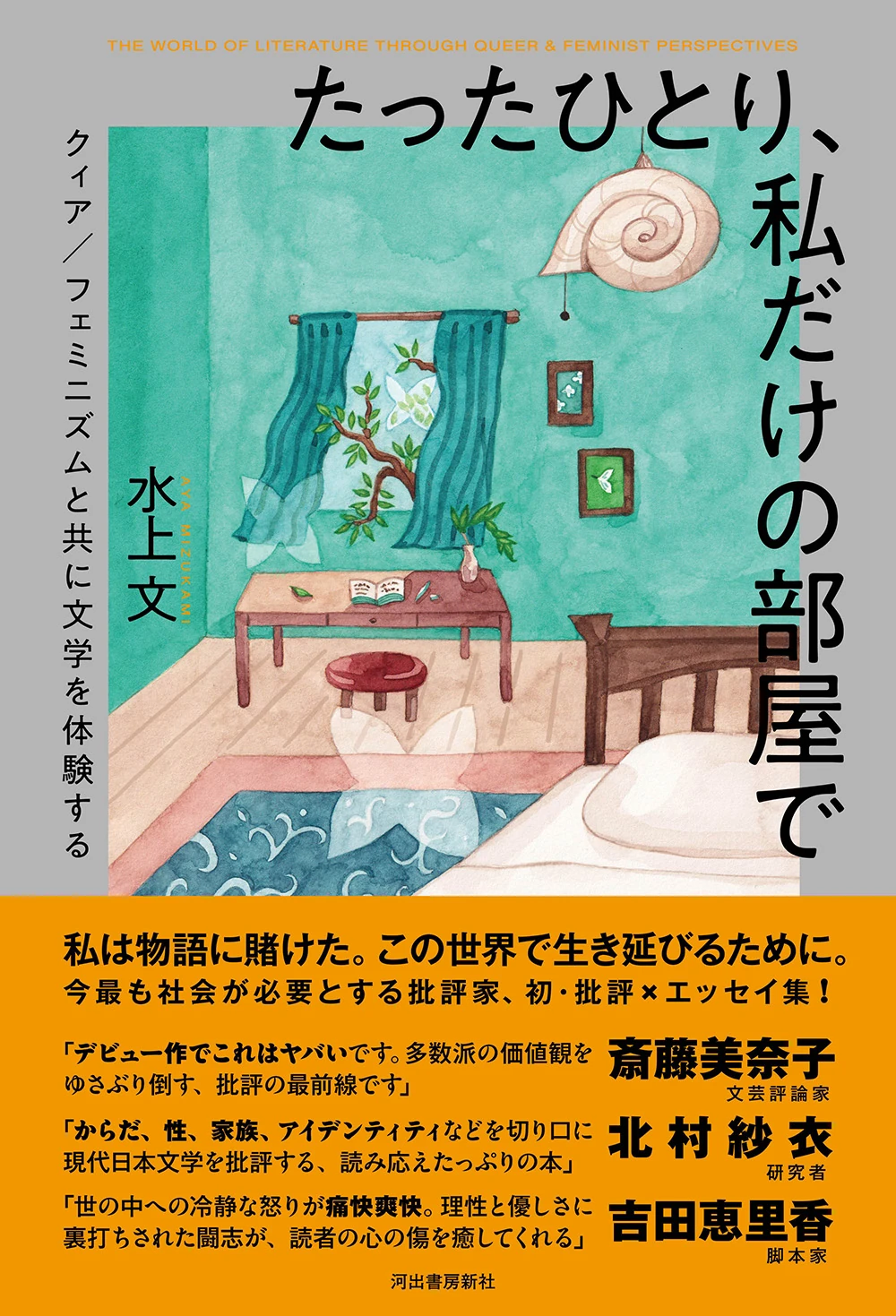
On September 18, 2026, Japanese publishing house Kawade Shobo Shinsha (河出書房新社) released the Japanese-language book “All Alone, in a Room of My Very Own: Experiencing Literature with Queer / Feminism” (たったひとり、私だけの部屋で クィア/フェミニズムと共に文学を体験する, Tatta hitori, watashi dake no heya de: Kuia / feminizumu to tomo ni bungaku o taiken suru). The volume was written by Japanese author and literary critic Aya Mizukami (水上文).
Born in 1992, Aya Mizukami is a prominent voice in the emerging generation of Japanese literary criticism. She examines contemporary prose through the lens of gender and queer theory, authoring regular quarterly literary reviews for the esteemed journal Bungei (文藝). Mizukami previously published the travelogue “A Queer Travelogue of Canada” (クィアのカナダ旅行記, 2025), co-authored the introductory volume “Introduction to Yuri Studies” (はじめての百合スタディーズ, exploring female same-sex romance in Japanese popular culture), co-edited the volume “We Are Already Together: Anti-Trans Discrimination Booklet” (われらはすでに共にある 反トランス差別ブックレット), and served as guest editor for a special issue of the feminist journal Etcetera focusing on queer women and community.
The title explicitly references Virginia Woolf’s landmark feminist essay A Room of One’s Own, but Mizukami recasts the search for space to read and write through the perspective of a non-heterosexual woman. In the introduction, she reflects on how reading fiction became not merely an intellectual pursuit, but an essential practice of survival and resistance within a society structured around cisnormativity and compulsory heterosexuality. The volume brings together critical essays, polemical texts, and curated reading guides centered on gender, sexuality, and bodily autonomy.
The collection is organized into four thematic parts. The first section explores embodiment and the complex bonds between mothers and daughters in contemporary Japanese fiction, offering a detailed analysis of Akutagawa Prize winner Rin Usami’s novel Kaka (かか). The second section addresses the lived reality of queer feminism and engages with the concept of “queer time” — temporality detached from conventional reproductive and heteronormative life scripts — while examining representations of female homosexuality and lesbian desire in the fiction of Risa Wataya.
The third section forms the book’s critical core and centers on transgender solidarity. Mizukami elucidates the concept of cisgender identity and examines Taiwanese-Japanese queer author Li Kotomi’s novel In the Land Where the Spirit of Words Brings Blessings (言霊の幸う国で) as literature of resistance that refuses to allow sexual and gender minorities to be erased. In two supplementary essays, Mizukami directly engages with debates in the literary establishment: she dismantles the rhetoric surrounding the “critique of cancel culture” and presents a reasoned critique of the trans-exclusionary rhetoric voiced by established novelist Yoriko Shono in works such as System within Crystal (水晶内制度). Mizukami argues that claims of artistic freedom and literary authority cannot justify discriminatory violence or the exclusion of trans women from feminist spaces.
The concluding section examines social pressure and the constraints of conformity. The author analyzes Junko Takase’s fiction regarding mechanisms of social coercion, revisits Woolf’s thought experiment of Shakespeare’s hypothetical sister through the early modernist writing of Mieko Kanai, and discusses radical queer pedagogy and bodily power dynamics in the works of Rieko Matsuura. Mizukami’s book demonstrates how attentive engagement with literature can challenge entrenched hierarchies and articulate paths toward justice for marginalized communities in contemporary Japan.