"The Battle for the Body" — Siobhan Guerrero's Book on Transfeminism, Culture Wars, and the Body
A biologist and philosopher examines anti-trans rhetoric and articulates a transfeminist vision.
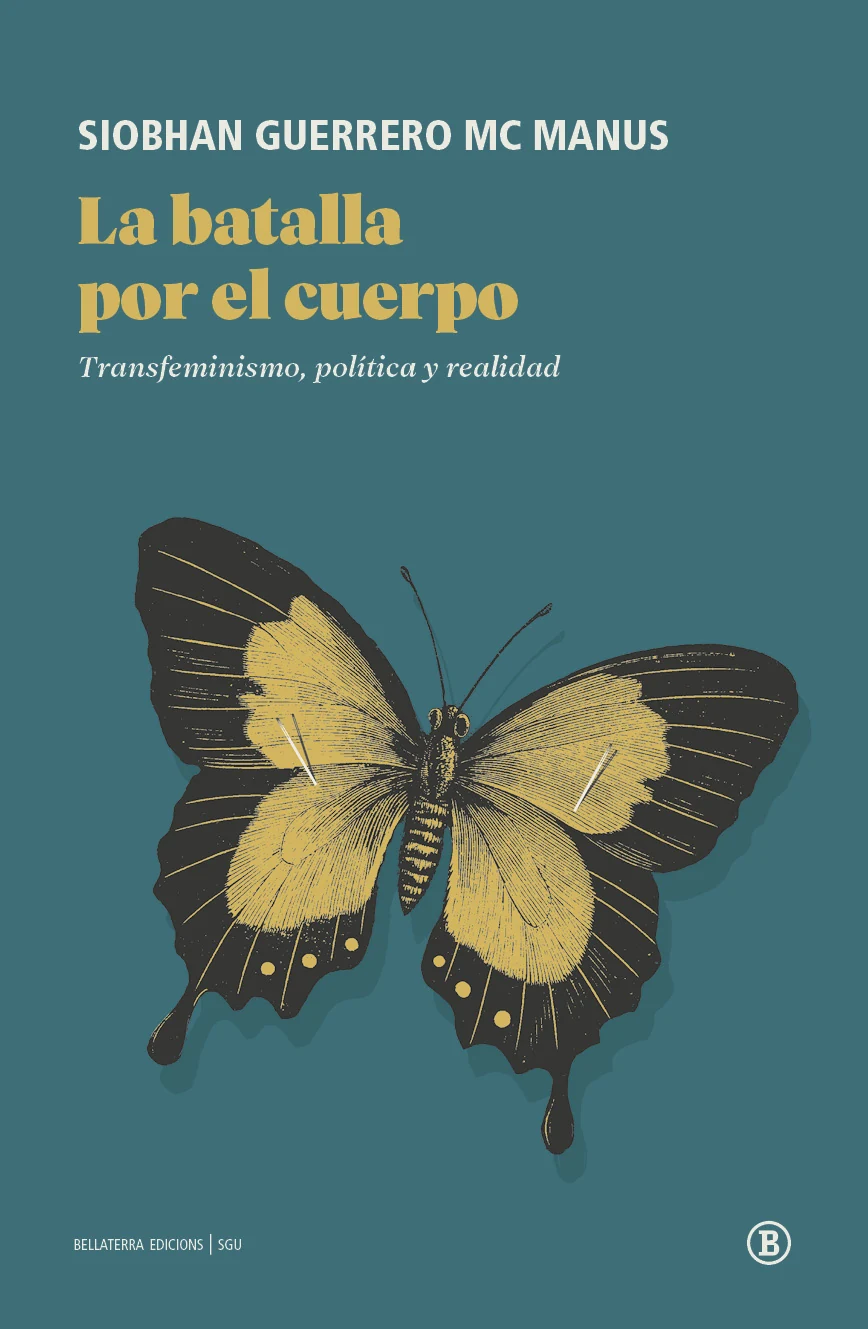
In August 2026, the Spanish publishing house Bellaterra Edicions released the Spanish-language book La batalla por el cuerpo: Transfeminismo, política y realidad (The Battle for the Body: Transfeminism, Politics, and Reality) as part of its Serie General Universitaria. Written by Mexican scholar, biologist, and philosopher of science Siobhan Guerrero (Siobhan Guerrero Mc Manus), the monograph explores how trans bodies have become the primary battleground of contemporary culture wars, offers a critical dissection of anti-gender rhetoric, and articulates a transfeminist response to the global mobilization of reactionary politics.
The author, Siobhan Guerrero, is an openly trans woman, scholar, and senior researcher at the Center for Interdisciplinary Research in Sciences and Humanities (CEIICH) at the National Autonomous University of Mexico (UNAM). She earned her undergraduate degree in biology from UNAM’s Faculty of Sciences, followed by a master’s degree and a PhD in philosophy of science from UNAM’s Institute of Philosophical Research. Guerrero is a co-founder of the Laboratorio Nacional Diversidades, serves on the editorial board of the prominent Latin American journal Debate Feminista, and was honored with the Research Award in Humanities by the Mexican Academy of Sciences in 2020 as well as the National University Distinction for Young Academics in 2018. Her prior works include co-editing volumes on affect and embodiment and contributing to the influential collection Alianzas rebeldes: Un feminismo más allá de la identidad (2021).
At the core of Guerrero’s investigation is the phenomenon of an unexpected political and discursive convergence between neoconservative forces, right-wing populism, and sectors of trans-exclusionary radical feminism. The author analyzes how these disparate ideological camps unite in demonizing trans identities, framing gender self-determination as an existential threat to the family, children’s welfare, women’s rights, and the nation. Drawing upon both philosophical argumentation and her background in evolutionary biology, Guerrero unmasks the mechanisms of moral panic: reactionary discourse disguises itself as “scientific objectivity,” “biological determinism,” and “common sense,” reviving archaic prejudices to cast trans individuals as dangers that must be surveilled, corrected, or excluded from public life.
Guerrero argues that the conflict surrounding trans existence extends far beyond semantics or institutional language: what is fundamentally at stake is who is permitted to live with dignity, which bodies are deemed worthy of legal protection, and whose lives are recognized as viable. Drawing on decolonial critique and transfeminist epistemology, she traces how colonial and patriarchal matrices of power historically imposed rigid binary classifications upon bodies to enforce subjugation. Countering biological essentialism, Guerrero posits the body not as a static anatomical given, but as a dynamic site of becoming, vulnerability, and agency upon which social hierarchies and violence are inscribed.
In the final section of the volume, Guerrero urges social movements to discard the politics of suspicion, punitive exclusion, and identity-based sectarianism. Instead of fracturing struggles among oppressed communities, she advocates a collective emancipatory project grounded in radical solidarity, cross-movement coalitions, and an ethics of mutual care. The rights and bodily autonomy of trans people, the book contends, pose no threat to anyone’s liberation; rather, they form an indispensable pillar in the shared pursuit of social justice, bodily self-determination, and human freedom.