“Disorienting Phenomenology” — A Book by Eden Kinkaid on Queer Space, Trans Life, and Critical Theory
A geographer explores how trans experience exposes the hidden politics of space and embodiment.
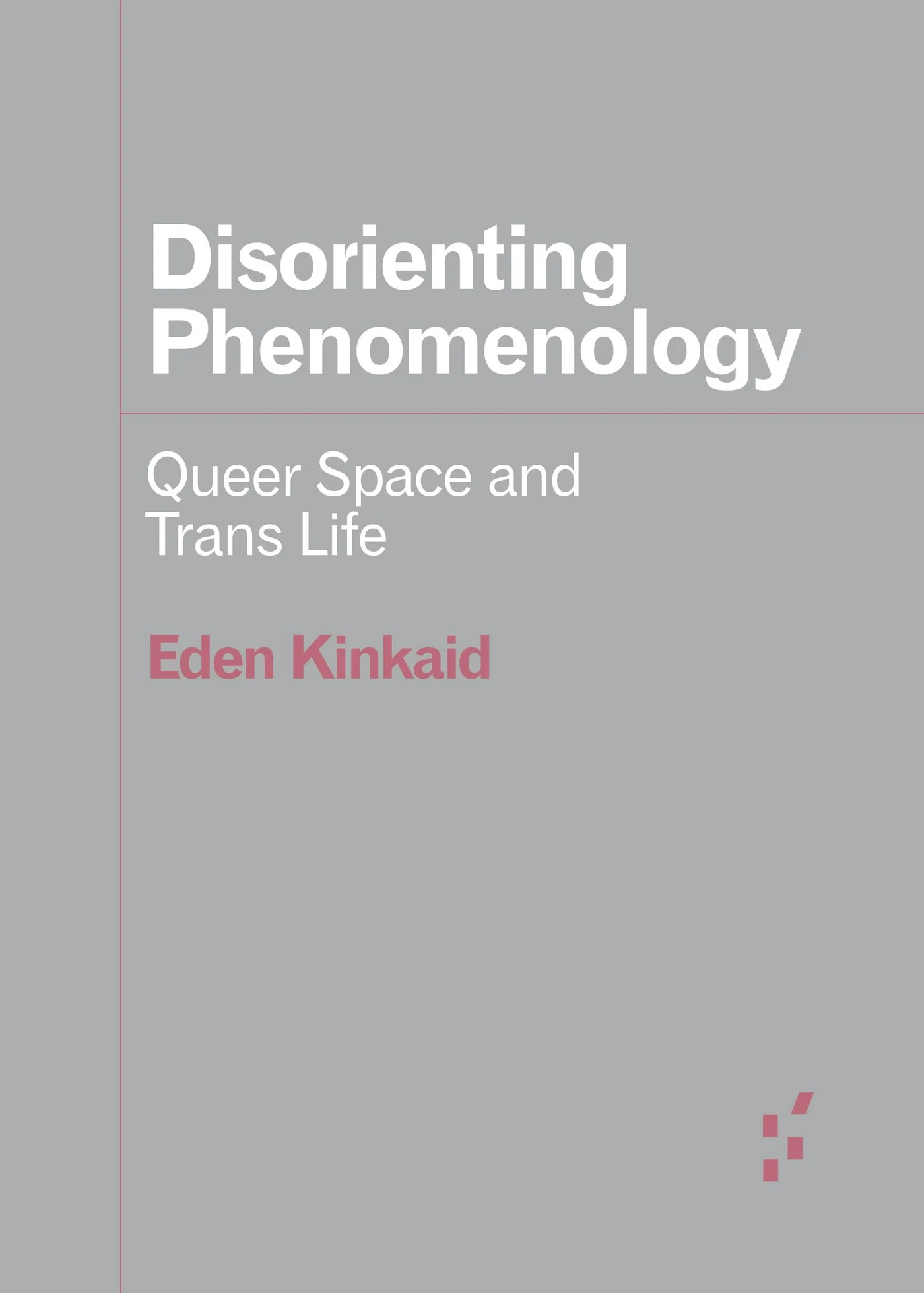
On August 4, 2026, the University of Minnesota Press published in its Forerunners: Ideas First series the English-language book Disorienting Phenomenology: Queer Space and Trans Life. Its author is the human geographer and queer theorist Eden Kinkaid.
Eden Kinkaid is a postdoctoral fellow in human geography at the University of Toronto Scarborough and an affiliate assistant professor in the Department of Geography and Spatial Sciences at the University of Delaware. Kinkaid earned a PhD in Geography from the University of Arizona in 2023, following a master’s degree at Penn State University. Their scholarship operates at the nexus of human geography, critical phenomenology, feminist theory, and transgender studies. Kinkaid has served on the editorial teams of academic journals including Gender, Place and Culture and you are here: the journal of creative geography, co-founded the independent geography zine network GEOZONe, and was selected as a 2026 Lambda Literary Fellow for Emerging LGBTQ Voices.
At the core of the monograph is a profound rethinking of social space through the prism of everyday trans embodiment. Kinkaid takes as a point of departure the phenomenon of disorientation arising in ordinary, mundane encounters: entering a gender-segregated public restroom, passing through airport security checkpoints, or navigating university institutional corridors. Rather than treating these episodes as mere individual awkwardness or hesitation, the author transforms them into sharp conceptual tools. In contrast to conventional understandings of space as a neutral, empty container for bodies, the book demonstrates that space is inherently structured by power: it is felt viscerally, dictates physical movements, and delineates the boundaries of safety and social recognition.
Methodologically, the book grounds itself in critical phenomenology, reimagining classical philosophical frameworks. Examining the foundational phenomenologies of Edmund Husserl and Maurice Merleau-Ponty, Kinkaid underscores that the universal subject of classical philosophy was implicitly modeled on the privileged position of a white, cisgender European male whose smooth movement through the world was taken for granted. Bringing the phenomenology of bodily perception into dialogue with Henri Lefebvre’s spatial theory regarding the production of abstract space, Kinkaid engages with Sara Ahmed’s Queer Phenomenology, Frantz Fanon’s anticolonial critique, and the work of Rosemarie Garland-Thomson, Denise Ferreira da Silva, and Susan Stryker. The author articulates a “misfit epistemology”: it is precisely the experience of dissonance between the body and its surrounding environment that reveals the submerged scaffolding of cisheteronormativity, racial hierarchy, and ableism.
A key theoretical contribution of the book lies in demonstrating that gender is not an isolated anatomical property of an individual, but an intersubjective, relational accomplishment that continually requires verification in social encounters. Transgender existence exposes the contingency of this arrangement: when normative recognition falters, disorientation spreads instantaneously to onlookers, yet its lasting existential and material toll is absorbed by the trans subject. In a chapter dedicated to institutional worlds, Kinkaid examines the North American academy, demonstrating how institutional diversity rhetoric frequently masks rigid bureaucratic norms that discipline and marginalize bodily and epistemic difference.
In contrast to institutional confinement, the final chapters investigate the emergence of “differential space” — constellations of queer gatherings, autonomous art spaces, dance parties, and mutual aid networks, ranging from Tucson’s Splinter Collective to encounters between trans colleagues at professional conferences. Drawing on Hil Malatino’s concept of the trans affective commons and José Esteban Muñoz’s understanding of queerness as an expansive horizon of utopian potentiality, Kinkaid illustrates how minoritized bodies in shared spaces cultivate alternative modes of relationality, care, and mutual witnessing. Ultimately, Disorienting Phenomenology affirms that critical phenomenology can operate as an emancipatory praxis, equipping readers to challenge spatial oppression and collectively build worlds that sustain diverse human lives.