"Bisexual, Christian, European" — A Book by Carol A Shepherd and José Calvo Tello on Faith and Church Life
An exploration of bisexual Christians across Europe through personal life stories and sociology.
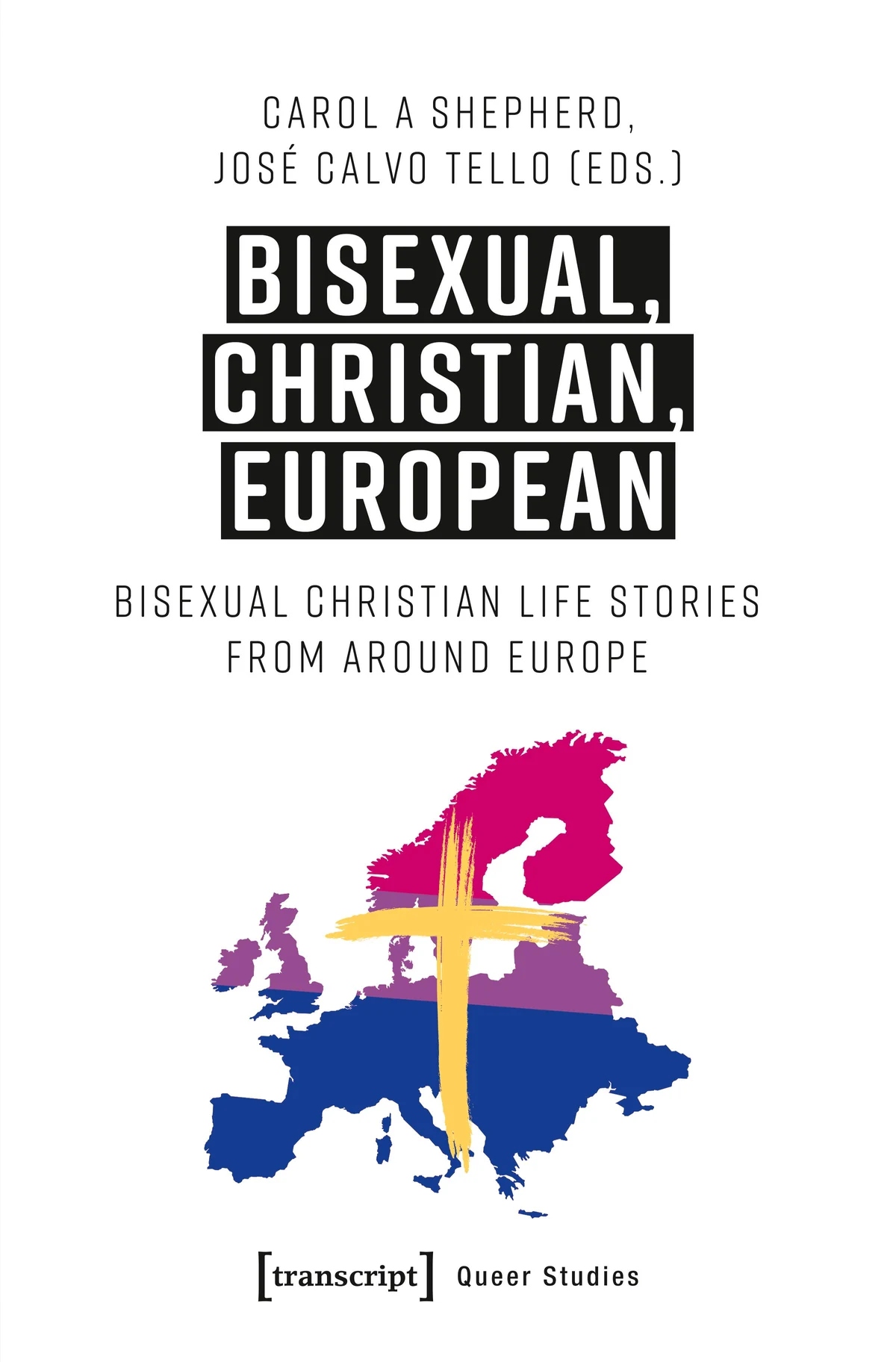
On July 21, 2026, German academic publisher transcript Verlag published in English the collective volume Bisexual, Christian, European: Bisexual Christian Life Stories from Around Europe. The book was co-edited and co-authored by British researcher Carol A Shepherd and Spanish scholar José Calvo Tello. The volume appeared as part of the Queer Studies series in open access with financial support from the NiedersachsenOPEN programme.
Carol A Shepherd is a British sociologist, theologian, and activist who earned her doctorate from the University of Winchester; her academic research focuses on the experiences of bisexual Christians and critiques monosexist norms within institutional churches. José Calvo Tello is a digital humanities scholar and subject librarian at the Göttingen State and University Library in Germany, holding a doctorate from the University of Würzburg, and an active participant in European queer Christian networks. By combining qualitative narrative sociology with computational corpus linguistics, the editors set out to address a profound scholarly void: while bisexual individuals constitute the numerical majority within the broader LGBTQ+ demographic, their voices and experiences are routinely erased or subsumed under generic categories in both church discourse and queer academia.
In their comprehensive introductory study, Shepherd and Calvo Tello explore the mechanics of bisexual erasure and the pervasive hold of monosexism—the cultural assumption that human sexual desire must be oriented exclusively toward one gender. To demonstrate the empirical scope of this marginalization, they deploy digital humanities methodologies across major linguistic corpora (COCA for English, DWDS for German, and CORPES XXI for Spanish) as well as national library catalogues in the United Kingdom, Germany, and Spain. Their quantitative findings show that while discussions of homosexuality have grown significantly in theological and general literature, bisexuality remains virtually unindexed in religious library records, leaving bisexual Christians culturally and ecclesiastically invisible.
The core of the volume presents 16 autobiographical life stories and in-depth interviews with believers across ten European nations: the United Kingdom, Germany, France, Italy, Spain, Poland, the Netherlands, Switzerland, Sweden, and Russia. Contributors represent diverse traditions, including Roman Catholicism, Eastern Orthodoxy, Anglicanism, Lutheranism, Reformed and Evangelical congregations, and the Metropolitan Community Church. The collection is arranged into four thematic sections. The first addresses political engagement and ecclesiastical activism, contrasting community campaigns in Scotland and England with accounts of navigating faith under conservative pressures in Russia and Poland. The second section examines the complexities of self-understanding, detailing late-in-life realizations, the spiritual journey of a trans man reconciling gender and faith in Sweden, and the psychological hurdles of internalized biphobia.
The third section addresses Mixed Orientation Marriages (MOM)—unions between a bisexual partner and a heterosexual spouse. These personal reflections candidly explore marital fidelity, disclosure, parenting, and ordained ministry, offering a theological re-reading of the Genesis creation account that moves beyond rigid dualisms. The fourth section traces how distinct national cultures and regional church establishments shape the possibilities of living openly. In the concluding chapter, Shepherd articulates a “lived theology” of bisexuality, arguing that bisexual experience should not be treated as a marginal pastoral problem or a source of perpetual doubt, but recognized as a prophetic gift of hope that dissolves binary dualisms and enriches Christian understanding of grace, the Incarnation, and the Trinity.